

Research Article
Received: 2026-02-15 | Revised:2026-03-17 | Accepted: 2026-03-24 | Published: 2026-04-23
Pages: 80-98
DOI: https://doi.org/10.58985/jafsb.2026.v04i01.94
Abstract
Soybean (Glycine max-TGX 1835) has been called the meat for the field since ancient times. The use of its flour after oil extraction is based on its functionalities which are linked to its physicochemical and functional properties. The functionalities of soybeans with the presence of proteins can be used more effectively if these proteins are well separated from the other components and purified. This study explores the use of a novel, solvent-free controlled differential sieving (CDSp) to create functional food powders from defatted soybean flour that had been subjected to various pretreatments. Analyses were conducted to determine the effects of different pretreatments (precooked-defatted, torrefied-defatted, defatted, and non-defatted) and differential sieving on the physicochemical and functional properties of fractions, produced. Regarding the chemical composition, the protein concentration showed a significant increase in all fractions with fractions between 250-355 µm and > 355 µm having the highest values of 65.26g/100g DM and 67.66g/100g DM, respectively. The span values of the powders were less than 3, indicating that these powders had a low range distribution, thus their particles were homogenous in size. Due to the low moisture content (<15%) and water activity (<0.6) of the powders produced, they are expected to have a longer shelf life; hence, the product could ensure food security all year round. Moreover, due to their high protein concentration, they can be used in diverse technological applications such as drying of sugar-rich foods. The process described is an alternative to the solvent extraction of macromolecules and may be more applicable in smaller-scale, less capital-intensive food industries.
Keywords
Defatted soybean, controlled differential sieving process, pretreatment, physicochemical properties, functional properties.

1. Introduction
Soybean (Glycine max-TGX 1835) is an important source of oil and proteins. Soybean has been called the meat for the field since ancient times [1]. Generally, soybean seeds contain crude protein (32 to 43.6%), fat (15.5 to 24.7%), starch (4.66 to 7%) and carbohydrates (31.7 to 31.85%) on a dry matter basis [2]. According to [3], the use of the powders depends on their functionalities, which are divided into physicochemical properties such as the flow properties and its behavior with the rehydration, nutritional properties such as vitamin content, and finally organoleptic properties (color, taste, texture). Studies have shown a relationship between human consumption of defatted soybean flour and its organoleptic properties [4]. In recent years, there has been growing interest in functional foods and beverages that not only provide basic nutrition but also offer health-promoting properties [5], which has led to the reduction in carbohydrate consumption [6]. Some of these functional foods are usually obtained after drying to increase their shelf life. For example, overripe fruit powders are difficult to obtain, hence substances termed anticaking/drying improvers have been used to conserve the quality and functions of these fruit powders. Anticaking agents such as; maltodextrin and food-grade anti-caking agents (e.g., tricalcium phosphate, silicon dioxide, starches, flours, silicates, phosphates, salts of stearic acid and modified carbohydrates, pectin, isolated protein and carboxymethyl cellulose), which have high Tg, are generally added to prepare fruit powders as they reduce stickiness and agglomeration (caking) problems during drying, grinding and storage, thereby reducing drying time and improving product stability [7]. Sankat [8] reported that the use of soy protein isolates as foaming agents in the drying of ripe fruits can be a useful method for obtaining fruit powders that are of high importance due to their functionality and nutritional qualities. However, the use of protein isolates from soy powder in food products is rapidly increasing [9]. Most commercially available protein isolates are extracted using solvents. Nevertheless, these solvents are generally not friendly to human and the environment [10]. The functionalities of proteins can be used more effectively if they are well separated from other components and purified. Currently, proteins are marketed as concentrates and/or protein isolates. For their individual valuation, it is necessary to hold them on a large scale and as pure as possible. Therefore, different conventional separation methods exist for protein fractionation, such as chromatography and selective precipitation.
However, these methods are expensive and time-consuming, which increases the price of pure proteins in the market [1]. In addition, the substitution of conventional extraction methods of bioactive ingredients from plants using solvents is required for environmental and safety reasons [11]. The controlled differential spraying & sieving process ‘CDSp’(PTC/FR2011/000561) is an emerging technology with great potential for the production of food powders with outstanding functional properties [12]. It aims to extract and separate active ingredients of plant origin. The method according to the invention makes it possible to concentrate the active ingredients of the plant organs and more generally, to separate the constituents of a body or a natural compound by dry means. This is a new dry extraction process that differs from conventional processes in that it uses no organic solvents and so-called green chemistry processes in that it can be used for the production of a wide range of active ingredients of very varied size and molecular weight. The method according to the invention is also distinguishable from methods using milking plants and supercritical fluids in that it leads to a higher production yield. The products obtained through this new process can be applied in analytical chemistry and food, nutraceutical, cosmetic, and pharmaceutical fields. The sieving process leads to the separation of particles according to their size, thus leading to different physicochemical properties of the resulting particle size classes [13]. The fine particles obtained from the combination of drying, grinding, and sieving processes enable a better release of bioactive substances owing to their high specific surface area [14].
Several recent studies have reported a link between the particle size range of plant powders, bioactive ingredient content, physicochemical properties, and functionalities [15,16]. Deli [11] studied the effects of successive grinding and sieving processes on the physicochemical properties of powders obtained from Boscia senegalensis seeds, Dichostachys glomerata fruits and Hibiscus sabdariffa calyxes. Applications include fruit and vegetable powders used as intermediate products in the beverage industry, as functional food additives to improve the nutritional value of foodstuff, as flavoring agents (in ice creams, yogurts, and fruit bars) and also as natural colorants [17]. The combination of drying, grinding, and sieving processes on corn flour produced fractions with high starch concentrations that were further used as a drying aid agents to dry overripe banana [18]. The powders produced exhibited good reconstitution properties as they were used to produce ‘beignet banane’, a popular food (mixture of fresh overripe bananas and corn flour) produced by women in most African countries. There is a great body of work accomplished on improving protein quality and quantity and potential in this area, altering the protein content of the soybean for functional purposes is a possible area of research. This study explores the use of a novel, solvent-free controlled differential sieving (CDSp) to create functional food powders from defatted soybean flour that had been subjected to various pretreatments.
2. Materials and methods
2.1.
Procurement of row material
A basic raw material, soybean (Glycine max-TGX 1835) legume was used in the present study.
This plant material was procured from the local market of Ngaoundere (Adamawa
Region of Cameroon) and immediately transported in plastic boxes to the laboratory
of the Department of Food Sciences and Nutrition, Ngaoundere University. The
grains were placed at room temperature of 25 ± 3 °C prior to further use. The
soybean grains were manually separated from inorganic materials, dirt, dust
particles, and other foreign materials before use.
2.2. Sample
preparation
2.2.1.
Soybean flour fraction preparation
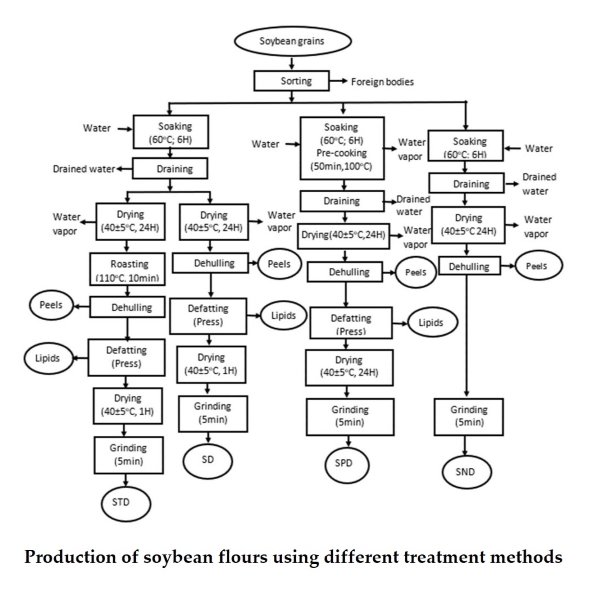
After sorting, the soybean grains were soaked for 6 h in tap water at 60 °C in a water bath at a ratio of 1/5 (w/v). Then, the soaked soybean grains were separated into 4 batches. The first batch was pre-cooked at 100 °C in a boiling water bath for 50 min (1/5, w/v) and drained to remove water. The drained grains were dried for (24h at 40 ± 5°C.), dehulled, defatted (laboratory electrical press), dried (24h at 40 ± 5°C) and ground (MOULINEX model, Paris, France) to produce soaked precooked defatted flour (SPD). The second batch contained soaked soybean grains, which were drained, and dried (24h at 40 ± 5°C.), and torrefied (10 min at 110 ± 5°C.). The roasted grains were dehulled, defatted (laboratory electrical press), dried (24h at 40 ± 5°C) and milled (MOULINEX model, Paris, France) to produce soaked torrefied defatted flour (STD). The third batch contained soaked soybean grains that were drained, dried (24h at 40 ± 5°C.), defatted (laboratory electrical press), dried (24h at 40 ± 5°C) and ground (MOULINEX model, Paris, France) to produce soaked defatted flour (SD). The fourth batch contained soaked soybean grains that were drained, dried (24h at 40 ± 5°C.) and ground (MOULINEX model, Paris, France) to produce soaked non-defatted flour (SND). Production of soybean flours using different treatment methods shown in Fig 1.

Figure 1. Production of soybean flours using
different treatment methods.
To produce soybean powder fractions, the four soybean flours (SPD, STD, SD and SND) were passed through selected test sieves with mesh sizes < 250 µm, 250-355 µm and > 355 µm to obtain powders with different particle sizes, as shown in Fig. 2. The resulting flour fractions were recovered and put in polyethylene plastic bag and kept prior to be analyzed.

Figure
2. Production of controlled differential screening
process (CDSp) flour fractions.
2.3. Chemical analysis of whole flours and flour fractions
The moisture of the defatted soybean flour was determined using an air oven, following the AOAC [19] method. The total nitrogen was determined after the mineralization of the samples according to the Kjeldahl method [20], and determined according to the colorimetric technique of Devani [21]. A mass of 0.5 g of flour and powder fractions was introduced into flasks (demineralization tubes or flasks) then 5 mL of H2SO4 acid, and one pinch of catalyst (Na2SO4 + CaSO4 + Se) were added. Then the whole was mineralized on a ramp (Kjeldatherm, Gerhardt, Les Essarts le Roi, France) for two to six hours at 400 °C until a clear solution was obtained. The calibration was performed with ammonium sulfate (0.4 mg nitrogen/mL) for nitrogen determination using the Hantzsch reaction and the amount of protein was determined by multiplying the amount of nitrogen by a conversion factor of 5.70. The ash content of the defatted soybean flour fractions was analyzed using the AOAC [19] method. A crucible (silica dish) was dried at 105 ± 1°C for 3 h, cooled in a desiccator, and weighed (W0). Five grams of the sample was weighed into the crucible and the total weight of the sample and crucible was recorded (W1). The crucible was then placed in a muffle furnace at 550 °C for 6 h for incineration. After incineration, the temperature of the furnace was decreased to 180 °C and the crucibles containing the residue of incineration were transferred into a desiccator, cooled, and weighed (W2). The ash content of the samples was calculated. The total lipid was extracted with a Soxhlet extractor with hexane as the solvent according to the Russian method [22]. 1g of powder was introduced into filter paper previously dried in an oven at 105 °C for 24 h and weighed. The whole was placed in the Soxhlet extractor (1:10 w/V). The extractor was then mounted on a flask containing 200 mL of hexane and placed in a flask heater at a temperature of 86 °C. Once the Soxhlet refrigerant was installed, the tap was opened and the balloon heater was turned on. The mixture was heated and extraction was carried out for about 10 h until the packed samples in the extractor were discolored. At the end of the extraction, the system was shut down, and the sachets were removed and placed in an oven at 105 °C for 1 h and then weighed. The starch content was determined using the chemical iodine method. Iodine (I2) interacts with amylose and amylopectin to respectively give a blue and brown coloration.
2.4. Functional properties of whole flours and powder fractions
2.4.1. Bulk and tapped density
The bulk density of the samples was determined following method described by [15], with modifications. About 20 g of the powder sample was poured into a 100 mL measuring cylinder and tapped 10 times on a flat wooden platform. The volume occupied by the sample was then recorded. The samples were filled up to the 50 mL mark and tapped as indicated above. The masses of the empty and filled measuring cylinders, and the final volume occupied by each sample were noted. The analyses were performed in triplicates. The bulk and tapped densities were calculated using the following equations [23].

2.4.2. Flow properties
2.4.2.1. Carr index (The Compressibility index)
It was determined from the bulk and tapped densities. In theory, the less compressible a material, the more flowable it is. Therefore, it is a measure of the relative importance of interparticle interactions. In a free-flowing powder, such interactions are generally less significant, and the bulk and tapped densities are closer in value. For poorer flowing materials, there are frequently greater inter-particle interactions, and a greater difference between the bulk and tapped densities is observed. These differences are reflected in Carr’s Index, which is calculated using the following formula.

2.4.2.2. Hausner’s ratio
Hausner’s ratio is an indirect index of ease of the powder flow. It is calculated using the following formula.

Where ρB is the bulk density (g/cm3) and ρT is the tapped density (g/cm3).
2.4.2.3. Porosity and cohesiveness
Porosity and cohesiveness were determined using the Carr index and Hausner ratio (Table 1) [24].
2.4.3. Solubility index and water absorption capacity
The water absorption capacity and water solubility index were determined by the following methods. 1g (M0) of sample flour and powder fractions was transferred into a centrifuge tube, to which 10 mL of distilled water was added. The mixture was agitated for 15 min and incubated at 25 °C for 10 min. Next, the mixture was centrifuged at 3500 rpm for 10 min and the resulting sediment was weighed (M2). The sediment was then dried in an oven at 105 °C for 24 h after which it was again weighed to obtain the mass M1. The water absorption capacity (WAC) and water solubility index (WSI) were calculated using the following formula:
o Water absorption capacity (WAC)

o Water solubility index (WSI)

2.5. Physical properties
2.5.1. Dry mass fraction of flours and powder fractions
The mass fraction (expressed per 100 g of powder) was calculated as the mass retained on each sieve relative to the initial amount of powder.
2.5.2. Determination of color
The colors of the soybean powder fractions were measured using instrumental color readings for LSDSF, which was equipped with a camera instrument control of image software and a D65 circumferential optical sensor. First, each powder sample was placed in a transparent Petri dish. A colorimeter based on the CIEL*a*b* color system was calibrated using a standard calibration plate with white and black areas that used for color characterization. The resulting data were expressed in the CIEL*a*b* color system in accordance with the reported method [11]. L* correspond to the lightness coordinate ranging from no reflection for black (L* = 0) to perfect diffuse reflection for white (L* = 100), a* is the redness coordinate varying from negative values for green to positive values for red and b* is the yellowness coordinate ranging from negative values for blue and positive values for yellow. Resulted values correspond to the average of three measurements performed at different locations of the powder layer.
2.5.3. Particle size analysis
The particle sizes of the soybean powders were measured using a laser diffraction particle size distribution analyzer (Mastersizer 2000). The experiments were carried out in wet cell using ethanol as solvent. Particle size analyses were applied for sample tree times and average of them was taken. The chosen size estimator was the particle size in volume and classical granulometric parameters were determined: D10, D50, D90 and span; where D50 means that 50% of the sample particles had diameters inferior to DX. The width of the particle distribution was evaluated using the span, calculated as follows (Equation 7).

2.5.4. pH, titratable acidity and water activity of flours and powder fractions
Titratable acid was determined according to the AFNOR standardized method [19] with 0.1N sodium hydroxide (NaOH) in the presence of phenolphthalein. 1 g. of composite powder was added to 10 mL of distilled water and titrated. The pH of the flour was measured using a pH meter (Hanna Instruments, model HI 1207 with FC200 probe, Mauritius). Flour suspension (8% (w/v)) was stirred for 5 min, allowed to stand for 30 min, filtered and the pH of the filtrate was measured. The water activity (range: 0.00 to 1.00 aw) was measured using HygroLab C1 monitors. It monitored the water activity and temperature values measured by the probe. When both values were at equilibrium for a few minutes, the measurement was automatically ended. Depending on the product being measured and the stability of the temperature, measurements typically require 30 to 60 min. Importantly, the measurements were initiated simultaneously for all probe inputs.
2.6. Statistical analyses
The results obtained were expressed as mean ± standard deviation for triplicate values and a comparison of the mean was performed based on analyses of variance (one way-ANOVA) with a significance level (p < 0.05). The Duncan Test, p value and test for significant differences were performed using STATGRAPHICS 19-X64.
3. Results and discussion
3.1. Physical characterization of powders
3.1.1. Dry mass fraction of delipidated and CDSp powders
The mass fractions are listed in Table 1. Extraction by pressing leads to varying yields depending on the treatment applied. Good oil removal is needed to facilitate the sieving of powders and for better concentration of the macromolecules of interest. The highest mass yields after electric pressing were obtained with SPD (87.05%) and STD (87.03%). The oil removal is much higher than that obtained by ethanol extraction (93.38%) observed by Mbassi [25]. The average yields for SPD and STD were very close to 87.05% and 87.03%, respectively. Indeed, as reported by [26]. Mass yield is not only dependent on the extraction method used, but also varies according to the nature or plant part from which the extraction is performed. A decrease in the mass yield indicates an increase in oil removal. This result agrees with those reported data [27], who also obtained a mass yield from 87.20-58.30% when an electronic press was used at different extraction speed, and it was 98.5-33.5% when an organic solvent was used. The mass yield varied significantly with respect to the different pre-treatment methods used.
Table 1. Effect of grinding on dry mass of delipidated (hot pressing) flours and powder fractions.
Treatment | Dry mass fraction of powder (%) | ||||
Un-sieved | ≥ 355 µm | 355-250 µm | ˂ 250 µm | ||
Knife mill | SPD | 87.45±0.01a | 30.78±0.01c | 27.13±0.00d | 41.62±0.01a |
SD | 90.85±0.01b | 13.51±0.02b | 15.00±0.01a | 71.49±0.01d | |
STD | 87.43±0.05a | 31.40±0.04c | 20.50±0.01b | 48.19±0.01b | |
SND | 100±0.00c | 7.50±0.00a | 22.75±0.01c | 69.75±0.02c | |
Values represent the mean ± standard deviation (n = 3). For the same treatment, results followed by the same letter in exponent in the same column indicates that there is no significant difference (p < 0,05). SPD= Soaked precooked delipidated grains, SD= Soaked delipidated grains, STD= Soaked torrefied delipidated grains, SND= Soaked non delipidated grains. | |||||
The results in Table 1 also show that the mass fraction of each particle size class obtained by the CDSp varied significantly depending on the treatment method (p < 0.05). The granulometric classes ≥ 355 µm, 250-355 µm and < 250 µm were the most frequent, with higher proportions of powders of 31.40%, 27% and 71%, respectively, for STD, SPD and SD when a knife mill was used. In contrast, the granulometric classes ≥ 355 µm, 250-355 µm and < 250 µm were the most frequent, with higher proportions of powders of 60.00%, 28% and 33%, respectively, for STD, SPD and SPD when a hammer mill was used. This result shows that there is a greater sieving yield when grinding is performed using a knife mill compared to a hammer mill, but there is a proportionate mass distribution for similar sieve sizes. The different distribution of powders from the four treatment methods among the granulometric classes are probably due to the differences in the friability (ease of grinding) of the four flours obtained from the different pretreatments. Indeed, each pretreated grain has distinct mechanical properties and the properties of a grain are the result of the individual properties of its tissues [28]. According to [29], the particle size of the powder is highly dependent on the inherent characteristics of the plant material being treated. This was demonstrated by [30] for wheat: soft wheat, which is easier to grind, results in a finer powder, compared with durum wheat, which leads to a powder made up of coarse particles. It is necessary to note that the shape of the particles in a powder, the speed and duration of the movement applied during sieving and the chemical composition (e.g., lipid and sugar content) are other factors likely to influence the particle size distribution after sieving [31].
3.1.2. Particle size distribution
Granulometry is a physical characteristic that enables the study of the size distribution of the particles that constitute a powder. The particle size of food ingredients has been shown to play significant roles in ingredient functionality as well as in the sensory perception of food and may influence other physicochemical properties such as swelling power and water-binding capacity [32]. The particle size distributions of the powders are listed in Table 2. The SPD, SD, STD, and SND powders exhibited a bimodal appearance with a population of small particles of around 2-10 µm and a population of large particles of around 64-95 µm. These classes were similar to those reported by Deli [33]. For powders, SPD, STD, SD and SND, a greater proportion of particles had a size <250 µm. We did not observe the presence of particles larger than the mesh size (1,000 µm) which could be due to the loss of grain structure and effective grinding and sieving used to produce the powders from these four flours. This could be explained by the fact that these powders contained fewer fibrous (elongated) or irregularly shaped particles. The characteristics of the particle size distribution of the powders, represented by the characteristic diameters D10, D50, D90 and the span, are listed in Table 2. The unsieved powders of SPD, SD, STD and SND had median (D50) values of 38.43, 40.64, 37.57, and 35.57 µm, respectively. These values are within the range reported by Zango [34]. The SND powder exhibited a finer texture (lower D50), compared to the SPD, SD and STD powders. In addition, the D50 values of the different fractions of powders from the different treatments (SPD, SD, STD and SND) were well within the mesh size range of the sieves used for their fractionation on powder sieve columns.
Table 2. D10, D50, D90 and span of particle size distribution of flours and powder fractions.
Treatments | Powders | D10 | D50 | D90 | Span |
SPD | Unsieved | 7.14±0.48d | 38.43±0.02b | 73.62±1.44b | 1.72±0.00a |
≥ 355 µm | 2.88±0.08a | 30.46±0.07a | 64.67±0.13a | 2.02±0.02b | |
355- 250 µm | 3.75±0.03b | 40.50±0.19c | 86.84±0.72c | 2.05±0.01b | |
˂ 250 µm | 5.33±0.21c | 43.80±0.05d | 95.28±0.00d | 2.04±0.00b | |
SD | Unsieved | 6.86±0.12c | 40.64±0.19a | 82.00±0.21a | 1.84±0.00a |
≥ 355 µm | 4.31±0.03a | 40.92±0.73a | 92.05±0.93b | 2.14±0.01d | |
355- 250 µm | 6.94±0.00c | 44.46±0.05c | 92.39±0.33b | 1.91±0.00b | |
˂ 250 µm | 6.25±0.01b | 43.33±0.09b | 92.84±0.23b | 1.99±0.00c | |
STD | Unsieved | 5.75±0.24a | 37.57±0.06a | 76.21±0.22a | 1.87±0.01a |
≥ 355 µm | 5.64±0.02a | 37.56±0.38a | 76.31±0.66a | 1.88±0.00a | |
355- 250 µm | 6.46±0.21b | 39.65±0.14b | 80.96±0.00b | 1.88±0.01a | |
˂ 250 µm | 7.56±0.02c | 40.97±0.07c | 86.47±0.19c | 1.92±0.00b | |
SND | Unsieved | 5.63±0.19b | 35.57±0.18a | 70.94±0.57a | 1.83±0.01c |
≥ 355 µm | 4.17±0.19a | 36.70±0.30b | 74.55±0.65b | 1.91±0.00d | |
355- 250 µm | 6.92±0.04c | 38.95±0.21c | 77.47±0.77c | 1.80±0.00b | |
˂ 250 µm | 9.42±0.15d | 39.38±0.04c | 78.89±0.07c | 1.76±0.00a | |
Values represent the mean ± standard deviation (n = 3). For the same treatment, results followed by the same letter in exponent in the same column indicates that there is no significant difference (p < 0,05). SPD= Soaked precooked delipidated grains, SD= Soaked delipidated grains, STD= Soaked torrefied delipidated grains, SND= Soaked non delipidated grains. | |||||
This confirms that the sieving process was able to separate the particles of these powders into distinct granulometric classes. Furthermore, the span values of the SD, STD and SND powders were generally moderate, which is consistent with the bimodality of the particle size distributions [28, 35]. On the other hand, during the sieving of these powders, it was noted that the powder was extremely sticky or cohesive, adhering to the sieve walls and particles aggregating. Similar observations were also reported [36] for ultra-fine cohesive powders and B. senegalensis [11]. This phenomenon, which occurs during sieving, proves to be a limiting factor that makes sieving a powder difficult. Consequently, the sieving of SPD, SD, STD and SND powders provided unreliable results on the distribution of particles according to their size. In addition to the distribution of powder particles, sieving this type of powder leads to another phenomenon: particle agglomeration, which is a characteristic of cohesive powders. The more this type of powder is subjected to vibrations, the more its particles reorganize into a compact state [11]. According to Pietsch [37], the inter-granular forces prevailing within the particle mass condition the appearance of particle associations (clusters, aggregates and agglomerates), as well as adhesion to the substrate. This could justify the higher span value (> 4) of SPD, compared with SD, STD and SND. However, the span values of SD, STD and SND less than 3 indicate that these powders have a low range distribution [38] thus their particles are homogenous in size. Span provides information on the homogeneity of the particle size of the powder [39]. Generally, a very high span value indicates several particle size populations within the powder [14]. For agglomerating powders, cryo-grinding is best suited to avoid particle agglomeration during sieving [40]. The particle size distribution of plant powders is directly related to the drying method and the type of grinding. It plays an important role in the functional properties, such as rehydration, water absorption capacity and flowability [41]. Thus, the different powders may find application in bakery, pastry, weaning diet and beverage formulations.
3.1.3. Color properties
Color is an attribute that defines the acceptability of the product to the consumer, and in this case, it can also indicate any changes due to the grinding and sieving operations. The colorimetric parameters of all powder samples are listed in Table 3.
Table 3. Color parameters of flours and powder fractions.
Treatments | Fractions | L* | a* | b* | Hue angle (-) | Chromaticity (-) |
SPD
| Unsieved | 74.00±1.00b | 661.50±0.78c | 8.33±0.57b | 0.013±0.00a | 25.86±1.50c |
≥ 355µm | 68.66±0.57a | 118.00±0.08a | 9.66±0.57c | 0.011±0.00b | 11.28±0.40a | |
355-250 µm | 73.00±1.00b | 653.00±0.39bc | 9.00±0.00bc | 0.080±0.00a | 25.72±0.76bc | |
˂ 250 µm | 76.66±0.57c | 480.50±0.94b | 7.00±0.00a | 0.014±0.00a | 22.02±2.13b | |
SD | Unsieved | 76.00±0.00b | 104.50±0.33a | 8.00±0.00a | 0.016±0.00b | 23.47±0.73a |
≥ 355µm | 67.50±2,12a | 740.00±0.02d | 10.00±0.00b | 0.013±0.00ab | 29.27±0.00b | |
355-250 µm | 77.50±0.70b | 145.00±0.01b | 7.50±0.70a | 0.011±0.00ab | 27.48±3.67ab | |
˂ 250 µm | 76.00±1.00b | 551.00±0.02c | 8.00±0.00a | 0.008±0.00a | 29.19±0.01b | |
STD | Unsieved | 75.50±0.70b | 542.50±0.34a | 9.00±0.00b | 0.016±0.00b | 23.47±0.73a |
≥ 355µm | 72.00±0.00a | 846.00±0.00d | 11.00±0.00c | 0.013±0.00ab | 29.27±0.00b | |
355-250 µm | 76.00±1.40b | 753.50±0.20c | 8.50±0.70ab | 0.011±0.00ab | 27.48±3.67ab | |
˂ 250 µm | 78.00±0.70c | 624.00±0.31b | 7.50±0.70a | 0.009±0.00a | 29.20±0.00b | |
SND | Unsieved | 78.00±1.41ab | 768.00±0.18b | 6.50±0.70ab | 0.008±0.00ab | 30.06±3.30ab |
≥ 355µm | 74.50±2.12a | 704.00±0.16a | 7.50±0.70b | 0.010±0.00b | 25.39±0.30a | |
355-250 µm | 77.00±0.00ab | 823.50±2.12d | 7.00±0.00ab | 0.008±0.00ab | 26.88±0.03b | |
˂ 250 µm | 80.50±2.12b | 795.00±0.82c | 5.00±1.41a | 0.006±0.00a | 26.45±1.47ab | |
The values presented represent the mean ± standard deviation (n = 3). For the same treatment, results followed by the same letter in exponent in the same column indicates that there is no significant difference (p < 0,05). L*= whiteness or luminance; a*= Chromatic component red-green; b*= Chromatic component yellow-bleu defined by the CIELab system. | ||||||
There was a significant variation (p < 0.05) in the colorimetric characteristics (L*, a*, b*, hue angle, and chromaticity) depending on the treatment method of the grains and the particle size of the powders. The predominantly SND powders (very high L* value) showed a dominance of this color in the powder fraction < 250 µm. However, the evolution of this color shows a general increase with a decrease in particle size, indicating a decrease in the intensity of the majority yellow color and the brightness of smaller particles. The reduction of flour particle size increases the brightness and whiteness of the flour, which is an important parameter for consumer acceptability as whitish flours have low a* and high L* values [42]. For all four powders obtained from the four different treatment methods, the values for a*, b*, hue angle and chromaticity followed no logic. This color evolution according to particle size suggests a higher content of colored molecules, such as anthocyanins and carotenoids, in fractions containing smaller particles [43]. According to [44], the variation in these color parameters could result from the difference in the composition of coloring compounds, such as anthocyanins and carotenoids, in the treated powders. The difference in color depending on the particle size of the powders could also be attributed to the greater compactness of the smaller particles, which reflect incident light better, and the difference in chemical composition.
3.1.4. pH, Titratable acidity and water activity
Table 4 shows the pH and titratable acidity values for different flour fractions. There was a significant difference in the titratable acid content of these powders. The pH of the powder samples ranged between 6.42 ± 0.02 (STD, < 250 µm) and 7.52 ± 0.01 (SPD, 355-250 µm). These values are within the range (6.26-6.82) reported by Maicon [45]. The temperature and rate of incorporation influenced the pH of the powder samples. The pH values in the powder samples near neutrality may be due to the increased availability of soluble soy proteins.
Table 4. Titratable acidity and pH of treated flours and powder fractions.
Treatments | Powders | Titratable acid (meqv/100g) | pH |
SPD | Unsieved | 0.15±0.01b | 7.47±0.01a |
≥ 355 µm | 0.10±0.00a | 7.47±0.02a | |
355- 250 µm | 0.12±0.02ab | 7.52±0.01b | |
˂ 250 µm | 0.28±0.01c | 7.48±0.00ab | |
SD | Unsieved | 0.17±0.01a | 6.88±0.06a |
≥ 355 µm | 0.16±0.00a | 6.92±0.03a | |
355- 250 µm | 0.27±0.00b | 6.92±001a | |
˂ 250 µm | 0.34±0.01c | 6.91±0.02a | |
STD | Unsieved | 0.26±0.01b | 6.92±0.00c |
≥ 355 µm | 0.11±0.00a | 6.55±0.00b | |
355- 250 µm | 0.33±0.01c | 6.55±0.01b | |
˂ 250 µm | 0.33±0.00c | 6.42±0.02a | |
SND | Unsieved | 0.18±0.02b | 7.27±0.01c |
≥ 355 µm | 0.08±0.00a | 7.23±0.04bc | |
355- 250 µm | 0.17±0.02b | 7.16±0.05b | |
˂ 250 µm | 0.24±0.01c | 6.80±0.00a | |
The values presented represent the mean ± standard deviation (n = 3). For the same treatment, results followed by the same letter in exponent in the same column indicates that there is no significant difference (p < 0,05). SPD= Soaked precooked delipidated grains, SD= Soaked delipidated grains, STD= Soaked torrefied delipidated grains, SND= Soaked non delipidated grains. | |||
The titratable acid value ranged from 0.08 (SND, 355-250 µm) to 0.34 (SD, ˂ 250 µm), with the majority of powders showing no significant (P < 0.05) difference. These values are lower than that reported by Maicon [45] for different treated soybean grains (0.35-0.93).
Water activity (𝑎𝑊) quantifies the degree to which water binds with the components of the food matrix. Therefore it is a decisive and crucial measurement variable in assessing product quality and safety [46], as it is of considerable importance in determining the rate of food spoilage reactions during storage. Indeed, it is accepted that good water availability is most often essential for degradation reactions (biochemical and microbiological transformations) [47]. Thus, 𝑎𝑊 is an indicator of the water available in the product, which is conducive to microbial growth and biochemical reactions, and therefore plays an important role in shelf life [31]. The water activity results for the different particle size fractions of the SPD, SD, STD and SND powders are summarized in Table 5. The 𝑎𝑊 values of unsieved powders are 0.30, 0.37, 0.35 and 0.23 for SPD, SD, STD and SND respectively, showing an effect of treatment applied. Continuous water in a material increases the vapor pressure at the surface of the material. However, it is not possible to directly estimate the water activity from the water content. The obtained aw values for all the treated powder fractions analyzed ranged from 0.15 to 0.40. These values are below the threshold (𝑎𝑊 < 0.6) for stimulating the growth of microorganisms (bacteria, fungi and yeasts) in the product [48]. The obtained aw values indicated that the studied powders studied were biochemically and microbiologically stable. The results in Table 5 also show a significant variation (p < 0.05) in the 𝑎𝑊 values according to the particle size of the powders. The 𝑎𝑊 increases significantly with decreasing particle size of SPD, SD, STD and SND powders. In fact, the specific surface area of the powders is significantly increased by the reduction in particle size, leading to increased interactions with atmospheric moisture, therefore, greater moisture uptake by adsorption/absorption. Similar observations were made by [49], who reported a higher water activity value for small particle sizes (<180 µm) compared to those of large particles (>315 µm) of H. sabdariffa powders. For all powders, the 𝑎𝑊 values differed significantly according to the granulometry of the powder fractions. This may be explained by differences in the treatment of grains (particularly, their lipid and fiber contents). Lastly, the aw results clearly pointed out its microbiological stability, indicating no probability of pathogenic microorganism growth, since all the values were significantly lower than 0.6. In general, most “spoilage” microorganisms are inhibited by aw values lower than 0.90 for bacteria, 0.88 for yeast, and 0.80 for molds [48]. Therefore, no microbial study was conducted in this study.
Table 5. Influence of particle size on water activity of flours and powder fractions.
Powder fractions | SPD | SD | STD | SND |
˂ 250 µm | 0.35±0.00d | 0.37±0.00c | 0.42±0.00c | 0.28±00d |
250- 355 µm | 0.30±0.00c | 0.40±0.00d | 0.35±0.00b | 0.20±00c |
≥ 355 µm | 0.29±0.00b | 0.35±0.00b | 0.35±0.00b | 0.15±00b |
Unsieved | 0.26±0.00a | 0.16±0.00a | 0.34±0.00a | 0.12±00a |
The values presented represent the mean ± standard deviation (n = 3). For the same treatment, results followed by the same letter in exponent in the same column indicates that there is no significant difference (p < 0,05). SPD= Soaked precooked delipidated grains, SD= Soaked delipidated grains, STD= Soaked torrefied delipidated grains, SND= Soaked non delipidated grains. | ||||
3.2. Functional properties
3.2.1. Solubility index and water absorption capacity
The water absorption capacity is significantly affected by the treatment method of the grains and the particle size of the powders. The solubility index of the samples ranged from 4.08 to 8.79 g/100g for SPD, SD, STD and SND powders. Therefore, the solubility index of the SPD powder was therefore better than those of SD, STD and SND. The water absorption capacity generally decreased with particle size from > 355 to < 250 µm. As shown in Table 6, variations in the water absorption capacity of powder fractions ranged from 17.60 to 53.41 g/100g for SPD powders, from 21.86 to 35.24 g/100g for SD powders, from 21.86 to 26.33 g/100g for STD and from 17.28 to 29.94 g/100g for SND powders. The water absorption capacity was higher for fractions > 355µm for all four pre-treated flours. The water absorption capacity generally decreased with particle size from > 355 to < 250 µm. This observation is evident from the fact that finer particles have a higher specific surface area and porosity, therefore, their hydration rate was higher [42, 43]. The high specific surface areas of smaller particles promote increased interactions between the particle surface and water, resulting in increased WAC and better solubility in water. This is certainly due to the exposure of the particle surface of hydrophilic groups or polar molecules (e.g. cellulose, hemicellulose, simple carbohydrates and proteins), which facilitate water uptake through the formation of hydrogen bonds [52]. These results corroborate those of Meng [44] and Deli [51] who also noted a pronounced increase in water uptake capacity at the smallest particle sizes of Moringa oleifera, Dendrobim officinale, rice leaf powders and B. senegalensis. However, the surface composition of the powders likely plays an essential role in the rehydration process. A high carbohydrate and protein content in the powder increases its polarity, and therefore, the formation of hydrogen bonds when it comes into contact with water. On the other hand, a high lipid content in the powder would contribute to reducing its water absorption capacity by limiting the hydration of hydrophilic groups by hydrophobic parts [53].
The water solubility index evaluates the ability of particles to dissolve in water. There was a significant variation in the water solubility index from 17.60 to 53.41 g/100 g DM, 15.40 to 35.24 g/100 g DM, 21.86 to 26.33 g/100 g DM and 17.28 to 29.94 g/100 g DM, for the powder fractions of SPD, SD, STD and SND, respectively. Similar to water absorption capacity, reducing the particle size of plant powders improves their solubility, probably by increasing their specific surface area.
Table 6. Water absorption capacity and solubility index in water of flours and powder fractions.
Treatments | Powders | WAC (g/100g DM) | SI (g/100g DM) |
SPD | Unsieved | 317.48±0.28a | 8.79±0.73a |
≥ 355 µm | 446.21±0.01b | 17.60±0.53b | |
355- 250 µm | 447.38±0.00c | 40.69±0.12c | |
˂ 250 µm | 650.31±0.03d | 53.41±0.25d | |
SD | Unsieved | 319.27±0.89a | 6.70±0.72a |
≥ 355 µm | 522.65±0.02c | 35.24±0.09c | |
355- 250 µm | 523.26±0.02d | 16.23±012b | |
˂ 250 µm | 461.89±0.10b | 15.40±0.24b | |
STD | Unsieved | 312.84±1.52a | 5.12±1.44a |
≥ 355 µm | 468.89±0.50c | 22.60±0.62b | |
355- 250 µm | 479.49±0.20d | 21.86±0.53b | |
˂ 250 µm | 390.243±0.00b | 26.33±0.28c | |
SND | Unsieved | 303.14±0.81a | 4.08±0.00a |
≥ 355 µm | 442.85±0.20d | 17.28±0.12b | |
355- 250 µm | 369.09±0.00c | 29.94±0.09d | |
˂ 250 µm | 334.22±0.03b | 23.79±0.00c | |
The values presented represent the mean ± standard deviation (n = 3). For the same treatment, results followed by the same letter in exponent in the same column indicates that there is no significant difference (p < 0,05). WAC: water absorption capacity, SI: solubility index in water. | |||
3.2.2. Bulk and tapped densities
Bulk and tapped densities were used to determine the expansion or porosity of the powder. They can also indicate the amount of how much packaging material to be used [51]. The powder densities were significantly influenced by the particle size (Table 7). There was a significant decrease (p < 0.05) in aerated density from 0.54 to 0.34 (SPD), from 0.58 to 0.33 (SD), from 0.58 to 0.35 (STD) and from 0.47 to 0.30 g/mL (SND) when the powder particle size decreased from 355 to 250 µm. These values fall within the range of bulk density values reported by Shittu [54]. The decrease in aerated density noted with the particle sizes of SPD, SD, STD and SND powders could be attributed to the greater porosity of the bed of small particles, which would offer a greater contact surface with the ambient air [55]. Conversely, Meng [44] found an increase in the density of small-sized mango and Dendrobium officinale pulp powder. According to these authors, the homogeneity of the size and shape of the fine particles and their more spherical shape would lead to a decrease in the interparticle spaces or porosity of the powder bed, thus leading to a more compact structure and consequently an increase in powder density. The tapped density also decreased significantly as the particle size of the SPD, SD, STD and SND powders decreased (Table 7).
These observations corroborate those of Deli [51], who showed a reduction in density from 0.44 to 0.35 kg/m3 and from 0.79 to 0.58 of ibuprofen and B. senegalensis powder, respectively, when the particle size decreased from 215 to 46 µm and from 315-180 µm. However, some authors who have studied the effect of particle size on powder density have reported contrary observations [56]. According to these authors, the higher tapped density for the finest powder particles can be explained by a geometric argument: the finest particles can leave less space between them than larger particles and are therefore likely to achieve a higher tapped density.
Table 7. Flow parameters of flours and powder fractions.
Treatments | Fractions | Hausner ratio (%) | Type of powder | Porosity (%) |
SPD
SD
STD | Unsieved | 1.52±0.00c | Very cohesive | 34.54±0.09c |
≥ 355µm | 1.25±0.00a | Faire flow | 20.00±0.00a | |
355-250 µm | 1.31±0.00b | Cohesive | 23.00±0.00b | |
˂ 250 µm | 1.69±0.03d | Non flow | 40.96±1.36d | |
Unsieved | 1.37±0.00b | Cohesive | 27.27±0.00b | |
≥ 355µm | 1.15±0.04a | Free flow | 13.15±3.72a | |
355-250 µm | 1.37±0.05b | Cohesive | 27.08±2.94b | |
˂ 250 µm | 1.65±0.03c | Very cohesive | 39.66±1.35c | |
Unsieved | 1.38±0.10b | Cohesive | 27.81±5.66bc | |
≥ 355µm | 1.09±0.04a | Very free flow | 11.11±0.00a | |
355-250 µm | 1.32±0.04b | Passable flow | 24.40±2.37b | |
˂ 250 µm | 1.56±0.01c | Very cohesive | 36.19±0.67c | |
SND | Unsieved | 1.58±0.08c | Very cohesive | 36.95±3.30c |
≥ 355µm | 1.18±0.00a | Free flow | 15.39±0.55a | |
355-250 µm | 1.42±0.01b | Cohesive | 29.80±0.89b | |
˂ 250 µm | 1.49±0.07bc | Very cohesive | 32.79±3.52bc | |
The values presented represent the mean ± standard deviation (n = 3). For the same treatment, results followed by the same letter in exponent in the same column indicates that there is no significant difference (p < 0,05). SPD= Soaked precooked delipidated grains, SD= Soaked delipidated grains, STD= Soaked torrefied delipidated grains, SND= Soaked non delipidated grains. | ||||
3.2.3. Powder flowability
Controlling the flow properties of powders is of prime importance in the food industry, as they enable us to understand the behavior of powders during the various operations they undergo (mixing, drying, coating, transport, storage, etc.). It has been reported that, in the case of dry powders under ambient conditions, cohesive (between particles within the powder bed) and adhesive (between particles and walls) forces can be mainly attributed to dispersive attractive forces such as van der Waals, capillary and electrostatic forces [15]. Therefore, the flow properties of these types of powders are shown in Table 2. and Table 7, are generally affected by intrinsic physical properties such as particle size, density, and porosity [57].
3.2.3.1 Hausner ratio
The Hausner ratio (HR) was used to classify the powders according to their flowability. Lower Hausner’s ratio (<1.25) indicates better flow properties than higher ones, between 1.25 to 1.5 showing moderate flow properties and more than 1.5 poor flow. All SPD, SD, STD and SND powders were cohesive. With the exception of the granulometric fractions >355 µm and 355 to 250 µm of the STD powder, which are classified as easy-flowing powders, all the other powder fractions are classified as cohesive powders. In addition, there was a clear decrease in the flow with decreasing particle size for all powders. As shown in Table 7, the Hausner ratio (HR) values varied from 1.25 to 1.69, 1.15 to 1.65, 1.09 to 1.56 and 1.18 to 1.58, respectively, for SPD, SD, STD and SND powders. These results show that the shape of the particles influences the flow properties. The flow of food powders is of vital importance for their handling in bulk and for technological reasons, as mentioned by Djantou [12] and Wilson [58].
3.2.3.2. Porosity
The porosity value is related to the compressibility of the powder. Compressing a powder involves applying normal stress to a bed of powder to agglomerate the particles to form a coherent solid of defined shape and compactness [55]. Thus, the variation in the volume of a powder under the action of a given normal force defines its compressibility. The results in Table 7 show that the porosity decreased with particle size for the SPD, SD, STD and SND powders. The higher porosity of powders composed of the finest particles can be explained by the fact that fine powders have larger interparticle spaces, in which they are more easily packed or confined. Similar observations were also reported by Clayton [59] who also found a significant decrease in the porosity due to the reduction in particle size of different powders. Juliana [60] investigated the relationship between porosity and powder flow and showed that the more porous (compressible) the powder, the more difficult it is to flow. In this study, a negative correlation was observed between the Hausner ratio and porosity, confirming the link between flowability and porosity.
3.2.3.3. Cohesiveness
Particle size is an important factor that influences interparticle cohesive forces. As shown in Table 7, the particle size significantly affected the cohesivity of the analyzed powders For SPD, SD, STD and SND, the cohesion increased with a decrease in the powder particle size. These results show that the cohesion of the obtained powder depends on the type of treatment performed on the grains. All powders exhibited higher cohesivity at the smallest particle size. These results show that the cohesion of the obtained powder depends on the nature of the grain and treatment methods. The cohesiveness of fine powder particles could also be attributed to their higher protein and lipid contents than those of large particles. These macromolecules help form hydrogen bonds (proteins), chemical bonds (proteins and lipid bridges) or capillary forces [57]. Similar observations were made by [61]. Although the finer particles of powders are richer in lipids and proteins, their significant effect on cohesion does not emerge from the results obtained.
3.3. Chemical properties of flours and powder fractions
Table 8 shows the chemical compositions of whole flours and CDSp powder fractions produced from treated soybeans (SPD, SD, STD and SND). The composition varied according to the pre-treatment method and powder fraction. As reported by numerous authors, the grains of soybean are an important source of oil (17-25%) and protein (35-45%). It contains large amounts of Vitamin B1 and B2 but is rather low in vitamin C [62]. The crude protein of soybean meal ranges from 41 to 50% (dry matter basis) depending on the amount of hull that is removed, and the processing method used [63]. The water content of the powders of the four pre-treated methods was between 1.96 and 8.90%, which is favorable for their long shelf life, given that the range of water content between 6 and 14% is optimal for the powder to hold well during storage [64].
However, the water content alone is insufficient to predict the stability and microbiological safety of a powder. In fact, it has been observed that several types of food with the same water content differ significantly in their degree of spoilage in part due to the bioavailability of water, measured by water activity. Considering the particle size fractions obtained by the CDSp of the four powders (SPD, SD, STD and SND), there was a variation in the water content according to the particle size of the powders. These observations differ from those previously reported by Zaiter [65] for Hypericum perforatum and Achillea millefolium powders, where the variation did not follow any logic. According to these authors, the water content of the powder granulometric fractions is linked either to the ease of grinding of the plant tissue (i.e. tissues containing less water would be easier to grind, as they would be less sticky, and would result in the formation of fine particles) or to the loss of water from the particles following evaporation induced by the rise in temperature of the plant material caused by grinding. Zaiter [65] also indicated that these phenomena leading to water loss could be compensated for by the greater specific surface area of the fine particles, facilitating the absorption of moisture from the surrounding air. Our results oppose those of Drakos [50], who noted an increase in water content from 6.03% (average size 35 µm) to 9.76% (average size 100 µm) and from 5.83% (average size 31 µm) to 11.53% (average size 181 µm) with the particle size of rice (Oryza sativa L.) and barley (Hordeum vulgare) powders, respectively. However, our results are consistent with those of Bressiani [66], who reported that, the moisture content was highest for superfine black soybean powder, which can be attributed to the different preparation methods of the samples, and the greater surface area of the superfine powder.
Table 8. Chemical composition of flours and powder fractions.
Treatments | Fractions | Moisture (g/100g DM) | Ash (g/100g DM) | Total proteins (g/100g DM) | Total lipids (g/100g DM) | Starch (g/100g DM) |
SPD | Unsieved | 3.36±0.22a | 4.47±0.42a | 36.25±0.00a | 10.14±0.05b | 5.84±0.15ab |
≥ 355µm | 6.94±0.68b | 4.71±0.71a | 45.13±1.38c | 6.69±0.08a | 6.72±0.15b | |
355-250 µm | 7.60±1.02b | 5.87±0.10a | 54.94±0.10d | 11.80±1.07c | 5.55±0.36ab | |
˂ 250 µm | 7.19±1.10b | 5.37±0.61a | 39.70±0.02b | 10.90±0.02bc | 4.81±1.21a | |
SD | Unsieved | 3.06±0,45a | 4.48±0.89a | 31.53±0.10a | 21.62±0.10b | 8.01±0.24c |
≥ 355µm | 6.87±0.88b | 4.33±0.07a | 67.66±0.00d | 6.46±0.01a | 3.03±0.00a | |
355-250 µm | 8.90±1.03b | 4.85±0.83ab | 65.26±0.02c | 9.52±0.00b | 3.66±0.36a | |
˂ 250 µm | 7.35±1.15b | 6.61±0.29b | 32.02±0.00b | 22.36±1.40bc | 6.04±0.50b | |
STD | Unsieved | 2.42±0.45a | 3.34±0.19b | 40.93±0.69b | 10.07±0.01b | 9.43±0.34c |
≥ 355µm | 4.71±0.35b | 3.51±0.10b | 64.97±0.00d | 10.07±0.16b | 3.55±0.00a | |
355-250 µm | 5.94±0.87bc | 3.29±0.17b | 53.42±0.02c | 5.36±0.01a | 4.28±0.07a | |
˂ 250 µm | 6.44±0.24c | 2.35±0.07a | 28.57±1.76a | 11.43±0.16c | 5.59±0.64b | |
SND | Unsieved | 1.96±1.20a | 2.98±0.53a | 28.60±1.52c | 30.18±1.08b | 7.88±0.09c |
≥ 355µm | 2.89±0.35a | 4.29±0.26a | 52.28±1.53d | 24.17±0.00a | 1.88±0.20a | |
355-250 µm | 3.74±0.00a | 3.83±1.00a | 13.80±1.52a | 17.90±0.03b | 4.69±0.96b | |
˂ 250 µm | 3.32±0.62a | 3.25±0.04a | 23.92±0.84b | 10.08±0.00b | 13.96±0.61d | |
DM: dry mass. The values presented represent the mean ± standard deviation (n = 3). For the same treatment, results followed by the same letter in exponent in the same column indicates that there is no significant difference (p < 0,05). SPD= Soaked precooked delipidated grains, SD= Soaked delipidated grains, STD= Soaked torrefied delipidated grains, SND= Soaked non delipidated grains. | ||||||
The results in Table 8 also show a significant variation (p < 0.05) in total lipid, total protein, total ash and total starch contents according to unsieved and fractionated powders. In general, the smaller the particle size of the powder fractions, the higher the total starch and lipid contents of flour. Conversely, when the particle size fractions were large, the protein content was high. There was no significant difference was observed in the ash content. These results could be explained by the differences in the texture of the pre-treated grains obtained using the four different pre-treatment methods (SPD, SD, STD and SND). The total protein content differed significantly (p < 0.05) depending on the pre-treated powder and the particle size of the powder fractions. For unsieved powders, the protein content ranged from 31.37 g/100 g DM (SND) to 44.89 g/100 g DM (STD). The total protein content of the CDSp powder fractions of SPD ranged from 36.25 to 54.94 g/100 g DM, that of SD from 31.53 to 67.66 g/100 g DM, that of STD from 28.57 to 64.97 g/100 g DM and that of SND from 13.80 to 52.80 g/100 g DM. The highest protein content was obtained in the particle size fractions >355 µm and 255-355 µm. Higher protein values in these fractions can facilitate the drying of overripe fruits using the foam mat drying method. This result is not in agreement with the observations of Zeiter [67] and Deli [51]. These differences in composition reflect the unequal distribution of moisture content, lipid content and pre-treatment method according to the particle size class of the powder. The powders of the four powders obtained from different pre-treatment methods analyzed constitute a significant source of total lipids, as this value ranged from 5.34‒24.17 g/100 g DM for powder fractions. The ranges of variation in lipid content for powder fractions were 6.69 ‒11.80 g/100 g DM for SPD, 6.46‒22.36 g/100 g DM for SD, 5.36 ‒11.43 g/100 g DM for STD and 10.08‒24.17 g/100 g DM for SND. A significant (p < 0.05) negative effect of the powder particle size was observed. The total lipid content was generally higher for smaller powder fractions, corroborating the observations made for other plant powders [61]. Smaller particles generally contained more total ash, but the total ash content was moderate overall in the different powders. The ranges of total ash content were 4.71‒5.87 g/100 g DM for SPD, 4.33‒6.61 g/100 g DM for SD, 2.35‒3.51 g/100 g DM for STD and 3.25‒4.29 g/100 g DM for SND. Overall, SPD and SD powders contained more total ash than the STD and SND powders and the particle size fractions obtained by the CDS process. The high total ash content of the SPD and SD powders suggests that they could be a good source of minerals.
4. Conclusions
This study explored the use of a novel, solvent free controlled differential sieving (CDSp) to create functional food powders from defatted soybean flour that had been subjected to various pretreatments. The effects of different pretreatments and CDSp on the physicochemical, functional, and hydration properties of the powder fractions obtained were studied. The results showed that the reduction of lipid was more pronounced in flours obtained through precooking and roasting. Regarding the chemical composition, the protein concentration showed a significant increase in all fractions, with fractions between 250‒355 µm and > 355 µm having the highest values with good free flow properties. These results are similar to the properties reported for protein isolates and it will be interesting to test these fractions in the ripening process of fruits to confirm this hypothesis. As regards, observations made by other authors, these fractions could present better technological properties, especially as good drying agents for sugar rich foods. There was a significant difference in aspects such as color, which may be due to the effect of residual lipid content and particle size variations. The span values of the powders were less than 3, indicating that these powders had a narrow range distribution, thus their particles were homogenous in size. Span provides information on the homogeneity of the particle size of the powder. Due to the low moisture content (<15%) and water activity (<0.6) of the powders produced, they are expected to have a longer shelf life; hence, the product could ensure food security all year round because of the long storage life, and it can be predicted that it may be used in diverse technological applications such as drying of sugar-rich foods. This study demonstrated that the production of functional free flowing powders from treated defatted soybean flour is a practical way for the valorization of soybean, which is a feasible process to increase the economic revenue and environmental sustainability of the food transformation industry. The process described is an alternative to the solvent extraction of macromolecules and may be more applicable in smaller-scale, less capital-intensive food industries, such as in Cameroon and sub-tropical Africa, especially in drying sugar-rich foods.
Compliance with ethical standards
Ethical standards were respected in accordance with the declaration of the Department of Food Science and Nutrition.
Disclaimer (artificial intelligence)
Authors hereby state that no generative AI tools such as Large Language Models (ChatGPT, COPILOT, etc.) and text-to-image generators were utilized in the preparation or editing of this manuscript.
Authors’ contributions
Protocol writing and statistical analyses, S.Z., N.R.M., D.E.B., N.R.; field work and laboratory analyses, S.Z.; drafted the manuscript, S.Z., D.M., N.R.M.
Acknowledgements
Authors are grateful to the Department of Food Science and Nutrition, ENSAI-University of Ngaoundere (Cameroon) for the support in the form of infrastructural facilities made available in undertaking the present study.
Funding
All authors attest that no external funding was made available for this study.
Availability of data and materials
All data will be made available on request according to the journal policy.
Conflicts of interest
All authors declare no conflict of interest.
References
1. | Sharma, H.; Krishan, D.S. Potential health benefits of soybean and its value addition. A review. Pharm. Innov. J. 2023, 12 (6), 2732–2736. |
2. | Kholmurodova, G.; Tangirova, G.; Rakhmankulov, M.; Yuldasheva, R. Analysis of protein and oil content in seeds of soybean collection varieties. E3S Web Conf. 2023, 377, 1–7. https://doi.org/10.1051/e3sconf/202337703016 |
3. | Chavan, G.M.; Kad, V.P.; Kamble, K.J.; Salve, V.A.; Shelke G.N.; Lad, P.A. Physico-chemical, reconstitution, flow and functional properties of mix fruit juice powder. Int. J. Adv. Biochem. Res. 2025, 9(5), 630–638. |
4. | Wang, C.Z.; Chen, K.K.A.; Zheng, Z. The influence of hedonic values on consumer behaviors. J. Global Market. 2000,14(1–2), 169–186. https://doi.org/10.1300/J042v14n01_09 |
5. | Gaikwad, S.M.; et. al. Development of an effervescent matcha powder : Synergistic antioxidant & metabolic benefits. 2020, 12(1), 1500–1506. |
6. | Westman, E.C.; Feinman, R.D.; Mavropoulos, J.C.; Vernon, M.C.; Volek, J.S.; Wortman. J.A.; Yancy, W.S.; Phinney, S.D. Low-carbohydrate nutrition and metabolism. Am. J. Clin. Nutr. 2007, 86(2), 276-84. https://doi.org/10.1093/ajcn/86.2.276 |
7. | Iasnaia, T.; et al. Dehydration of jambolan (Syzygium cumini L .) juice during foam mat drying. Quantitative and qualitative changes of the phenolic compounds. Food Res. Int. 2017, 102 (6), 32–42. https://doi.org/10.1016/j.foodres.2017.09.068 |
8. | Sankat, C.K.; Castaigne, F. Foaming and drying behaviour of ripe bananas. LWT - Food Sci. Technol. 2004, 37, 517–525. https://doi.org/10.1016/S0023-6438(03)00132-4 |
9. | Marzlan, A.A.; Muhialdin, B.J.; Hussin, A.S.M. Production of banana cake premix from banana (musa acuminata colla) by-products via foam mat drying process. Malaysian J. Med. Health. Sci. 2020, 16 (11), 150–158. |
10. | Menezes, R.G.L.; Cardozo-Filho.; Silva, C. Pressurized liquid extraction of oil from soybean seeds. Can. J. Chem. Eng. 2017, 95 (12), 2383–2389. https://doi.org/10.1002/cjce.22922 |
11. | Deli, M.; Petit, J.; Nguimbou, R.M.; Baudelaire, D.E.; Njintang, Y.N.; Scher, J. Effect of sieved fractionation on the physical, flow and hydration properties of Boscia senegalensis Lam., Dichostachys glomerata Forssk. and Hibiscus sabdariffa L. powders. Food Sci. Biotechnol. 2019, 28 (5), 1375–1389. https://doi.org/10.1007/s10068-019-00597-6 |
12. | Baudelaire, E.D. Grinding for food powder production. Handbook of Food Powders: Processes and Properties. Elsevier Inc. 2013, 132–149. https://doi.org/10.1533/9780857098672.1.132 |
13. | Jesny, S.; Prasobh, G.R.; A Review on size separation. Int. J. Pharm. Res. Appl. 2022, 7(2), 286–296. |
14. | Jiang, Z. High-protein nutrition bars: Hardening mechanisms and anti-hardening methods during storage. Food Control. 2021, 9 (1), 108-127. https://doi.org/10.1016/j.foodcont.2021.108127 |
15. | Lai, S.; Cui, Q.; Sun, Y.; Liu, R.; Niu, Y. Effects of particle size distribution on the physicochemical, functional, and structural properties of Alfalfa leaf powder. Agriculture. 2024, 14 (4), 1–16. https://doi.org/10.3390/agriculture14040634 |
16. | Zaiter, A. Antioxidant and antiacetylcholinesterase activities of different granulometric classes of Salix alba (L.) bark powders. Powder Technol. 2016, 301, 649–656. https://doi.org/10.1016/j.powtec.2016.07.014 |
17. | Bochnak-Niedźwiecka, J.; Świeca, M. Quality of new functional powdered beverages enriched with lyophilized fruits-potentially bioaccessible antioxidant properties, nutritional value, and consumer analysis. Appl. Sci. 2020, 10 (11), 3668. https://doi.org/10.3390/app10113668 |
18. | Marcel, N.R.; Christian, F.G.; Markusse, D.; Valentine, T.M.; Baudelaire, E.N.; Nicolas, N.Y. Enhancing the quality of overripe plantain powder by adding superfine fractions of Adansonia digitata L. pulp and Hibiscus sabdariffa L. calyces: characterization and antioxidant activity assessment. SN Appl. Sci. 2020, 2 (11). https://doi.org/10.1007/s42452-020-03638-6 |
19. | AOAC. Analytical Chemists. Officers and Standing Committees for AOAC for the Year Ending October 1984. 1984, 67 (2). https://doi.org/10.1093/jaoac/67.2.450 |
20. | Aulia, R. Protein and lipid content estimation in soybeans using Raman hyperspectral imaging. Front. Plant Sci. 2023, 14 (8), 1–12. https://doi.org/10.3389/fpls.2023.1167139 |
21. | Achu, B.A.; Fokou, E.; Tchiégang, C.; Fotso, M.; Tchouanguep, F.M. Chemical Characteristics and Fatty acid Composition of Cucurbitaceae Oils fron Cameroon. 13th World Congress of Food Science & Technology. 2006. https://doi.org/10.1051/iufost:20060026 |
22. | Bourely, J. Observations sur le dosage de l’huile des graines de cotonnier. Cot. Fibres Trop. 1982, 37(2), 183–196. |
23. | Le Thanh-Blicharz, J.; Lewandowicz, J.; Małyszek, Z.; Baranowska, H.M.; Kowalczewski, P.L. Chemical modifications of normal and waxy potato starches affect functional properties of aerogels. Gels. 2022, 8 (11), 1–13. https://doi.org/10.3390/gels8110720 |
24. | Ivanova, P.; Chalova, V.; Koleva, L. Functional properties of proteins isolated from industrially produced sunflower meal. Int. J. Food Stud. 2014, 3(2), 203–12. https://doi.org/10.7455/ijfs/3.2.2014.a6 |
25. | Mbassi, L.S. Sieving fractionation, phenolics profile and in vivo antioxidant activities of Dichrostachys glomerata Forssk. powder. Afr. J. Food Sci. 2022, 16(7), 184–191. https://doi.org/10.5897/ajfs2020.2051 |
26. | Sharmin, T.H.; et al. Extraction of bioactive compound from some fruits and vegetables (Pomegranate Peel, Carrot and Tomato). Am. J. Food Nutr. 2016, 4 (1), 8–19. |
27. | Vieito, C.; Fernandes, É.; Velho, M.V.; Pires, P. The effect of different solvents on extraction yield, total phenolic content and antioxidant activity of extracts from pine bark (Pinus pinaster subsp. atlantica). Chem. Eng. Trans. 2018, 64 (9), 127–132. https://doi.org/10.3303/CET1864022 |
28. | Karam, M.C.; Petit, J.; Zimmer, D.; Baudelaire, D.E.; Scher, J. Effects of drying and grinding in production of fruit and vegetable powders: A review. J. Food Eng. 2016, 188, 32-49. https://doi.org/10.1016/j.jfoodeng.2016.05.001 |
29. | Suhag, R.; Kellil, A.; Razem, M. Factors Influencing Food Powder Flowability. Powders. 2024, 3 (1), 65–76. https://doi.org/10.3390/powders3010006 |
30. | Dziki, D.; Krajewska, A.; Findura, P. Particle size as an indicator of wheat flour quality: A Review. Processes. 2024, 12(11), 1–16. https://doi.org/10.3390/pr12112480 |
31. | O’Donoghue, L.T. Influence of particle size on the physicochemical properties and stickiness of dairy powders. Int. Dairy J. 2019, 98, 54–63. https://doi.org/10.1016/j.idairyj.2019.07.002 |
32. | Olakanmi, S.J.; Jayas, D.S.; Paliwal, J. Impact of particle size on the physicochemical, functional, and in vitro digestibility properties of fava bean flour and bread. Food. 2024, 1–18. https://doi.org/10.3390/foods13182862 |
33. | Deli, M.; Baudelaire, E.; Josiane, N.T.N.; Petit, J.; Njintang, N. Successive grinding and sieving as a new tool to fractionate polyphenols and antioxidants of plants powders. Application to Boscia senegalensis seeds , Dichrostachys glomerata fruits , and Hibiscus sabdariffa calyx powders. Food Sci. Nutr. 2019, 1795–1806. https://doi.org/10.1002/fsn3.1022 |
34. | Zango, S.; Marcel, N.R.; Elie, D. Foam-mat drying characteristics of overripe banana pulp using superfine (< 100 µm) fraction of defatted soybean flour as foaming agent. J. Agric. Food Sci. Biotechnol. 2025, 3 (1), 100–110. https://doi.org/10.58985/jafsb.2025.v03i01.70 |
35. | Weaver, J.S. The effects of particle size distribution on the rheological properties of the powder and the mechanical properties of additively manufactured 17-4 PH stainless steel. Addit. Manuf. 2020, 39 (12), 101-851. https://doi.org/10.1016/j.addma.2021.101851 |
36. | Marnani, A.K.; Bück, A.; Antonyuk, S.; van Wachem, B.D. Thévenin, and J. Tomas. The effect of very cohesive ultra-fine particles in mixtures on compression, consolidation, and fluidization. Processes. 2019, 7 (7). https://doi.org/10.3390/pr7070439 |
37. | Nagaashi, Y.; Omura, T.; Kiuchi, M.; Nakamura, A.M.; Wada, K.; Hasegawa, S. Laboratory experiments on agglomeration of particles in a granular stream. Prog. Earth Planet. Sci. 2018, 5 (1). https://doi.org/10.1186/s40645-018-0205-6 |
38. | Dyankova, S.; Doneva, M.; Todorov, Y.; Terziyska, M. Determination of particle size distribution and analysis of a natural food supplement on pectin base. IOSR J. Pharm. 2016, 6 (5), 1–08. |
39. | Mendez C.T.; Halbert, G.W.; Lamprou, D.A. A novel methodology to study polymodal particle size distributions produced during continuous wet granulation. Int. J. Pharm. 2017, 519 (1–2), 230–239. https://doi.org/10.1016/j.ijpharm.2017.01.023 |
40. | Zhang, H.; Du, S.; Wang, Y.; Xue, F. Prevention of crystal agglomeration: Mechanisms, factors, and impact of additives. Crystals. 2024, 14(8). https://doi.org/10.3390/cryst14080676 |
41. | Van Esbroeck, T.; Sala, G.; Stieger, M.; Scholten, E. Effect of structural characteristics on functional properties of textured vegetable proteins. Food Hydrocoll. 2023, 149 (9), 109-529. https://doi.org/10.1016/j.foodhyd.2023.109529 |
42. | Pang, J.; Guan, E.; Yang, Y.; Li, M.; Bian, K. Effects of wheat flour particle size on flour physicochemical properties and steamed bread quality. Food Sci. Nutr. 2021, 9 (9), 4691–4700. https://doi.org/10.1002/fsn3.2008 |
43. | Luiza B.K. Flavonoids, anthocyanins, betalains, curcumin, and carotenoids: Sources, classification and enhanced stabilization by encapsulation and adsorption. Food Res. Int. 2022, 153 (1). https://doi.org/10.1016/j.foodres.2021.110929 |
44. | Khoo, H.E.; Azlan, A.; Tang, S.T.; Lim, S.M. Anthocyanidins and anthocyanins: Colored pigments as food, pharmaceutical ingredients, and the potential health benefits. Food Nutr. Res. 2017, 61 (1). https://doi.org/10.1080/16546628.2017.1361779 |
45. | Araujo, M.M.V.; Caneppele, M.A.B.; Das, M.G. A. Bianchini. Total alcoholic acidity and pH tests as quality parameters in stored soybean grains. Pesqui. Agropecuária Trop. 2016, 46 (2), 191–196. |
46. | Dimassi, O. Water Activity as a Central Determinant of Tahini Quality, Safety, and Shelf Stability. J. Food Sci. 2026, 91 (1), e70810. https://doi.org/10.1111/1750-3841.70810 |
47. | Einhorn-Stoll, U.; Kastner, H.; Urbisch, A.; Kroh, L.W.; Drusch, S. Thermal degradation of citrus pectin in low-moisture environment - Influence of acidic and alkaline pre-treatment. Food Hydrocoll. 2019, 86, 104–115. |
48. | Fontana. A.J.D. Minimum water activity limits for growth of microorganisms. Water Act. Foods. 2020, 571–572. https://doi.org/10.1002/9781118765982.app4 |
49. | Deli, M.; Nguimbou, R.M.; Njantou, E.B.; Njintang Y.N.; Scher, J.; Mbofung, C.M. Effect of controlled differential sieving processing on micronutrient contents and in vivo antioxidant activities of Hibiscus sabdariffa L. calyxes powder. Food Sci. Biotechnol. 2020, 29 (12), 1741–1753. https://doi.org/10.1007/s10068-020-00828-1 |
50. | Drakos, A.; Kyriakakis, G.; Evageliou, V.; Protonotariou, S.; Mandala, I.; Ritzoulis, C. Influence of jet milling and particle size on the composition, physicochemical and mechanical properties of barley and rye flours. Food Chem. 2017, 215, 326–332. https://doi.org/10.1016/j.foodchem.2016.07.169 |
51. | Deli, M.; Petit, J.; Nguimbou, R.M.; Beaudelaire, E.D.; Njintang Y.N.; Scher, J. Effect of sieved fractionation on the physical, flow and hydration properties of Boscia senegalensis Lam., Dichostachys glomerata Forssk. and Hibiscus sabdariffa L. powders. Food Sci. Biotechnol. 2019, 28 (5), 1375–1389. https://doi.org/10.1007/s10068-019-00597-6 |
52. | Qadri, T. Storage stability of spray dried apple powder: Effect of anti-caking agents and storage conditions. Pharma Innov. J. 2022, 11 (2), 1830–1836. |
53. | Mohamad Y.N.S.; Abdullah, N.; Muhammad, N.; Matias-Peralta, H.M. Application of starch and starch-based products in food industry. J. Sci. Technol. 2018, 10 (2), 144–174. https://doi.org/10.30880/jst.2018.10.02.023 |
54. | Shittu, T.A.; Lawal, M.O. Factors affecting instant properties of powdered cocoa beverages. Food Chem. 2007, 100 (1), 91–98. https://doi.org/10.1016/j.foodchem.2005.09.013 |
55. | Shah, D.S.; Moravkar, K.K.; Jha, D.K.; Lonkar, V.; Amin, P.D.; Chalikwar, S.S. A concise summary of powder processing methodologies for flow enhancement. Heliyon. 2023, 6 (1). https://doi.org/10.1016/j.heliyon.2023.e16498 |
56. | Haferkamp, L. Effect of the particle size distribution and morphology on powder processability in laser powder bed fusion. Doctoral Thesis. 2022, 3, 1-18. https://doi.org/10.3929/ethz-b-000549156 |
57. | Siliveru, K.; Jange, C.G.; Kwek, J.W.; R.P.K. Granular bond number model to predict the flow of fine flour powders using particle properties. J. Food Eng. 2017, 208, 11-18. https://doi.org/10.1016/j.jfoodeng.2017.04.003 |
58. | Wilson, R.A.; Kadam, D.M.; Chadha, S.; Sharma, M. Foam mat drying characteristics of mango pulp. Int. J. Food Sci. Nutr. Eng. 2012, 2 (4), 63–69. https://doi.org/10.5923/j.food.20120204.03 |
59. | Clayton, J. An introduction to powder characterization. Handbook of Pharmaceutical Wet Granulation. Elsevier Inc. 2018. https://doi.org/10.1016/B978-0-12-810460-6.00021-X |
60. | Pacheco, C.; García-Martínez, E.; Moraga, G.; Piña, J.; Nazareno, M.A.; Martínez-Navarrete, N. Development of dried functional foods: Stabilization of orange pulp powder by addition of biopolymers. Powder Technol. 2020, 362 (2), 11–16. https://doi.org/10.1016/j.powtec.2019.11.116 |
61. | Siliveru, K.; Jange, C.G.; Kwek, J.W.; Ambrose, R.P.K. Granular bond number model to predict the flow of fine flour powders using particle properties. J. Food Eng. 2017, 208, 11–18. https://doi.org/10.1016/j.jfoodeng.2017.04.003 |
62. | Hrubša, M. Biological properties of vitamins of the B-complex, part 1: Vitamins B1, B2, B3, and B5. Nutrients. 2022, 14 (3), 484. https://doi.org/10.3390/nu14030484 |
63. | Ibáñez, M.A.; De Blas, C.; Cámara, L.; Mateos, G.G. Chemical composition, protein quality and nutritive value of commercial soybean meals produced from beans from different countries: A meta-analytical study. Anim. Feed Sci. Technol. 2020, 267. https://doi.org/10.1016/j.anifeedsci.2020.114531 |
64. | Padma, M.; Rao, P.V.K.J.; Edukondalu, L.K.A.; Babu, G.R. The effects of spray drying conditions on moisture content, water activity, bulk density, and tapped density of rice milk powder. Int. J. Environ. Clim. Chang. 2022, 12 (11), 3575–3590. https://doi.org/10.9734/ijecc/2022/v12i111406 |
65. | Zaiter, A.; Becker, L.; Karam, M.C.; Dicko, A. Effect of particle size on antioxidant activity and catechin content of green tea powders. J. Food Sci. Technol. 2016, 53 (4), 2025–2032. https://doi.org/10.1007/s13197-016-2201-4 |
66. | Bressiani, J.; et al. Influence of milling whole wheat grains and particle size on thermo-mechanical properties of flour using Mixolab. Czech J. Food Sci. 2019, 37 (4), 276–284. https://doi.org/10.17221/239/2018-cjfs |
67. | Zaiter, A.; et al. Antioxidant and antiacetylcholin-esterase activities of different granulometric classes of Salix alba (L.) bark powders. Powder Technol. 2016, 301 (11), 649–656. https://doi.org/10.1016/j.powtec.2016.07.014 |

This work is licensed under the
Creative Commons Attribution
4.0
License (CC BY-NC 4.0).
Abstract
Soybean (Glycine max-TGX 1835) has been called the meat for the field since ancient times. The use of its flour after oil extraction is based on its functionalities which are linked to its physicochemical and functional properties. The functionalities of soybeans with the presence of proteins can be used more effectively if these proteins are well separated from the other components and purified. This study explores the use of a novel, solvent-free controlled differential sieving (CDSp) to create functional food powders from defatted soybean flour that had been subjected to various pretreatments. Analyses were conducted to determine the effects of different pretreatments (precooked-defatted, torrefied-defatted, defatted, and non-defatted) and differential sieving on the physicochemical and functional properties of fractions, produced. Regarding the chemical composition, the protein concentration showed a significant increase in all fractions with fractions between 250-355 µm and > 355 µm having the highest values of 65.26g/100g DM and 67.66g/100g DM, respectively. The span values of the powders were less than 3, indicating that these powders had a low range distribution, thus their particles were homogenous in size. Due to the low moisture content (<15%) and water activity (<0.6) of the powders produced, they are expected to have a longer shelf life; hence, the product could ensure food security all year round. Moreover, due to their high protein concentration, they can be used in diverse technological applications such as drying of sugar-rich foods. The process described is an alternative to the solvent extraction of macromolecules and may be more applicable in smaller-scale, less capital-intensive food industries.
Abstract Keywords
Defatted soybean, controlled differential sieving process, pretreatment, physicochemical properties, functional properties.
This work is licensed under the
Creative Commons Attribution
4.0
License (CC BY-NC 4.0).
Editor-in-Chief


This work is licensed under the
Creative Commons Attribution 4.0
License.(CC BY-NC 4.0).