

Research Article
Received: 2026-03-26 | Revised:2026-04-18 | Accepted: 2026-04-20 | Published: 2026-04-23
Pages: 51-63
DOI: https://doi.org/10.58985/jeopc.2026.v04i01.81
Abstract
World Flora Online and Flora of North America
treat Juniperus maritima and Juniperus scopulorum as conspecifics.
However, Robert P. Adams concluded that these two species are separate. This study
aimed to compare the foliar essential oils of six J. maritima samples, collected
from two habitats in the Puget Sound area of northwestern Washington state,
with the essential oils of J. scopulorum reported in the literature. The
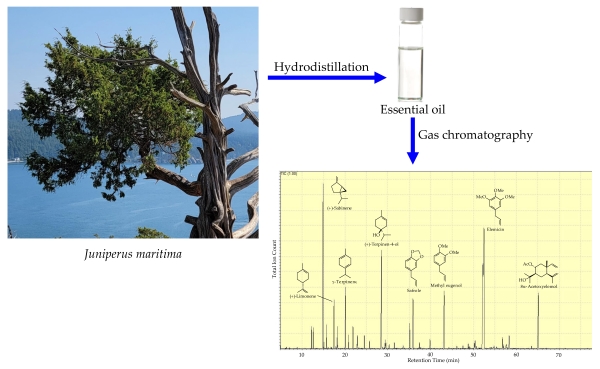
essential oils were obtained by hydrodistillation and characterized by gas
chromatography and enantioselective gas chromatography. The essential oil
compositions of J. maritima and J. scopulorum were considerably
different with elemicin dominating J. maritima essential oils
(19.9-34.7%), but apparently not observed in previously published J.
scopulorum; the essential oils of J. scopulorum, on the other hand,
were rich in sabinene (29.8-86.5%). The enantiomeric distributions of chiral
monoterpenoids in J. maritima are consistent with the distributions observed
in other Juniperus species. However, a limitation of this study is the
small number of samples available; the findings are exploratory and limited in
scope.
Keywords
Chemotaxonomy, phenylpropanoids,
sabinene, elemicin, gas chromatography, enantioselective, chiral.
1. Introduction
Essential oils are mixtures of volatile
terpenoids, phenylpropanoids, and other secondary metabolites [1]. The compositions of essential oils
have been exploited as chemotaxonomic markers to differentiate closely related
taxa [2]. Essential oil compositions with
chemometric analyses such as principal component analysis (PCA) or hierarchical
cluster analysis (HCA), have been used to discriminate taxa where morphological
differentiation is subtle or cryptic, such as in Piper [3], Eugenia [4], and Aniba [5] species. Studies of essential oil
compositions coupled with chemometrics have also been conducted on coniferous
species such as Pinus [6] and Sabina [7] as well as Juniperus [8–10].
The World Flora Online treats Juniperus maritima R.P. Adams (Puget Sound juniper, Cupressaceae) as conspecific with Juniperus scopulorum Sarg. (Rocky Mountain juniper) [11]. The natural range of J. maritima includes the coastal areas of southwestern British Columbia, Canada, and northwestern Washington, U.S.A., whereas the range of J. scopulorum is widespread in western North America (Fig. 1).

Figure 1. Native ranges of Juniperus
scopulorum Sarg. (green) and Juniperus maritima R.P. Adams (red) [13]. This work is in the public domain in
the United States because it is a work prepared by an officer or employee of
the United States Federal Government as part of that person’s official duties
under the terms of Title 17, Chapter 1, Section 105 of the US Code.
The morphology of the two species is barely distinguishable (Fig. 2), but Adams, using nuclear ribosomal DNA and single nucleotide polymorphisms concluded that J. maritima should be considered a species separate from J. scopulorum [12]. This study aimed to examine the essential oil composition, including the enantiomeric distributions of chiral monoterpenoids, of J. maritima from Puget Sound, Washington, and compare it with previously published essential oil compositions of J. scopulorum. We hypothesized that differences in essential oil compositions could provide complementary chemotaxonomic evidence for the separation of the two Juniperus species.

Figure 2. Herbarium specimens of Juniperus maritima R.P. Adams (image 01104983) and Juniperus scopulorum Sarg. (image 01477457) from the C.V. Starr Virtual Herbarium of the New York Botanical Garden [14].
2. Materials and methods
2.1. Plant material
Foliage of J. maritima was collected on 2 September 2025, from three individual mature trees located on sand dunes near Deception Pass (mid-day, 11:50-12:10) and from three mature individuals on a bluff overlooking Burrows Bay (early afternoon, 13:50-14:10), Washington (Fig. 3, Table 1). The plants were identified by W.N. Setzer in the field and verified by comparison with herbarium samples from the C.V. Starr Virtual Herbarium of the New York Botanical Garden [14]. Voucher samples (WNS-Jmar-2609 and WNS-Jmar-2631) were deposited at the University of Alabama in Huntsville Herbarium. Fresh plant materials were immediately frozen and stored (‒20 °C) until processing. The fresh/frozen foliage of the six J. maritima samples were subjected to hydrodistillation (4 h) using a Likens-Nickerson apparatus (500-mL distillation flask, foliage, and sufficient distilled water to cover the plant material) with continuous extraction of the distillate with dichloromethane (20 mL) to obtain colorless essential oils (Table 1). The obtained essential oils were stored at ‒20 °C until analysis.

Figure 3. Collection sites of Juniperus maritima from northwestern Washington (Google Earth Pro, v. 7.3.7, accessed on 6 March, 2026).
Table 1. Collection and hydrodistillation details of Juniperus maritima from northwestern Washington.
Sample | Collection location | Mass foliage (g) | Mass essential oil (g) | Yieldd (%) |
J.m. #1a | 48°23'44" N, 122°39'51" W, 4 m asl | 123.11 | 4.456 | 3.62 |
J.m. #2a | 48°23'42" N, 122°39'51" W, 5 m asl | 106.72 | 3.110 | 2.91 |
J.m. #3b | 48°23'41" N, 122°39'50" W, 4 m asl | 126.61 | 4.059 | 3.21 |
J.m. #4b | 48°29'30" N, 122°41'36" W, 65 m asl | 108.37 | 4.030 | 3.72 |
J.m. #5b | 48°29'31" N, 122°41'37" W, 63 m asl | 95.18 | 1.928 | 2.03 |
J.m. #6c | 48°29'30" N, 122°41'36" W, 65 m asl | 153.34 | 3.785 | 2.47 |
a Male tree. b Gender not determined. c Female tree. Yieldd (% ) = 100 ´ mass essential oil/mass fresh/frozen foliage.
2.2. Gas chromatographic analysis
The J. maritima foliar essential oils were analyzed by GC-MS and chiral GC-MS, as previously described [15, 16]. The instrumental details for GC-MS and chiral GC-MS are summarized in Table 2. Each essential oil was analyzed by GC-MS and chiral GC-MS using a single injection for each measurement. Retention index values were calculated using the van den Dool and Kratz method [17]. The components of the essential oils were determined by comparing the retention indices (within 5 RI units) and mass spectral fragmentation (similarity index > 80%) with those in the databases of Adams [18], Satyal [19], Mondello [20], and NIST20 [21]. The percentages of the essential oil components were calculated based on peak integration without standardization.
Table 2. Instrument details for the gas chromatographic analyses of Juniperus maritima.
Gas Chromatography - Mass Spectrometry (GC-MS) | |
Instrument | Shimadzu GC-MS-QP2010 Ultra (Shimadzu Scientific Instruments, Columbia, MD, USA) |
GC Column | Zebron ZB-5ms fused silica capillary column (60 m ´ 0.25 mm ´ 0.25 μm film thickness) (Phenomenex, Torrance, CA, USA) |
MS Detector Conditions | Electron impact (EI) mode, electron energy = 70 eV, scan range = 40–400 atomic mass units, scan rate = 3.0 scans/second |
Carrier Gas, Conditions | Helium, column head pressure = 208.3 kPa, flow rate = 2.00 mL/min |
Injector, Detector Temperatures | Injector temperature = 260 °C, interface temperature = 260 °C, ion source temperature = 260 °C |
GC Oven Temperature Program | Initial temperature = 50 °C, ramp 2 °C/min to 260 °C, hold 260 °C for 5 min |
Sample Concentration, Volume Injected | 5% (in dichloromethane), 0.1 μL volume |
Split Mode | 24.5 : 1.0 |
Chiral Gas Chromatography - Mass Spectrometry | |
Instrument | Shimadzu GCMS-QP2010S (Shimadzu Scientific Instruments, Columbia, MD, USA) |
GC Column | Restek B-Dex 325 chiral GC column (30 m ´ 0.25 mm ´ 0.25 μm film thickness) (Restek Corp., Bellefonte, PA, USA) |
MS Detector Conditions | Electron impact (EI) mode, electron energy = 70 eV, scan range = 40–400 atomic mass units, scan rate = 3.0 scans/second |
Carrier Gas, Conditions | Helium, column head pressure = 53.6 kPa, flow rate = 1.00 mL/min |
Injector, Detector Temperatures | Injector temperature = 240 °C, interface temperature = 240 °C, ion source temperature = 240 °C |
GC Oven Temperature Program | Initial temperature = 50 °C, hold for 5 min, ramp 1 °C/min to 100 °C, ramp 2 °C/min to 220 °C |
Sample Concentration, Volume Injected | 5% (in dichloromethane), 0.3 μL volume |
Split Mode | 24.0 : 1.0 |
2.3. Statistical analyses
Agglomerative hierarchical cluster analysis (HCA) and principal component analysis (PCA) were carried out using XLSTAT v. 2018.1.1.62926 (Addinsoft, Paris, France). For the HCA, the major components (α-pinene, sabinene, myrcene, limonene, γ-terpinene, terpinen-4-ol, pregeijerene B, safrole, methyl eugenol, α-elemol, elemicin, α-cadinol, and 8α-acetoxyelemol) were used for the analysis, dissimilarity was used to determine clustering based on the Euclidean distance, and Ward’s method was used to define the agglomeration. For the PCA, a Pearson correlation analysis was used to corroborate the results of the HCA using the same major components. Analysis of variance (ANOVA), followed by Tukey’s post hoc test, and Student’s t-test were carried out using Minitab® v. 22.4.0 (Minitab Inc., State College, PA, USA). Normal distributions were assumed and no corrections were applied. Differences were considered statistically significant at p < 0.05.
3. Results and discussion
3.1. Chemical composition of Juniperus maritima essential oil
The clear colorless essential oils were obtained by hydrodistillation of the foliage, with yields of 2.03-3.72% (w/w). The J. maritima essential oils were analyzed by GC-MS. A total of 149 compounds were identified in the six essential oil samples, which accounted for 98.9-99.8% of the compositions (Table 3).
The J. maritima foliage was collected from trees growing in different habitats. Samples #1, #2, and #3 were collected from trees growing on sand dunes near the water’s edge, whereas samples #4, #5, and #6 were collected from trees growing on a sandstone bluff overlooking the bay (Fig. 3). The major components in the essential oils were sabinene (4.6-11.0% for the dunes trees, 15.4-21.8% for the bluff trees), limonene (19.9-33.2% for the dunes trees, but only 0.6-1.3% for the bluff trees), terpinen-4-ol (2.6-4.8% for the dunes trees, 6.0-12.2% for the bluff trees), safrole (0.4-4.6%), methyl eugenol (2.4-15.6%), elemicin (19.9-34.7%), and 8α-acetoxyelemol (4.7-10.1%).
Table 3. Foliar essential oil compositions (percentages) of Juniperus maritima from northwestern Washington, U.S.A.
RIcalc | RIdb | Compounds | J.m. #1 | J.m. #2 | J.m. #3 | J.m. #4 | J.m. #5 | J.m. #6 |
783 | 780 | Methyl 2-methylbutanoate | 0.1 | tr | 0.1 | 0.2 | 0.1 | tr |
801 | 801 | Hexanal | tr | 0.1 | tr | tr | tr | tr |
848 | 850 | (2E)-Hexenal | 0.1 | 0.1 | tr | 0.1 | 0.1 | 0.1 |
849 | 853 | (3Z)-Hexenol | 0.1 | tr | tr | 0.1 | 0.1 | tr |
922 | 923 | Tricyclene | tr | tr | tr | tr | tr | tr |
925 | 925 | α-Thujene | 0.4 | 0.3 | 0.3 | 0.8 | 0.7 | 0.9 |
932 | 932 | α-Pinene | 0.5 | 0.3 | 0.4 | 0.8 | 0.5 | 0.8 |
941 | 950 | 4-Methyl-1-hexanol | tr | - | 0.1 | tr | - | tr |
942 | 942 | Isopropyl butanoate | - | - | - | - | tr | - |
947 | 948 | α-Fenchene | tr | tr | tr | tr | tr | tr |
948 | 950 | Camphene | tr | tr | tr | tr | tr | tr |
954 | 956 | (2E)-Heptenal | - | tr | tr | tr | tr | tr |
968 | 968 | Isopentyl propanoate | - | - | - | tr | - | - |
971 | 971 | Sabinene | 11.0 | 4.6 | 9.8 | 21.8 | 15.4 | 16.7 |
977 | 978 | β-Pinene | - | tr | tr | - | - | - |
977 | 978 | 1-Octen-3-ol | 0.2 | 0.1 | 0.2 | 0.4 | 0.4 | 0.3 |
983 | 983 | Octan-3-one | - | - | - | - | - | tr |
988 | 989 | Myrcene | 1.1 | 0.8 | 1.0 | 1.4 | 0.7 | 1.0 |
992 | 992 | 6-Methyl-5-hepten-2-ol (= Sulcatol) | - | - | - | - | tr | - |
995 | 996 | Butyl butanoate | tr | tr | 0.1 | - | tr | tr |
996 | 992 | Methyl (2E)-heptenoate | 0.1 | 0.1 | 0.5 | 1.0 | tr | tr |
998 | 997 | Ethyl hexanoate | - | - | - | tr | tr | tr |
1004 | 1005 | (3Z)-Hexenyl acetate | - | - | - | 0.1 | - | - |
1006 | 1006 | α-Phellandrene | tr | tr | tr | tr | tr | 0.1 |
1008 | 1008 | δ-3-Carene | - | - | tr | - | - | tr |
1017 | 1017 | α-Terpinene | 0.9 | 0.5 | 0.7 | 1.7 | 1.2 | 2.5 |
1024 | 1025 | p-Cymene | tr | tr | tr | 0.1 | 0.1 | 0.1 |
1030 | 1030 | Limonene | 25.3 | 33.2 | 19.9 | 1.3 | 0.6 | 1.1 |
1032 | 1031 | β-Phellandrene | 0.1 | 0.1 | 0.1 | 0.1 | 0.1 | 0.2 |
1032 | 1033 | Benzyl alcohol | - | tr | - | tr | tr | tr |
1034 | 1034 | Isopropyl hexanoate | - | - | - | tr | tr | tr |
1039 | 1040 | 2-Methylbutyl butanoate | - | - | - | - | tr | tr |
1045 | 1047 | Butyl isopentanoate | - | - | - | tr | tr | tr |
1054 | 1056 | Isopentyl butanoate | 0.3 | tr | tr | tr | 0.4 | tr |
1057 | 1057 | γ-Terpinene | 1.4 | 0.8 | 1.2 | 2.6 | 1.9 | 3.8 |
1063 | 1064 | 3-Methyl-2-butenyl butanoate | 0.1 | - | tr | tr | 0.1 | tr |
1069 | 1069 | cis-Sabinene hydrate | 0.4 | 0.3 | 0.5 | 1.0 | 0.8 | 0.7 |
1081 | 1083 | Heptyl acetate | - | - | - | 0.2 | - | - |
1085 | 1086 | Terpinolene | 0.8 | 0.6 | 0.6 | 0.9 | 0.6 | 1.1 |
1088 | 1090 | Fenchone | tr | tr | tr | - | - | - |
1093 | 1094 | Methyl benzoate | 0.1 | tr | tr | tr | tr | tr |
1099 | 1099 | Linalool | 0.5 | 0.2 | 0.7 | 0.7 | 0.5 | 0.2 |
1100 | 1101 | trans-Sabinene hydrate | 0.7 | 0.3 | 0.6 | 0.9 | 0.7 | 0.7 |
1104 | 1104 | Nonanal | tr | 0.1 | 0.1 | - | tr | tr |
1106 | 1109 | Isopentyl isopentanoate (= Solustrerol) | tr | tr | tr | tr | 0.6 | 0.1 |
1109 | 1108 | cis-Rose oxide | - | - | - | tr | tr | - |
1115 | 1115 | 3-Methyl-3-butenyl isopentanoate | tr | - | tr | tr | 0.2 | tr |
1117 | 1117 | β-Thujone | tr | - | tr | tr | tr | tr |
1118 | 1120 | endo-Fenchol | 0.1 | tr | tr | - | - | - |
1118 | 1120 | trans-4-Methoxythujane | - | - | - | - | 0.1 | - |
1123 | 1124 | cis-p-Menth-2-en-1-ol | 0.3 | 0.2 | 0.2 | 0.6 | 0.4 | 0.7 |
1125 | 1127 | trans-Rose oxide | - | - | - | tr | tr | - |
1125 | 1121 | trans-Pinene hydrate | tr | tr | tr | - | - | - |
1136 | 1134 | cis-Limonene oxide | 0.1 | 0.1 | tr | - | - | - |
1137 | 1140 | 3-Methyl-2-butenyl 2-methylbutanoate | - | - | - | - | tr | - |
1141 | 1142 | trans-p-Menth-2-en-1-ol | 0.2 | 0.1 | 0.2 | 0.4 | 0.3 | 0.5 |
1147 | 1148 | 3-Methyl-2-butenyl pentanoate | tr | - | - | tr | 0.1 | tr |
1151 | 1151 | Citronellal | 0.1 | tr | tr | tr | tr | tr |
1154 | 1156 | Camphene hydrate | tr | - | - | - | - | - |
1155 | 1157 | Sabina ketone | - | - | - | - | - | tr |
1171 | 1170 | Borneol | 0.1 | tr | 0.1 | 0.1 | 0.1 | tr |
1177 | 1179 | 2-Isopropenyl-5-methyl-4-hexenal | - | tr | tr | - | - | - |
1180 | 1180 | Terpinen-4-ol | 4.8 | 2.6 | 3.7 | 9.3 | 6.0 | 12.2 |
1184 | 1187 | (3Z)-Hexenyl butanoate | tr | tr | tr | tr | tr | 0.1 |
1185 | 1186 | p-Cymen-8-ol | tr | tr | tr | tr | tr | tr |
1189 | 1190 | Butyl hexanoate | - | - | - | - | - | tr |
1190 | 1190 | Methyl salicylate | tr | tr | tr | - | tr | 0.1 |
1194 | 1195 | α-Terpineol | 0.2 | 0.2 | 0.2 | 0.4 | 0.2 | 0.5 |
1196 | 1196 | cis-Piperitol | 0.1 | tr | tr | 0.1 | 0.1 | 0.2 |
1197 | 1197 | Methyl chavicol (= Estragol) | 0.2 | 0.5 | 0.4 | 0.1 | 0.4 | 0.3 |
1208 | 1208 | trans-Piperitol | 0.1 | tr | 0.1 | 0.2 | 0.1 | 0.2 |
1226 | 1227 | Citronellol | 1.6 | 0.7 | 0.7 | 0.9 | 0.6 | 0.3 |
1228 | 1226 | iso-Nerol | tr | - | 0.7 | - | tr | tr |
1229 | 1231 | (3Z)-Hexenyl 2-methylbutanoate | - | - | - | - | - | tr |
1235 | 1235 | (3Z)-Hexenyl isopentanoate | - | - | - | tr | tr | tr |
1240 | 1242 | Hexyl isopentanoate | - | - | - | - | - | tr |
1242 | 1242 | Carvone | 0.1 | tr | tr | - | - | - |
1249 | 1252 | Isopentyl hexanoate | tr | - | - | - | tr | - |
1249 | 1249 | Geraniol | - | - | - | tr | - | - |
1255 | 1255 | (4Z)-Decen-1-ol | tr | tr | 0.1 | tr | 0.1 | 0.2 |
1256 | 1256 | Methyl citronellate | 0.2 | 0.3 | tr | 0.1 | 0.2 | 0.1 |
1265 | 1264 | (Z)-Anethole | - | - | - | - | tr | - |
1278 | 1278 | Pregeijerene B | 2.8 | 2.3 | 2.1 | 1.5 | 1.8 | 1.6 |
1283 | 1282 | Bornyl acetate | tr | tr | tr | tr | tr | tr |
1285 | 1285 | (E)-Anethole | tr | 0.1 | tr | tr | tr | tr |
1288 | 1291 | Safrole | 2.6 | 0.4 | 4.3 | 3.9 | 2.9 | 4.6 |
1292 | 1292 | 3-Methyl-2-butenyl hexanoate | tr | - | tr | - | - | - |
1293 | 1293 | (2E,4Z)-Decadienal | 0.1 | tr | 0.1 | tr | tr | tr |
1309 | 1307 | 4-Methylhexenyl 2-methylbutanoate | - | - | - | - | - | tr |
1312 | 1310 | (2E,4E)-Decadienol | 0.3 | 0.1 | 0.3 | 0.2 | 0.2 | 0.4 |
1317 | 1318 | (2E,4E)-Decadienal | 0.1 | tr | 0.1 | 0.1 | tr | 0.1 |
1319 | 1319 | Methyl geranate | tr | tr | - | tr | tr | tr |
1326 | 1327 | p-Mentha-1,4-dien-7-ol | - | - | - | - | - | tr |
1346 | 1348 | α-Cubebene | - | - | - | tr | tr | tr |
1348 | 1349 | Citronellyl acetate | - | - | - | 0.1 | tr | - |
1349 | 1356 | Eugenol | 0.1 | 0.3 | 0.6 | 0.9 | 0.1 | 0.5 |
1364 | 1362 | Chavibetol | tr | tr | 0.1 | tr | 0.1 | tr |
1374 | 1375 | α-Copaene | - | - | - | tr | tr | tr |
1386 | 1387 | β-Cubebene | - | - | - | tr | tr | tr |
1388 | 1390 | trans-β-Elemene | - | - | - | tr | tr | tr |
1398 | 1403 | Methyl eugenol | 2.4 | 15.6 | 10.8 | 4.2 | 5.4 | 6.2 |
1418 | 1424 | (E)-β-Caryophyllene | 0.1 | 0.1 | tr | 0.1 | 0.1 | 0.1 |
1427 | 1427 | γ-Elemene | - | - | - | - | - | tr |
1433 | 1433 | cis-Thujopsene | - | - | - | - | 0.1 | tr |
1447 | 1446 | cis-Muurola-3,5-diene | - | - | - | 0.3 | 0.2 | 0.1 |
1454 | 1454 | α-Humulene | - | - | - | 0.1 | tr | tr |
1470 | 1472 | trans-Cadina-1(6),4-diene | tr | tr | tr | 0.3 | 0.2 | 0.2 |
1473 | 1475 | γ-Muurolene | tr | tr | tr | tr | tr | tr |
1479 | 1480 | Germacrene D | tr | tr | tr | tr | tr | tr |
1490 | 1490 | γ-Amorphene | tr | tr | tr | 0.5 | 0.4 | 0.3 |
1493 | 1497 | epi-Cubebol | tr | tr | tr | 0.4 | 0.3 | 0.2 |
1496 | 1497 | α-Muurolene | 0.1 | 0.1 | - | - | - | 0.1 |
1511 | 1512 | γ-Cadinene | 0.1 | tr | 0.1 | tr | tr | tr |
1513 | 1515 | Cubebol | tr | tr | tr | 1.2 | 0.7 | 0.3 |
1516 | 1518 | δ-Cadinene | 0.5 | 0.3 | 0.4 | 0.7 | 0.7 | 0.5 |
1520 | 1519 | trans-Calamenene | - | - | - | tr | tr | tr |
1521 | 1521 | Zonarene | - | - | - | 0.2 | 0.2 | 0.1 |
1530 | 1533 | trans-Cadina-1,4-diene | - | - | - | 0.1 | tr | tr |
1535 | 1536 | α-Copaen-11-ol | 0.1 | 0.1 | tr | 0.1 | 0.1 | 0.1 |
1535 | 1538 | α-Cadinene | tr | tr | tr | tr | tr | - |
1539 | 1540 | Liguloxide | tr | - | - | - | - | - |
1548 | 1549 | α-Elemol | 1.0 | tr | 1.8 | 1.2 | 1.4 | 1.2 |
1550 | 1551 | Elemicin | 27.1 | 19.9 | 27.5 | 25.6 | 34.7 | 28.8 |
1557 | 1557 | Germacrene B | tr | - | tr | tr | tr | tr |
1560 | 1560 | (E)-Nerolidol | tr | - | - | - | - | - |
1575 | 1574 | Germacra-1(10),5-dien-4β-ol | 0.4 | 0.2 | 0.4 | 0.4 | 0.4 | 0.1 |
1580 | 1587 | Caryophyllene oxide | tr | 0.1 | 0.1 | 0.1 | 0.1 | 0.1 |
1591 | 1592 | Methoxyeugenol | - | - | - | 0.3 | - | - |
1601 | 1600 | α-Oplopenone | 0.1 | 0.1 | 0.1 | 0.1 | 0.1 | 0.1 |
1606 | 1606 | Cedrol | tr | tr | - | - | - | - |
1607 | 1609 | Humulene epoxide II | - | tr | - | - | - | - |
1613 | 1614 | 1,10-di-epi-Cubenol | tr | tr | tr | - | - | - |
1620 | 1624 | epi-γ-Eudesmol | tr | tr | tr | - | - | - |
1626 | 1628 | 1-epi-Cubenol | tr | 0.1 | tr | 1.2 | 0.9 | 0.7 |
1630 | 1632 | γ-Eudesmol | 0.3 | 0.2 | 0.2 | 0.2 | 0.2 | 0.3 |
1640 | 1643 | τ-Cadinol | 0.2 | 0.3 | 0.2 | 0.2 | 0.3 | 0.2 |
1642 | 1644 | τ-Muurolol | 0.3 | 0.4 | 0.3 | 0.4 | 0.6 | 0.3 |
1643 | 1645 | (E)-iso-Elemicin | 0.1 | tr | tr | tr | tr | 0.1 |
1644 | 1643 | α-Muurolol (= δ-Cadinol) | 0.1 | 0.1 | 0.1 | 0.1 | 0.2 | 0.1 |
1647 | 1647 | cis-Guaia-3,9-dien-11-ol | tr | - | - | - | - | - |
1652 | 1652 | α-Eudesmol | 0.4 | 0.2 | 0.2 | 0.2 | 0.1 | 0.3 |
1653 | 1655 | α-Cadinol | 1.1 | 1.3 | 1.0 | 0.9 | 1.4 | 0.6 |
1680 | 1686 | Botrydiol | 0.1 | 0.1 | 0.1 | - | 0.1 | tr |
1691 | 1689 | Shyobunol | tr | tr | tr | tr | 0.1 | tr |
1737 | 1740 | 8α,11-Elemodiol | 0.1 | 0.1 | 0.1 | 0.1 | 0.1 | tr |
1778 | 1779 | 8α-Acetoxyelemol | 7.0 | 10.1 | 5.8 | 4.7 | 9.8 | 5.8 |
2287 | 2295 | 4-epi-Abietal | 0.1 | 0.1 | 0.1 | 0.2 | 0.1 | 0.1 |
|
| Compound classes |
|
|
|
|
|
|
Monoterpene hydrocarbons | 41.4 | 41.2 | 33.9 | 31.6 | 21.9 | 28.4 | ||
Oxygenated monoterpenoids | 9.3 | 4.8 | 7.7 | 14.7 | 10.0 | 16.4 | ||
Sesquiterpene hydrocarbons | 0.7 | 0.4 | 0.5 | 2.3 | 1.7 | 1.4 | ||
Oxygenated sesquiterpenoids | 11.1 | 13.2 | 10.4 | 11.4 | 16.7 | 10.2 | ||
Diterpenoids | 0.1 | 0.1 | 0.1 | 0.2 | 0.1 | 0.1 | ||
Benzenoid aromatics | 32.5 | 36.7 | 43.6 | 35.0 | 43.6 | 40.4 | ||
Non-terpenoid esters | 0.6 | 0.1 | 0.7 | 1.5 | 1.6 | 0.2 | ||
Others | 3.6 | 2.7 | 3.0 | 2.3 | 2.7 | 2.5 | ||
Total identified | 99.4 | 99.2 | 99.8 | 98.9 | 98.4 | 99.6 |
RIcalc = Retention index values determined with respect to a homologous series of n-alkanes on a ZB-5ms column. RIdb = Reference retention index values from the databases. tr = trace (< 0.05%). Compounds used for the HCA and PCA analyses are highlighted in bold.
3.2. Comparison with published Juniperus scopulorum essential oils
Although both World Flora Online [11] and Flora of North America [22] treat the two as conspecific, Adams concluded that J. maritima and J. scopulorum are different species based on essential oil composition, leaf morphology, and DNA sequence data [12]. A comparison of the major essential oil components of J. maritima with J. scopulorum shows noteworthy differences in support of the treatment by Adams. However, we cannot rule out potential hybridization [23], abiotic environmental characteristics of the collection sites [24, 25], or biotic factors, such as herbivory [26, 27] or fungal infection [28]. Hierarchical cluster analysis (HCA) revealed two major groupings that separated J. maritima from J. scopulorum (Fig. 4).

Figure 4. Dendrogram obtained from agglomerative hierarchical cluster analysis (HCA) based on the major components in the foliar essential oils of Juniperus maritima and Juniperus scopulorum. J.m. #1-#6 (this study), J.m. #7 [43], J.s. #1-#3 [44], J.s. #4 [43], J.s. #5 [45], J.s. #6 [46], J.s. #7 [47], J.s. #8 [48], J.s. #9 [49], J.s. #10 [50].
The J. maritima group is rich in elemicin (apparently not observed in J. scopulorum), whereas the J. scopulorum group is rich in sabinene. The J. maritima group can be subdivided into two clusters, cluster 1, (elemicin/limonene) and cluster 2 (elemicin/sabinene). The J. scopulorum group can also be subdivided into a sabinene-rich cluster (cluster 3) and a sabinene/terpinen-4-ol/α-elemol cluster (cluster 4). The principal component analysis (PCA, Fig. 5) corroborated the HCA, showing that J. maritima foliar essential oils correlated strongly with elemicin and that J. scopulorum essential oils strongly correlated with sabinene. The ANOVA analysis further illustrates the differences among the four clusters (Fig. 6). That is, Cluster 1 (the dunes J. maritima) is characterized by significantly high concentrations of limonene and elemicin, Cluster 2 (the bluff J. maritima) is also characterized by a significantly high concentration of elemicin, while the two J. scopulorum clusters have significantly high concentrations of sabinene. Note that these statistical methods provide support for, but do not establish taxonomic separation.

Figure 5. Biplot obtained from principal component analysis (PCA) based on the major components in the foliar essential oils of Juniperus maritima and Juniperus scopulorum. J.m. #1-#6 (this study), J.m. #7 [43], J.s. #1-#3 [44], J.s. #4 [43], J.s. #5 [45], J.s. #6 [46], J.s. #7 [47], J.s. #8 [48], J.s. #9 [49], J.s. #10 [50].

Figure 6. Average percentage compositions of the major components in Juniperus maritima (Clusters 1 and 2) and Juniperus scopulorum (Clusters 3 and 4). For each component, bars with the same numbers are not significantly different (p > 0.05, ANOVA followed by Tukey’s test).
3.3. Comparison between the two Juniperus maritima collection sites
Several factors have been attributed to variations in the chemical composition of essential oils within a species [29–33]. These include genetic factors [34–36], abiotic environmental characteristics of the collection sites [24, 25], seasonality/phenology [37], and biotic factors such as herbivory [26, 27] or fungal infection [28], as well as differences in processing methods. The factors responsible for the observed compositional differences in the samples from the two J. maritima collection sites are unclear, but they may be due to abiotic and/or biotic environmental characteristics. Exposure to salt stress may be a factor in the differences between the compositions of dunes and the bluff trees. The trees collected from the sand dunes were very near the water’s edge, whereas those on the bluff were farther away and higher in elevation. Salt stress is known to affect the composition of essential oils [38]. However, biotic factors such as competition with other flora [39, 40] or arbuscular mycorrhizal fungal diversity [41,42] may also play a role, but this is speculative at this point.
3.4. Enantiomeric distribution of chiral monoterpenoids in Juniperus maritima essential oils
The J. maritima essential oils were subjected to enantioselective GC-MS analysis (Table 4). With the exception of α-thujene (100% (–)-α-thujene), the dominant enantiomer in each of the monoterpenoids detected was the dextrorotatory, (+)-enantiomer. In particular, (+)-α-pinene (98.5 ± 0.7%), (+)-sabinene (99.7 ± 0.2%), (+)-limonene (98.2 ± 1.9%), (+)-cis-sabinene hydrate (95.0 ± 2.6%), and (+)-trans-sabinene hydrate (96.8 ± 1.4%) were dominant. Interestingly, there were minor, but significant (t-test) differences in the distributions from the two habitats for limonene (99.8 ± 0.0% (+)-limonene for the dunes trees, 96.5 ± 1.1% for the bluff trees, p = 0.035) and for α-terpineol (68.0 ± 1.0% (+)-α-terpineol for the dunes trees, 52.5 ± 1.1% for the bluff trees, p < 0.001). These results are consistent with the distributions observed in other Juniperus species [16], including J. scopulorum [50].
Table 4. Enantiomeric distributions (percent of each enantiomer) of chiral monoterpenoids in the foliar essential oils of J. maritima from northwestern Washington, U.S.A.
Enantiomers | RIcalc | RIdb | J.m. #1 | J.m. #2 | J.m. #3 | J.m. #4 | J.m. #5 | J.m. #6 |
(+)-α-Thujene | n.o. | 950 | 0.0 | 0.0 | 0.0 | 0.0 | 0.0 | 0.0 |
953 | 951 | 100.0 | 100.0 | 100.0 | 100.0 | 100.0 | 100.0 | |
(–)-α-Pinene | 977 | 976 | 1.6 | 2.8 | 1.8 | 1.0 | 1.1 | 0.0 |
(+)-α-Pinene | 981 | 982 | 98.4 | 97.2 | 98.2 | 99.0 | 98.9 | 99.3 |
(+)-Sabinene | 1016 | 1021 | 99.7 | 99.3 | 99.7 | 99.9 | 99.9 | 99.9 |
(–)-Sabinene | 1030 | 1030 | 0.3 | 0.7 | 0.3 | 0.1 | 0.1 | 0.1 |
(–)-Limonene | 1077 | 1073 | 0.2 | 0.1 | 0.1 | 2.8 | 4.7 | 2.9 |
(+)-Limonene | 1081 | 1081 | 99.8 | 99.9 | 99.9 | 97.2 | 95.3 | 97.1 |
(+)-cis-Sabinene hydrate | 1198 | 1199 | 94.4 | 90.8 | 93.5 | 97.3 | 96.8 | 97.2 |
(–)-cis-Sabinene hydrate | 1202 | 1202 | 5.6 | 9.2 | 6.5 | 2.7 | 3.2 | 2.8 |
(–)-Linalool | 1229 | 1228 | 13.3 | 16.7 | 13.2 | 12.4 | 23.0 | 18.2 |
(+)-Linalool | 1232 | 1231 | 86.7 | 83.3 | 86.8 | 87.6 | 77.0 | 81.7 |
(+)-trans-Sabinene hydrate | 1231 | 1231 | 97.1 | 94.4 | 96.0 | 98.1 | 97.8 | 97.8 |
(–)-trans-Sabinene hydrate | 1236 | 1235 | 2.9 | 5.6 | 4.0 | 1.9 | 2.2 | 2.2 |
(+)-Terpinen-4-ol | 1294 | 1297 | 73.0 | 73.3 | 73.5 | 68.1 | 74.1 | 67.1 |
(–)-Terpinen-4-ol | 1300 | 1300 | 27.0 | 27.7 | 26.5 | 31.9 | 25.9 | 32.9 |
(–)-α-Terpineol | 1348 | 1347 | 32.5 | 30.8 | 32.7 | 46.9 | 46.8 | 48.7 |
(+)-α-Terpineol | 1356 | 1356 | 67.5 | 69.2 | 67.3 | 53.1 | 53.2 | 51.3 |
RIcalc = Retention index values determined with respect to a homologous series of n-alkanes on a Restek B-Dex 325 capillary column. RIdb = Retention index from our in-house database prepared using commercially available standards. n.o. = compound not observed.
4. Conclusions
There is some controversy regarding the classification of Juniperus maritima as a species separate from Juniperus scopulorum. The current study provides new compositional and chiral data for J. maritima and suggests distinct chemical differences compared to published J. scopulorum essential oil profiles, thus providing complementary supporting evidence, but not definitive taxonomic proof, for separating the species based on essential oil analysis. Multivariate analyses revealed two major clusters that separated J. maritima from J. scopulorum. The J. maritima cluster was rich in elemicin, whereas the J. scopulorum cluster was rich in sabinene. The J. maritima cluster showed two sub-clusters, one described as an elemicin/sabinene chemotype and the other as an elemicin/limonene chemotype. The J. scopulorum cluster was subdivided into a cluster dominated by sabinene, and another cluster dominated by sabinene/terpinen-4-ol. It is apparent that phenylpropanoids define the volatile phytochemistry of J. maritima and differentiate its essential oil from that of J. scopulorum. The taxonomic treatment of J. maritima requires additional scrutiny. This study was preliminary and was limited by the small sample size. The HCA and PCA are used as exploratory pattern-recognition tools and are supportive of taxonomic separation rather than confirmation. Future research should include more samples from various habitats and focus on the effects of the ecological components present in the different habitats of J. maritima. In addition to providing chemotaxonomic evidence to support the existence of a separate species, this report provides chiral GC data identifying the enantiomeric distributions of chiral monoterpenoid components.
Disclaimer (artificial intelligence)
Authors hereby state that no generative AI tools such as Large Language Models (ChatGPT, Copilot, etc.) and text-to-image generators were utilized in the preparation or editing of this manuscript.
Authors’ contributions
Conceptualization, W.N.S.; methodology, P.S., W.N.S.; software, P.S.; validation, P.S., W.N.S.; formal analysis, A.P., P.S., W.N.S.; investigation, K.S., A.P., P.S., W.N.S.; resources, P.S., W.N.S.; data curation, W.N.S.; writing—original draft preparation, W.N.S.; writing—review and editing, K.S., A.P., P.S.; visualization, W.N.S.; supervision, P.S., W.N.S.; project administration, W.N.S.
Acknowledgements
This work was carried out as part of the activities of the Aromatic Plant Research Center (APRC, https://aromaticplant.org/).
Funding
This research received no specific grant from any funding agency.
Availability of data and materials
All data will be made available on request according to the journal policy.
Conflicts of interest
The authors declare no conflict of interest.
References
|
1. |
Sell, C. Chemistry of essential oils. In
Handbook of Essential Oils; Başer, K.H.C., Buchbauer, G., Eds.; CRC Press:
Boca Raton, Florida, USA, 2010; pp. 121–150. ISBN 978-1-4200-6315-8. |
|
2. |
Amin, A.; Park, S. Harnessing molecular
phylogeny and chemometrics for taxonomic validation of Korean aromatic
plants: Integrating genomics with practical applications. Plants. 2025, 14,
2364. https://doi.org/10.3390/plants14152364 |
|
3. |
Nugroho, L.H.; Lexinta, E.C.; Priyono,
Y.; Susandarin, R. Composition of terpenoid compounds in essential oils
extracted from stems of eight Piper species and their role in
taxonomic relationships. Biodiversitas. 2020, 21, 3438–3443.
https://doi.org/10.13057/biodiv/d210804. |
|
4. |
Silveira, R.M.; Menezes, F.H.; Lima,
I.G.; Carvalho, A.F.F.U.; Bünger, M. de O.; da Costa, I.R. Essential oil
constituents as the chemosystematic markers in Eugenia L. (Myrtaceae):
An evolutionary perspective. South African J. Bot. 2023, 160, 309–318.
https://doi.org/10.1016/j.sajb.2023.07.015 |
|
5. |
Xavier, J.K.A.M.; Maia, L.; Figueiredo,
P.L.B.; Folador, A.; Ramos, A.R.; Andrade, E.H.; Maia, J.G.S.; Setzer, W.N.;
da Silva, J.K.R. Essential oil composition and DNA barcode and identification
of Aniba species (Lauraceae) growing in the Amazon Region. Molecules.
2021, 26, 1914. https://doi.org/10.3390/molecules26071914 |
|
6. |
Bakó, E.; Böszörményi, A.; Vargáné Szabó,
B.; Engh, M.A.; Hegyi, P.; Ványolós, A.; Csupor, D. Chemometric analysis of
monoterpenes and sesquiterpenes of conifers. Front. Plant Sci. 2024, 15,
1392539. https://doi.org/10.3389/fpls.2024.1392539 |
|
7. |
Malhocká, A.; Švábová, M.; Suchý, T.
Chemotaxonomy according to leaf terpenes of eight cypress species growing in
the Czech Republic in the light of modern phylogenetic classification.
Biochem. Syst. Ecol. 2025, 120, 104980.
https://doi.org/10.1016/j.bse.2025.104980 |
|
8. |
Caramiello, R.; Bocco, A.; Buffa, G.;
Maffei, M. Chemotaxonomy of Juniperus communis, J. sibirica and
J. intermedia. J. Essent. Oil Res. 1995, 7, 133–145. https://doi.org/10.1080/10412905.1995.9698488 |
|
9. |
Hu, H.; Li, D.; Bai, R.; Zhang, W.; Luo,
H.; Yu, E. Chemodiversity and bioactivity of the essential oils of Juniperus
and implication for taxonomy. Int. J. Mol. Sci. 2023, 24, 15203.
https://doi.org/10.3390/ijms242015203 |
|
10. |
Xie, Q.; Liu, Z. Chemometrics of the
composition and antioxidant capacity of essential oils obtained from six
Cupressaceae taxa. Sci. Rep. 2024, 14, 18612.
https://doi.org/10.1038/s41598-024-69600-3 |
|
11. |
World Flora Online, W.F.O. Juniperus
scopulorum Sarg. Available online:
http://www.worldfloraonline.org/taxon/wfo-0000354991 (accessed on 6 March
2026). |
|
12. |
Adams, R.P. Juniperus maritima,
the seaside juniper, a new species from Puget Sound, North America.
Phytologia. 2007, 89, 263–283. |
|
13. |
Little, E.L. Digital Representations of
Tree Species Range Maps. Available online:
https://commons.wikimedia.org/wiki/Flora_distribution_maps_of_North_America
(accessed on 6 March 2026). |
|
14. |
New York Botanical Garden, N.Y.B.G. C. V.
Starr Virtual Herbarium. Available online:
https://sweetgum.nybg.org/science/vh/ (accessed on 6 March 2026). |
|
15. |
Swor, K.; Satyal, P.; Poudel, A.; Setzer,
W.N. Gymnosperms of Idaho: Chemical compositions and enantiomeric
distributions of essential oils of Abies lasiocarpa, Picea
engelmannii, Pinus contorta, Pseudotsuga menziesii, and Thuja
plicata. Molecules. 2023, 28, 2477.
https://doi.org/10.3390/molecules28062477 |
|
16. |
Setzer, W.N.; Poudel, A.; Satyal, P.;
Swor, K.; Ankney, E. Enantioselective gas chromatographic analysis of
Cupressaceae foliar essential oils: Callitropsis nootkatensis, Calocedrus
decurrens, Sequoia sempervirens, and Thuja plicata. J.
Essent. Oil Plant Comp. 2025, 3, 140–153. https://doi.org/10.58985/jeopc.2025.v03i02.73 |
|
17. |
van den Dool, H.; Kratz, P.D. A
generalization of the retention index system including linear temperature
programmed gas-liquid partition chromatography. J. Chromatogr. A. 1963, 11,
463–471. https://doi.org/10.1016/s0021-9673(01)97887-2 |
|
18. |
Adams, R.P. Identification of Essential
Oil Components by Gas Chromatography/Mass Spectrometry; 4th ed.; Allured
Publishing: Carol Stream, Illinois, USA, 2007. ISBN 978-1-932633-21-4. |
|
19. |
Satyal, P. Development of GC-MS Database
of Essential Oil Components by the Analysis of Natural Essential Oils and
Synthetic Compounds and Discovery of Biologically Active Novel Chemotypes in
Essential Oils, Ph.D. Dissertation, University of Alabama in Huntsville,
Huntsville, AL, USA, 2015. |
|
20. |
Mondello, L. FFNSC 3; Shimadzu Scientific
Instruments: Columbia, Maryland, USA, 2016. |
|
21. |
NIST20; National Institute of Standards
and Technology: Gaithersburg, Maryland, USA, 2020. |
|
22. |
eFloras.org. Juniperus scopulorum
Sargent. Available online: |
|
|
http://www.efloras.org/florataxon.aspx?flora_id=1&taxon_id=233500739
(accessed on 7 March 2026). |
|
23. |
Adams, R.P. Allopatric hybridization and
introgression between Juniperus maritima R. P. Adams and J.
scopulorum Sarg.: Evidence from nuclear and CpDNA and leaf terpenoids.
Phytologia. 2015, 97, 55–66. |
|
24. |
Lakušić, D.V.; Ristić, M.S.; Slavkovska,
V.N.; Šinžar-Sekulić, J.B.; Lakušić, B.S. Environment-related variations of
the composition of the essential oils of rosemary (Rosmarinus officinalis
L.) in the Balkan Penninsula. Chem. Biodivers. 2012, 9, 1286–1302.
https://doi.org/10.1002/cbdv.201100427 |
|
25. |
Mansinhos, I.; Gonçalves, S.;
Rodríguez-Solana, R.; Moreno-Rojas, J.M.; Romano, A. Environmental factors
related to climate change alter the chemical composition and biological
activity of Lavandula viridis L’Hér essential oil. Agriculture. 2024,
14, 1067. https://doi.org/10.3390/agriculture14071067 |
|
26. |
Palermo, T.B.; Cappellari, L. del R.;
Palermo, J.S.; Giordano, W.; Banchio, E. Simultaneous impact of rhizobacteria
inoculation and leaf-chewing insect herbivory on essential oil production and
VOC emissions in Ocimum basilicum. Plants. 2024, 13, 932.
https://doi.org/10.3390/plants13070932 |
|
27. |
de Brito-Machado, D.; Ramos, Y.J.;
Antunes e Defaveri, A.C.; de Queiroz, G.A.; Guimarães, E.F.; Moreira, D.L.
Volatile chemical variation of essential oils and their correlation with
insects, phenology, ontogeny and microclimate: Piper mollicomum Kunth,
a case of study. Plants. 2022, 11, 3535. https://doi.org/10.3390/plants11243535 |
|
28. |
Giannoulis, K.D.; Evangelopoulos, V.;
Gougoulias, N.; Wogiatzi, E. Could bio-stimulators affect flower, essential
oil yield, and its composition in organic lavender (Lavandula angustifolia)
cultivation? Ind. Crop. Prod. 2020, 154, 112611.
https://doi.org/10.1016/j.indcrop.2020.112611 |
|
29. |
Sangwan, N.S.; Farooqi, A.H.A.; Shabih,
F.; Sangwan, R.S. Regulation of essential oil production in plants. Plant
Growth Regul. 2001, 34, 3–21. https://doi.org/10.1023/a:1013386921596 |
|
30. |
Barra, A. Factors affecting chemical
variability of essential oils: A review of recent cevelopments. Nat. Prod.
Commun. 2009, 4, 1147–1154. https://doi.org/10.1177/1934578x0900400827 |
|
31. |
Moore, B.D.; Andrew, R.L.; Külheim, C.;
Foley, W.J. Explaining intraspecific diversity in plant secondary metabolites
in an ecological context. New Phytol. 2014, 201, 733–750.
https://doi.org/10.1111/nph.12526 |
|
32. |
Etri, K.; Pluhár, Z. Exploring chemical
variability in the essential oils of the Thymus genus. Plants. 2024,
13, 1375. https://doi.org/10.3390/plants13101375 |
|
33. |
Hassiotis, C.N.; Vlachonasios, K.E. How
biological and environmental factors affect the quality of lavender essential
oils. Physiologia 2025, 5, 11. https://doi.org/10.3390/physiologia5010011 |
|
34. |
Vieira, R.F.; Grayer, J.; Paton, A.;
Simon, J.E. Genetic diversity of Ocimum gratissimum L. based on
volatile oil constituents, flavonoids and RAPD markers. Biochem. Syst. Ecol.
2001, 29, 287–304. https://doi.org/10.1016/s0305-1978(00)00062-4 |
|
35. |
Xavier, J.K.A.M.; Baia, T.G.C.; Alegria,
O.V.C.; Figueiredo, P.L.B.; Carneiro, A.R.; Moreira, E.C.O.; Maia, J.G.S.;
Setzer, W.N.; da Silva, J.K.R. Essential oil chemotypes and genetic
variability of Cinnamomum verum leaf samples commercialized and
cultivated in the Amazon. Molecules. 2022, 27, 7337.
https://doi.org/10.3390/molecules27217337 |
|
36. |
Çelik, C.; Tuğlu, Ü.; Telci, İ.;
Karakurt, Y.; Özek, T.; Özek, G. Determination of gene expression of some
essential oil components and some genes responsible for the synthesis of
these components in Mentha species harvested in different phenological
periods. Acta Physiol. Plant. 2025, 47, 68.
https://doi.org/10.1007/s11738-025-03815-3 |
|
37. |
Barros, L.S.P.; da Cruz, E.N.S.;
Guimarães, B.A.; Setzer, W.N.; Mourão, R.H.V.; da Silva, J.K.R.; da Costa,
J.S.; Figueiredo, P.L.B. Chemometric analysis of the seasonal variation in
the essential oil composition and antioxidant activity of a new geraniol chemotype
of Lippia alba (Mill.) N.E.Br. ex Britton & P. Wilson from the
Brazilian Amazon. Biochem. Syst. Ecol. 2022, 105, 104503.
https://doi.org/10.1016/j.bse.2022.104503 |
|
38. |
Borromeo, I.; Giordani, C.; Forni, C. The
role of plant-derived essential oils in eco-friendly crop protection
strategies under drought and salt stress. Plants. 2025, 14, 3789.
https://doi.org/10.3390/plants14243789 |
|
39. |
Ormeño, E.; Bousquet-Mélou, A.; Mévy,
J.P.; Greff, S.; Robles, C.; Bonin, G.; Fernandez, C. Effect of intraspecific
competition and substrate type on terpene emissions from some Mediterranean
plant species. J. Chem. Ecol. 2007, 33, 277–286.
https://doi.org/10.1007/s10886-006-9219-4 |
|
40. |
Chelan, Z.A.; Amini, R.; Nasab, A.D.M.
Essential oil yield and compositions of Dracocephalum moldavica L. in
intercropping with fenugreek, inoculation with mycorrhizal fungi and bacteria.
Sci. Rep. 2023, 13, 8039. https://doi.org/10.1038/s41598-023-35156-x |
|
41. |
Alguacil, M.M.; Torres, M.P.;
Montesinos-Navarro, A.; Roldán, A. Soil characteristics driving arbuscular
mycorrhizal fungal communities in semiarid Mediterranean soils. Appl.
Environ. Microbiol. 2016, 82, 3348–3356. https://doi.org/10.1128/aem.03982-15 |
|
42. |
da Trindade, R.; Almeida, L.; Xavier, L.;
Lins, A.L.; Andrade, E.H.; Maia, J.G.; Mello, A.; Setzer, W.N.; Ramos, A.; da
Silva, J.K. Arbuscular mycorrhizal fungi colonization promotes changes in the
volatile compounds and enzymatic activity of lipoxygenase and phenylalanine
ammonia lyase in Piper nigrum L. 'Bragantina'. Plants. 2019, 8, 442.
https://doi.org/10.3390/plants8110442 |
|
43. |
Adams, R.P. The leaf essential oil of Juniperus
maritima R.P. Adams compared with J. horizontalis, J.
scopulorum and J. virginiana oils. Phytologia. 2009, 91, 31–39. |
|
44. |
Poulson, A.; Wilson, T.M.; Packer, C.;
Carlson, R.E.; Buch, R.M. Aromatic profiles of trunk, limb, and leaf
essential oils of Juniperus scopulorum (Cupressaceae) from Utah.
Phytologia. 2021, 103, 10–17. |
|
45. |
Dambolena, J.S.; Meriles, O.M.; López,
A.G.; Gallucci, M.N.; González, S.B.; Guerra, P.E.; Bruno, A.; Zunino, M.P.
Actividad antifúngica del aceite esencial de cinco especies de Juniperus
de Argentina. Bol. Latinoam. y del Caribe Plantas Med. y Aromat. 2011, 10,
104–115. |
|
46. |
Zheljazkov, V.D.; Astatkie, T.;
Jeliazkova, E.A.; Schlegel, V. Distillation time alters essential oil yield,
composition, and antioxidant activity of male Juniperus scopulorum
trees. J. Oleo Sci. 2012, 61, 537–546. https://doi.org/10.5650/jos.61.537 |
|
47. |
Zheljazkov, V.D.; Astatkie, T.;
Jeliazkova, E. Year-round variations in essential oil content and composition
of male and female juniper. HortScience. 2013, 48, 883–886. |
|
48. |
Zheljazkov, V.D.; Astatkie, T.;
Jeliazkova, E.A.; Heidel, B.; Ciampa, L. Essential oil content, composition
and bioactivity of juniper species in Wyoming, United States. Nat. Prod.
Commun. 2017, 12, 201–204. https://doi.org/10.1177/1934578x1701200215 |
|
49. |
Özek, G.; Schepetkin, I.A.;
Yermagambetova, M.; Özek, T.; Kirpotina, L.N.; Almerekova, S.S.; Abugalieva,
S.I.; Khlebnikov, A.I.; Quinn, M.T. Innate immunomodulatory activity of
cedrol, a component of essential oils isolated from Juniperus species.
Molecules. 2021, 26, 7644. https://doi.org/10.3390/molecules26247644 |
|
50. |
Swor, K.; Poudel,
A.; Satyal, P.; Setzer, W.N. Enantiomeric distribution of terpenoids in Juniperus
essential oils: Composition of Juniperus horizontalis and Juniperus
scopulorum leaf essential oils from southwestern Idaho. Nat. Prod.
Commun. 2022, 17, 1934578X221091006.
https://doi.org/10.1177/1934578x221091006 |

This work is licensed under the
Creative Commons Attribution
4.0
License (CC BY-NC 4.0).
Abstract
World Flora Online and Flora of North America
treat Juniperus maritima and Juniperus scopulorum as conspecifics.
However, Robert P. Adams concluded that these two species are separate. This study
aimed to compare the foliar essential oils of six J. maritima samples, collected
from two habitats in the Puget Sound area of northwestern Washington state,
with the essential oils of J. scopulorum reported in the literature. The
essential oils were obtained by hydrodistillation and characterized by gas
chromatography and enantioselective gas chromatography. The essential oil
compositions of J. maritima and J. scopulorum were considerably
different with elemicin dominating J. maritima essential oils
(19.9-34.7%), but apparently not observed in previously published J.
scopulorum; the essential oils of J. scopulorum, on the other hand,
were rich in sabinene (29.8-86.5%). The enantiomeric distributions of chiral
monoterpenoids in J. maritima are consistent with the distributions observed
in other Juniperus species. However, a limitation of this study is the
small number of samples available; the findings are exploratory and limited in
scope.
Abstract Keywords
Chemotaxonomy, phenylpropanoids,
sabinene, elemicin, gas chromatography, enantioselective, chiral.
This work is licensed under the
Creative Commons Attribution
4.0
License (CC BY-NC 4.0).
Editor-in-Chief


This work is licensed under the
Creative Commons Attribution 4.0
License.(CC BY-NC 4.0).