

Short Communication
Received: 2026-05-08 | Revised:2026-05-22 | Accepted: 2026-05-25 | Published: 2026-06-03
Pages: 64-70
DOI: https://doi.org/10.58985/jeopc.2026.v04i02.82
Abstract
The chemical composition of the resin from Pinus
edulis collected in Joes Valley, Utah, was analyzed using GC-MS to
characterize its dominant volatile compounds. Three samples were prepared using
pooled resin collected from the trunk, branches, and surrounding soil. Across
the three samples, the resin was primarily composed of monoterpene
hydrocarbons, with α-pinene as the most abundant constituent (30.4–33.5%),
followed by δ-3-carene (8.0–9.0%) and smaller contributions from sesquiterpenes
and esters. The samples showed high chemical similarity, with over 90% of the compounds
identified and only minor variations between replicates. Previous studies on P.
edulis from Utah revealed that α-pinene levels in the samples were lower
than those reported across other plant tissues, while δ-3-carene values were
consistent with trunk resin data. These findings support the classification of P.
edulis resin as monoterpene-dominated and highlight its potential as a
regional chemotype.
Keywords
Pinus edulis, Utah, Pinyon pine resin, gas chromatography, chemical
profiling, phytochemistry.
1. Introduction
Pinus edulis,
commonly known as the two-needle pinyon pine, is an essential-oil-bearing
evergreen tree belonging to the family Pinaceae [1].
This small, drought-tolerant species is native to the dry mountain slopes of
North America [2, 3]. As a co-dominant with
juniper species, P. edulis inhabits extensive pinyon–juniper woodlands
across Arizona, Colorado, New Mexico, and Utah, with smaller populations
extending into California, Wyoming, Texas, and Oklahoma [1–3]. The trees are monoecious and typically reach heights of
up to 20 ft., forming broad, spreading crowns. Each fascicle bears two
blue-green needles, and cones develop near the terminal ends of the branches [1–3]. P. edulis begins producing cones
around 25 years of age, when trees measure 5–10 m tall, and can continue
reproducing for several centuries [1, 3].
Historically, the plant
parts of P. edulis have been used for medicinal purposes. Native
American tribes of the Lake Tahoe Basin used the tree’s resins and needles as a
form of dermatological first aid [4]. Pine resin
is also used as an antiseptic treatment for burns, wounds, and other skin
conditions [4, 5]. Modern Contemporary
studies have demonstrated that P. edulis essential oil and its major
constituents (especially α-pinene and δ-3-carene) exhibit antimicrobial
activity against both Gram-positive and Gram-negative bacteria, including
antibiotic-resistant strains, as well as antioxidant and potential
anti-inflammatory effects [7, 4]. The
essential oil derived from P. edulis resin is dominated by monoterpene
hydrocarbons, primarily α-pinene, accompanied by notable levels of δ-3-carene,
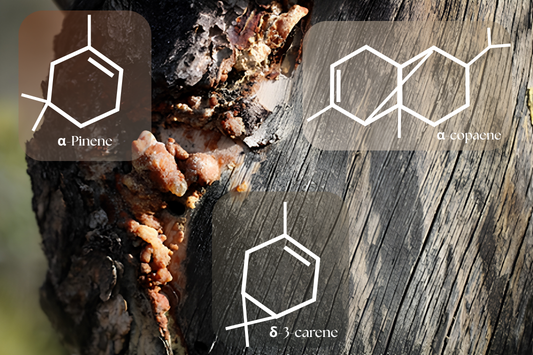
longifolene, α-copaene, and various esters, such as ethyl octanoate [6]. This composition imparts a fresh, woody, and resinous
aroma with subtle citrus notes, which may contribute to its
bioactivity.
Despite its traditional
importance and promising bioactivity, detailed chemical characterization of
resin-derived essential oils from Utah populations remains limited. This study
presents the GC-MS profiles of resin collected in Joes Valley, Utah, to characterize
the dominant volatile compounds and assess batch-to-batch consistency within
the local population. By examining the volatile constituents of P. edulis
resin from a defined regional source, this study contributes to a broader
understanding of the geographical variation in P. edulis resin and provides
data that may support future applications in aromatherapy, natural product
formulation, and pharmacological research.
2.
Materials and methods
P. edulis resin (Fig 1) was collected on January 29th, 2026, from a population within a defined geographical area in accordance with the Bureau of Land Management. The resin site (Fig 2) is located on public land in Joes Valley, Utah, USA (elevation 2006 m). Approximately 6 kg of resin was collected in one visit from numerous trees distributed throughout the permitted area. Trees were selected using an opportunistic sampling method based on the presence of visible resin deposits. The collected resin ranged from aged, dry material to fresh wet material (Fig 1) and was harvested using metal scraping tools to gently remove existing deposits formed on the trunks, branches, and ground surrounding trees. All collected resins were thoroughly combined into a single sample and then frozen prior to subsampling for hydrodistillation and GC-MS analysis. A representative voucher sample was collected from the site and is held in the Young Living Aromatic Herbarium (YLAH): Pinus edulis Engelm., Wilson 2026-01 (YLAH).

Figure 1. Close up photo of dry (left) and wet (right) Pinus edulis resin, photo credit: Tyler
Wilson.

Figure 2. Satellite image
of the resin collection area located 39°17'22" N 111°10'38" W.
Essential oil (EO) samples (n = 3) were produced by distilling the resin from the trees. Samples were produced by laboratory-scale hydrodistillation as follows: 6 L of water was added to the bottom of a 12-L distillation chamber (Albrigi Luigi S.R.L., Grezzana, Italy), the resin was accurately weighed and added to the distillation chamber, hydrodistilled for 3 h, and the volatile oil was separated with a cooled condenser and Florentine flask. The EO samples were filtered and stored in sealed amber glass bottles at room temperature until analysis. Samples A-C (Table 1) were generated from subsamples of a single homogenized batch and represented independent replicates. The essential oil yield (w/w) was calculated as (mass of essential oil extracted ÷ mass of resin used) × 100. Resin mass was measured immediately upon removal from the freezer after separation and prior to hydrodistillation. To determine volatile compound profiles, EO samples were analyzed, and compounds were identified and quantified by GC/MS using an Agilent 7890B GC/5977B MSD (Agilent Technologies, Santa Clara, CA, USA) and Agilent J & W DB-5, 60 m × 0.25 mm, 0.25 μm film thickness, fused silica capillary column. Operating conditions: 0.1 μL of sample (20% soln. for EO in ethanol), 100:1 split ratio, initial oven temp. of 40 °C with an initial hold time of 5 min, and the oven ramp rate was 4.5 °C per min to 310 °C with a hold time of 5 min. The electron ionization energy was 70 eV, the scan range was 35–650 amu, the scan rate was 2.4 scans per s, source temp. 230 °C, and the quadrupole temp. was 150 °C. The compounds were identified using the Adams volatile oil library [15] and a Chemstation library search in conjunction with retention indices (KI). Variability between samples A-C was evaluated by comparing the relative percentage compositions of the major constituents between the samples.
3.
Results
Hydrodistillation of resin from trees of P. edulis resulted in 3 essential oil (EO) samples, identified as A, B, and C. Naturally exuded resin was collected from the trunk, branches and earth surrounding each tree. The yields (w/w) ranged from 2.61-2.69%, with an average of 2.66% (Table 1)
Table 1. Hydrodistillation and essential oil production details, including sample identity (A-C), resin mass (g), essential oil yield (g), and essential oil % (w/w).
|
Sample |
Resin
mass (g) |
Essential
oil yield (g) |
Essential
oil (%, w/w) |
|
A |
2202.70 |
59.09 |
2.68 |
|
B |
2229.43 |
60.05 |
2.69 |
|
C |
2027.50 |
52.92 |
2.61 |
The GC/MS analysis identified 49 volatile compounds present in at least one of the three resin samples (Table 2). Prominent compounds, defined as relative area % ≥ 2% in at least one sample, included α-pinene (avg. 32.2%), δ-3-carene (avg. 8.6%), α-copaene (avg. 5.6%), longifolene (avg. 4.2%), δ-cadinene (avg. 2.9%), γ-muurolene (avg. 2.6%), 3,7,7-trimethyl-1,3,5-cycloheptatriene (avg. 2.5%), limonene (avg. 2.2%), and ethyl octanoate (avg. 2.1%). These compounds showed relatively low variability between the three samples, with standard deviations typically below 1% for most of the major constituents (e.g., α-pinene σ = 1.6, δ-3-carene σ = 0.5, α-copaene σ = 0.4 and longifolene σ = 0.9). Overall, the chemical profiles were highly consistent across the three samples.
Table 2. Chemical components of P. edulis resin samples.
Compound Name | KI | Sample A | Sample B | Sample C |
Tricyclene | 921 | 0.5 | 0.5 | 0.4 |
α-Thujene | 924 | 1.1 | 1.3 | 1.0 |
α-Pinene | 932 | 33.5 | 32.8 | 30.4 |
Camphene | 946 | 1.9 | 1.8 | 1.7 |
Thuja-2,4(10)-diene | 953 | 1.4 | 1.4 | 1.2 |
3,7,7-Trimethyl-1,3,5-cycloheptatriene | 966 | 2.4 | 2.6 | 2.4 |
Sabinene | 969 | 0.3 | 0.4 | 0.4 |
β-Pinene | 974 | 1.2 | 1.2 | 1.2 |
Myrcene | 988 | 0.5 | 0.4 | 0.9 |
δ-3-Carene | 1008 | 8.0 | 9.0 | 8.8 |
α-Terpinene | 1014 | 0.5 | 0.6 | 0.5 |
p-Cymene | 1020 | 0.4 | 0.4 | 0.3 |
o-Cymene | 1022 | 2.1 | 2.1 | 1.9 |
Limonene | 1024 | 2.2 | 2.4 | 2.0 |
cis-β-Ocimene | 1032 | 0.5 | 0.6 | 0.6 |
Trans-β-ocimene | 1044 | 0.1 | 0.1 | 0.1 |
γ-Terpinene | 1054 | 0.7 | 0.8 | 0.7 |
Terpinolene | 1086 | 1.0 | 1.0 | 1.1 |
1,3,8-p-Menthatriene | 1108 | 0.3 | 0.3 | 0.2 |
Endo-fenchol | 1114 | tr | tr | tr |
Unknown compound #1 | 1123 | 1.0 | 0.9 | 0.9 |
trans-Pinocarveol | 1135 | 1.0 | 0.8 | 0.7 |
trans-Verbenol | 1140 | 0.3 | 0.3 | 0.2 |
Camphor | 1141 | 0.1 | 0.1 | 0.1 |
trans-Pinocamphone | 1158 | 0.2 | 0.1 | 0.1 |
Pinocarvone | 1160 | 0.1 | 0.1 | tr |
Borneol | 1165 | 0.3 | 0.2 | 0.3 |
p-Mentha-1,5-dien-8-ol | 1166 | 0.6 | 0.5 | 0.4 |
Terpinen-4-ol | 1174 | 0.7 | 0.6 | 0.5 |
p-Cymen-8-ol | 1179 | 0.2 | 0.1 | 0.2 |
Ethyl octanoate | 1196 | 2.6 | 1.5 | 2.3 |
Myrtenal | 1195 | 0.4 | 0.3 | 0.3 |
Verbenone | 1204 | 0.4 | 0.3 | 0.3 |
Bornyl acetate | 1284 | 0.8 | 0.7 | 0.8 |
α-Terpinyl acetate | 1346 | 0.1 | 0.1 | 0.1 |
α-Cubebene | 1348 | 1.1 | 1.1 | 1.1 |
Longipinene | 1350 | 0.2 | 0.2 | 0.3 |
α-Copaene | 1374 | 5.2 | 5.9 | 5.8 |
Ethyl-(4E)-decenoate | 1380 | 0.4 | 0.2 | 0.4 |
β-Bourbonene | 1387 | 1.9 | 2.3 | 2.1 |
Ethyl decanoate | 1395 | 0.3 | 0.2 | 0.3 |
Longifolene | 1407 | 4.1 | 3.4 | 5.2 |
Trans-caryophyllene | 1417 | 0.3 | 0.4 | 0.5 |
β-Ylangene | 1419 | 0.5 | 0.5 | 0.6 |
γ-Muurolene | 1478 | 2.6 | 2.4 | 2.7 |
α-Amorphene | 1483 | 0.1 | 0.1 | 0.2 |
β-Selinene | 1489 | 0.2 | 0.1 | 0.2 |
α-Muurolene | 1500 | 1.8 | 2.1 | 2.1 |
γ-Cadinene | 1513 | 1.2 | 1.3 | 1.3 |
δ-Cadinene | 1522 | 2.7 | 2.9 | 3.1 |
α-Cadinene | 1537 | 0.1 | 0.1 | 0.2 |
α-Calacorene | 1544 | 0.3 | 0.3 | 0.3 |
β-Calacorene | 1564 | 0.1 | 0.1 | 0.1 |
1,10-Di-epi-cubenol | 1618 | 0.1 | 0.1 | 0.1 |
Cadalene | 1675 | 0.1 | 0.1 | 0.1 |
Abietadiene | 2087 | 0.6 | 0.5 | 0.8 |
Identified total |
| 91.2 | 90.9 | 90.3 |
KI is the Kovat’s Index value and was previously calculated by Robert Adams using a linear calculation on a DB-5 column [15]. *KI not included in the Adam’s Library [15] and was manually calculated using alkane standards on a DB-5 column. The compound name and value (relative area %) are reported for each detected compound. Values less than 0.1% are denoted as trace (tr).
4. Discussion
The GC-MS profiles of the three resin samples from P. edulis collected in Joes Valley, Utah, established a chemotype dominated by monoterpene hydrocarbons. α-Pinene was the most prominent constituent (30.4–33.5%), followed by δ-3-carene (8.0–9.0%), with contributions from sesquiterpenes such as α-copaene (5.2–5.9%) and longifolene (3.4–5.2%), as well as esters including ethyl octanoate (1.5–2.6%). These results align with the volatile composition previously reported for trunk, limb, and resinous samples of P. edulis from Utah populations [16]. A high percentage of compounds were identified across samples A-C (90.3-91.2%). The three samples displayed strong phytochemical similarities, with only minor differences between them (typically < 3% for major constituents). Small variations are typical of pooled natural resins and may reflect genetic and micro-environmental differences among individual trees within the Joes Valley population. However, these factors were not examined in the present study. This high level of consistency suggests that P. edulis resin from Joes Valley may represent a uniform local chemotype, although additional sampling is necessary to confirm this pattern. If supported by further studies, this attribute could be advantageous for potential commercial or other research applications.
Comparison with existing literature reveals that the α-pinene levels observed here (30.4–33.5%) are lower than those reported for trunk, limb, needle, and seed cone essential oils of Utah P. edulis (~59.3%) [16]. These results align with those of previous studies, showing α-pinene as a dominant monoterpene in P. edulis across its native range [17]. Other findings on the essential oils of P. edulis in Utah found that needle oils were characterized by higher levels of sabinene, β-pinene, and myrcene, along with bornyl acetate as a prominent monoterpene [6]. In contrast, the resin samples from the present study showed lower or trace amounts of sabinene, β-pinene, myrcene, reduced bornyl acetate, and a more balanced presence of sesquiterpenes (longifolene, α-copaene, δ-cadinene, etc.). These differences highlight the significant plant-part-dependent variation in the volatile chemistry of P. edulis within the Utah populations.
The high abundance of α-pinene plays a central role in shaping the physical and biological properties of P. edulis resins. The dominance of α-pinene contributes significantly to the fluidity/volatility of resin, allowing it to spread quickly over tree wounds. At this high percentage, α-pinene forms the primary chemical defense of the resin against bark beetles, fungi, and other pathogens [7, 11,18]. The presence of α-pinene, δ-3-carene, and α-copaene is consistent with the purported wound-healing applications of P. edulis resin in traditional medicine and contributes to its signature aroma [10-14]. Other major constituents, such as longifolene and other sesquiterpenes, also contribute notably to the antimicrobial activity, antioxidant effects, and other medicinal applications of P. edulis resin/essential oils [8-10]. The limitations of this study include the limited collection area and small sample size. Future research should evaluate the bioactivity of these specific samples, expand the sample collection range and size, investigate seasonal or site-specific variation, and compare results across different Utah populations.
5. Conclusions
Overall, this study adds to the limited chemical characterization of P. edulis exuded resin from a microenvironment in Utah and documents a consistent regional chemotype, possibly supporting further research efforts and highlighting the potential for commercialization.
Disclaimer (artificial intelligence)
Author(s) hereby state that no generative AI tools such as Large Language Models (ChatGPT, COPILOT, etc.) and text-to-image generators were utilized in the preparation or editing of this manuscript.
Authors’ contributions
Conceptualization, data curation, formal analysis (GC/MS), methodology, sample procurement, software, writing –review and editing, T.M.W.; data curation, sample procurement, writing – original draft, review and editing, I.P.L.; funding acquisition, validation, writing – review and editing. All authors have read and agreed to the published version of the manuscript, C.R.B.
Acknowledgements
The authors want to thank the Gary D. Young Research Institute for supporting this research.
Funding
Young Living Essential Oils funded this research.
Availability of data and materials
All data will be made available on request according to the journal policy.
Conflicts of interest
The authors declare no conflicts of interest. The funding entity had no role in the design of the study, nor in the
collection, analysis, or interpretation of data.
References
1. | World Flora Online Consortium. Taxon details: WFO-0000481286. World Flora Online. Retrieved May 5, 2026. https://www.worldfloraonline.org/taxon/wfo-0000481286 |
2. | Cronquist, A.; Holmgren, A.H.; Holmgren, N.H.; Reveal, J.L. Intermountain Flora; Vascular Plants of the Intermountain West, USA; Hafner Publishing Company, Inc.: New York, NY, USA; Volume 1, p. 232, 1972. |
3. | Burns, R.M.; Honkala, B.H. (Technical coordinators). Silvics of North America: Volume 1. Conifers. Agriculture Handbook 654. U.S. Department of Agriculture, Forest Service, 1990. |
4. | Ren,W.; Liu, T.; Wu, J. Unveiling abietic acid's therapeutic potential: A narrative review of its pharmacological activities and clinical prospects. Front. Pharmacol. 2025, 16, 1738572. https://doi.org/10.3389/fphar.2025.1738572 |
5. | Li, X.Q., Chen, Y. Rosin: A comprehensive review on traditional uses, phytochemistry, and pharmacology. Fitoterapia. 2024, 177,106068. https://doi.org/10.1016/j.fitote.2024.106068 |
6. | Swor, K.; Poudel, A.; Satyal, P.; Setzer, W.N. The pinyon pines of Utah: Leaf essential oils of Pinus edulis and Pinus monophylla. J. Essent. Oil Bear. Plant. 2024, 27(2), 547–559. https://doi.org/10.1080/0972060X.2024.2328115 |
7. | Ancuceanu, R.; Anghel, A.I.; Hovaneț, M.V.; Ciobanu, A.M.; Lascu, B.E.; Dinu, M. Antioxidant activity of essential oils from Pinaceae species. Antioxidants. 2024, 13(3), 286. https://doi.org/10.3390/antiox13030286 |
8. | Shu, H.; Chen, H.; Wang, X.; Hu, Y.; Yun, Y.; Zhong, Q.; Chen, W.; Chen, W. Antimicrobial activity and proposed action mechanism of 3-carene against Brochothrix thermosphacta and Pseudomonas fluorescens. Molecules. 2019, 24(18), 3246. https://doi.org/10.3390/molecules24183246 |
9. | Woo, J.; Yang, H.; Yoon, M.; Gadhe, C.G.; Pae, A.N.; Cho, S.; Lee, C.J. 3-Carene, a phytoncide from pine tree, has a sleep-enhancing effect by targeting the GABAA-benzodiazepine receptors. Experiment. Neurobiol. 2019, 28(5), 593–601. https://doi.org/10.5607/en.2019.28.5.593 |
10. | Chruszcz-Lipska, K. Probing the stereochemical structure of carenes using Raman and Raman optical activity spectroscopy. Spectrochim. Acta Part A: Mol. Biomol. Spect. 2022, 278, 121339. https://doi.org/10.1016/j.saa.2022.121339 |
11. | Himejima, M.; Hobson, K.R.; Otsuka, T.; Wood, D.L.; Kubo, I. Antimicrobial terpenes from oleoresin of ponderosa pine tree Pinus ponderosa: A defense mechanism against microbial invasion. J. Chem. Ecol. 1992, 18(10), 1809–1818. https://doi.org/10.1007/BF02751105 |
12. | Mirković, S.; Tadić, V.; Milenković, M.T.; Žugić, A.; Arsenijevic, J.; Dekic. Antimicrobial activities of essential oils of different Pinus species from Bosnia and Herzegovina. Pharmaceutics. 2024, 16(10), 1331. https://doi.org/10.3390/pharmaceutics16101331 |
13. | Marinaș, I.C.; Oprea, E.; Buleandra, M.; Badea, I.A.; Tihauan, B.M.; Marutescu, L.; Lazar, V; Chifiriuc, M.C.; Velescu, B.S. Chemical composition, antipathogenic and cytotoxic activity of the essential oil extracted from Amorpha fruticose fruits. Molecules. 2021, 26(11), 3146. https://doi.org/10.3390/molecules26113146 |
14. | Verma, R.S.; Padalia, R.C.; Goswami, P.; Verma, S.K.; Chauhan, A.; Darokar, M.P. Chemical composition and antibacterial activity of foliage and resin essential oils of Araucaria cunninghamii Aiton ex D.Don and Araucaria heterophylla (Salisb.) Franco from India. Ind. Crop. Prod. 2014, 61, 410–416. https://doi.org/10.1016/j.indcrop.2014.07.025 |
15. | Adams, R.P. Identification of Essential Oil Components by Gas Chromatography/Mass Spectrometry, 4th ed.; Allured Publ.: Carol Stream, IL, USA, 1997. https://doi.org/10.1016/S1044-0305(97)00026-3 |
16. | Poulson, A.; Wilson, T.M.; Packer, C.; Carlson, R.E.; Buch, R.M. Essential oils of trunk, limbs, needles and seed cones of Pinus edulis (Pinaceae) from Utah. Phytologia. 2020, 102(3), 200–207. https://doi.org/10.3390/molecules26082343 |
17. | Trowbridge, A.M.; Helmig, D.; Monson, R.K.; Turnipseed, A.A. Ecosystem and leaf-level fluxes of volatile organic compounds from an arid woodland of Pinus edulis and Juniperus monosperma. Biogeosci. 2019, 16, 2449–2467. https://doi.org/10.5194/bg-16-2449-2019 |
18. | Keeling, C.I.; Bohlmann, J. Genes, enzymes and chemicals of terpenoid diversity in the constitutive and induced defense of conifers against insects and pathogens. New Phytol. 2006, 170(4), 657–675. https://doi.org/10.1111/j.1469-8137.2006.01716 |

This work is licensed under the
Creative Commons Attribution
4.0
License (CC BY-NC 4.0).
Abstract
The chemical composition of the resin from Pinus
edulis collected in Joes Valley, Utah, was analyzed using GC-MS to
characterize its dominant volatile compounds. Three samples were prepared using
pooled resin collected from the trunk, branches, and surrounding soil. Across
the three samples, the resin was primarily composed of monoterpene
hydrocarbons, with α-pinene as the most abundant constituent (30.4–33.5%),
followed by δ-3-carene (8.0–9.0%) and smaller contributions from sesquiterpenes
and esters. The samples showed high chemical similarity, with over 90% of the compounds
identified and only minor variations between replicates. Previous studies on P.
edulis from Utah revealed that α-pinene levels in the samples were lower
than those reported across other plant tissues, while δ-3-carene values were
consistent with trunk resin data. These findings support the classification of P.
edulis resin as monoterpene-dominated and highlight its potential as a
regional chemotype.
Abstract Keywords
Pinus edulis, Utah, Pinyon pine resin, gas chromatography, chemical
profiling, phytochemistry.
This work is licensed under the
Creative Commons Attribution
4.0
License (CC BY-NC 4.0).
Editor-in-Chief


This work is licensed under the
Creative Commons Attribution 4.0
License.(CC BY-NC 4.0).