
Review Article
Received: 2026-05-21 | Revised:2026-06-04 | Accepted: 2026-06-10 | Published: 2026-06-23
Pages: 71-187
DOI: https://doi.org/10.58985/jeopc.2026.v04i02.83
Abstract
Essential oils extracted from the Asteraceae family, one of the largest families of angiosperms, have shown numerous biological properties and are widely used in the pharmaceutical, perfumery, agricultural, and food industries. The biological properties of these natural agents are directly related to their chemical composition. Therefore, the present review aims to investigate the chemical components of essential oils from the Asteraceae family and introduce their major compounds. The Asteraceae family, essential oils, chemical components, and major compounds were used as keywords in the searches. Terpene and phenylpropanoid compounds were identified as the dominant compounds in most of the essential oils. For instance, the major components of Artemisia annua L. essential oil are artemisia ketone, 1,8-cineole, and camphor. (Z)-β-ocimene was identified in all specimens of Tagetes minuta L. essential oils. Agglomerative hierarchical cluster analysis (HCA) was used for the essential oils that had been studied extensively. For example, in the Artemisia absinthium L. essential oil, three different chemotypes, sabinyl acetate, β-thujone-rich cluster, and 6,7-epoxyocimene, were identified. In some cases, diverse chemotypes from different locations have been introduced. For example, the chemotypes of Achillea millefolium L. are not restricted to geographical locations and the largest cluster (the β-pinene cluster) has representatives from India, Iran, Brazil, Sardinia, Lithuania, Cuba, and Portugal. Likewise, essential oils from Iran represent all five different chemotypes. The results of this review can be used to make decisions about the use of Asteraceae essential oils.
Keywords
Compositae, chemical profile, essential oils, terpenes.
1. Introduction |
The Asteraceae family is known as the largest family of flowering plants, comprises approximately 23,000 species across 1,500 genera. Most members of this family are herbaceous or shrubby and can be annual, biennial, or perennial. Their stems may be erect, ascending, or prostrate, and their root systems exhibit significant variability, including taproots, fibrous roots, rhizomes, or stolons. Leaf morphology also varies widely, with some species having only basal or cauline leaves, while others possess both types. Leaf forms can range from simple and unlobed to lobed or compound. The inflorescence, known as a capitulum, contains a few to many florets surrounded by bracts called phyllaries, which form the involucre. The flower heads may feature ray florets that are zygomorphic, often with erose or lobed tips, in addition to disc florets that are actinomorphic, short-tubular, and typically four- or five-lobed. The fruits produced by the Asteraceae family are called cypselae; these are dry, single-seeded fruits that develop from bicarpellate inferior ovaries [1, 2].
The aromatic properties of several Asteraceae species are primarily due to the volatile constituents of their essential oils. In general, essential oils play a critical role in protecting plants against herbivores, particularly insects, mites, and nematodes, although other effects, such as the attraction of pollinators or phytotoxic activity against damaging weeds, have also been documented [3]. The diverse biological effects of many Asteraceae essential oils have been demonstrated in previous studies. These essential oils are an important source of insecticidal agents, and their high potential for controlling many insect pests from various groups, including crop, greenhouse, stored-product, and orchard pests, and medically important ones, has been well documented [4–10]. In addition, the acaricidal, nematicidal, antifungal, antibacterial, antiprotozoal, antiviral, antioxidant, cytotoxic, and phytotoxic effects of these natural agents have been documented, which are related to the chemical profiles of essential oils [11–25].
The chemical composition of essential oils isolated from the Asteraceae family, which mainly comprises terpenes, phenylpropanes, and other low molecular weight aromatic and aliphatic constituents, has been extensively studied in numerous species worldwide. It has also been reported that the chemical profile of Asteraceae essential oils can vary in response to various endogenous and exogenous factors, including geographical location, harvesting season, plant ontogeny (growth stage), chemotype or subspecies, the specific plant part used, and even the extraction method [26–32].
Accordingly, this review comprehensively focuses on the significant findings regarding the chemical profiles of essential oils from the Asteraceae family. Agglomerative
hierarchical cluster analysis (HCA) was conducted using XLSTAT v. 2018.1.1.62926 (Addinsoft, Paris, France). The analysis employed the percentages of the main components of each essential oil, with clustering determined by Euclidean distance and agglomeration defined by Ward’s method.
Essential oils are generally obtained by three different methods: (1) cold pressing (now used almost exclusively for the production of Citrus peel essential oils), (2) steam distillation or hydrodistillation (the most frequently used method for obtaining essential oils), and (3) dry distillation, which is rarely used Volatile components of plants have also been obtained by non-polar solvent extraction (e.g., hexane), or by supercritical CO2 extraction, however, the oils obtained are not considered “essential oils”. In this review, unless otherwise indicated, essential oils were obtained by steam distillation or hydrodistillation.
2. Materials and methods |
The complete list of Asteraceae genera was obtained from World Flora Online [33]. Each genus, coupled with the search terms ‘’Asteraceae’’, “essential oil”, or “chemical composition” was searched using the databases GoogleScholar, Scopus, and Web of Science. The search was conducted until April, 2025. Reports based on solvent extracts or those with unreliable gas chromatographic analyses were excluded.
3. Results and discussion |
3.1. Chemical composition of essential oils
3.1.1. Acanthospermum Schrank
The genus is primarily Neotropical comprised of six species: Acanthospermum australe (Loefl.) Kuntze, Acanthospermum consobrinum S.F. Blake, Acanthospermum glabratum (DC.) Wild, Acanthospermum hispidum DC., Acanthospermum humile DC., and Acanthospermum microcarpum B.L. Rob. Of these, A. hispidum has been naturalized in many areas of the world [33].
Acanthospermum hispidum DC. This plant is native to Central and South America, but has been naturalized in Eurasia, Africa, and North America [34, 35]. The essential oil compositions of A. hispidum have been reported from Argentina, Congo, Ivory Coast, and Nigeria (Table 1) and are largely dominated by sesquiterpenoids, especially (E)-β-caryophyllene.
Table 1. Chemical compositions of Acanthospermum hispidum essential oils.
Geographical location | Plant tissue | Major components (> 5%) | Ref. |
Argentina | Aerial parts | (E)-β-Caryophyllene (35.2%), α-bisabolol (11.4%), germacrene D (11.1%), trans-β-elemene (10.0%), α-humulene (9.7%), bicyclogermacrene (9.7%) | [36] |
Congo | Leaves | (E)-β-Caryophyllene (34.0-42.7%), α-humulene (1.4-12.7%), germacrene D (6.4-10.1%), bicyclogermacrene (5.3-10.6%), α-bisabolol (3.7-11.2%) | [37] |
Ivory Coast | Aerial parts | (E)-β-Caryophyllene (33.3-34.9%), germacrene D (7.3-8.4%), bicyclogermacrene (6.3-9.5%), α-bisabolol (6.5-9.9%), α-humulene (6.5-7.0%), α-pinene (4.6-7.9%) | [38] |
Nigeria | Aerial parts | (E)-β-Caryophyllene (28.0%), α-pinene (15.9%), bicyclogermacrene (11.0%), α-bisabolol (8.9%), germacrene D (6.9%), α-humulene (6.0%), | [39] |
Nigeria | Leaves | (E)-β-Caryophyllene (21.8%), α-bisabolol (20.7%), bicyclogermacrene (7.9%), caryophyllene oxide (6.6%), germacrene D (6.1%), α-humulene (5.9%) | [40] |
3.1.2. Achillea L.
The essential oil composition of Achillea species was reviewed in 2005 [41] and 2016 (from Türkiye) [42]. The following summary complements these previous reviews.
Achillea filipendulina Lam. Several studies have been reported on the essential oil composition of A. filipendulina (Table 2). Santolina alcohol, 1,8-cineole, and borneol generally dominate the aerial part essential oils, while the floral and leaf essential oils have shown some variation.
Table 2. Chemical compositions of Achillea filipendulina essential oils.
Geographical location | Plant tissue | Major components (> 5%) | Ref. |
Iran | Aerial parts | Santolina alcohol (31.4%)a, carvacrol (14.9%), borneol (11.6%), 1,8-cineole (8.1%), bornyl acetate (5.1%) | [43] |
Iran | Aerial parts | Santolina alcohol (17.9%), 1,8-cineole (7.5%), borneol (5.5%) | [44] |
Iran | Aerial parts | Santolina alcohol (37.2%), borneol (12.7%), 1,8-cineole (8.6%), germacrene D (6.2%) | [45] |
Iran | Flowers | Ascaridole (30.2%), trans-isoascaridole (25.0%), 1,8-cineole (12.4%), p-cymene (9.5%), camphor (6.7%) | [46] |
Iran | Flowers | Chrysanthenyl acetate (19.1%), 1,8-cineole (17.2%), borneol (9.7%), α-pinene (9.6%), β-pinene (7.1%) | [47] |
Iran | Flowers | α-Terpineol (14.6%), chrysanthenyl acetate (13.7%), γ-terpinen (11.2%), bornyl acetate (10.0%), α-pinene (7.7%), α-campholenal (7.6%), | [48] |
Iran | Leaves | 1,8-Cineole (32.7%), camphor (17.7%), ascaridole (7.1%), trans-isoascaridole (6.6%) | [46] |
Iran | Leaves | Chrysanthenyl acetate (16.3%), 1,8-cineole (12.0%), α-pinene (8.8%), borneol (7.7%), bornyl acetate (7.2%), β-pinene (5.7%), cis-verbenol (5.7%), | [47] |
Iran | Leaves | 1,8-Cineole (29.9%), chrysanthenyl acetate (16.7%), bornyl acetate (14.0%), α-pinene (8.4%), terpinen-4-ol (5.7%), camphene (5.4%) | [48] |
Kazakhstan | Aerial parts | Santolina alcohol (29.0%), borneol (27.8%), 1,8-cineole (19.1%), bornyl acetate (8.1%) | [49] |
Tajikistan | Aerial parts | Santolina alcohol (46.3%, 43.6%), 1,8-cineole (8.8%, 11.4%), cis-chrysanthenyl acetate (6.5%, 9.3%), borneol (5.3%, 6.0%), iso-borneol (4.8%, 5.4%), | [50] |
Türkiye | Aerial parts | Santolina alcohol (43.8%), 1,8-cineole (14.5%), cis-chrysanthenyl acetate (12.5%) | [51] |
a Identified as 2,7-dimethyl-4(E),6-octadien-2-ol | |||
Achillea millefolium L. The essential oil compositions of A. millefolium have been extensively investigated from numerous geographical locations, including Brazil [52], Cuba [53], Egypt [54],Estonia [55], England [56], France [57], Greece [58, 59], India [60–62], Iran [63–71], Kaliningrad [72], Italy [73], Kashmir [74], Kazakhstan [75], Kosova [76], Lithuania [77], Macedonia [78], Poland [4, 79], Portugal [80, 81], Sardinia [80], Serbia [82, 83], and Türkiye [84].
A hierarchical cluster analysis (HCA, Fig. 1) indicates at least five different chemotypes of A. millefolium based on the essential oil compositions. Interestingly, chemotypes are not restricted to geographical locations. For example, the largest cluster (the β-pinene
cluster) has representatives from India, Iran, Brazil, Sardinia, Lithuania, Cuba, and Portugal. Likewise, essential oils from Iran represent all five different chemotypes. Some additional miscellaneous Achillea essential oils are summarized in Table 3.
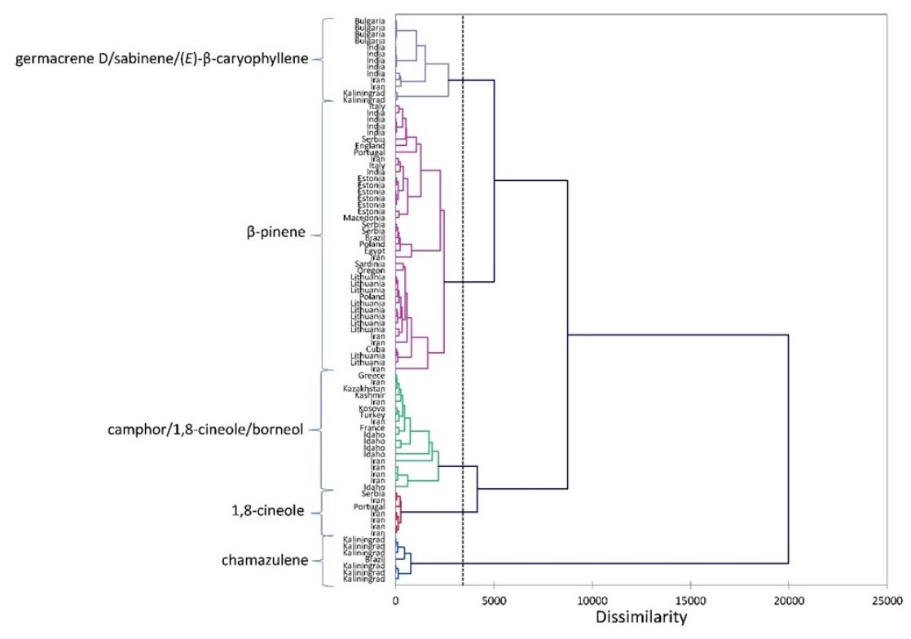
Figure 1. Dendrogram obtained by hierarchical cluster analysis (HCA) based on the essential oil compositions of Achillea millefolium.
Table 3. Chemical compositions of essential oils of miscellaneous Achillea species.
Achillea species | Geographical location | Plant tissue | Major components (> 5%) | Ref. |
Achillea arabica Kotschy. | Türkiye | Leaves | Piperitone (31.1%), camphor (12.5%), 1,8-cineole (10.9%) | [85] |
Achillea arabica Kotschy. | Iran | Aerial parts | p-Cymene (14.6%), piperitone (13.1%), camphor (12.8%), 1,8-cineole (12.0%), germacrene D (9.7%), borneol (6.5%), linalool (6.1%), α-terpinene (5.4%) | [45] |
Achillea cartilaginea Ledeb. ex Rchb. | Kazakhstan | Aerial parts | α-Thujone (26.2%), β-thujone (11.8%), 1,8-cineole (8.8%), terpinen-4-ol (7.8%), camphor (6.8%) | [49] |
Achillea eriophora DC. | Iran | Leaves | Camphor (34.0%), 1,8-cineole (29.3%), camphene (5.9%) | [65] |
Achillea eriophora DC. | Iran | Aerial parts | Camphor (19.6%), 1,8-cineole (19.1%), camphene (9.6%), α-pinene (7.4%), borneol (6.7%), bornyl acetate (5.4%) | [45] |
Achillea fragrantissima Sch. Bip. | Yemen | Leaves | Artemisia ketone (49.5%), camphor (14.8%), α-bisabolol (11.2%) | [86] |
Achillea fragrantissima Sch. Bip. | Saudi Arabia | Aerial parts | α-Thujone (34.5%), santolina alcohol (25.6%), β-thujone (11.9%), artemisia ketone (9.9%), β-sesquiphellandrene (5.5%) | [87] |
Achillea grandiflora M. Bieb. | Kazakhstan | Aerial parts | β-Pinene (8.9%), selin-11-en-4α-ol (8.5%), γ-eudesnol (6.3%), 1,8-cineole (5.9%), | [75] |
Achillea ledebourii Heimerl | Kazakhstan | Aerial parts | Germacrene D (20.5%), spathulenol (10.9%), (E)-β-caryophyllene (6.5%), caryophyllene oxide (6.2%), unidentified (21.4%), unidentified (5.5%) | [49] |
Achillea lingulata Waldst. & Kit. | Bosnia and Herzegovina | Aerial parts | Borneol (30.1%), trans-verbenol (15.5%), 2-tridecanone (12.2%), fragranol (8.3%), myrtenol (7.9%) | [88] |
Achillea magnifica Heimerl ex Hub.-Mor. | Türkiye | Aerial parts | Linalool (27.5%), spathulenol (5.8%), terpinen-4-ol (5.5%) | [51] |
Achillea nobilis L. | Iran | Leaves | α-Thujone (54.0%), 1,8-cineole (12.8%), cadin-4-en-7-ol (6.7%), β-thujone (5.9%) | [65] |
Achillea nobilis L. | Iran | Flowers | α-Thujone (58.7%), 1,8-cineole (9.2%), β-thujone (6.0%) | [65] |
Achillea nobilis L. | Kazakhstan | Aerial parts | Camphor (17.0%), 1,8-cineole (15.6%), terpinen-4-ol (10.0%), borneol (7.2%), α-eudesmol (7.1%) | [75] |
Achillea sudetica Opiz | Kazakhstan | Aerial parts | Linalool (11.8%), bornyl acetate (8.9%), γ-eudesmol (6.9%), 1,8-cineole (5.9%), borneol (5.9%), unidentified (5.9%) | [49] |
Achillea tenuifolia Lam. | Türkiye | Aerial parts | Artemisia ketone (12.4%), camphor (7.1%), terpinen-4-ol (5.9%) | [51] |
3.1.3. Acmella Rich. ex Pers.
There are 30 species of Acmella currently recognized by the World Flora Online [33], but Acmella oleracea (L.) R.K. Jansen is the most important. The plant is believed to have derived from central Peru, but is known only from cultivation [89] and is now cultivated worldwide, including in Bolivia, Brazil, the Caribbean, China, Ecuador, India, Madagascar, Nepal, Peru, and Tanzania [90]. The essential oil compositions of A. oleracea are summarized in Table 4. The essential oils are generally characterized by sesquiterpenoids: (E)-β-caryophyllene, caryophyllene oxide, and germacrene D, monoterpenes: β-pinene, myrcene, and β-phellandrene, as well as the fatty acid derivatives: spilanthol and acmellonate.
The major components in the essential oil from the aerial parts of Acmella radicans (Jacq.) R.K. Jansen collected in Kerala, India, were 2-tridecanone (30.1%), 1-pentadecene (25.2%) and (E)-β-caryophyllene (12.8%) [97]. The essential oil from Baoshan, Yunnan Province, China, on the other hand, showed 2-tridecanone (30.5%), caryophyllene oxide (19.2%), (E)-β-caryophyllene (7.7%), and a sesquiterpenoid identified as 4,8,11,11-tetramethylbicyclo [7.2.0]undec-3-en-5-ol (7.8%) (note: this structure is not found in the Dictionary of Natural Products [98], so the identification is doubtful) [99].
3.1.4. Ageratum L.
There are around 52 species of Ageratum in the Asteraceae, all of which are native to the Neotropics [33, 100]. Three species have been extensively studied in terms of their essential oils.
Ageratum conyzoides L. Although native to South America, this plant has been introduced throughout the tropics and is a noxious invasive weed in many locations. Nevertheless, it is an important ethnomedicine in many locations. There have been numerous reports on the chemical compositions and biological activities from several geographical locations, including Benin [101], Brazil [102–105], Cameroon [106–108], Congo [109], Fiji
Table 4. Chemical compositions of Acmella oleracea essential oils.
Geographical location | Plant tissue | Major components (> 5%) | Ref. |
Castelfidardo, Italy | Flowers | (E)-β-Caryophyllene (20.8%), β-pinene (17.3%), myrcene (17.1%), caryophyllene oxide (10.0%), germacrene D (5.2%), β-phellandrene (5.1%) | [91] |
Umuarama, Paraná, Brazil | Leaves | Germacrene D (20.2%), (E)-β-caryophyllene (7.8%), caryophyllene oxide (6.4%), cis-β-santalol (5.8%), manoyl oxide (5.7%), epi-globulol (5.6%) | [92] |
Campos dos Goytacazes, Brazil | Aerial parts | Spilanthol (14.4-29.5%), phytol (15.3-27.1%), acmellonate (12.2-15.9%), 1-pentadecene (2.8-12.2%), (E)-β-caryophyllene (0.7-6.8%) | [93] |
Belém, Pará, Brazil | Flowers | (E)-β-Caryophyllene (27.1%), myrcene (25.0%), germacrene D (10.3%), β-pinene (10.0%) | [94] |
Belém, Pará, Brazil | Flowers | (E)-β-Caryophyllene (25.7%), germacrene D (14.8%), 1-pentadecene (11.4%), spilanthol (5.2%) | [95] |
Belém, Pará, Brazil | Leaves | Caryophyllene oxide (28.1%), (E)-β-caryophyllene (27.3%), germacrene D (17.9%) | [94] |
Castelfidardo, Italy | Aerial parts | (E)-β-Caryophyllene (19.4%), myrcene (17.4%), β-pinene (14.7%), germacrene D (11.8%), caryophyllene oxide (10.0%), β-phellandrene (6.5%), (Z)-β-ocimene (6.0%) | [96] |
[110], Ghana [111], India [112, 113], Ivory Coast [114, 115], Nepal [116], Nigeria [117–119], Pakistan [120], Reunion [121], São Tomé e Príncipe [122], Thailand [123], and Vietnam [124, 125]. The essential oils of A. conyzoides are generally dominated by precocene I (6-demethoxyageratochromene), precocene II (ageratochromene), and (E)-β-caryophyllene. Hierarchical cluster analysis (HCA) revealed three well-defined clusters, a precocene I/(E)-β-caryophyllene cluster, a precocene I cluster, and a precocene II/precocene I cluster (Fig. 2).
Ageratum fastigiatum (Gardner) R.M. King & H. Rob. Essential oils from A. fastigiatum were obtained from leaves, stems and inflorescences, of plants obtained in Minas Gerais, Brazil, in which essential oils were largely dominated by sesquiterpenoids (Table 5).
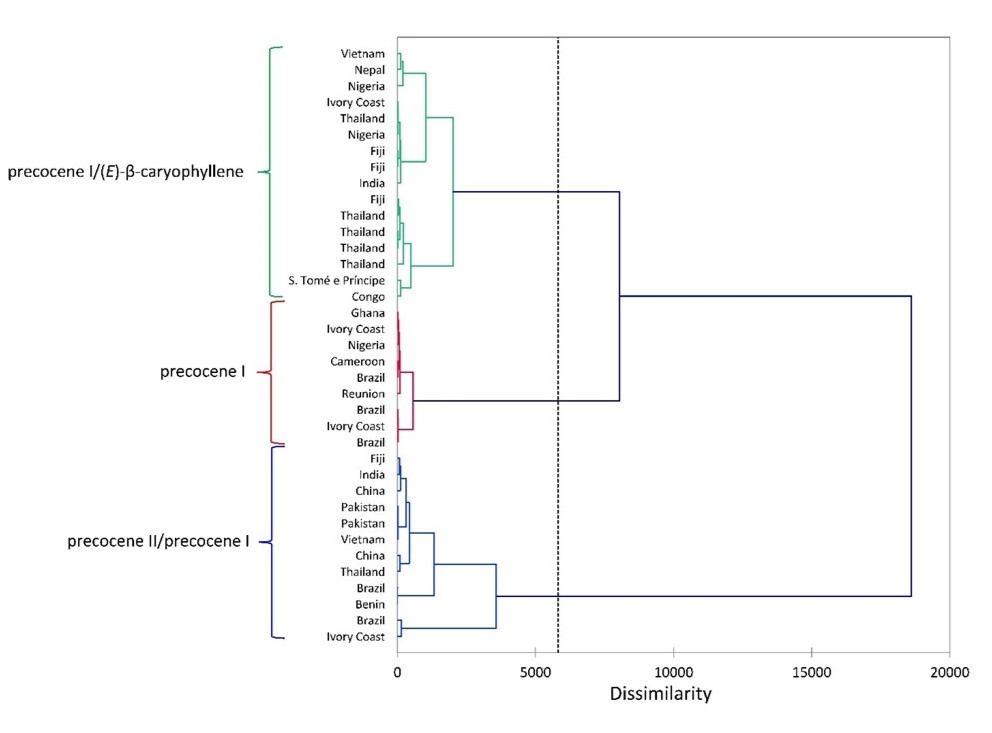
Figure 2. Dendrogram obtained by hierarchical cluster analysis (HCA) based on the essential oil compositions of Ageratum conyzoides.
Ageratum houstonianum Mill. The essential oils of A. houstonianum are dominated by precocene I (6-demethoxyageratochromene), precocene II (ageratochromene), and (E)-β-caryophyllene (Table 6).
Table 5. Chemical compositions of Ageratum fastigiatum essential oils.
Geographical location | Plant tissue | Major components (> 5%) | Ref. |
Diamantina, Minas Gerais, Brazil | Aerial parts | 1,6-Humuladien-3-ol (17.7%), caryophyllene oxide (13.6%), humulene epoxide II (8.4%), α-pinene (7.5%), limonene (5.9%) | [126] |
Rio Paranaíba, Minas Gerais, Brazil | Leaves | Germacrene D (42.1%), (E)-β-caryophyllene (13.3%), α-pinene (10.6%), α-humulene (9.5%) | [11] |
São João Del-Rei, Minas Gerais, Brazil | Leaves | Germacrene D (20.0%), (E)-β-caryophyllene (19.6%), 1,10-di-epi-cubenol (15.4%), nonadecane (14.6%) | [127] |
São João Del-Rei, Minas Gerais, Brazil | Stems | (E)-β-Caryophyllene (34.9%), germacrene D (26.5%), α-humulene (9.6%), 1,10-di-epi-cubenol (5.9%) | [127] |
São João Del-Rei, Minas Gerais, Brazil | Leaves | Germacrene D (24.2%), α-humulene (11.2%), β-cedrene (10.6%), α-pinene (9.5%), δ-cadinene (7.0%), α-muurolene (5.7%) | [128] |
Diamantina, Minas Gerais, Brazil | Flowers | α-Pinene (41.2%), limonene (16.5%), germacrene D (8.23%), (E)-β-caryophyllene (5.8%), β-pinene (5.0%) | [129] |
Diamantina, Minas Gerais, Brazil | Leaves | α-Pinene (51.3%), limonene (17.2%), germacrene D (9.1%) | [129] |
Table 6. Chemical compositions of Ageratum houstonianum essential oils.
Geographical location | Plant tissue | Major components (> 5%) | Ref. |
Palampur, Himachal Pradesh, India | Aerial parts | Precocene II (42.2%), precocene I (18.7%), (E)-β-caryophyllene (15.6%) | [130] |
Jammu region, India | Aerial parts | Precocene II (44.0%), precocene I (23.3%), (E)-β-caryophyllene (9.2%) | [131] |
Giza, Egypt | Flowers | Precocene I (34.6%), precocene II (29.7%), (E)-β-caryophyllene (13.6%), (E)-β-farnesene (10.2%) | [132] |
Giza, Egypt | Leaves | (E)-β-Caryophyllene (63.9%), precocene I (22.4%), precocene II (10.9%) | [132] |
Palampur, India | Aerial parts | Precocene II (52.6%), precocene I (22.5%), (E)-β-caryophyllene (9.7%) | [133] |
Lishui City, Zhejiang Province, China | Aerial parts | Precocene II (62.7%), precocene I (13.2%), (E)-β-caryophyllene (7.9%) | [134] |
Bafoussam region, Cameroon | Leaves | Precocene I (32.0%), (E)-β-caryophyllene (27.5%), precocene II (24.0%) | [106] |
Dschang, Cameroon | Flowers | Precocene I (48.0%), precocene II (36.6%), (E)-β-caryophyllene (8.4%) | [12] |
Shobra El-Khema, Egypt | Aerial parts | Precocene II (48.8%), (E)-β-caryophyllene (20.8%), caryophyllene oxide (11.8%), (γ-cadinene (9.4%) | [135] |
Pantnagar, Uttarakhand, India | Aerial parts | Precocene II (32.0%), (E)-β-caryophyllene (23.1%), precocene I (8.5%), (E)-β-farnesene (6.5%) | [5] |
3.1.5. Ainsliaea DC.
Essential oil compositions of Ainsliaea aptera DC. [136], Ainsliaea fragrans Champ. ex Benth. [137], and Ainsliaea pertyoides Franch. [138] have been reported. Essential oils from the aerial parts of A. aptera from two different sites in Uttarakhand state, India, showed the sesquiterpenoids germacrene D (14.6%, 3.2%), bicyclogermacrene (10.2%, 3.3%), δ-cadinene (4.2%, 6,9%), spathulenol (11.6%, 3.0%), τ-muurolol (7.6%, 10.8%) and α-cadinol (13.8%, 19.5%) to be the major components. Phenylpropanoids dominated the essential oil of A. fragrans aerial parts from Zhejiang Province, China, with myristicin (41.3%), elemicin (11.9%), and (Z)-isosafrole (11.5%), along with borneol (9.1%) and (E)-β-caryophyllene (8.8%). The major components of the essential oil from fresh aerial parts of A. pertyoides from Yunnan Province, China, were (E)-β-caryophyllene (24.5%), trans-β-elemene (16.3%), germacrene B (10.5%), α-guaiene (7.2%), and (E)-nerolidol (6.3%).
3.1.6. Artemisia L.
The essential oils of Artemisia have been reviewed [3, 18, 139, 140]. Therefore, this report summarizes the recent compositions of Artemisia essential oils.
Artemisia absinthium L. has been the subject of numerous essential oil investigations. Several reviews have been conducted on A. absinthium essential oils and their bioactivities [141–144]. A hierarchical cluster analysis of 190 accessions from the literature, based on the major essential oil components, reveals at least three different chemotypes (Fig. 3): (1) a cluster dominated by sabinyl acetate, (2) a β-thujone-rich cluster, and (3) a 6,7-epoxyocimene cluster, which is consistent with that previously reported by Chialva and co-workers [145].
Artemisia abyssinica Sch. Bip. ex A. Rich. The plant is native to Chad, Eritrea, Ethiopia, Saudi Arabia and Yemen [146]. The essential oils of A. abyssinica have been analyzed and reported in Ethiopia and Yemen (Table 7). The essential oils from Yemen are rich in camphor and davanone, whereas those from Ethiopia are dominated by yomogi alcohol and artemisyl acetate.
Artemisia annua L. The chemical compositions of A. annua essential oils has been extensively reviewed [151–154]. Essential oils are generally complex and variable in composition, depending on geographical location and growing conditions. However, the major components are often artemisia ketone, 1,8-cineole, and camphor (Fig. 4). For
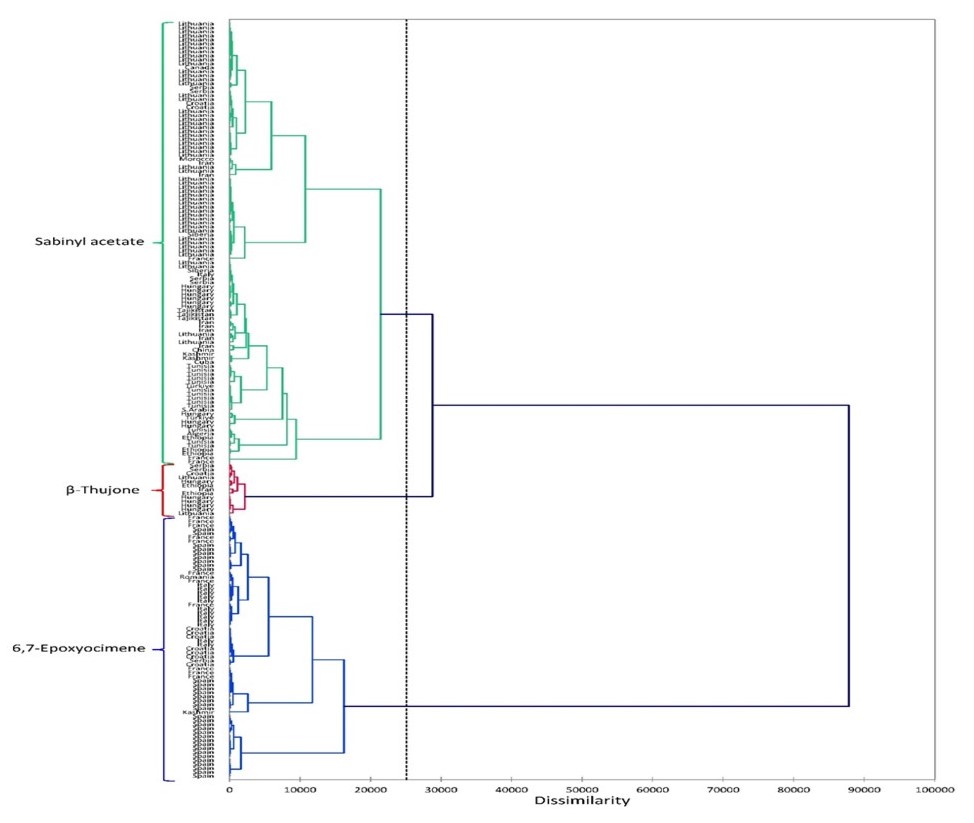
Figure 3. Dendrogram obtained by hierarchical cluster analysis (HCA) based on the essential oil compositions of 190 accessions of Artemisia absinthium.
Table 7. Chemical compositions of Artemisia abyssinica essential oils.
Geographical location | Plant tissue | Major components (> 5%) | Ref. |
Sana’a, Yemen | Aerial parts | Davanone (42.3%), camphor (22.9%), (E)-nerolidol (9.0%) | [147] |
Alhodiadah, Yemen | Aerial parts | Camphor (42.5%), davanone (32.3%), cis-sabinene hydrate (5.8%) | [148] |
Sana’a, Yemen | Aerial parts | Camphor (42.1%), davanone (34.5%) | [148] |
Taiz, Yemen | Aerial parts | Davanone (49.4%), camphor (29.6%), (E)-nerolidol (5.1%) | [148] |
Addis Ababa, Ethiopia | Aerial parts | Yomogi alcohol (32.2%), artemisyl acetate (26.7%), nonanone (6.4%) | [149] |
Inchini, Ethiopia | Leaves | Yomogi alcohol (38.5%), artemisyl acetate (24.9%), artemisia alcohol (6.7%) | [150] |
example, the major components in the floral essential oil of A. annua from Rasht, Iran, were camphor (13,1%), artemisia ketone (11.8%), β-selinene (10.7%), pinocarvone (7.4%), 1,8-cineole (6.8%), α-pinene (5.9%), and caryophyllene oxide (5.4%) [155], while the essential oil from the aerial parts growing in Tajikistan were rich in camphor (32.5-58.9%), 1,8-cineole (13.7-17.8%), and camphene (4.5-8.4%) [156]. In contrast, the essential oil from the aerial parts of Belgrade, Serbia, was dominated by pinocarvone (29.4%) and artemisia ketone (19.2%) [157].
Artemisia arborescens L. The natural range of A. arborescens is along the Mediterranean coastal strips of Portugal, Spain, Italy, Greece, Morocco, Algeria, Tunisia, Libya, and Türkiye, as well as along the Tyrrhenian and Adriatic coasts, 0-1000 m asl [158]. At least four chemotypes of A. arborescens have been identified based on their essential oil compositions (Table 8): chamazulene β-thujone camphor/chamzulene and β-thujone/chamazulene types [159, 160]. A notable exception is the essential oil sample from Yemen, which was dominated by artemisia ketone (51.1%) [147].
Artemisia campestris L. This plant has a broad natural range in the northern hemisphere, including North Africa, temperate Asia, Europe, and North America [33, 179]. It is a complex species, composed of many races, and its taxonomy is still unclear. The essential oils of A. campestris have exhibited several chemotypes, that are generally correlated with geographical location, environmental conditions, or subspecies (Table 9) [180–182].
Artemisia capillaris Thunb. The plant is native to Assam, China North-Central, China South-Central, China Southeast, Hainan, Inner Mongolia, Irkutsk, Japan, Korea, Manchuria, Mongolia, Nansei-shoto, Pakistan, Primorye, Qinghai, Tibet, West Himalaya, Xinjiang, and has been introduced into Afghanistan, Borneo, Cambodia, India, Java, Lesser Sunda Islands, Malaya, Myanmar, Nepal, Philippines, Sulawesi, Sumatera, Taiwan, Thailand, and Vietnam [206]. The major essential oil components of A. capillaris are summarized in Table 10.
Artemisia dracunculus L. The essential oil chemistry of A. dracunculus has been recently reviewed [26,213]. Commercially important French tarragon essential oil is rich in estragol (69.0-84.0%) [214]. The essential oil compositions of A. dracunculus are highly variable and several chemotypes have been described [213, 215], including ocimene, α-terpinene, capillene, methyl eugenol, (Z)-artemidin, and estragole chemotypes, as well as a mixed (sabinene/elemicin/estragole/capillene/anethole) chemotype. The recent A. dracunculus essential oil compositions are summarized in Table 11.
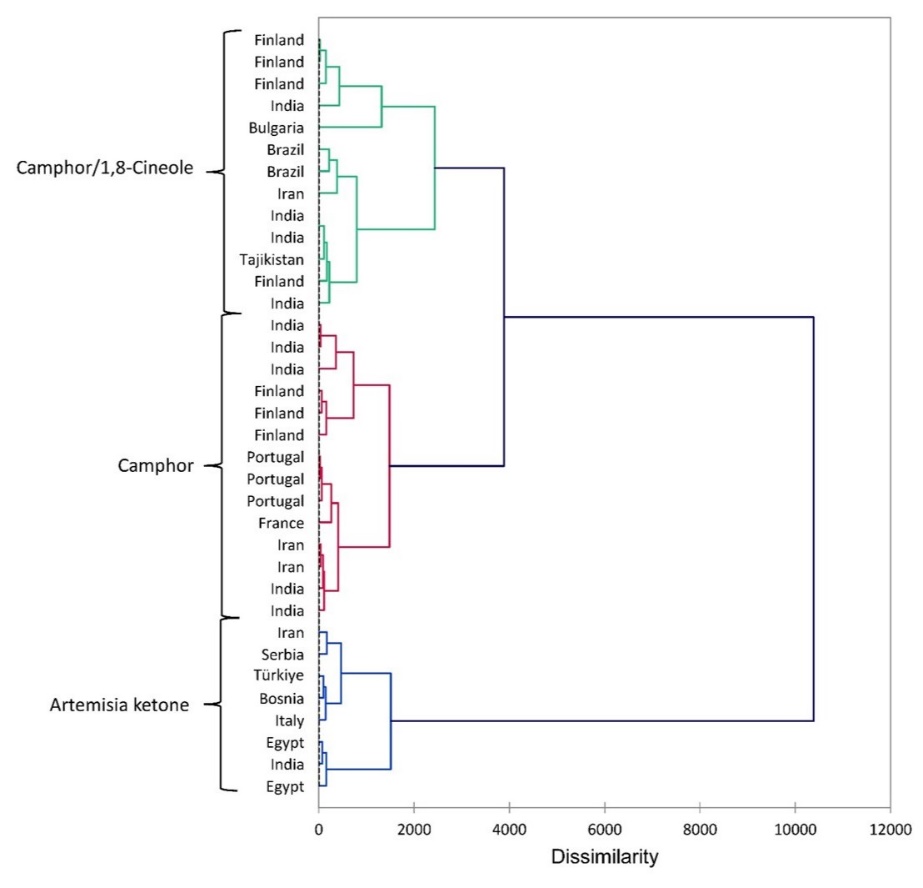
Figure 4. Dendrogram obtained by hierarchical cluster analysis (HCA) based on the essential oil compositions of 37 accessions of Artemisia annua.
Table 8. Chemical compositions of Artemisia arborescens essential oils.
Geographical location | Plant tissue | Major components (> 5%) | Ref. |
Amizour, Algeria | Leaves | Chamazulene (31.4%), β-thujone (28.9%), β-eudesmol (8.4%), catalponol (5.7%) | [161] |
Cap Bouak, Algeria | Leaves | β-Thujone (59.8%) | [161] |
Sahel, Algeria | Leaves | Camphor (58.7%), β-thujone (12.0%) | [161] |
Algeria | Aerial parts | Chamazulene (30.2%), β-thujone (27.8%), β-eudesmol (8.1%), catalponol (5.5%) | [162] |
Sana’a, Yemen | Aerial parts | Artemisia ketone (51.1%), camphor (14.1%), α-bisabolol (12.6%) | [147] |
Southwestern Tunisia | Not indicated | Chamazulene (31.9%), camphor (25.8%), bornyl acetate (7.7%), terpinen-4-ol (5.1%) | [163] |
Messina, Italy | Aerial parts | Chamazulene (51.8%), camphor (14.8%), β-thujone (6.9%), myrcene (5.1%) | [164] |
Ras al Biyyada, Lebanon | Aerial parts | β-Thujone (68.5%), chamazulene (12.3%) | [165] |
Budva, Montenegro | Aerial parts | Chamazulene (38.3%), (E)-β-caryophyllene (15.6%), camphene (7.1%), camphor (6.4%), α-pinene (5.7%) | [157] |
Stari Ulcinj Island, Montenegro | Aerial parts | Camphor (39.5%), β-thujone (28.6%) | [157] |
Usellus, Sardinia | Aerial parts | Camphor (35.7%), β-thujone (24.0%), chamazulene (7.7%) | [166] |
Sicily, Italy | Leaves | β-Thujone (33.7%), chamazulene (26.6%), camphor (6.7%) | [167] |
Armenoi, Crete | Aerial parts | Chamazulene (59.3%), camphor (20.7%), β-thujone (6.2%) | [168] |
North-western Sicily | Aerial parts | β-Thujone (45.0%), chamazulene (22.7%), camphor (6.8%) | [169] |
Petru, Sicily | Aerial parts | Chamazulene (49.4%), β-thujone (20.5%) | [159] |
Diga, Sicily | Aerial parts | β-Thujone (49.5%), chamazulene (24.9%) | [159] |
Felice, Sicily | Aerial parts | β-Thujone (55.9%), chamazulene (15.2%), myrcene (5.1%) | [159] |
Arte, Sicily | Aerial parts | β-Thujone (44.0%), chamazulene (15.7%), myrcene (5.4%) | [159] |
Venti, Sicily | Aerial parts | β-Thujone (41.7%), chamazulene (18.5%), myrcene (6.8%) | [159] |
Marathon, Athens, Greece | Aerial parts | β-Thujone (28.6%), nonanal (10.0%), chamazulene (9.9%), myroxide (9.0%) | [170] |
La Maddalena, Sardinia | Aerial parts | Chamazulene (51.5%), β-thujone (38.0%) | [171] |
Ventimiglia, Italy | Aerial parts | β-Thujone (24.2%), camphor (18.9%), aromadendrene (6.5%), camphene (6.0%), 8-cedren-13-ol (5.2%) | [172] |
Sicily, Italy | Leaves | Chamazulene (37.6%), camphor (21.4%) | [173] |
Calabria Island, Italy | Leaves | Camphor (39.5%), chamazulene (27.1%) | [173] |
Lipari Island, Italy | Leaves | Chamazulene (34.6%), camphor (20.1%), β-thujone (6.6%) | [173] |
Ain Drahem, Tunisia | Leaves | Camphor (57.3%), chamazulene (14.0%), linalool (5.8%), terpinen-4-ol (5.3%) | [174] |
Oued Meliz, Tunisia | Leaves | Camphor (30.4%), chamazulene (15.3%), linalool (10.6%), trans-sabinene hydrate (7.1%), terpinen-4-ol (6.5%), bornyl acetate (5.0%) | [174] |
Fernana, Tunisia | Leaves | Camphor (38.9%), chamazulene (26.2%), terpinen-4-ol (9.6%), bornyl acetate (7.1%), linalool (5.3%) | [174] |
Jendouba, Tunisia | Leaves | Camphor (58.1%), chamazulene (18.5%), terpinen-4-ol (13.1%) | [174] |
Elkef, Tunisia | Leaves | Camphor (29.4%), chamazulene (17.1%), terpinen-4-ol (14.4%), linalool (7.3%) | [174] |
Beja, Tunisia | Leaves | Chamazulene (33.1%), camphor (25.7%), bornyl acetate (9.5%), terpinen-4-ol (6.9%) | [174] |
Thala, Tunisia | Leaves | Camphor (36.0%), chamazulene (29.8%) | [174] |
Kasserine, Tunisia | Leaves | Camphor (31.6%), chamazulene (16.5%), bornyl acetate (11.3%), germacrene D (7.1%) | [174] |
Gafsa, Tunisia | Leaves | Chamazulene (28.4%), camphor (24.0%), β-thujone (11.3%), bornyl acetate (8.0%), trans-sabinene hydrate (6.5%) | [174] |
Mateur, Tunisia | Leaves | Chamazulene (45.3%), camphor (36.3%), terpinen-4-ol (5.7%) | [174] |
Menzel Bourguiba, Tunisia | Leaves | β-Thujone (36.5%), chamazulene (17.2%), camphor (15.1%) | [174] |
Bizerte, Tunisia | Leaves | β-Thujone (35.0%), camphor (22.8%), chamazulene (20.7%), terpinen-4-ol (5.5%) | [174] |
Zaghouan, Tunisia | Leaves | Camphor (47.0%), chamazulene (11.7%), β-thujone (7.9%) | [174] |
Bouficha, Tunisia | Leaves | Camphor (28.5%), chamazulene (27.0%), bornyl acetate (16.0%) | [174] |
Cultivated, Tunisia | Leaves | Chamazulene (47.0%), camphor (24.9%), myrcene (5.5%) | [175] |
Capo Zafferano, Sicily | Aerial parts | Chamazulene (51.7%), β-thujone (13.5%), camphor (10.0%) | [160] |
Alimena, Sicily | Aerial parts | Chamazulene (55.4%), β-thujone (34.4%) | [160] |
Lami, Lipari Island, Italy | Aerial parts | Camphor (65.6%), chamazulene (14.9%) | [160] |
Acqua Calda, Lipari Island, Italy | Aerial parts | Chamazulene (63.0%), camphor (21.5%) | [160] |
Bechar, Algeria | Aerial parts | β-Thujone (27.0%), camphor (25.7%), chamazulene (13.8%), terpinen-4-ol (7.7%) | [176] |
Ain Sefra, Algeria | Aerial parts | β-Thujone (71.3%) | [176] |
Capo Zafferano, Sicily | Aerial parts | Chamazulene (43.1%), β-thujone (19.6%), camphor (8.8%) | [176] |
Termini Imerese, Sicily | Aerial parts | Chamazulene (36.8%), β-thujone (19.9%), camphor (8.7%) | [176] |
Chania, Crete | Aerial parts | Camphor (30.5%), β-thujone (18.4%), chamazulene (15.7%), iso-bornyl acetate (8.0%) | [177] |
Commercial (Anyang, Korea) | Not indicated | β-Thujone (43.7%), camphor (22.9%), myrcene (7.2%) | [6] |
Beni Snous, Algeria | Aerial parts | Camphor (72.2%) | [178] |
Bidar, Algeria | Aerial parts | Camphor (50.3%), myrcene (7.4%), terpinen-4-ol (6.1%_ | [178] |
Chetouane, Algeria | Aerial parts | Camphor (32.8%), terpinen-4-ol (8.9%), chamazulene (8.7%) | [178] |
Table 9. Chemical compositions of Artemisia campestris essential oils.
Geographical location | Plant tissue | Major components (> 5%) | Ref. |
A. campestris L. (subspecies not identified) | |||
Bengardane, Tunisia | Aerial parts | β-Pinene (49.8%), α-pinene (9.1%), limonene (8.4%), γ-terpinene (5.2%) | [183] |
Benikhdache, Tunisia | Aerial parts | β-Pinene (45.8%), α-pinene (12.5%), limonene (7.7%) | [183] |
Jerba, Tunisia | Aerial parts | β-Pinene (36.4%), α-pinene (9.7%), p-cymene (8.0%), limonene (5.8%) | [183] |
Tataouine, Tunisia | Aerial parts | β-Pinene (37.8%), α-pinene (10.4%), limonene (9.3%), γ-terpinene (5.5%) | [183] |
Beni-Khedache, Tunisia | Aerial parts | β-Pinene (34.2%), limonene (8.2%), germacrene D (7.3%), γ-terpinene (6.1%), myrcene (6.0%), α-pinene (5.3%) | [184] |
Lmarija, Morocco | Aerial parts | Camphor (19.0%), car-3-en-5-one (11.3%), thujone (6.6%, isomer not indicated), chrysanthenone (6.2%) | [185] |
Gafsa, Tunisia | Aerial parts | β-Pinene (33.0%), limonene (15.1%), α-pinene (12.3%), γ-terpinene (7.6%), myrcene (5.5%) | [186] |
Salah Bey, Algeria | Aerial parts | β-Pinene (15.2%), α-pinene (11.2%), myrcene (10.3%), germacrene D (9.0%), (Z)-β-ocimene (8.1%), γ-curcumene 6.4%) | [187] |
Djebel Amour, Algeria | Leaves | β-Pinene (25.6%), sabinene (17.0%), α-pinene (9.9%), limonene (6.6%) | [188] |
Boussaada, Algeria | Aerial parts | α-Terpinyl acetate (18.8%), α-pinene (18.4%), camphor (9.2%), camphene (7.7%), limonene (5.2%), borneol (5.2%) | [189] |
Vojvodina, Serbia | Aerial parts | Spathulenol (9.2%), β-pinene (9.1%) | [190] |
Tajerouine, Le Kef, Tunisia | Leaves | β-Pinene (35.0%), 1,8-cineole (14.4%), p-cymene (10.9%), α-pinene (8.1%) | [191] |
Djelfa Wilaya, Algeria | Aerial parts | (Z,E)-Farnesol (10.3%), cedrol (5.4%) | [192] |
Oued Moura, Algeria | Aerial parts | α-Pinene (18.7%), myrcene (17.3%), β-pinene (16.8%), germacrene D (10.3%), limonene (5.9%) | [193] |
Ćemovsko polje, Montenegro | Aerial parts | Germacrene D (24.2%), bicyclogermacrene (14.7%), γ-himachalene (12.6%), β-pinene (9.1%) | [157] |
Zintan, Libya | Aerial parts | β-Pinene (46.4%), α-pinene (6.8%), p-cymene (6.1%), limonene (5.4%) | [157] |
Hassi Bahbah, Djelfa, Algeria | Leaves | Camphor (42.0%), chrysanthenone (14.0%), 1,8-cineole (13.3%), β-thujone (7.0%) | [194] |
Near Tendrara, Morocco | Aerial parts | p-Cymene (17.3%), spathulenol (16.8%),β-pinene (15.6%), α-pinene (11.4%), α-campholenal (8.8%) | [195] |
Central Tunisia | Leaves | β-Pinene (32.0%), limonene (17.3%), α-pinene (11.4%), myrcene (6.0%), γ-terpinene (5.5%) | [196] |
Kasserine, Tunisia | Aerial parts | β-Pinene (11.6%), β-eudesmol (6.5%), α-pinene (5.9%), γ-terpinene (5.5%) | [197] |
North Tunisia | Aerial parts | Germacrene D (30.5%), β-pinene (16.8%), limonene (7.0%), β-eudesmol (6.6%), α-farnesene (5.0%) | [198] |
Tunisia | Aerial parts | Germacrene D (16.4%), β-pinene (16.3%), limonene (9.2%), p-cymene (6.6%) | [199] |
A. campestris subsp. campestris | |||
El Mergueb, Algeria | Aerial parts | β-Pinene (15.3%), limonene (6.6%), p-cymene (6.2%), germacrene D (6.2%), spathulenol (6.0%), α-pinene (5.4%), β-eudesmol (5.2%) | [200] |
Laghouat, Algeria | Aerial parts | Capillene (25.6%), α-pinene (9.1%), β-pinene (8.9%), p-cymene (8.1%), spathulenol (5.3%) | [182] |
Lithuania | Aerial parts | Caryophyllene oxide (8.4-38.8%), germacrene D (3.5-15.0%) | [180] |
Łodz, Poland | Aerial parts | Germacrene D (23.0%), β-pinene (13.9%), γ-humulene (7.5%), β-elemene (5.9%) | [201] |
A. campestris subsp. glutinosa (Gay ex Bess.) Batt. | |||
Laghouat, Algeria | Aerial parts | β-Pinene (26.9%), limonene (8.4%), γ-terpinene (5.0%) | [182] |
Djelfa, Algeria | Aerial parts | β-Pinene (32.8%%), limonene (9.2%), p-cymene (8.3%), α-pinene (7.5%), (γ-terpinene (5.4%) | [182] |
Figuig, Morocco | Aerial parts | Spathulenol (13.1%), β-pinene (11.9%), p-cymene (9.4%), α-pinene (7.3%) | [179] |
Camargue, southern France | Aerial parts | 1-Phenyl-2,4-pentadiyne (29.7%), capillene (22.3%), γ-terpinene (20.8%), methyl eugenol (6.6%) | [202] |
Tuzluca, Igdir, Türkiye | Leaves | Camphor (31.8%), 1,8-cineole (23.1%), α-thujone (16.8%), camphene (11.7%), | [203] |
Tamanrasset, Algeria | Aerial parts | β-Pinene 28.9%), p-cymene (13.4%), α-pinene (8.8%) | [204] |
A. campestris subsp. maritima (DC.) Arcang. | |||
Figueira da Foz, Portugal | Aerial parts | β-Pinene (54.5%), cadin-4-en-7-ol (9.5%), (Z)-β-ocimene (6.0%) | [205] |
Table 10. Chemical compositions of Artemisia capillaris essential oils.
Geographical location | Plant tissue | Major components (> 5%) | Ref. |
Milam Glacier, Uttarakhand, India | Leaves | Capillene (60.2%), γ-terpinene (11.1%) | [207] |
Jinan, Korea | Aerial parts | Capillene (32.7%, β-pinene (9.4%) | [208] |
Beijing, China | Aerial parts | β-Pinene (12.7%), germacrene D (8.4%), γ-terpinene (8.2%), (E)-β-caryophyllene (7.7%), 1,8-cineole (6.9%), (E)-β-farnesene (5.7%), (Z)-β-ocimene (5.3%) | [209] |
Uttarakhand, India | Aerial parts | Capillene (42.1%), (E)-β-caryophyllene (12.5%). Myrcene (9.2%), β-pinene (8.6%), p-cymene (6.8%), limonene (6.4%), (E)-β-ocimene (5.8%), γ-terpinene (5.3%) | [210] |
Jianguo, China | Aerial parts | Capillin (24.2%), β-pinene (12.1%), (E)-β-caryophyllene (5.2%) | [211] |
Jinan, Korea | Aerial parts | Acenaphthylene (37.9%), β-pinene (12.1%), 4-carene (10.6%), γ-curcumene (9.9%), (E)-β-caryophyllene (8.8%), germacrene D (5.9%) | [212] |
Table 11. Chemical compositions of Artemisia dracunculus essential oils.
Geographical location | Plant tissue | Major components (> 5%) | Ref. |
Cultivated, Kashan, Iran | Aerial parts | Estragole (81.9%) | [216] |
Cultivated, Black Sea, Russia | Aerial parts | Estragole (79.3%), (Z)-β-ocimene (11.9%), (E)-β-ocimene (6.8%) | [217] |
Cultivated (?), Taounate, Mernissa, Morocco | Aerial parts | Estragole (69.2%), (E)-β-ocimene (9.1%), (Z)-β-ocimene (7.9%), limonene (5.7%) | [218] |
Cultivated, Iran | Aerial parts | Estragole (81.6-88.1%) | [219] |
Commercial essential oil, Iran | Not indicated | Estragole (75.0%), (Z)-β-ocimene (8.3%), (E)-β-ocimene (7.8%) | [220] |
Cultivated, Tehran, Iran | Aerial parts | Estragole (64.9%), (Z)-β-ocimene (10.6%), (E)-β-ocimene (10.2%), p-cymene (5.4%), | [221] |
Cultivated, Iasi, Romania | Aerial parts | (E)-Isoelemicin (38.9%), methyl eugenol (23.4%), terpinen-4-ol (6.5%), carvacrol (5.0%) | [222] |
Wild-growing, Kukteppa village, Ziddi, Varzob rebion, Tajikistan | Aerial parts | Sabinene (29.1%), estragole (24.6%), limonene (7.8%) | [213] |
Wild-growing, southwestern Idaho | Aerial parts | Terpinolene (20.0%), 5-phenyl-1,3-pentadiyne (191.2%), capillene (13.8%), (Z)-β-ocimene (11.1%), methyl eugenol (8.7%), β-phellandrene (5.8%) | [223] |
Artemisia herba-alba Asso. Artemisia herba-alba is a perennial shrub that naturally grows in the dry steppes of the Iberian Peninsula and North Africa [224, 225]. The essential oil compositions of A. herba alba prior to 2017 have been summarized in previous studies [18, 139, 140, 226]. Recent reports on the essential oil compositions of A. herba alba are summarized in Table 12. Several chemotypes have been described based on the essential oil compositions, including α-thujone, β-thujone, camphor, davanone, chrysanthenone, pinocarvone, and 1,8-cineole [227, 228]. Based on the data in Table 12, there may be
several additional chemotypes (e.g., β-copaene, 2,6-dimethyl-1,3,5-heptatriene, chrysanthenyl acetate, and α-thujene).
Artemisia maritima L. Artemisia maritima is a perennial shrub, that grows to about 1 m tall, with a limited range. This plant has been reported in the cold desert regions of Afghanistan, Pakistan, and northwestern India, including Kashmir, Kurram, and Kishtwar [262, 263]. 1,8-Cineole, camphor, or chrysanthenone are the dominant volatile components (Table 13).
Artemisia monosperma Delile. The native range of A. monosperma is to North Africa (Libya, Egypt), eastern Mediterranean (Lebanon, Syria, Palestine), and the Arabian Peninsula (Gulf States, Kuwait, Oman, and Saudi Arabia) [33]. There are wide variations in the chemical compositions of the essential oils of A. monosperma (Table 14).
Artemisia nilagirica (C.B. Clarke) Pamp. Artemisia nilagirica is native to tropical Asia, including the Indian subcontinent, western Himalayas, and Indo-China [33]. The essential oils showed a wide variation in composition (Table 15).
Artemisia rutifolia Steph. ex Spreng. This plant has been reported in China, Mongolia, Middle Asia, and the Himalayas [33]. There are only a few reports on the essential oil compositions, but there are at least three different chemotypes (Table 16).
Artemisia scoparia Waldst. & Kit. The natural range of A. scoparia includes Europe, Asia, and the Middle East including Afghanistan, China, India, Japan, Korea, Pakistan, Russia, and Thailand; central and southwestern Asia; eastern, central, and southern Europe [33, 290]. There is a wide variation in the reported essential oil compositions of A. scoparia and there are likely numerous chemotypes of this species [291]. The recent chemical compositions of A. scoparia are listed in Table 17.
Table 12. Chemical compositions of Artemisia herba alba essential oils.
Geographical location | Plant tissue | Major components (> 5%) | Ref. |
Djelfa, Algeria | Aerial parts | Davanone (48.8%), chrysanthenone (16.0%), camphor (14.8%), 1,8-cineole (5.7%) | [229] |
Djelfa, Algeria | Leaves | Camphor (22.4%), 1,8-cineole (12.0%), α-thujone (8.2%), chrysanthenone (7.3%), β-thujone (5.4%) | [230] |
Amskrod, Morocco | Aerial parts | Chrysanthenone (56.8%), β-thujone (31.1%) | [231] |
Boulemane, Morocco | Aerial parts | α-Thujone (29.0%), β-thujone (28.6%), chrysanthenone (14.8%), 1,8-cineole (11.7%) | [232] |
Riyadh, Saudi Arabia | Aerial parts | Piperitone (44.6%), ethyl (E)-cinnamate (14.7%) | [226] |
Souk-Ahras, Algeria | Aerial parts | β-Copaene (16.2%), limonene (14.6%), 1,8-cineole (14.5%), camphor (13.7%), borneol (5.4%) | [233] |
Azzemour, Morocco | Aerial parts | α-Thujone (25.5%), β-thujone (17.7%), vanillyl alcohol (11.5%), nor-davanone (7.8%), cis-threo-davanafuran (5.8%) | [234] |
Taroudant, Morocco | Aerial parts | Chrysanthenone (39.7%), camphor (13.3%), α-thujone (12.9%), β-thujone (11.5%) | [229] |
Guelmim, Morocco | Aerial parts | α-Thujone (28.9%), borneol (22.3%), pulegone (14.4%), | [235] |
Bejaia, Algeria | Aerial parts | Camphor (32.0%), α-thujone (13.7%), 1,8-cineole (9.8%), β-thujone (5.0%) | [236] |
Ain Aghbal, Morocco | Aerial parts | Camphor (49.8%), (3E)-2,6-dimethyl-1,3,5-heptatriene (18.3%), α-thujone (13.5%), camphene (6.1%) | [227] |
Tizi Lafaka, Morocco | Aerial parts | Camphor (53.7%), (3E)-2,6-dimethyl-1,3,5-heptatriene (12.0%), α-thujone (7.7%), camphene (6.1%), 1,8-cineole (5.8%), β-thujone (5.1%) | [227] |
Lakhtatba, Morocco | Aerial parts | Camphor (58.8%), borneol (9.9%), (3E)-2,6-dimethyl-1,3,5-heptatriene (9.6%), camphene (6.4%), 1,8-cineole (5.2%), | [227] |
Talezzarte, Morocco | Aerial parts | Camphor (59.8%), α-thujone (7.8%), camphene (7.0%), 1,8-cineole (5.2%) | [227] |
Bni Boufrah, Morocco | Aerial parts | α-Thujone (47.4%), camphor (10.1%), β-thujone (8.9%), borneol (5.2%) | [227] |
Boudnib, Morocco | Aerial parts | α-Thujone (75.4%), β-thujone (10.5%) | [227] |
Ighrem, Morocco | Aerial parts | Camphor (32.6%), davanone (12.3%), 1,8-cineole (8.8%), davana ether (6.4%), α-thujone (5.1%) | [227] |
Tata, Morocco | Aerial parts | α-Thujone (49.7%), camphor (30.7%), β-thujone (8.2%) | [227] |
Es-Smara, Morocco | Aerial parts | Davanone (41.4%), camphor (12.9%), 1,8-cineole (7.2%) | [227] |
Tlemcen, Algeria | Aerial parts | Camphor (32.3%), chrysanthenone (25.6%), camphene (10.3%), 1,8-cineole (8.4%) | [237] |
Bouilef, Algeria | Aerial parts | Camphor (50.5%), α-thujone (12.7%), β-thujone (10.0%), chrysanthenone (8.2%), 1,8-cineole (8.2%) | [238] |
Er-rich, Morocco | Aerial parts | Camphor (14.7%), chrysanthenone (14.1%), β-thujone (12.6%), α-thujone (9.2%), α-pinene (6.1%) | [239] |
Thala, Tunisia | Aerial parts | β-Thujone (23.9%), chrysanthenone (17.4%), α-thujone (10.3%), 1,8-cineole (9.8%), p-cymene (8.3%), terpinen-4-ol (5.2%) | [240] |
Jerada, Morocco | Aerial parts | (3E)-2,6-Dimethyl-1,3,5-heptatriene (36.4%), camphor (22.5%), thujonea (7.21%), 1,8-cineole (6.0%), (1,3-dimethyl-2-methylene-cyclopentyl)-methanolb (6.5%) | [241] |
Taourirt, Morocco | Aerial parts | Camphor (55.3%), 1,8-cineole (14.6%), camphene (10.0%) | [241] |
Karak, Jordan | Leaves | α-Pinene (17.2%), α-thujone (11.4%), 1,8-cineole (10.4%), sabinene (8.4%), (E)-β-caryophyllene (8.3%), β-pinene (6.2%), artemisia alcohol (5.2%), germacrene D (5.1%) | [242] |
Talsint, Morocco | Aerial parts | Davanone (38.3%), davana ether isomer 1 (9.9%), davana ether isomer 2 (8.3%), camphor (6.3%) | [243] |
Gueldaman, Morocco | Aerial parts | Camphor (46.6%), borneol (5.7%), 1,8-cineole (5.6%) | [244] |
Imizar-Azilal, Morocco | Aerial parts | Chrysanthenone (47.7%), cis-dihydro-β-terpineol (21.6%) | [245] |
Jelma, Tunisia | Aerial parts | β-Thujone (27.8%), camphor (22.7%), chrysanthenone (18.0%), α-thujone (13.6%) | [246] |
Al- Jabal Al-Akhder, Libya | Aerial parts | α-Thujone (63.1%), β-thujone (26.6%), camphor (5.8%) | [247] |
Taliouine, Morocco | Aerial parts | Camphor (55.4-57.4%), 1,8-cineole (8.3-8.4%). Camphene (6.9-8.8%), santolina alcohol (4.3-6.7%) | [248] |
Rabat, Morocco | Aerial parts | α-Thujone (65.0%), β-thujone (14.4%), camphor (6.0%) | [249] |
Guelma, Algeria | Aerial parts | Camphor (26.2%), chrysanthenone (12.4%), 1,8-cineole (8.0%), α-thujone (7.8%), β-thujone (7.8%) | [250] |
Fez-Boulemane, Morocco | Aerial parts | cis-Chrysanthenyl acetate (26.7-30.0%), β-thujone (12.9-23.2%), chrysanthenone (1.0-14.0%), 1,8-cineole (1.5-11.8%), trans-dihydro-β-terpineol (6.9-7.8%), α-thujone (3.1-5.4%) | [251] |
Djelfa, Algeria | Aerial parts | Camphor (37.5%), chrysanthenone (10.4%), 1,8-cineole (8.6%), α-thujone (7.0%), camphene (6.0%) | [252] |
Sidi Bel Abbess, Algeria | Aerial parts | Camphor (30.6%), (3E)-2,6-dimethyl-1,3,5-heptatriene (26.7%), safranal (7.0%) | [253] |
Agadir, Morocco | Aerial parts | β-Thujone (24.3%), camphor (22.2%), α-thujone (14.6%), 1,8-cineole (10.3%), camphene (7.6%) | [254] |
Boussâada, Algeria | Aerial parts | Chrysanthenone (24.1%), camphor (16.2%), α-thujone (12.8%), 1,8-cineole (5.6%) | [255] |
Taounate, Morocco | Aerial parts | Piperitone (85.7%) | [256] |
Bechar, Algeria | Aerial parts | α-Thujone (48.0%), β-thujone (13.4%), camphor (13.1%) | [257] |
Ouarzazate, Morocco | Flowers | β-Thujone (59.2%), camphor (18.4%), dehydrosabina ketone (10.0% | [258] |
Biskra, Algeria | Aerial parts | β-Thujone (51.2%), α-thujone (13.2%), camphor (8.8%), chrysanthenone (6.9%) | [259] |
Giza, Egypt | Aerial parts | α-Thujene (61.4%) | [260] |
Truel, Spain | Aerial parts | Camphor (29.8%), β-thujone (22.0%), 1,8-cineole (14.5%), α-thujone (10.8%) | [261] |
a Correct isomer was not indicated. b This structure is not found in the Dictionary of Natural Products [98], therefore, the identification is doubtful. | |||
Table 13. Chemical c compositions of Artemisia maritima essential oils.
Geographical location | Plant tissue | Major components (> 5%) | Ref. |
Keylong, Himachal Pradesh, India | Aerial parts | 1,8-Cineole (41.1%), bornyl acetate (18.1%), myrcene (9.6%), sabinene (6.4%) | [264] |
Western Himalayas, India | Aerial parts | 1,8-Cineole (23.8-44.2%), chrysanthenone (0.8-38.1%) | [265] |
Jhelum, Uttarakhand, India | Aerial parts | 1,8-Cineole (25.0%), chrysanthenone (23.6%), germacrene D (7.4%) | [266] |
Jhelum, Uttarakhand, India | Aerial parts | Chrysanthenone (25.7%), 1,8-cineole (23.6%), germacrene D (6.7%) | [267] |
Commercial sample, source not indicated | Not indicated | 1,8-Cineole (41.1%), camphor (20.3%) | [268] |
Keylong, Himachal Pradesh, India | Aerial parts | 1,8-Cineole (23.2%), camphor (20.7%), borneol (13.7%), bornyl acetate (13.2%) | [269] |
Lahaul-Spiti, Hamachal Pradesh, India | Aerial parts | Camphor (44.4%), 1,8-cineole (27.3%), camphene (5.5%) | [263] |
Lahaul valley, Himachal Pradesh, India | Aerial parts | 1,8-Cineole (38.9-49.9%), terpinen-4-ol (9.7-14.2%), bornyl acetate (8.0-13.5%), camphor (1.8-5.5%), myrcene (1.6-5.8%) | [270] |
Table 14. Chemical compositions of Artemisia monosperma essential oils.
Geographical location | Plant tissue | Major components (> 5%) | Ref. |
Ghat region, Saudi Arabia | Aerial parts | 7-epi-trans-Sesquisabinene hydrate (8.3-25.1%), dehydroaromadendrene (0.9-13.5%), junipene (3.5-6.3%), α-bulnesene (3.2-5.9%), 6-epi-shyobunol (1.9-10.4%), dehydrocyclolongifolene oxide (0.4-6.6%) | [271] |
Thumamah, Saudi Arabia | Aerial parts | 7-epi-trans-Sesquisabinene hydrate (6.1-20.4%), dehydroaromadendrene (9.5-15.0%), junipene (4.5-13.1%), 6-epi-shyobunol (9.1-13.4%), dehydrocyclolongifolene oxide (4.1-9.0%) | [271] |
Giham, Saudi Arabia | Aerial parts | 7-epi-trans-Sesquisabinene hydrate (7.9-19.0%), dehydroaromadendrene (9.8-11.3%), junipene (4.5-8.8%), 6-epi-shyobunol (9.6-10.1%), dehydrocyclolongifolene oxide (6.8-8.3%) | [271] |
Matrouh, Egypt | Leaves | Capillene (36.9%), capillin (14.7%), γ-terpinene (12.5%), β-pinene (7.9%) | [272] |
South Sinai, Egypt | Aerial parts | β-Pinene (20.7%), spathulenol (8.8%), limonene (7.5%), shyobunone (7.1%), citronellyl isovalerate (6.6%) | [273] |
Al Qalibah, Saudi Arabia | Aerial parts | 2-Vinylnaphthalene (24.9%), β-eudesmol (15.4%), β-pinene (11.9%), limonene (8.8%) | [273] |
Tobruk Desert, Libya | Aerial parts | Bornyl acetate (8.0-31.0%), β-pinene (9.0-24.0%), sabinene (13.2-22.9%), (E)-β-ocimene (3.7-12.9%), (Z)-β-ocimene (5.3-11.0%), myrcene (4.6-7.0%), p-cymene (1.1-11.2%), limonene (3.0-5.3%), α-pinene (1.1-6.2%) | [274] |
Gabal Ataka, Suez Desert, Egypt | Aerial parts | β-Pinene (56.4%), δ-cadinene (18.4%), α-pinene (6.8%), limonene (5.4%) | [275] |
New Damietta, Egypt | Aerial parts | γ-Eudesmol (14.7%), widdrol (7.6%), biphenyl (6.6%), β-pinene (6.4%), ar-curcumene (5.7%), viridiflorol (5.6%), 2-vinylnaphthalene (5.2%) | [276] |
Ha'il region, Saudi Arabia | Leaves | β-Pinene (29.9%), terpinolene (8.6%), bornyl acetate (7.6%), (E)-β-ocimene (7.1%), limonene (5.7%), cis-sabinene hydrate (5.3%) | [277] |
Cairo, Egypt | Aerial parts | Artemisia ketone (31.7%), camphor (16.9%), α-bisabolol (11.6%), β-phellandrene (10.2%) | [278] |
Table 15. Chemical compositions of Artemisia nilagirica essential oils.
Geographical location | Plant tissue | Major components (> 5%) | Ref. |
Pantnagar, Uttarakhand, India | Aerial parts | Artemisia ketone (62.6%) | [279] |
Milam glacier, Uttarakhand, India | Leaves | Artemisia ketone (55.1%), (E)-β-caryophyllene (6.5%), germacrene D (5.8%) | [280] |
Coimbatore, Tamilnadu, India | Aerial parts | Camphor (19.7%), caryophyllene oxide 13.9%), 1,8-cineole (9.2%), humulene epoxide II (7.3%), α-humulene (7.0%), (E)-β-caryophyllene (6.6%) | [281] |
Meghalaya, India | Aerial parts | Artemisia ketone (32.7%), artemisia alcohol (13.4%) | [282] |
Nilgris, Tamil Nadu, India | Aerial parts | α-Thujone (33.8%), germacrene D (9.3%), β-thujone (6.0%), (E)-β-caryophyllene (5.9%), caryophyllene oxide (6.2%) | [283] |
Pokhari-Nagnath, Uttarakhand, India | Aerial parts | α-Thujone (36.4%), β-thujone (9.4%), germacrene D (6.3%), terpinen-4-ol (6.3%), camphene (5.5%), (E)-β-caryophyllene (5.4%) | [284] |
Uttarakhand, India | Aerial parts | Linalool (16.3%), α-thujone (13.9%), (E)-β-caryophyllene (7.5%), germacrene D (7.1%), terpinen-4-ol (7.1%), | [210] |
Gorakhpur, India | Aerial parts | Camphor (22.8%), (E)-β-caryophyllene (16.7%), α-thujone (14.6%), sabinene (14.3%) | [285] |
Palampur, India | Aerial parts | Camphor (12.6%), artemisia ketone (10.2%), caryophyllene oxide (7.4%), 1,8-cineole (5.3%), borneol (5.3%) | [263] |
Table 16. Chemical compositions of Artemisia rutifolia essential oils.
Geographical location | Plant tissue | Major components (> 5%) | Ref. |
Kharkhiraa Mountain, Mongolia | Aerial parts | Santolina triene (22.4%), myrcene (21.8%), (E)-β-caryophyllene (7.2%), caryophyllene oxide (5.8%), p-mentha-1(7),8-diene (5.3%) | [286] |
Buryatia, Russia | Aerial parts | Benzylacetone (35.0%), camphor (16.7%), 1,8-cineole (16.5%) | [287] |
Khonaobod, Tajikistan | Aerial parts | β-Thujone (47.3%), α-thujone (20.9%) | [288] |
Chormaghzak, Tajikistan | Aerial parts | α-Thujone (36.6%), β-thujone (36.1%), 1,8-cineole (11.7%) | [288] |
Altai Mountain, Mongolia | Aerial parts | Benzylacetone (33.1%), camphor (22.4%), 1,8-cineole (19.1%) | [289] |
Table 17. Chemical compositions of Artemisia scoparia essential oils.
Geographical location | Plant tissue | Major components (> 5%) | Ref. |
Riyadh, Saudi Arabia | Aerial parts | 2-Nonanone (55.0%), 2-undecanone (24.5%), 2-nonyl acetate (9.3%) | [292] |
Mashhad, Iran | Aerial parts | Artemisia ketone (21.0-25.8%), camphor (11.9-16.4%), 1,8-cineole (12.4-13.7%), myrcene (9.5-13.3%), α-pinene (6.6-8.0%) | [293] |
Khovd aimag, Mongolia | Aerial parts | Capillene (20.8%), methyl eugenol (11.9%), eugenol (10.9%), spathulenol (11.8%), eugenyl 2-methylbutanoate (7.7%), ar-curcumene (5.9%) | [294] |
Hawal Bagh, Uttarakhand, India | Aerial parts | Capillene (28.8%), β-pinene (12.6%), α-terpinolene (12.5%), limonene (11.8%) (E)-β-caryophyllene (8.5%), (E)-β-ocimene (8.1%) | [295] |
Niška Banja, Serbia | Aerial parts | Capillene (63.8%), 2,4-pentadiynylbenzene (10.0%) | [296] |
Various locations, Serbia | Aerial parts | Capillene (33.6-67.9%), 2,4-pentadiynylbenzene (9.8-24.7%), β-pinene (4.7-16.9%), (Z)-β-ocimene (4.6-8.5%) | [297] |
Various locations, Pakistan | Aerial parts | Capillene (9.6-31.8%), myrcene (6.8-21.5%), γ-terpinene (9.2-19.5%), p-cymene (3.2-14.6%), limonene (4.4-14.1%), (E)-β-caryophyllene (0.8-12.4%), methyl eugenol (0.2-12.7%), (Z)-β-ocimene (2.8-7.4%), 2,4-pentadiynylbenzene (0.4-6.1%), | [298] |
Grocka, Serbia | Aerial parts | 1,8-Cineole (57.2%), β-thujone (34.5%) | [299] |
Tehran, Karaj, Iran | Aerial parts | β-Pinene (13.1-30.5%), 2,4-pentadiynylbenzene (7.9-22.0%), (Z)-β-ocimene (1.9-16.2%), bicyclogermacrene (7.9-10.5%), (E)-β-caryophyllene (6.0-7.5%) | [300] |
Chormaghzak, Yovon region, Tajikistan | Aerial parts | 2,4-Pentadiynylbenzene (34.2%), β-pinene (21.3%), methyl eugenol (5.5%), myrcene (5.2%), limonene (5.0%) | [291] |
Artemisia sieberi Besser. Artemisia sieberi grows naturally in Iran, Syria, Palestine, Iraq, Afghanistan, Turkey, and Central Asia [301]. The phytochemistry, including essential oil composition, and the antifungal activities of A. sieberi were reviewed in 2017 [302]. The predominant chemotypes were thujone, chrysanthenone, 1,8-cineole/camphor, and santolina alcohol, however, their compositions are subject to seasonal and geographical variations. Zare and co-workers examined the chemical compositions of 17 accessions from different geographical regions of Iran [303]. These workers identified five different chemotypes, namely thujane, davanone, menthane, bornane, and a chemotype based on irregular monoterpenoids. The recently published essential oil compositions are summarized in Table 18.
Table 18. Chemical compositions of Artemisia sieberi essential oils.
Geographical location | Plant tissue | Major components (> 5%) | Ref. |
Riyadh, Saudi Arabia | Aerial parts | Davanone (36.1%), camphor (24.1%), terpinen-4-ol (5.4%), (E)-nerolidol (5.0%) | [292] |
Hail, Saudi Arabia | Aerial parts | cis-Chrysanthenyl acetate (48.6%), davanone (10.3%), 1,8-cineole (6.8%), caryophyllene diepoxide (5.3%) | [304] |
Bandar Abbas, Iran | Fruits | Camphor (47.0%), 1,8-cineole (20.9%) | [305] |
Shabestar-Eeat, Iran | Aerial parts | Camphor (33.6%), 1,8-cineole (25.7%), camphene (15.7%), chrysanthenone (7.9%) | [306] |
Geno Mountain, Bandar Abbas, Iran | Aerial parts | 1,8-Cineole (48.7%), camphor (32.7%) | [307] |
Ardabil, Iran | Leaves | Camphor (19.5%), β-thujone (17.4%), 1,8-cineole (16.3%), germacrene D (8.4%), terpinen-4-ol (5.1%) | [301] |
Commercial sample, Kashan, Iran | Not indicated | α-Thujone (38.2%), santolinyl acetate (23.8%), β-thujone (11.3%), camphor (6.3%) | [308] |
Arak, Iran | Aerial parts | α-Thujone (31.5%), camphor (12.3%), β-thujone (11.9%), 1,8-cineole (10.1%), camphene (8.7%) | [309] |
Qom, Iran | Aerial parts | Camphor (25.2%), 1,8-cineole (6.3%), α-terpineol (6.2%), sabinene (5.2%) | [310] |
Artemisia vulgaris L. The plant is native to Eurasia, but is now established in the eastern North America, Central America, and Colombia [33]. The volatile phytochemistry of A. vulgaris has been extensively reviewed [3, 18, 139, 140, 311–313]. Judzentiene and Budiene carried out an extensive study of A. vulgaris essential oils throughout Lithuania [314]. These workers were able, to define six chemotypes based on the compositions: I, a cis-chrysanthenyl chemotype; II, an artemisia ketone chemotype; III, a sabinene chemotype; IV, a 1,8-cineole chemotype; V, a sabinene/cis-chrysanthenyl acetate chemotype; and VI, a camphor chemotype. In addition, Haider and co-workers [315] examined A. vulgaris essential oils from various locations in Uttarakhand Himalaya, India, and identified three chemotypes: vulgarole, artemisia ketone, and thujone chemotypes. Recent reports on the essential oil compositions of A. vulgaris are summarized in Table 19. A perusal of Table 19 reveals at least one additional chemotype: germacrene D/(E)-β-caryophyllene. The essential oil compositions of several Artemisia species are summarized in Table 20.
3.1.7. Aster L.
Aster is a genus comprising approximately 250 species growing throughout the northern hemisphere [33]. Despite the large number of species in this genus, only a few have been analyzed for their essential oil composition (Table 21).
3.1.8. Baccharis L.
Baccharis is a large genus in the Asteraceae comprising around 480 species, native to the Americas, but several have been introduced to Africa, Asia, Australia, and Europe [33, 355]. Several Baccharis species have been investigated for their essential oils and the essential oil phytochemistry, including the biological activities, of Baccharis has been reviewed [356–360]. The essential oils of Baccharis dracunculifolia DC. (Table 22), Baccharis punctulata DC. (Table 23), and Baccharis trimera (Less.) DC. (syn. Baccharis genistelloides subsp. crispa (Spreng.) Joch. Müll.) (Table 24) have been extensively investigated. In addition, recent and complementary aspects of Baccharis essential oil compositions are presented in Table 25. It is obvious that there is much variation in the compositions both Baccharis species and within Baccharis species. Nevertheless, the data suggest opportunities for additional research into the biological activities and potential medicinal applications of essential oils from various Baccharis species.
Table 19. Chemical compositions of Artemisia vulgaris essential oils.
Geographical location | Plant tissue | Major components (> 5%) | Ref. |
Zeytinburnu Medicinal Plants Garden, İstanbul, Türkiye | Aerial parts | α-Thujone (30.7-47.1%), (E)-β-caryophyllene (7.9-22.1%), 1,8-cineole (6.8-9.6%), β-thujone (6.3-9.1%), germacrene D (2.6-8.2%) | [316] |
Urumqi, China | Aerial parts | cis-Sabinol (15.2%), trans-sabinyl acetate (11.1%), 1,8-cineole (10.9%), trans-piperitol (8.4%), trans-sabinene hydrate (6.2%) | [317] |
Northwestern Lithuania | Aerial parts | Germacrene D (10.6-30.5%), (E)-β-caryophyllene (3.3-16.7%), 1,8-cineole (2.7-9.8%), caryophyllene oxide (4.1-9.3%), α-humulene (2.8-5.5%) | [318] |
Pauri region, Uttarakhand, India | Aerial parts | Camphor (10.8%), β-eudesmol (9.0%), (E)-β-caryophyllene (6.5%), borneol (6.5%), bornyl acetate (6.3%) | [319] |
Sao Luís, Maranhão, Brazil | Aerial parts | (E)-β-Caryophyllene (37.5%), germacrene D (16.2%), α-humulene (13.7%), borneol (6.8%), caryophyllene oxide (5.7%) | [320] |
Pasighat, Arunachal Pradesh, India | Leaves | 1,8-Cineole (16.8%), camphor (11.9%), isopulegol (9.4%), borneol (8.1%) | [321] |
Timisoara, Romania | Aerial parts | Terpinen-4-ol (18.2%), spathulenol (12.1%), τ-muurolol (11.8%), palmitic acid (11.2%), α-terpineol (10.0%), caryophyllene oxide (8.5%), cuminol (7.2%) | [220] |
Karaj, Iran | Aerial parts | Camphor (30.6-49.9%), 1,8-cineole (17.5-31.2%), camphene (6.1-10.9%) | [300] |
Hetauda Makwanpur, Nepal | Aerial parts | α-Thujone (30.5%), 1,8-cineole (12.4%), camphor (10.3%), β-thujone 7.1%) | [322] |
Manipur, India | Leaves | 1,8-Cineole (29.9%), sabinene (8.4%), borneol (8.2%), 2,7-dimethyl-2,6-octadien-4-ol (6.8%), 10-epi-γ-eudesmol (6.5%) | [323] |
Wuhan, China | Leaves | 1,8-cineole (46.5%), borneol (10.2%), piperitol (9.5%), α-cadinene (8.9%), camphor (6.2%), α-humulene (5.5%) | [324] |
Table 20. Chemical compositions of Artemisia essential oils.
Artemisia species | Geographical location | Plant tissue | Major components (> 5%) | Ref. |
Artemisia anethoides Mattf. | Gansu province, China | Leaves | 1,8-Cineole (36.5%), 2-isopropyl-5-methyl-3-cyclohexen-1-one (10.4%), terpinen-4-ol (8.6%), o-cymene (6.2%), pinocarveol (5.1%) | [325] |
Artemisia aragonensis Lam. (syn. Artemisia herba alba Asso) | Morocco | Aerial parts | β-Thujone (29.0%), camphor (14.7%), octacosane (14.0%) | [7] |
Artemisia brachyloba Franch. | Shanxi province, China | Aerial parts | α-Terpineol (21.7%), davabibe (10.7%), 1,8-cineole (6.2%) | [326] |
Artemisia douglasiana Besser | Santa Barbara, California, USA | Leaves | Camphor (29.0%), artemisia ketone (26.1%), artemisia alcohol (13.2%), α-thujone (9.7%), 1,8-cineole (7.5%), hexanal (5.3%) | [327] |
Artemisia dubia Wall. ex Besser | Kirtipur, Kathmandu, Nepal | Leaves | Chrysanthenone (29.0%), coumarin (18.3%), camphor (16.4%), verbenone (5.2%) | [322] |
Artemisia eriopoda Bunge. | Xiaolongmeng National Forest Park, China | Aerial parts | Germacrene D (21.6%), 1,8-cineole (14.2%), δ-elemene (8.0%), sabinene (7.8%) | [328] |
Artemisia frigida Willd. | Hohhot, Mongolia | Aerial parts | cis-p-Menth-2-en-1-ol (20.8%), 1,8-cineole (12.0%), borneol (10.2%), lavandulol (9.3%), camphor (6.9%), bicyclogermacrene (5.5%) | [329] |
Artemisia indica Willd. | Dhulikhel, Kavre, Nepal | Leaves | Ascaridole (15.4%), isoascaridole (9.9%), trans-p-mentha-2,8-dien-1-ol (9.7%), trans-verbenol (8.4%), cis-p-mentha-1(7),8-dien-2-ol (6.0%), α-terpineol (5.6%), menthol (5.4%) | [322] |
Artemisia judaica L. | Sinai Peninsula, Egypt | Aerial parts | Piperitone (32.4%), camphor (20.6%), ethyl (E)-cinnamate (8.2%) | [330] |
Artemisia judaica L. | Gabal Ataka, Suez Desert, Egypt | Aerial parts | Piperitone (43.8%), artemisia ketone (38.9%) | [275] |
Artemisia khorassanica Podlech | Khorasane-Razavi, Iran | Leaves | 1,8-Cineole (17.7%), camphor (13.9%), davanone (12.2%), isogeraniol (5.7%) | [331] |
Artemisia lavandulifolia DC. | Changchun, China | Aerial parts | Artemisia ketone (33.7%), 3-hydroxy-3-methylvaleric acid (7.5%), γ-terpinene (7.0%), butyl acetate (5.1%) | [332] |
Artemisia leucotricha Krash. ex Ladygine | Khashkhorog, Ishkoshim District, Tajikistan | Aerial parts | β-Thujone (41.5%), 1,8-cineole (33.0%), camphor (18.3%) | [333] |
Artemisia lobelii All. | Zlatibor, Serbia | Aerial parts | Camphor (41.9%), 1,8-cineole (13.8%), syn-anti-anti-Helifolen-12-al A (10.2%), camphene (8.9%) | [157] |
Artemisia mongolica (Fisch. ex Besser) Fisch. ex Nakai | Beijing, China | Aerial parts | 1,8-Cineole (13.8%), germacrene D (10.4%), camphor (8.6%), artemisia ketone (7.0%), calarene (5.6%) | [209] |
Artemisia mongolica (Fisch. ex Besser) Fisch. ex Nakai | Anshan City, China | Aerial parts | 1,8-Cineole (39.9%), cis-verbenol (14.9%), terpinen-4-ol (7.2%), camphor (6.0%) | [334] |
Artemisia negrei A. Ouyahya | Atlas Mountains, Morocco | Aerial parts | α-Thujone (29.0%), 6-camphenol (14.7%), octacosane (14.0%), 1,8-cineole (5.6%) | [335] |
Artemisia negrei A. Ouyahya | Morocco | Aerial parts | Camphor (25.0%), borneol (13.2%), 1,8-cineole (10.9%), fenchone (10.2%), bisabolone oxide A (5.6%) | [7] |
Artemisia ordosica Krasch. | Kubuqi Desert, Inner Mongolia, China | Aerial parts | (E)-β-Caryophyllene (17.8%), β-bisabolene (12.1%), spathulenol (10.6%), caryophyllene oxide (8.7%), (E)-phytol (5.6%), β-elemene (5.6%) | [336] |
Artemisia ordosica Krasch. | Kubuqi Desert, Inner Mongolia, China | Aerial parts | Spathulenol (9.9%), ar-curcumene (9.2%), α-bisbolol (6.5%), (E)-nerolidol (5.3%) | [337] |
Artemisia princeps Pamp. | South Korea | Aerial parts | 1,8-Cineole (20.1%), (E)-β-caryophyllene (16.3%), limonene (12.6%), phenol (7.5%), naphthalene (5.5%), cis-sabinene hydrate (5.0%) | [338] |
Artemisia rupestris L. | Hebei, China | Aerial parts | α-Terpinyl acetate (37.2%), spathulenol (10.7%), α-terpineol (10.1%), linalool (7.6%) | [339] |
Artemisia rupestris L. | Karkaralisk, Kazakhstan | Aerial parts | Myrcene (9.5%), β-elemene (5.4%), decanoic acid (5.1%) | [340] |
Artemisia rupestris L. | Altay, China | Leaves | Longifolene (6.0%), tricyclene (5.1%) | [341] |
Artemisia santonicum L. | Erzurum region, Türkiye | Aerial parts | Camphor (18.2%), 1,8-cineole (7.5%), β-eudesmol (7.2%) | [342] |
Artemisia santonicum L. | Near Eskiköy, Türkiye | Aerial parts | Camphor (36.6%), 1,8-cineole (10.2%), α-thujone (10.1%) | [343] |
Artemisia spicigera K. Koch | Erzurum region, Türkiye | Aerial parts | Camphor (34.9%), 1,8-cineole (9.5%), borneol (5.1%) | [342] |
Artemisia spicigera K. Koch | Azarbayjane-Sharghi and Azarbayjane-Ghabi, Iran | Aerial parts | 1,8-Cineole (9.1-47.2%), camphor (15.3-39.3%), α-thujone (2.6-21.2%), camphene (2.0-18.7%) | [344] |
Artemisia subdigitata Mattf. | Xiaolongmeng National Forest Park, China | Aerial parts | 1,8-Cineole (12.3%), ar-curcumene (10.8%), β-pinene (7.4%), borneol (6.2%), eugenol (5.9%) | [345] |
Artemisia tridentata subsp. tridentata Nutt. | Swan Falls area, Snake River Canyon, Idaho, USA | Aerial parts | Yomogi alcohol (19.1%), camphor (11.7%), artemisia alcohol (7.8%), β-artemisyl acetate (7.8%), (Z)-tagetone (5.9%) | [346] |
Artemisia tridentata subsp. vaseyana (Rydb.) Beetle | Boise Foothills, Idaho, USA | Aerial parts | α-Thujone (23.6%), camphor (21.3%), 1,8-cineole (10.7%) | [347] |
Artemisia tridentata subsp. wyomingensis Beetle & A.L.Young | Snake River Birds of Prey National Conservation Area, Idaho, USA | Aerial parts | Camphor (15.2%), artemiseole (7.5%), methyl santolinate (6.2%), santolina triene (5.9%), β-artemisyl acetate (5.2%) | [347] |
Artemisia vachanica Krasch. ex Poljakov | Khashkhorog, Ishkashim District, Tajikistan | Aerial parts | 1,8-Cineole (52.0%), santolina triene (14.9%), linalool (5.6%) | [348] |
Table 21. Chemical compositions of Aster essential oils.
Aster species | Geographical location | Plant tissue | Major components (> 5%) | Ref. |
Aster ageratoides Turcz. | Beijing, China | Aerial parts | α-Terpineol (10.8%), (E)-β-caryophyllene (10.3%), linalool (7.2%), limonene (6.9%), spathulenol (6.5%), bornyl acetate (5.8%), bicyclosesquiphellandrene (5.6%) | [349] |
Aster koraiensis Nakai | Pohang, Kyungbuk Province, Korea | Aerial parts | Caryophyllene oxide (8.4%), aristolene (7.1%), epi-globulol (5.6%) | [350] |
Aster ovatus Franch. & Sav.) Hand.-Mazz. | Yoro town, Gifu, Japan | Aerial parts | Bornyl acetate (13.0%), terpinolene (9.7%), bicyclosesquiphellandrene (9.5%), (E)-β-ocimene (9.1%), (Z)-β-ocimene (7.6%) | [351] |
Aster scaber Thunb. | Yangsang, Korea | Leaves | Myrcene (18.8%), β-phellandrene (10.6%), germacrene D (7.3%), limonene (5.7%), (E)-β-caryophyllene (5.3%) | [352] |
Aster spathulifolius Maxim. | Jeju Island, South Korea | Leaves | Germacrene D (35.1%), (E)-β-caryophyllene (15.9%), (E)-phytol (14.9%), caryophyllene oxide (6.0%), hexahydrofarnesylacetone (5.6%) | [353] |
Aster subulatus Michx. | Selçuk, İzmir, Türkiye | Aerial parts | Elemol (21.5%), β-eudesmol (6.3%), caryophyllene oxide (5.2%), α-eudesmol (5.0%) | [354] |
Aster tataricus L. f. | Pohang, Kyungbuk Province, Korea | Aerial parts | Germacrene D (14.1%), spathulenol (13.5%) | [350] |
Table 22. Chemical compositions of Baccharis dracunculifolia essential oils.
Geographical location | Plant tissue | Major components (> 5%) | Ref. |
Rio de Janeiro, Brazil | Leaves | Camphor (25.2%), 1,8-cineole (10.4%), myrcene (10.2%), verbenone (10.1%) | [361] |
Santa Helena, Paraná, Brazil | Leaves | Bicyclogermacrene (14.2%), germacrene D (9.9%), (E)-β-caryophyllene (8.4%), (E)-nerolidol (8.0%), limonene (6.7%), δ-cadinene (5.5%), β-pinene (5.3%) | [19] |
Guaraniaçu, Brazil | Aerial parts | Spathulenol (27.4%), (E)-nerolidol (23.1%), heptacosane (6.0%), β-pinene (5.4%) | [362] |
Not indicated | Not indicated | β-Pinene (9.9%), limonene (9.6%), (E)-nerolidol (7.9%), (E)-β-caryophyllene (7.7%), spathulenol (6.7%), α-muurolene (6.7%), α-pinene (5.3%) | [363] |
Brasilia, Federal District, Brazil | Leaves | (E)-Nerolidol (28.2%), spathulenol (17.7%), β-copaen-4α-ol (8.3%) | [364] |
Estiva Gerbi, São Paulo, Brazil | Leaves | Limonene (19.4%), bicyclogermacrene (10.8%), β-pinene (9.6%), (E)-β-caryophyllene (6.4%), γ-gurjunene (6.2%), α-pinene (5.7%), α-cadinene (5.4%) | [364] |
Canelinha, Santa Catarina, Brazil | Leaves | Bicyclogermacrene (14.2%), (E)-nerolidol (14.0%), limonene (10.5%), β-pinene (9.7%), spathulenol (9.5%), (E)-β-caryophyllene (8.7%), γ-gurjunene (6.2%) | [364] |
Federal University of Technology, Paraná, Brazil | Leaves | (E)-Nerolidol (17.6%), γ-elemene (15.1%), limonene (10.5%), (E)-β-caryophyllene (9.8%), β-pinene (9.6%), spathulenol (8.5%), germacrene D (8.2%) | [365] |
Franca, São Paulo State, Brazil | Leaves | (E)-Nerolidol (23.6%), germacrene D (21.5%), bicyclogermacrene (19.2%), (E)-β-caryophyllene (7.2%), spathulenol (6.0%) | [366] |
Estación Porvenir, Paysandú, Uruguay | Aerial parts (♀) | (E)-Nerolidol (17.3%), β-pinene (10.9%), limonene (8.9%), spathulenol (5.2%) | [367] |
Estación Porvenir, Paysandú, Uruguay | Aerial parts (♂) | (E)-Nerolidol (16.7%), β-pinene (10.5%), limonene (9.1%), spathulenol (5.5%) | [367] |
Las Brujas INIA Research Station, Canelones Province, Uruguay | Aerial parts | Spathulenol (13.8%), β-pinene (11.8%)viridiflorol (11.2%), limonene (8.2%), caryophyllene oxide (7.1%) | [368] |
Commercial, São Paulo, Brazil | Not indicated | Limonene (20.0%), (E)-nerolidol (13.0%), bicyclogermacrene (10.8%), β-pinene (9.6%), (E)-β-caryophyllene (6.4%), γ-gurjunene (6.2%), α-pinene (6.0%), α-cadinene (5.4%) | [369] |
Franca, São Paulo State, Brazil | Aerial parts | (E)-Nerolidol (33.5%), spathulenol (16.2%) | [370] |
Bento Gonçalves, Rio Grande do Sul, Brazil | Leaves | β-Pinene (18.0%), ledol (13.6%), spathulenol (13.4%), limonene (10.1%), germacra-1(10),5-dien-4β-ol (5.4%) | [371] |
Cerrado biome, Brazil | Leaves | (E)-Nerolidol (22.7-38.6%), spathulenol (7.7-23.5%), limonene (9.9-13.7%), β-pinene (5.3-12.9%), α-pinene (2.5-6.3%) | [372] |
Commercial (Harmonia Natural, Canelinha, Santa Catarina, Brazil) | Not indicated | Spathulenol (14.8%), β-pinene (11.4%), (E)-nerolidol (10.2%), limonene (9.1%), (E)-β-caryophyllene (8.5%), bicyclogermacrene (7.7%), iso-aromadendrene epoxide (6.3%), α-pinene (6.1%) | [8] |
Particular do Patrimônio Natural (RPPN) Butuquara, Brazil | Leaves | (E)-Nerolidol (8.9-21.7%), limonene (11.7-14.6%), β-pinene (8.9-16.2%), spathulenol (5.1-9.4%), bicyclogermacrene (3.5-8.1%) | [373] |
♀ = Female plant. ♂ = Male plant. | |||
Table 23. Chemical compositions of Baccharis punctulata essential oils.
Geographical location | Plant tissue | Major components (> 5%) | Ref. |
Santa Helena, Paraná, Brazil | Leaves (♀) | Bicyclogermacrene (42.4%), germacrene D (21.2%), (E)-β-caryophyllene (14.1%) | [374] |
Santa Helena, Paraná, Brazil | Leaves (♂) | δ-Elemene (14.3%), germacrene D (11.3%), bicyclogermacrene (10.9%), (E)-β-farnesene (6.7%), β-elemene (6.1%) | [374] |
Campos Gerais, Ponta Grossa, Paraná | Aerial parts | α-Bisabolol (23.6%), limonene (11.4%), spathulenol (10.0%), β-pinene (5.0%) | [375] |
Roldán City, Argentina | Leaves | Alismol (18.9%), spathulenol (9.4%), caryophyllene oxide (5.2%) | [376] |
Luján, Buenos Aires State, Argentina | Leaves (♀) | Verboccidentafuran (16.3-47.5%), δ-elemene (4.8-16.4%), germacra-1(10),5-dien-4α-ol (7.0-10.6%), amorph-4,7(11)-dien (2.2-9.4%) | [377] |
Luján, Buenos Aires State, Argentina | Leaves (♂) | Verboccidentafuran (22.4-43.9%), δ-elemene (8.6-9.1%), germacra-1(10),5-dien-4α-ol (0.7-17.3%), amorph-4,7(11)-dien (2.3-7.5%) | [377] |
Luján, Buenos Aires State, Argentina | Leaves (♂) | Verboccidentafuran (5.2-49.0%), amorph-4-en-7-ol (2.2-22.8%), alismol (0.0-25.7%), germacra-1(10), 5-dien-4α-ol (2.2-18.9%) | [378] |
Estación Porvenir, Paysandú, Uruguay | Aerial parts | Germacra-1(10), 5-dien-4α-ol (7.0%), β-phellandrene (5.2%), bornyl acetate (5.2%) | [367] |
♀ = Female plant. ♂ = Male plant. | |||
Table 24. Chemical compositions of Baccharis trimera essential oils.
Geographical location | Plant tissue | Major components (> 5%) | Ref. |
Paraná, Brazil | Cladodes | Carquejyl acetate (73.3-73.5%), ledol (6.0-7.7%) | [379] |
Santa Catarina, Brazil | Cladodes | Carquejyl acetate (65.1-66.7%), ledol (7.0-7.7%), carquejol (6.2-6.3%) | [379] |
Commercial, Laszlo Aromatology Company, Brazil | Leaves | β-Pinene (23.4%), carquejyl acetate (19.0%), (E)-β-caryophyllene (6.4%), limonene (5.9%), germacrene D (5.0%) | [380] |
Private Reserve of Natural Patrimony, Paraná, Brazil | Leaves | Carquejyl acetate (28.2%), palustrol (11.5%), β-pinene (9.7%), viridiflorol (7.3%), β-eudesmol (6.4%), bicyclogermacrene (6.0%) | [381] |
Unicamp – Campinas, São Paulo, Brazil | Leaves | Germacrene D (15.3%), (E)-β-caryophyllene (14.8%), bicyclogermacrene (14.7%), δ-cadinene (6.8%) | [382] |
Atlantic Forest near Piraquara, Paraná, Brazil | Leaves | Limonene (42.2%), carquejyl acetate (22.0%), palustrol (13.1%), β-eudesmol (6.1%) | [383] |
Campinas State University (UNICAMP), Paulínia-SP, Brazil | Aerial parts | (E)-β-Caryophyllene (18.9%), bicyclogermacrene (15.6%), germacrene D (10.6%), δ-cadinene (6.7%), caryophyllene oxide (5.5%) | [384] |
Erechim, Rio Grande Do Sul, Brazil | Leaves | Carquejyl acetate (73.6%), palustrol (5.5%) | [385] |
Bento Gonçalves, Rio Grande do Sul, Brazil | Leaves | Carquejyl acetate (67.5%), α-thujene (6.2%) | [371] |
Various sites from northern Argentina and southern Brazil | Aerial parts | Carquejyl acetate (35.5-68.0%), ledol (5.9-24.2%), β-eudesmol (2.3-14.8%) | [386] |
Piraquara, Parana, Brasil | Leaves | Carquejyl acetate (52.7%), limonene (18.6%), palustrol (6.4%) | [387] |
Table 25. Chemical compositions of Baccharis essential oils.
Baccharis species | Geographical location | Plant tissue | Major components (> 5%) | Ref. |
Baccharis albilanosa A.S. Oliveira & Deble | Grassland, Rio Grande do Sul, Brazil | Aerial Parts | Spathulenol (38.6%), caryophyllene oxide (14.0%) | [20] |
Baccharis anomala DC. | Atlantic Forest near Piraquara, Paraná, Brazil | Leaves | β-Pinene (18.3%), thujopsan-2α-ol (17.7%), limonene (13.0%), globulol (10.9%), spathulenol (8.0%), viridiflorol (7.2%), α-muurolol (6.3%), β-eudesmol (6.0%) | [383] |
Baccharis anomala DC. | Piraquara, Parana, Brasil | Leaves | Limonene (23.9%), germacrene D (19.7%), δ-cadinene (8.0%), (E)-β-caryophyllene (7.3%) | [387] |
Baccharis aracatubaensis Malag. | Morro do Canal, Piraquara, Paraná, Brazil | Inflorescenses | γ-Muurolene (21.4-23.9%), bicyclogermacrene (21.4-21.7%), (E)-β-caryophyllene (10.9-12.7%), δ-cadinene (6.6-8.2%), mint sulfide (3.2-6.9%) | [21] |
Baccharis articulata Pers. | BioEstação Gaia, Piraquara, Paraná, Brazil | Aerial parts | β-Pinene (52.2%), limonene (17.4%), germacrene D (9.0%) | [388] |
Baccharis articulata Pers. | Los Cerrillos, Canelones, Uruguay | Aerial parts | β-Pinene (25.6%), spathulenol (12.9%), caryophyllene oxide (10.1%) | [367] |
Baccharis articulata Pers. | Erechim, Rio Grande Do Sul, Brazil | Leaves | β-Pinene (22.3%), (E)-β-caryophyllene (21.5%), bicyclogermacrene (17.6%), guaia-3,9-diene (10.5%), spathulenol (9.9%), neo-iso-longifolene (7.6%), germacrene D (6.8%) | [385] |
Baccharis articulata Pers. | Piraquara, Parana, Brasil | Leaves | Limonene (38.4%), β-pinene (30.2%) | [387] |
Baccharis axillaris DC. | Piraquara, Parana, Brasil | Leaves | α-Pinene (41.9%), limonene (31.9%), β-pinene (7.4%) | [387] |
Baccharis boliviensis (Wedd.) Cabrera | Near La Paz, Bolivia | Leaves | Limonene (17.4-29.6%), α-pinene (11.9-14.7%), β-pinene (10.0-10.4%), p-cymene (8.6-10.4%), sabinene (7.2-11.9%), myrcene (4.6-5.8%) | [389] |
Baccharis burchellii Baker | Morro do Canal, Piraquara, Paraná, Brazil | Inflorescenses | Bicyclogermacrene (17.8-20.7%), γ-muurolene (7.3-10.8%), (E)-β-caryophyllene (6.9-11.8%), thujopsan-2α-ol (6.4-9.1%), β-eudesmol (0.4-12.3%) | [21] |
Baccharis calvescens DC. | Atlantic Forest near Piraquara, Paraná, Brazil | Leaves | Spathulenol (21.3%), limonene (20.6%), α-pinene (15.7%), thujopsan-2α-ol (13.2%), β-pinene (11.8%) | [383] |
Baccharis calvescens DC. | BioEstação Gaia, Piraquara, Paraná, Brazil | Aerial parts | β-Pinene (25.1%), limonene (22.8%), α-pinene (15.6%), germacrene D (6.5%) | [388] |
Baccharis calvescens DC. | Piraquara, Parana, Brasil | Leaves | Limonene (39.5%), β-pinene (13.7%) | [387] |
Baccharis coridifolia DC. | Private Reserve of Natural Patrimony, Paraná, Brazil | Aerial parts | Germacrene D (23.7%), bicyclogermacrene (17.1%), (E)-β-caryophyllene (8.4%), (E)-β-ocimene (8.2%), spathulenol (8.1%), myrcene (6.7%), β-pinene (5.8%) | [390] |
Baccharis coridifolia DC. | Grassland, Rio Grande do Sul, Brazil | Aerial Parts | Spathulenol (25.1%), caryophyllene oxide (11.3%) | [20] |
Baccharis crispa Spreng. | Quebrada de los Quervos, Treinta y Tres, Uruguay | Aerial parts (♀) | Spathulenol (16.1%), globulol (15.0%), caryophyllene oxide (12.7%) | [367] |
Baccharis crispa Spreng. | Quebrada de los Quervos, Treinta y Tres, Uruguay | Aerial parts (♂) | Globulol (17.8%), spathulenol (16.4%), caryophyllene oxide (10.8%) | [367] |
Baccharis cultrata Baker | Quebrada de los Cuervos, Uruguay | Aerial parts | Sylvestrene (10.6%), terpinen-4-ol (10.1%), spathulenol (10.0%), β-pinene (7.3%), (E)-β-caryophyllene (6.7%), sabinene (5.1%) | [367] |
Baccharis densiflora Wedd. | Near La Paz, Bolivia | Leaves | Limonene (46.2%), α-pinene (16.4%), β-pinene (7.2%), (E)-β-ocimene (5.9%), myrcene (5.6%) | [389] |
Baccharis erigeroides DC. | Grassland, Rio Grande do Sul, Brazil | Aerial Parts | Spathulenol (19.7%), caryophyllene oxide (11.0%) | [20] |
Baccharis erioclada DC. | Campos Gerais, Ponta Grossa, Paraná, Brazil | Aerial parts | Dihydro-ar-turmerone (28.0%), fokienol (13.5%), ledol (9.8%), α-santalol (5.4%) | [391] |
Baccharis gaudichaudiana DC. | Prov. Misiones, Argentina | Aerial parts | Spathulenol (22.0-38.2%), β-pinene (25.1-31.0%), caryophyllene oxide (8.7-14.0%), limonene (4.6-7.2%) | [392] |
Baccharis genistifolia DC. | El Pinar, Canelones, Uruguay | Aerial parts | α-Muurolol (13.4%), himachalol (8.0%), α-cadinol (6.6%), γ-muurolene (5.9%) | [367] |
Baccharis gibertii Baker | El Pinar, Canelones, Uruguay | Aerial parts | Geranyl acetate (55.5%) | [367] |
Baccharis gnaphalioides Spreng. | El Pinar, Canelones, Uruguay | Aerial parts | α-Cadinol (13.8%), spathulenol (11.6%), ζ-muurolola (10.6%), δ-cadinene (5.7%) | [367] |
Baccharis halimifolia L. | Poitiers, France | Leaves | Caryophyllene oxide (37.5%), humulene epoxide II (8.1%) | [393] |
Baccharis heterophylla Kunth | Capulálpam de Méndez, Oaxaca, México | Aerial parts | Limonene (36.2%), myrcene (29.6%), β-pinene (28.9%), α-pinene (5.3%) | [394] |
Baccharis latifolia Pers. | Near La Paz, Bolivia | Leaves | α-Pinene (6.3-8.6%), α-thujene (6.2-8.0%), γ-cadinene (5.3-5.9%), β-pinene (4.3-5.2%), β-cadinene (1.3-10.2%), aromadendrene (0.0-12.1%) | [389] |
Baccharis linearifolia Pers. subsp. linearifolia | Quebrada de los Quervos, Treinta y Tres, Uruguay | Aerial parts (♀) | α-Pinene (18.0%), β-pinene (16.7%), benzyl salicylate (14.3%), myrcene (5.9%) | [367] |
Baccharis linearifolia Pers. subsp. linearifolia | Quebrada de los Quervos, Treinta y Tres, Uruguay | Aerial parts (♂) | α-Pinene (25.0%), β-pinene (21.6%), benzyl salicylate (9.3%), benzyl benzoate (6.9%) | [367] |
Baccharis mesoneura DC. | Atlantic Forest near Piraquara, Paraná, Brazil | Leaves | α-Pinene (72.6%), β-pinene (14.1%), limonene (13.3%) | [383] |
Baccharis mesoneura DC. | Piraquara, Parana, Brasil | Leaves | Limonene (32.2%), α-pinene (15.5%), α-thujene (14.4%), β-pinene (8.2%), sabinene (6.3%) | [387] |
Baccharis microcephala DC. | Prov. Misiones, Argentina | Aerial parts | Caryophyllene oxide (22.4%), spathulenol (17.4%), humulene epoxide II (12.4%), globulol (10.1%) | [392] |
Baccharis microdonta DC. | Campos Gerais, Ponta Grossa, Paraná, Brazil | Aerial parts | Spathulenol (22.7%), kongol (22.2%) | [375] |
Baccharis microdonta DC. | Las Brujas INIA Research Station, Canelones Province, Uruguay | Aerial parts | Spathulenol (17.3%), caryophyllene oxide (14.0%), limonene (9.6%), β-pinene (6.1%) | [368] |
Baccharis milleflora DC. | Atlantic Forest near Piraquara, Paraná, Brazil | Leaves | β-Pinene (67.5%), limonene (28.2%) | [383] |
Baccharis milleflora DC. | BioEstação Gaia, Piraquara, Paraná, Brazil | Aerial parts | Bicyclogermacrene (12.1%), (E)-β-caryophyllene (11.9%), germacrene D (10.1%), α-pinene (6.8%), β-phellandrene (5.9%), α-humulene (5.9%), myrcene (5.3%) | [388] |
Baccharis milleflora DC. | Piraquara, Parana, Brasil | Leaves | Viridiflorol (24.1%), limonene (22.6%) | [387] |
Baccharis myriocephala Baker | Piraquara, Parana, Brasil | Leaves | Limonene (41.9%), β-pinene (16.7%) | [387] |
Baccharis myriocephala Baker (syn. Baccharis genistelloides subsp. crispa (Spreng.) Joch. Müll) | Teresópolis, Rio de Janeiro State, Brazil | Leaves | β-Copaene (36.1%), (E)-β-caryophyllene (13.8%), myrcene (7.2%) | [395] |
Baccharis napaea G. Heiden | Grassland, Rio Grande do Sul, Brazil | Aerial Parts | Spathulenol (28.5%), caryophyllene oxide (15.2%) | [20] |
Baccharis oblongifolia Pers. | Atlantic Forest near Piraquara, Paraná, Brazil | Leaves | α-Pinene (22.1%), α-thujene (20.2%), limonene (12.5%), β-pinene (10.8%), sabinene (9.9%), β-phellandrene (6.6%), terpinen-4-ol (5.5%) | [383] |
Baccharis oblongifolia Pers. | Piraquara, Parana, Brasil | Leaves | Limonene (32.7%), germacrene D (6.3%), β-pinene (5.0%) | [387] |
Baccharis ochracea Spreng. | Quebrada de los Cuervos, Treinta y Tres, Uruguay | Aerial parts | Spathulenol (30.8%), caryophyllene oxide (14.1%) | [367] |
Baccharis ochracea Spreng. | Grassland, Rio Grande do Sul, Brazil | Aerial Parts | Spathulenol (28.6%), caryophyllene oxide (12.7%) | [20] |
Baccharis odorata Spreng. | Cuzco, Peru | Aerial parts | δ-Cadinene (9.1%), β-pinene (8.8%), α-cadinol (8.1%), limonene (6.2%), τ-cadinol (5.5%) | [396] |
Baccharis oreophilla Malme | Piraquara, Paraná, Brazil | Leaves | Khusimone (16.4%), spathulenol (16.1%), δ-cadinol (5.7%) | [397] |
Baccharis organensis Baker | Morro do Canal, Piraquara, Paraná, Brazil | Inflorescenses | Viridiflorol (11.9-23.0%), bicyclogermacrene (15.1-15.2%), γ-muurolene (6.8-10.4%), curcuphenol (4.8-5.9%) | [21] |
Baccharis palustris Heering | Paso Carrasco region, Uruguay | Aerial parts | Baccharisdiyne (52.7%), (7Z)-dehydrobaccharisdiyne (14.4%), (E)-β-ocimene (8.3%), (Z)-lachnophyllum ester (5.3%) | [398] |
Baccharis papillosa Rusby | Near La Paz, Bolivia | Leaves | α-Pinene (20.4-23.6%), α-thujene (7.4-10.3%), β-pinene (5.4-5.9%), α-cubebene (0.8-12.5%), γ-amorphene (1.0-9.6%) | [389] |
Baccharis parvidentata Malag. | Pedra do Sino, Teresópolis, Brazil | Aerial parts | Sabinene (15.2%), β-pinene (9.2%), δ-3-carene (5.7%) | [399,400] |
Baccharis pauciflosculosa DC. | Campos Gerais, Ponta Grossa, Paraná | Aerial parts | Limonene (18.8%), β-pinene (18.3%), α-pinene (10.5%), spathulenol (9.5%) | [375] |
Baccharis penningtonii Heering | Prov. Entre Ríos, Argentina | Aerial parts | Germacrene D (29.3%) | [392] |
Baccharis phyteumoides DC. | Mendoza Chico, Florida, Uruguay | Aerial parts | Limonene (20.1%), spathulenol (7.8%) | [367] |
Baccharis phyteumoides DC. | Prov. Santa Fe, Argentina | Aerial parts | (E)-Phytyl acetate (16.2%), β-selinene (12.9%), limonene (8.7%), spathulenol (8.2%), caryophyllene oxide (5.7%) | [392] |
Baccharis pluricapitulata (Deble) G. Heiden | Grassland, Rio Grande do Sul, Brazil | Aerial Parts | Caryophyllene oxide (17.1%), spathulenol (7.5%) | [20] |
Baccharis psiadioides (Less.) Joch.Müll. | Morro Santana, Campos Sulinos rebion, Brazil | Leaves | β-Pinene (44.7%), δ-3-carene (13.5%), limonene (6.5%) | [22] |
Baccharis reticularia DC. | Restinga de Jurubatib a National Park, Brazil | Aerial parts | Limonene (14.6%), myrcene (12.6%), bicyclogermacrene (12.5%), (E)-β- caryophyllene (10.7%), β-eudesmol (10.4%), spathulenol (6.9%) | [401] |
Baccharis reticularioides Deble & A.S.Oliveira | Campos Gerais, Ponta Grossa, Paraná | Aerial parts | α-Pinene (24.5%), β-pinene (7.7%), α-phellandren-8-ol (5.6%), spathulenol (5.5%) | [375] |
Baccharis reticulata (Ruiz & Pav.) Pers. | Private Reserve of Natural Patrimony, Paraná, Brazil | Aerial parts | Dillapiole (33.8%), α-pinene (31.7%), β-pinene (9.4%), limonene (7.0%) | [402] |
Baccharis semiserrata DC. | Ponta Grossa, Paraná, Brazil | Leaves (♀) | Spathulenol (42.7%), aromadendrene (9.6%), δ-cadinene (9.5%), α-muurolene (8.9%) | [403] |
Baccharis semiserrata DC. | Ponta Grossa, Paraná, Brazil | Leaves (♂) | Spathulenol (50.8%), α-eudesmol (5.5%) | [403] |
Baccharis sphenophylla Dusén ex Malme | Campos Gerais, Ponta Grossa, Paraná | Aerial parts | β-Pinene (15.2%), limonene (14.3%), spathulenol (13.2%), α-pinene (10.7%) | [375] |
Baccharis spicata (Lam.) Baill. | Roldán City, Argentina | Leaves | Caryophyllene oxide (31.9%), spathulenol (26.3%), β-pinene (14.6%), (E)-β-caryophyllene (5.4%) | [376] |
Baccharis spicata (Lam.) Baill. | Quebrada de los Quervos, Treinta y Tres, Uruguay | Aerial parts (♀) | β-Pinene (20.1%), spathulenol (18.9%), caryophyllene oxide (9.9%), limonene (8.5%) | [367] |
Baccharis spicata (Lam.) Baill. | Quebrada de los Quervos, Treinta y Tres, Uruguay | Aerial parts (♂) | Spathulenol (24.0%), caryophyllene oxide (9.6%), β-pinene (5.9%), limonene (5.1%) | [367] |
Baccharis spicata (Lam.) Baill. | Northeastern Argentina | Aerial parts | β-Pinene (7.1-26.0%), spathulenol (13.1-18.7%), caryophyllene oxide 3.6-15.1%), (E)-β-caryophyllene (7.7-8.3%), limonene (4.4-8.1%) | [392] |
Baccharis tola Phil. | Near La Paz, Bolivia | Leaves | α-Pinene (15.0-22.0%), β-pinene (18.4-21.9%) | [389] |
Baccharis tridentata Vahl | São Francisco de Paula, Rio Grande do Sul, Brazil | Aerial parts (♀) | α-Pinene (29.5%), β-pinene (17.9%), limonene (16.4%), bornyl acetate (10.1%) | [404] |
Baccharis tridentata Vahl | São Francisco de Paula, Rio Grande do Sul, Brazil | Aerial parts (♂) | α-Pinene (30.8%), β-pinene (17.0%), limonene (16.7%), bornyl acetate (9.1%) | [404] |
Baccharis uncinella DC. | Atlantic Forest near Curitiba, Paraná, Brazil | Leaves | Limonene (88.8%), β-pinene (7.6%) | [383] |
Baccharis uncinella DC. | Piraquara, Parana, Brasil | Leaves | Limonene (24.1%), spathulenol (17.2%), α-pinene (6.7%), caryophyllene oxide (6.3%) | [387] |
♀ = Female plant. ♂ = Male plant. a This name is not found in the Adams database [405], the Dictionary of Natural Products [98], or NIST website [406]. | ||||
3.1.9. Balsamorhiza Hook.
There are 15 species of Balsamorhiza, all of which are distributed in western North America [33]. However, only one species of Balsamorhiza essential oil has been described in the literature to date. Balsamorhiza sagittata (Pursh) Nutt. is native to western North America. The major essential oil components were germacrene D (10.8-34.5%), β-phellandrene (6.4-19.4%), (E)-β-caryophyllene (1.4-15.0%), and (E)-β-ocimene (3.1-8.4%) [407].
3.1.10. Bidens L.
Bidens is a cosmopolitan genus comprising approximately 245 species [33]. The phytochemistry and biological activities of Bidens pilosa L. has been reviewed [408]. The important essential oils produced from Bidens species include Bidens pilosa L. and Bidens tripartita L. (Table 26).
3.1.11. Blumea DC.
Blumea is a genus of approximately 115 species, which are found naturally in Africa, temperate and tropical Asia [33]. The essential oil compositions and biological activities of Blumea species were reviewed in 2024 [27].
3.1.12. Boltonia L’Hér.
Boltonia is a relatively small genus comprising seven species found in North America [33]. Boltonia asteroides (L.) L'Hér. essential oil was dominated by germacrene D (47.4%) along with (Z,E)-matricaria ester (15.4%) and β-pinene (7.3%) [421].
3.1.13. Chaenactis DC.
There are 21 species of Chaenactis currently listed in the World Flora Online [33], all of which are found in western North America. The essential oil of Chaenactis douglasii Hook. & Arn. showed tiglic acid (35.9%) as the major component, followed by thymol (8.4%) and δ-cadinene (5.0%) [422].
3.1.14. Chamaemelum Mill.
The most important species of this genus is Chamaemelum nobile All. (syn. Anthemis nobilis L., Roman chamomile). The chemotypes of C. nobile (syn. A. nobilis) have been reviewed [28]. The major essential oil components of Chamaemelum species are summarized in Table 27.
3.1.15. Dieteria Nutt.
There are three species of Dieteria, which are found in western North America, Dieteria asteroides Torr., Dieteria bigelovii (A. Gray) D.R.Morgan & R.L.Hartm., and Dieteria canescens (Pursh) Nutt. [33]. Only D. canescens has been analyzed in terms of its essential oil composition [422]. The sesquiterpenoid-rich essential oil was composed largely of δ-cadinene (28.3%), epi-cubebol (24.4%), 1-epi-cubenol (10.0%), and cubenol (7.7%).
3.1.16. Chromolaena DC.
Chromolaena is a large genus comprising approximately 176 species, native to the Americas [33]. Two species, Chromolaena laevigata (Lam.) R.M. King & H. Rob. and Chromolaena odorata (L.) R.M. King & H. Rob. have been examined for essential oil compositions (Table 28). Chromolaena laevigata is native to the Neotropics, whereas C. odorata is native to tropical and warm temperate North, Central, and South America, but has been introduced to tropical areas of Africa, Asia, and Australia [33].
3.1.17. Chrysanthemum L.
There are approximately 69 species of Chrysanthemum found in the northern hemisphere [33]. The volatile phytochemistry of Chrysanthemum has been reviewed [442–444]. Only recent aspects of the essential oil compositions of Chrysanthemum are included here (Table 29). The native range of Chrysanthemum indicum L. is to Bhutan, China, India, Japan, Korea, Nepal, Russia, and Uzbekistan [445]. Chrysanthemum morifolium Ramat. is common in East Asia. These two species are the main parents of commercial (florist’s) chrysanthemum.
3.1.18. Chrysothamnus Nutt.
There are 12 recognized species of Chrysothamus, all of which are found in western North America [33]. The essential oil of Chrysothamnus viscidiflorus Nutt. from Idaho, USA, was dominated by monoterpene hydrocarbons (82.6%), including (–)-β-pinene (41.3%), (+)-limonene (17.4%), (+)-sabinene (9.1%), myrcene (4.2%), and (E)-β-ocimene (4.2%) [453].
3.1.9. Clibadium F. Allam. ex L.
There are 38 recognized species of Clibadium, all of which are native to the Neotropics [33]. Only two have been investigated for their essential oils. Clibadium leiocarpum Steetz,
Table 26. Chemical compositions of Bidens essential oils.
Bidens species | Geographical location | Plant tissue | Major components (> 5%) | Ref. |
Bidens alba DC. | Kendall, Miami, Florida, USA | Leaves | 1-Phenylhepta-1,3,5-triyne (54.0%), α-pinene (10.1%), 1-phenylhept-5-ene-1,3-diyne (6.1%) | [409] |
Bidens bipinnata L. | Fortaleza, Ceara, Brazil | Aerial parts | Thymol (17.7%), (E)-β-caryophyllene (16.8%), γ-cadinene (14.0%), γ-elemene (11.9%), δ-cadinene (5.8%), α-humulene (10.5%), thymyl methyl ether (5.1%) | [410] |
Bidens cernua L. | Vlasina Lake, Serbia | Aerial parts | 1-Phenylhepta-1,3,5-triyne (57.1%) | [411]. |
Bidens cernua L. | Southeastern Poland | Aerial parts | Linalool (7.6%), β-elemene (7.3%), (E)-β-caryophyllene (6.7%) | [412] |
Bidens frondosa L. | Lishui City, Zhejiang Province, China | Aerial parts | Caryophyllene oxide (20.5%), borneol (17.7%), terpinen-4-ol (17.3%), β-funebrene (6.9%) | [413] |
Bidens graveolens Mart. | Chapada dos Veadeiros, Goiás, Brazil | Leaves | Limonene (22.8-47.7%), α-pinene (18.3-21.0%), β-pinene (14.2-14.9%) | [414] |
Bidens pilosa L. | San Isidro, Buenos Aires, Argentina | Leaves | 1-Phenylhepta-1,3,5-triyne (48.0%), germacrene D (18.0%), 1-phenylhept-5-ene-1,3-diyne (13.7%), (E)-β-caryophyllene (6.1%) | [409] |
Bidens pilosa L. | Lower Himalaya, India | Roots | Octadecadienola (32.8%), bornyl acetate (19.4%), 1-hexadecanol (7.7%) | [415] |
Bidens pilosa L. | Iwo, Nigeria | Leaves | Caryophyllene oxide (37.0%), (E)-β-caryophyllene (10.5%), humulene epoxide II (6.0%), germacrene D (5.5%) | [416] |
Bidens pilosa L. | Medicinal Plant Garden, State University of Santa Cruz, Ilhéus, Bahia, Brazil | Leaves | 1-Phenylhepta-1,3,5-triyne (69.4%) | [417] |
Bidens tripartita L. | Białystok, Poland | Roots | α-Pinene (15.0%), β-bisabolene (9.3%), p-cymene (6.0%), hexanal (5.7%) | [418] |
Bidens tripartita L. | Bielsk Podlaski, Poland | Aerial parts | allo-Ocimene (38.3%), (Z)-β-ocimene (30.6%) | [419] |
Bidens tripartita L. | Kaunas Botanic Garden, Vytautas Magnus University, Lithuania | Aerial partsb | (Z)-β-Ocimene (40.5-45.9%), β-elemene (9.9-15.6%), α-pinene (3.7–12.1 %), α-humulene (5.2-8.2%), trans-α-bergamotene (3.3-9.4%), (E)-β-caryophyllene (4.3-6.8%), p-cymene (2.8–8.0 %) | [420] |
a Correct isomer was not identified. b Supercritical CO2 extraction. | ||||
Table 27. Chemical compositions of Chamaemelum essential oils.
Chamaemelum species | Geographical location | Plant tissue | Major components (> 5%) | Ref. |
Chamaemelum fuscatum (Brot.) Vasc. | Cerro del Viento, Badajoz, Spain | Aerial parts | (E)-2-Methyl-2-butenyl methacrylate (18.5%), palmitic acid (10.7%), ar-curcumene (8.1%), 2-methylallyl isobutyrate (7.5%) | [423] |
Chamaemelum mixta All. | Corsica | Aerial parts | Santolina alcohol (12.5-26.2%), germacrene D (6.0-28.6%), yomogi alcohol (0.7-16.2%), (E,E)-α-farnesene (3.4-15.6%), artemisia alcohol (1.3-13.2%), (Z)-heptadeca-9,16-dien-7-one (4.4-11.5%), (E)-β-farnesene (1.9-11.3%) | [424] |
Chamaemelum mixta All. | Sardinia | Aerial parts | Santolina alcohol (39.8-46.2%), (Z)-heptadeca-9,16-dien-7-one (12.3-12.7%), (E)-β-farnesene (3.0-5.6%) | [424] |
Chamaemelum nobile All. | Eastern Cape, South Africa | Flowers | α-Bisabolol oxide A (50.0%), (E)-β-farnesene (5.4%) | [425] |
Chamaemelum nobile All. | Southeastern Serbia | Flowers | 3-Methylpentyl angelate (4.9-20.9%), artemisia ketone (4.1-15.9%), isoamyl angelate (5.5-13.8%), isoamyl tiglate (5.5-11.4%), isobutyl angelate (4.3-13.6%), camphene (1.4-12.3%), α-pinene (4.7-10.9%), octyl formate (3.5-7.9%) | [426] |
Chamaemelum nobile All. | Khénifra, Morocco | Aerial parts | Verbenone (33.7%), pulegone (26.5%), 2-isopropyl-5-methylcyclohex-3-en-1-one (8.9%) | [427] |
Chamaemelum nobile All. | Shoushtar, Iran | Aerial parts | Chamazulene (27.8%), β-pinene (7.9%), 1,8-cineole (7.5%), α-pinene (5.9%), α-bisabolol (5.8%) | [428] |
Chamaemelum nobile All. | France | Flowers | Isobutyl angelate (32.1%), 2-methylbutyl angelate (16.2%), isobutyl isobutyrate (5.3%) | [429] |
Chamaemelum nobile All. | Nitra, Slovak Republic | Flowers | Isobutyl angelate (21.6%), 2-methylbutyl angelate (14.4%), 2-methyl-2-propenyl angelate (9.1%), 3-methylamyl angelate (8.4%), isoamyl angelate (5.5%), 2-methylbutyl isobutyrate (5.2%), (E)-2-methyl-2-propenyl isobutyrate | [430] |
Table 28. Chemical compositions of Chromolaena essential oils.
Chromolaena species | Geographical location | Plant tissue | Major components (> 5%) | Ref. |
Chromolaena laevigata (Lam.) R.M. King & H. Rob. | Instituto de Botânica, São Paulo, Brazil | Leaves | Laevigatin (24.2%), spathulenol (17.4%), germacrene D (8.2%), bicyclogermacrene (5.9%), β-bisabolene (5.0%) | [431] |
Chromolaena laevigata (Lam.) R.M. King & H. Rob. | Gonzanamá, Loja Province, Ecuador | Aerial parts | Laevigatin (46.8%), germacrene D (15.4%), viridiflorol (11.4%) | [432] |
Chromolaena odorata (L.) R.M. King & H. Rob. | Godomey, Benin | Leaves | α-Pinene (20.7%), pregeijerene (14.6%), geijerene (12.0%), β-pinene (10.3%), germacrene D (9.7%), (E)-β-caryophyllene (6.5%) | [433] |
Chromolaena odorata (L.) R.M. King & H. Rob. | Jorhat, India | Aerial parts | Geijerene (26.3%), α-copaene (17.9%), (E)-β-caryophyllene (11.1%), δ-3-carene (10.6%), δ-cadinene (8.0%) | [434] |
Chromolaena odorata (L.) R.M. King & H. Rob. | Belgaum, Karnataka, India | Roots | Himachalol (24.2%), 7-isopropyl-1,4-dimethyl-2-azulenol (17.6%), androencecalinol (14.1%), 2-methoxy-6-(1-methoxy-2-propenyl)naphthalene (5.6%), dodecane (5.1%) | [435] |
Chromolaena odorata (L.) R.M. King & H. Rob. | Belgaum, Karnataka, India | Aerial parts | Pregeijerene (14.2%), epi-cubebol (9.8%), cubebol (8.6%), cis-sabinene hydrate (5.7%) | [436] |
Chromolaena odorata (L.) R.M. King & H. Rob. | Belgaum, Karnataka, India | Flowers | Germacrene D (24.8%), geijerene (12.6%), pregeijerene (12.5%), cyperene (7.8%) | [436] |
Chromolaena odorata (L.) R.M. King & H. Rob. | Kpalimé, Togo | Aerial parts | (E)-β-Caryophyllene (25.2%), germacrene D (18.8%), linalool (7.9%), (Z)-β-farnesene (5.7%) | [437] |
Chromolaena odorata (L.) R.M. King & H. Rob. | Abomey-Calavi University, Bénin | Leaves | Pregeijerene (16.3-29.9%), germacrene D (13.3-21.6%), (E)-β-caryophyllene (7.3-14.3%), geijerene (3.5-10.1%), α-pinene (4.1-8.0%) | [438] |
Chromolaena odorata (L.) R.M. King & H. Rob. | Epe, Lagos, Lagos state, Nigeria | Leaves | α-Pinene (42.2%), β-pinene (10.6%), germacrene D (9.7%), β-copaen-4α-ol (9.4%), (E)-β-caryophyllene (5.4%) | [439] |
Chromolaena odorata (L.) R.M. King & H. Rob. | Naresuan University, Thapho, Muang district, Phitsanulok, Thailand | Aerial parts | Pregeijerene (17.6%), germacrene D (11.1%), α-pinene (8.3%), (E)-β-caryophyllene (7.3%), vestitenone (6.5%), β-pinene (5.7%) | [440] |
Chromolaena odorata (L.) R.M. King & H. Rob. | Thailand | Leaves | Pregeijerene (40.6%), dauca-5,8-diene (16.8%), α-pinene (9.7%), (E)-β-caryophyllene (6.1%), β-pinene (5.4%) | [25] |
Chromolaena odorata (L.) R.M. King & H. Rob. | Côte d'Ivoire | Leaves | Germacrene D (13.9-34.5%), pregeijerene (4.2-20.8%), (E)-β-caryophyllene (6.0-21.3%), geijerene (3.4-11.1%), α-pinene (1.3-8.6%) | [441] |
Chromolaena odorata (L.) R.M. King & H. Rob. | Côte d'Ivoire | Leaves | Germacrene D (15.3-20.0%), geijerene (14.1-16.9%), pregeijerene (10.7-12.3%), α-pinene (7.6-10.3%), (E)-β-caryophyllene (7.6-9.7%), β-pinene (4.2-5.2%) | [23] |
Table 29. Chemical compositions of Chrysanthemum essential oils.
Chrysanthemum species | Geographical location | Plant tissue | Major components (> 5%) | Ref. |
Chrysanthemum indicum L. | China | Flowers | Camphor (36.7%), iso-borneol (7.6%), α-terpinene (5.7%), caryophyllene oxide (5.5%) | [446] |
Chrysanthemum indicum L. | Shanghai, China | Leaves | (E)-β-Caryophyllene (20.3%), zingiberene (17.8%), germacrene D (13.2%), δ-cadinene (6.7%), β-eudesmol (5.6%), 1,8-cineole (5.5%) | [447] |
Chrysanthemum indicum L. | Shanghai, China | Flowers | (E)-β-Caryophyllene (14.2%), α-bergamotene (12.2%), 1,8-cineole (9.9%), zingiberene (9.1%), δ-cadinene (7.1%), ar-curcumene (6.2%) | [447] |
Chrysanthemum morifolium Ramat. | Macheng, China | Flowers | Camphor (16.9%), 1,8-cineole (10.6%), β-curcumene (9.5%), bornyl acetate (7.4%), α-zingiberene (7.0%), β-elemene (6.5%), borneol (6.24%) | [448] |
Chrysanthemum morifolium Ramat. | Egypt | Leaves | Chrysanthenone (32.8%), borneol (15.1%), (Z)-anethole (9.5%), filifolone (6.3%) | [449] |
Chrysanthemum morifolium Ramat. | Shenyang, Jiangsu Province, China | Aerial parts | (E)-Tibetin spiroether (20.53%), (E)-β-caryophyllene (8.8%), (Z)-tibetin spiroether (6.8%), (2E,6E)-farnesyl acetate (6.5%), phytol (5.8%) | [450] |
Chrysanthemum morifolium Ramat. | Hainoi, Vietnam | Flowers | Chrysanthenone (64.1%), camphor (9.7%), α-thujone (9.0%), γ-eudesmol (5.7%) | [451] |
Chrysanthemum parthenium (L.) Bernh. | Debrebrhan, North Shewa, Ethiopia | Aerial parts | trans-Chrysanthenyl acetate (32.4%), camphor (25.6%), trans-chrysanthenol (9.0%) | [452] |
from Monteverde, Costa Rica, was found to be rich in sesquiterpenoids, including germacrene D (21.1%), sabinene (16.0%), germacra-4(15),5,10(14)-trien-1α-ol (11.9%), and (E)-β-caryophyllene (9.2%), as well as the monoterpene β-phellandrene (7.3%) [454]. Clibadium surinamense L. is native to Central America and northern South America, has been introduced to Indonesia [33]. The essential oil from Padang City, West Sumatera Province, Indonesia, was dominated by (E)-β-caryophyllene (30.4%), along with β-sesquiphellandrene (8.5%) and δ-3-carene (8.2%) [455].
3.1.20. Coleostephus Cass.
The essential oil of the Mediterranean plant, Coleostephus myconis (L.) Rchb. f., has been studied. The floral essential oil of C. myconis from Beja, Tunisia, showed τ-muurolol (18.4%), epi-α-bisabolol (18.0%), α-cadinol (9.4%), α-bisabolol oxide B (6.7%), and elemol (5.1%) as its major components [456]. In comparison, the C. myconis floral essential oil from Montemarcello, Italy, was dominated by τ-cadinol (66.2%), along with valeranone (8.2%) and germacrene D (6.0%) [457]. The major components of the essential oil from the flowers of Coleostephus macrotus Durand (syn. Glossopappus macrotus (Walp.) Briq. & Cavill.) from Zaghouan, Tunisia, were cubenol (28.3%), τ-cadinol (10.5%), α-cadinol (6.5%), and pentacosane (5.4%) [458].
3.1.21. Conoclinium DC.
There are only four recognized species of Conoclinium [33] of which only one has been examined for its essential oil. The major components of the essential oil extracted from the aerial parts of Conoclinium coelestinum DC. from northern Alabama were germacrene D (28.8%), (2E)-hexenal (9.6%), (E)-β-caryophyllene (7.4%), and (Z,Z)-α-farnesene (7.2%) [459].
3.1.22. Conyza Less.
There are around 152 species of Conyza currently recognized by the World Flora Online [33]. However, taxonomic classification is difficult and in flux. Conyza species are generally found in tropical and warm temperate regions [100]. The essential oil compositions of Conyza bonariensis (L.) Cronquist (syn. Erigeron bonariensis L.) [460], Conyza canadensis (L.) Cronquist (syn. Erigeron canadensis L.) [460,461], and Conyza sumatrensis (Retz.) E. Walker (syn. Erigeron sumatrensis Retz.) [460] have been summarized; only recent studies are included in Table 30.
3.1.23. Crassocephalum Moench.
There are 26 recognized species of Crassocephalum, all of which are all native to sub-Saharan Africa [33]. Some of these (e.g., Crassocephalum crepidioides S. Moore) have been introduced to other tropical areas, where they are invasive weedy pests [469]. The major components of the essential oils of Crassocephalum spp. are summarized in Table 31.
3.1.24. Dieteria Nutt.
There are three recognized Dieteria species, Dieteria asteroides Torr., Dieteria bigelovii (A. Gray) D.R. Morgan & R.L. Hartm. and Dieteria canescens (Pursh) Nutt., all of which are
Table 30. Chemical compositions of Conyza essential oils.
Conyza species | Geographical location | Plant tissue | Major components (> 5%) | Ref. |
Conyza aegyptiaca (L.) Aiton | Giza, Egypt | Aerial parts | Limonene (48.8%), (E)-β-ocimene (8.7%), germacrene D (7.5%), β-pinene (6.9%), bicyclogermacrene (5.3%). | [462] |
Conyza albida Willd. ex Spreng. | Athens, Greece | Aerial parts | (Z)-Lachnophyllum ester (30.0%), germacrene D (12.9%), limonene (11.2%), (E)-β-farnesene (12.5%), (E)-β-ocimene (8.4%), lachnophyllum lactonea (7.1%), bicyclogermacrene (5.3%) | [463] |
Conyza albida Willd. ex Spreng. | Athens, Greece | Aerial parts | (Z)-Lachnophyllum ester (8.8-36.5%), limonene (10.0-21.1%), germacrene D (10.5-20.2%), (E)-β-ocimene (2.5-11.4%), (E)-β-farnesene (3.6-9.6%), bicyclogermacrene (4.2-7.6%), β-pinene (3.9-5.6%) | [464] |
Conyza bonariensis (L.) Cronquist | Dagni Koudzragan, Togo | Leaves | (E)-β-Caryophyllene (16.2%), (E)-β-farnesene (15.5%), limonene (12.8%), (Z)-lachnophyllum ester (9.8%), germacrene D (6.8%) (E)-β-ocimene (5.8%), γ-cadinene (5.3%) | [465] |
Conyza bonariensis (L.) Cronquist | Paraiba, João Pessoa, Brazil | Aerial parts | (Z)-Lachnophyllum ester (57.2%), limonene (14.3%), β-sesquiphellandrene (7.0%) | [466] |
Conyza bonariensis (L.) Cronquist | Bach Ma National Park, Thue Thien Hue, Vietnam | Aerial parts | allo-Aromadendrene (41.2%), (E)-β-caryophyllene (13.3%), caryophyllene oxide (12.2%), α-humulene (5.4%) | [460] |
Conyza canadensis (L.) Cronquist | Al-Jubeiha, Jordan | Leaves | (2E,8Z)-Matricaria ester (60.7%) | [461] |
Conyza canadensis (L.) Cronquist | Bach Ma National Park, Thue Thien Hue, Vietnam | Aerial parts | Limonene (41.5%), β-pinene (8.8%), (Z)-lachnophyllum ester (5.5%) | [460] |
Conyza newii Oliv. & Hiern | Kenya (various locations) | Leaves | Perilla aldehyde (28.6-31.9%), geraniol (16.6-30.4%), limonene (6.8-13.1%), perilla alcohol (3.1-7.1%), 1,8-cineole (4.4-5.9%) | [467] |
Conyza newii Oliv. & Hiern | Nyanza, Kenya | Leaves | Perilla aldehyde (29.3%), limonene (10.1%), 2-methyl-5-isopropylcyclohex-2-en-1-ol (7.3%), 1,8-cineole (6.8%) | [468] |
Conyza sumatrensis (Retz.) E. Walker | Bach Ma National Park, Thue Thien Hue, Vietnam | Aerial parts | Limonene (25.5%), (Z)-lachnophyllum ester (20.7%), caryophyllene oxide (5.8%), (E)-β-caryophyllene (5.5%), spathulenol (5.2%) | [460] |
a Correct isomer was not identified. | ||||
Table 31. Chemical compositions of Crassocephalum essential oils.
Crassocephalum species | Geographical location | Plant tissue | Major components (> 5%) | Ref. |
Crassocephalum biafrae S. Moore | Bafoussam, Cameroon | Leaves | Germacrene D (22.6%), α-pinene (10.8%), α-muurolene (9.6%), (Z)-β-ocimene (6.9%), β-pinene (5.4%) | [470] |
Crassocephalum biafrae S. Moore | Mbalmayo, Cameroon | Leaves | Germacrene D (66.7%) | [470] |
Crassocephalum bougheyanum C.D. Adams | Bafoussam, Cameroon | Leaves | α-Phellandrene (34.9%), p-cymene (26.5%), α-humulene (9.2%), (E)-β-caryophyllene (6.3%), caryophyllene oxide (5.4%) | [470] |
Crassocephalum crepidioides S. Moore | Costa Rica | Aerial parts | Myrcene (51.2%), (Z)-β-farnesene (11.3%), β-phellandrene (8.7%), α-copaene (5.0%) | [469] |
Crassocephalum crepidioides S. Moore | Da Nang, Vietnam | Leaves | Myrcene (59.3%), β-phellandrene (11.9%), cryptone (6.4%) | [471] |
Crassocephalum crepidioides S. Moore | Belgaum, Karnataka, India | Aerial parts | Myrcene (45.3%), β-phellandrene (20.2%), dauca-5,8-diene (6.9%) | [472] |
Crassocephalum crepidioides S. Moore | Belgaum, Karnataka, India | Roots | (E)-β-Farnesene (30.6%), α-humulene (10.3%), (E)-β-caryophyllene (7.2%), cis-β-guaiene (6.1%), α-bulnesene (5.3%) | [473] |
Crassocephalum crepidioides S. Moore | Nainital district, Kumaon region, Uttarakhand, India | Flowers | Myrcene (54.2%), β-phellandrene (25.9%) | [474] |
Crassocephalum crepidioides S. Moore | Palampur, India | Aerial parts | Myrcene (65.9%), β-phellandrene (8.8%) | [475] |
Crassocephalum crepidioides S. Moore | Fafoussam, Cameroon | Leaves | Myrcene (31.1%), limonene (20.6%), sabinene (17.6%), (E)-β-ocimene (5.6%) | [470] |
Crassocephalum crepidioides S. Moore | Yaounde, Cameroon | Leaves | Limonene (69.7%), myrcene (14.8%), | [470] |
Crassocephalum mannii (Hook. f.) Milne-Redh. | Bafoussam, Cameroon | Leaves | α-Pinene (32.0%), β-pinene (18.4%), germacrene D (16.6%), (E)-β-ocimene (11.0%) | [470] |
Crassocephalum montuosum (S. Moore) Milne-Redh. | Bafoussam, Cameroon | Leaves | α-Phellandrene (87.6%), limonene (5.8%) | [470] |
Crassocephalum montuosum (S. Moore) Milne-Redh. | Yaounde, Cameroon | Leaves | (E)-β-Ocimene (91.6%), α-pinene (5.1%) | [470] |
Crassocephalum rubens (Jacq.) S. Moore | Akobo-Ojurin, Ibadan, Nigeria | Aerial parts | Limonene (81.1%) | [476] |
Crassocephalum rubens (Jacq.) S. Moore | Savalou, Benin | Leaves | Limonene (48.8%), myrcene (30.7%), (E)-β-ocimene (7.4%) | [477] |
Crassocephalum rubens (Jacq.) S. Moore | Bafoussam, Cameroon | Leaves | Limonene (34.2%), α-pinene (19.2%), (E)-β-ocimene (12.0%) | [470] |
Crassocephalum rubens (Jacq.) S. Moore | Yaounde, Cameroon | Leaves | Limonene (44.9%), (E)-β-ocimene (36.3%), myrcene (9.4%) | [470] |
Crassocephalum vitellinum S. Moore | Bafoussam, Cameroon | Leaves | Myrcene (24.6%), α-pinene (23.8%), β-pinene (21.2%), germacrene D (8.5%) | [470] |
Crassocephalum vitellinum S. Moore | Dschang, Cameroon | Leaves | α-Pinene (43.3%), β-pinene (24.8%), germacrene D (5.4%), (E)-β-caryophyllene (5.3%) | [470] |
Crassocephalum sp. (unidentified) | Gabia, Gôh region, Côte d'Ivoire | Flowers | Myrcene (87.3%) | [478] |
native to western North America [33]. Only D. canescens from Boise, Idaho, USA, has been analyzed for its essential oil. The major components were δ-cadinene (28.3%), epi-cubebol (24.4%), 1-epi-cubenol (10.0%), and cubenol (7.7%) [422].
3.1.25. Dittrichia Greuter
According to the World Flora Online, there are only two species of Dittrichia, Dittrichia graveolens (L.) Greuter and Dittrichia viscosa (L.) Greuter. The phytochemistry and bioactivities of D. viscosa have been reviewed [479, 480], including a survey of essential oil compositions [481]. Mitic and co-workers have surveyed the essential oil compositions of D. graveolens and identified four chemotypes, (1) bornyl acetate, (2) 1,8-cineole, (3) borneol/bornyl acetate, and (4) borneol [482]. The major components of the essential oils of D. graveolens and D. viscosa are summarized in Table 32.
3.1.26. Echinops L.
There are approximately 194 species of Echinops recognized by the World Flora Online [33], which are naturally distributed from central Asia, Mongolia and north-eastern China to the Mediterranean basin, temperate regions of Eurasia, reaching to Indian subcontinent and tropical Africa [33]. The phytochemistry and biological activities of the genus have been reviewed several times [29, 493–495]. Polyacetylenes and thiophenes characterize members of the genus, but essential oils have also been characterized. Recent essential oil compositions of Echinops species are summarized in Table 33.
3.1.27. Emilia Cass.
Although there are 121 species of Emilia have been listed in the World Flora Online [33], only three species have been investigated for their essential oil composition. The leaf essential oil of Emilia coccinea G. Don was rich in α-terpinyl acetate (31.3%), whereas the root essential oil was rich in 1,8-cineole (21.4%) [506]. The major components of the leaf essential oil of Emilia fosbergii Nicolson from Brazil were the sesquiterpenoids, including
Table 32. Chemical compositions of Dittrichia essential oils.
Dittrichia species | Geographical location | Plant tissue | Major components (> 5%) | Ref. |
Dittrichia graveolens (L.) Greuter | Shush, Khuzestan, Iran | Aerial parts | 1,8-Cineole (54.9%), p-cymene (16.2%), β-pinene (6.9%), borneol (5.4%) | [483] |
Dittrichia graveolens (L.) Greuter | Bekaa, Lebanon | Aerial parts | Bornyl acetate (72.3%), τ-cadinol (13.4%) | [484] |
Dittrichia graveolens (L.) Greuter | Sannine, Lebanon | Aerial parts | Bornyl acetate (70.6%), borneol (12.4%) | [484] |
Dittrichia graveolens (L.) Greuter | Shushtar, Khuzestan Province, Iran | Aerial parts | Borneol (38.2%), bornyl acetate (14.9%) | [485] |
Dittrichia graveolens (L.) Greuter | Stara Planina Mountain, Serbia | Aerial parts | Bornyl acetate (21.7%), borneol (18.7%), τ-cadinol (14.6%), caryophyllene oxide (9.6%) | [486] |
Dittrichia graveolens (L.) Greuter | Vladimirovci, Montenegro | Aerial parts | Borneol (43.6%), bornyl acetate (38.3%) | [482] |
Dittrichia viscosa (L.) Greuter | Fez, Morocco | Aerial parts | Isocostic acid (72.3%), juniper camphor (5.1%) | [232] |
Dittrichia viscosa (L.) Greuter | Irbid, Jordan | Aerial parts | Fokienol (20.9%), (E)-nerolidol (19.8%), β-eudesm-6-en-4α-ol (5.6%) | [487] |
Dittrichia viscosa (L.) Greuter | Spain | Aerial parts | Fokienol (38.8%), (E)-nerolidol (7.1%) | [488] |
Dittrichia viscosa (L.) Greuter | Marciana, Elba Island, Italy | Aerial parts | (E)-β-Caryophyllene (16.7%), limonene (15.5%), terpinen-4-ol (6.9%), β-pinene (6.2%), | [489] |
Dittrichia viscosa (L.) Greuter | Žnjan locality, Split, Croatia | Aerial parts | 1,8-Cineole (16.4%), caryophyllene oxide (15.1%), α-terpinyl acetate (13.9%), α-muurolol (13.8%), linalool (6.6%) | [490] |
Dittrichia viscosa (L.) Greuter | Bainem Forest, Algeria | Leaves | Caryophyllene oxide (10.4%), fokienol (9.6%), α-eudesmol (7.6%), (E)-nerolidol (7.0%), γ-eudesmol (6.2%) | [481] |
Dittrichia viscosa subsp. revoluta (Hoffmanns. & Link) P. Silva & Tutin | Algarve, Portugal | Aerial parts | 3-Methoxycuminyl isobutyrate (12.0%), α-cadinol (6.3%) | [491] |
Dittrichia viscosa (L.) Greuter subsp. viscosa | Ajaccio, Corsica, France | Aerial parts | Isocostic acid (43.7%), fokienol (21.1%), eudesma-4,11(13)-dien-12-oic acid (10.9%), (E)-nerolidol (8.6%), eudesm-6-en-4α-ol (6.2%) | [492] |
Table 33. Chemical compositions of Echinops essential oils.
Echinops species | Geographical location | Plant tissue | Major components (> 5%) | Ref. |
Echinops bannaticus Rochel ex Schrad. | Southern Serbia | Roots | 5-(3-Buten-1-ynyl)-2,2′-bithienyl (47.3%), α-terthienyl (15.5%) | [496] |
Echinops giganteus A. Rich. | Western Cameroon | Roots | Silphiperfol-6-ene (26.9%), presilphiperfol-7(8)-ene (9.4%), (E)-β-caryophyllene (8.3%) | [497] |
Echinops graecus Mill. | Prefecture Attiki, Greece | Aerial parts | Estragole (42.5%), pentacosane (9.5%), cyclopentadecanolide (7.9%), camphor (6.5%), benzyl benzoate (6.3%), heptacosane (6.1%), linalool (5.6%), (3Z)-hexenyl benzoate (5.3%) | [498] |
Echinops grijsii Hance | Jiangsu Province, China | Roots | 5-(3-Buten-1-ynyl)-2,2′-bithienyl (27.6%), α-terthienyl (15.0%), 1,8-cineole (5.6%), (Z)-β-ocimene (5.0%) | [499] |
Echinops ilicifolius Bunge | Yazd Province, Iran | Roots | Decane (23.1%), dodecane (14.5%), silphiperfol-4,7(14)-diene (11.1%), selin-11-en-4α-ol (9.5%), palmitic acid (7.8%), tetradecane (5.3%) | [500] |
Echinops ilicifolius Bunge | Yazd Province, Iran | Leaves | Palmitic acid (36.3%), linalool (16.4%), geraniol (8.3%), | [500] |
Echinops kebericho Mesfin | West Shoa region, Ethiopia | Roots | Eudesm-7(11)-en-4-ol (14.3%), caryophyllene oxide (9.7%), τ-cadinol (8.3%), (E)-nerolidol (7.2%) | [501] |
Echinops kebericho Mesfin | Inchini, Ethiopia | Roots | Dehydrocostus lactone (41.8%), β-phellandrene (10.8%), germacrene B (5.4%) | [502] |
Echinops latifolius Tausch | Xiaolongmen National Forest, China | Aerial parts | 1,8-Cineole (19.6%), (Z)-β-ocimene (18.4%), β-pinene (15.6%) | [503] |
Echinops polyceras Boiss. | Jordan | Flowering inforescence | Pseudophytol (7.8%), β-bisabolene (7.5%), dolabradiene (5.5%) | [504] |
Echinops ritro L. | Prefecture Attiki, Greece | Aerial parts | (2E)-Hexenal (21.4%), 1,8-cineole (16.3%), p-cymene (12.1%), linalool (9.8%) | [498] |
Echinops sphaerocephalus L. | Southern Serbia | Roots | 5-(3-Buten-1-ynyl)-2,2′-bithienyl (48.9%), α-terthienyl (13.7%) | [496] |
Echinops spinosus L. | Southern Tunisia | Roots | δ-Cadinene (27.2%), 5-(3-buten-1-ynyl)-2,2′-bithienyl (21.3%), α-terthienyl (18.0%), caryophyllene oxide (5.2%) | [505] |
germacrene B (23.6%), spathulenol (11.5%), cis-muurola-4(14),5-diene (10.3%), β-longipinene (9.4%), α-humulene (7.8%), γ-gurjunene (7.2%), and β-vetivene (5.9%) [507]. The leaf essential oil of Emilia sonchifolia (L.) DC., collected from southwestern Nigeria, was dominated by the sesquiterpenoids γ-himachalene (25.2%), (E)-β-caryophyllene (15.7%), and γ-gurjunene (8.6%), along with the fatty acid palmitic acid (5.2%) [508].
3.1.28. Encelia Adans.
As far as we are aware, only the essential oil of Encelia farinosa A. Gray ex Torr. from the Sonoran Desert in Arizona has been characterized [509]. The major components of the leaf essential oil were eupatoriochromene (20.8%), limonene (14.1%), α-pinene (11.6%), bicyclogermacrene (9.8%), sabinene (9.2%), and germacrene D (7.4%). The essential oil from the stems was dominated by α-pinene (53.5%) and bicyclogermacrene (10.7%).
3.1.29. Erechtites Raf.
There are approximately 19 species of Erechtites, which are native to the New World, but have been introduced to Africa, Asia, Australasia, Europe, and the Pacific islands [33]. The essential oils of two species, Erechtites hieraciifolius (L.) Raf. ex DC. and Erechtites valerianifolius (Wolf) DC. have been analyzed [510]. Erechtites hieraciifolius and E. valerianifolius essential oils from South America have shown wide variations in their chemical compositions. The essential oil of E. hieraciifolius aerial parts from Vietnam, which showed mosquito larvicidal activity, was rich in limonene (21.4%) and caryophyllene oxide (15.1%). The essential oil of E. valerianifolius from Vietnam was dominated by myrcene (47.8%) and α-pinene (30.2%) [510].
3.1.30. Ericameria Nutt.
The essential oils of Ericameria nauseosa (Pursh) G. L. Nesom & G. I. Baird and Ericameria linearifolia (DC.) Urbatsch & Wussow were analyzed. The major components of the essential oil from the aerial parts of Ericameria linearifolia (southwestern Utah, USA) were sabinene (13.2-14.3%), β-pinene (4.0-13.4%), β-phellandrene (0.3-13.9%), myrcene (6.0-12.2%), terpinen-4-ol (6.3-8.1%), limonene (1.5-15.8%), (Z)-β-ocimene (4.6-6.1%), (E)-β-ocimene (3.3-7.5%), and α-pinene (4.5-8.2%) [511]. The essential oil compositions of E. nauseosa showed wide variations depending on geographical location. The major components of the essential oil from Utah, USA, were β-phellandrene (20.0%), limonene (9.6%), β-pinene (9.3%), and myrcene (5.4%), the essential oil from Idaho, USA, was composed of β-phellandrene (43.6%), β-pinene (11.5%), (Z)-β-ocimene (11.5%), sabinene (6.0%), and 1,3,8-p-menthatriene (5.3%) [512]; whereas the major components in the essential oil from Montana, USA, were γ-decalactone (13.3%), cryptone (9.4%), and terpinen-4-ol (9.3%) [513].
3.1.31. Eriocephalus L.
Eriocephalus is a genus of 37 species, found naturally in southern Africa [33]. Of these, essential oils from nine species have been reported (Table 34).
3.1.32. Eupatorium L.
There are approximately 117 species of Eupatorium, which are naturally found in tropical and subtropical regions of Africa, Asia, Europe, North and South America [33]. However, the taxonomy of the genus is currently in flux. The phytochemistry, including the volatile components of Eupatorium was reviewed in 2015 [522] and the antimicrobial activities of Eupatorium species were reviewed in 2017 [523]. A summary of Eupatorium major essential oil components was published in 2020 [13]. Recently published essential oil data are summarized in Table 35.
3.1.33. Flourensia DC.
According to World Flora Online, there are 33 species of Flourensia [33]. However, only three species have been analyzed in terms of their essential oil compositions (Table 36).
3.1.34. Grindelia Willd.
Of the 68 species of Grindelia recognized by World Flora Online [33], only six have been investigated in terms of essential oil composition (reviewed in [539], Table 37).
3.1.35. Gutierrezia Lag.
Only three species of Gutierrezia have been analyzed in terms of their essential oil composition (Table 38).
3.1.36. Helianthus L.
There are 79 species of Helianthus listed in the World Flora Online [33]. The two most investigated species are Helianthus annuus L. (common sunflower) and Helianthus tuberosus L. (Jerusalem artichoke). The essential oils of these two and other Helianthus species are summarized in Table 39.
Table 34. Chemical compositions of Eriocephalus essential oils.
Eriocephalus species | Geographical location | Plant tissue | Major components (> 5%) | Ref. |
Eriocephalus africanus L. | Alexandria, Egypt | Leaves | Artemisia ketone (77.9%), ledol (19.9%) | [514] |
Eriocephalus africanus L. | Dakahlia, Egypt | Aerial parts | Artemisia ketone (41.0%), juniper camphor (14.2%), yomogi alcohol (7.1%), (E)-β-caryophyllene (6.3%) | [515] |
Eriocephalus africanus L. | Medifood, Egypt | Aerial parts | Artemisia ketone (38.4%), juniper camphor (17.0%), epi-γ-eudesmol (5.3%) | [516] |
Eriocephalus africanus L. | Burjassot, Spain | Aerial parts | Artemisia ketone (56.5%), intermedeol (9.6%), γ-eudesmol (5.6%) | [517] |
Eriocephalus africanus L. | Sagunto, Spain | Aerial parts | Artemisia ketone (56.6%), intermedeol (11.6%) | [517] |
Eriocephalus africanus L. | Valencia, Spain | Aerial parts | Artemisia ketone (56.6%), intermedeol (9.2%) | [517] |
Eriocephalus africanus L. | Giza, Egypt | Aerial parts | Artemisia ketone (30.6%) | [518] |
Eriocephalus dinteri S. Moore | Near Aus, Namibia | Aerial parts | Camphor (38.4%) | [519] |
Eriocephalus ericoides Druce | Windhoek district, Namibia | Aerial parts | 1,8-Cineole (39.0%), camphor (14.3%), yomogi alcohol (5.6%), 2,6-dimethyl-3,5-heptadien-2-ol (5.4%) | [519] |
Eriocephalus ericoides Druce | Farm Hohenheim, Namibia | Aerial parts | Linalool (10.4%), linalyl acetate (5.0%) | [519] |
Eriocephalus klinghardtensis M.A.N. Müll. | Neiaab Mountain, Namibia | Aerial parts | Chrysanthenone (24.4%), p-cymene (8.9%), α-pinene (7.9%), trans-chrysanthenyl acetate (5.6%), terpinen-4-ol (5.4%), β-eudesmol (5.3%) | [519] |
Eriocephalus luederitzianus O. Hoffm. | Near Windhoek, Namibia | Aerial parts | α-Pinene (30.8%), (E)-β-caryophyllene (13.3%), β-pinene (10.3%), α-longipinene (10.3%), p-cymene (6.7%) | [519] |
Eriocephalus merxmuelleri M.A.N. Müll. | Buschmanberge, Namibia | Aerial parts | 1,8-Cineole (17.4%), camphor (14.0%), yomogi alcohol (6.1%), chrystanthenone (5.2%) | [519] |
Eriocephalus pinnatus O. Hoffm. | Brandberg, Namibia | Aerial parts | Isoamyl 2-methylbutyrate (7.9%), β-pinene (7.2%), isoamyl valerate (6.5%) | [519] |
Eriocephalus punctulatus DC. | Commercial (South Africa) | Aerial parts | 2-Methylbutyl isobutyrate (27.4%), isobutyl isobutyrate (14.3%), 2-methylbutyl 2-methylbutyrate (5.5%) | [520] |
Eriocephalus punctulatus DC. | Commercial (South Africa) | Not indicated | 2-Methylbutyl isobutyrate (21.5%), isobutyl isobutyrate (10.1%) | [521] |
Eriocephalus scariosus DC. | Near Aus, Namibia | Aerial parts | 1,8-Cineole (24.1%), camphor (17.2%), santolina alcohol (14.8%), borneol (5.8%) | [519] |
Table 35. Chemical compositions of Eupatorium essential oils.
Eupatorium species | Geographical location | Plant tissue | Major components (> 5%) | Ref. |
Eupatorium adenophorum Spreng. | Palampur, Himachal Pradesh, India | Aerial parts | p-Cymene (13.5%), τ-cadinol (16.6%), bornyl acetate (7.7%), α-phellandrene (7.5%), δ-2-carene (5.8%) | [524] |
Eupatorium adenophorum Spreng. | Sahiya (Chakrata), Dehradun, India | Aerial parts | p-Cymene (12.9%), α-phellandrene (9.4%), cis-cadin-4-en-7-ol (7.5%), bornyl acetate (6.0%), camphene (5.8%), γ-patchoulene (5.2%) | [525] |
Eupatorium adenophorum Spreng. | Nanning, Guangxi Zhuang Autonomous Region, China | Whole plant | α-Muurolol (30.1%), aristolone (11.5%), α-bisabolol (9.1%), α-curcumene (7.9%), palmitic acid (5.2%) | [526] |
Eupatorium africanum Oliv. & Hieron. | Bombo-Lumene Game reserve, Kinshasa Province, D.R. Congo | Leaves | β-Eudesmol (49.1%), 10-epi-γ-eudesmol (11.3%), α-humulene (8.9%), hedycaryol (8.9%), elemeol (5.8%) | [527] |
Eupatorium betonicaeforme (DC.) Baker | Acarape County, State of Ceará, Brazil | Aerial parts | (E)-β-Caryophyllene (41.7%), γ-murrolene (19.0%), bicyclogermacrene (17.5%), α-humulene (11.7%) | [528] |
Eupatorium buniifolium Hook. & Arn. | Potrero de los Funes, Argentina | Aerial parts | α-Pinene (47.4%), (E)-β-ocimene (8.3%), limonene (7.7%), sabinene (6.5%), δ-2-carene (6.4%) | [529] |
Eupatorium buniifolium Hook. & Arn. | Las Brujas, Canelones, Uruguay | Aerial parts | α-Pinene (18.0%), trans-β-guaiene (9.0%), germacrene D (7.7%), β-pinene (7.0%), limonene (5.2%), (E)-β-caryophyllene (5.0%) | [530] |
Eupatorium buniifolium Hook. & Arn. | Sauce-Canelones, Uruguay | Aerial parts | α-Pinene (22.0%), trans-β-guaiene (10.0%), germacrene D (7.8%), β-pinene (6.1%), sabinene (5.9%), (E)-β-caryophyllene (5.8%) | [9] |
Eupatorium fortunei Turcz. | Zhengzhou City, Henan Province, China | Aerial parts | α-Phellandrene (60.5%), thymyl tiglate (9.1%) p-cymene (8.0%), methyl thymyl ether (5.6%) | [531] |
Eupatorium glutinosum Lam. | Provincia Del Napo, Ecuador | Aerial parts | Carvacrol (43.6%), caryophyllene oxide (10.8%), terpinen-4-ol (7.7%), p-cymene (6.6%), thymol (5.5%) | [532] |
Eupatorium intermedium DC. | Palmeira, State of Paraná, Brazil | Leaves | β-Pinene (25.9%), α-pinene (19.8%), limonene (15.0%), trans-muurola-4(14),5-diene (10.6%), bicyclogermacrene (9.1%) | [533] |
Eupatorium serotinum Michx. | North Alabama, U.S.A. | Aerial parts | Cyclocolorenone (23.4%), α-copaen-11-ol (7.9%), germacrene D (6.6%), palustrol (5.3%) | [13] |
Table 36. Chemical compositions of Fluorensia essential oils.
Flourensia species | Geographical location | Plant tissue | Major components (> 5%) | Ref. |
Flourensia campestris Griseb. | Punilla Valley, Córdoba Province, Argentina | Leaves | (Z)-β-Ocimene (19.6%), germacrene A (14.6%), santolina triene (12.6%), δ-selinene (8.0%), α-pinene (6.0%) | [534] |
Flourensia cernua DC. | Estanque de León, Coahuila de Zaragoza, Mexico | Leaves | α-Himachalene (21.5%), ledol (19.5%), β-eudesmol (13.2%), elemol (11.1%), (E)-β-caryophyllene (11.1%), germacrene D (8.0%) | [535] |
Flourensia cernua DC. | Tortuga, Coahuila de Zaragoza, Mexico | Leaves | Ledol (27.7%), β-himachalene (19.4%), β-selinol (16.5%), (E)-β-caryophyllene (10.8%), elemol (7.8%), germacrene D (7.8%) | [535] |
Flourensia cernua DC. | Jornada Experimental Range, New Mexico, U.S.A. | Aerial parts | β-Eudesmol (24.5%), α-eudesmol (6.9%), limonene (6.6%) | [536] |
Flourensia oolepis S.F. Blake | El Volcan, San Luis, Argentina | Aerial parts | γ-Gurjunene (20.7%), δ-cadinene (10.3%), 2-methylene-4,8,8-trimethyl-4-vinyl-bicyclo[5.2.0]nonanea (10.2%), santolina triene (6.2%), τ-muurolene (6.1%) | [537] |
Flourensia oolepis S.F. Blake | Córdoba, Argentina | Aerial parts | τ-Cadinol (10.5%), β-selinene (9.8%), linalool (8.2%), β-eudesmol (8.0%) | [538] |
a This structure is not found in the Dictionary of Natural Products [98]. | ||||
Table 37. Chemical compositions of Grindelia essential oils.
Grindelia species | Geographical location | Plant tissue | Major components (> 5%) | Ref. |
Grindelia discoidea Hook. & Arn. | Central Argentina | Aerial parts | (Z,E)-Farnesol (18.2-34.9%), (E,E)-farnesol (9.0-16.8%), γ-cadinene (9.4-15.6%), globulol (6.2-10.5%), (E)-β-caryophyllene (trace-8.6%), δ-cadinene (3.2-6.1%) | [540] |
Grindelia hirsutula Hook. & Arn. | Targu Mures, Romania | Aerial parts | Limonene (7.0%), α-pinene (6.2%), germacrene D (4.2%), spathulenol (5.5%), 10,11-epoxycalamenene (4.1%) | [541] |
Grindelia humilis Hook. & Arn. | Cairo, Egypt | Aerial parts | Polyacetylene isomer (22.1%), germacrene D (11.9%), polyacetylene isomer (10.5%), bornyl acetate (5.1%), α-pinene (4.9%), (E)-lachnophyllol acetate (4.1%) | [542] |
Grindelia integrifolia DC. | Łodz, Poland | Leaves | Myrcene (16.9%), spathulenol (12.3%), β-eudesmol (11.9%), limonene (10.1%), α-cadinene (6.4%), α-pinene (4.6%), germacrene D (4.5%), humulene epoxide I (4.1%) | [543] |
Grindelia robusta Nutt. | Casola Valsenio, Italy | Aerial parts | Borneol (15.0%), α-pinene (11.0%), trans-pinocarveol (8.2%), β-eudesmol (5.5%), bornyl acetate (4.4%), β-selinene (4.3%), limonene (4.2%), | [544] |
Grindelia robusta Nutt. | Commerciala | Aerial parts | Borneol (14.8%), α-pinene (8.8%), trans-pinocarveol (6.1%), bornyl acetate (5.4%), limonene (4.1%), p-cymen-8-ol (4.1%) | [542] |
Grindelia robusta Nutt. | Urbino, Italy | Aerial parts | Borneol (15.2%), α-pinene (10.3%), trans-pinocarveol (7.0%), bornyl acetate (4.5%), limonene (4.3%), β-eudesmol (4.1%) | [545] |
Grindelia robusta Nutt. | Erlangen, Germany | Aerial parts | Germacrene D (23.3%), α-pinene (13.4%), germacrene B (8.3%), myrcene (7.2%), (E)-β-caryophyllene (4.1%) | [546] |
Grindelia squarrosa (Pursh) Dunal | Commerciala | Aerial parts | Limonene (16.8%), α-pinene (16.1%), germacrene D (6.8%), β-pinene (5.2%), borneol (4.5%) | [542] |
Grindelia squarrosa (Pursh) Dunal | Southwestern Idaho, USA | Aerial parts | α-Pinene (21.9%), limonene (17.1%), terpinolene (10.6%), borneol (6.5%), β-pinene (4.2%) | [539] |
Grindelia squarrosa (Pursh) Dunal | Erlangen, Germany | Aerial parts | Limonene (16.2%), germacrene B (13.2%), α-pinene (10.4%), phytone (6.5%), bornyl isovalerate (4.3%) | [546] |
Grindelia squarrosa (Pursh) Dunal | Southwestern Montana, USA | Aerial parts | α-Pinene (23.2%), borneol (16.6%), limonene (14.7%), p-cymen-8-ol (5.8%), bornyl acetate (5.1%) | [547] |
Grindelia squarrosa (Pursh) Dunal | Targu Mures, Romania | Aerial parts | Bornyl acetate (10.8%), α-pinene (8.3%), limonene (8.1%), spathulenol (5.4%), caryophyllene oxide (4.9%) | [541] |
a Commercial sample, source not indicated. | ||||
Table 38. Chemical compositions of Gutierrezia essential oils.
Gutierrezia species | Geographical location | Plant tissue | Major components (> 5%) | Ref. |
Gutierrezia mandonii (Sch.Bip.) Solbrig | Tafí del Valle, Tumucán, Argentina | Aerial parts | Limonene (13.3%), sabinene (13.1%), δ-2-carene (7.7%), (6R,7R)-bisabolone (6.6%), β-pinene (6.4%), | [548, 549] |
Gutierrezia repens Griseb. | Tafí del Valle, Tumucán, Argentina | Aerial parts | (6R,7R)-Bisabolone (58.0%), β-pinene (17.8%), (E)-β-ocimene (7.0%) | [548, 549] |
Gutierrezia sarothrae (Pursh) Britton & Rusby | Muskrat Canyon, Utah, USA | Aerial parts | (+)-α-Pinene (12.6–22.9%), (–)-β-pinene (27.6–40.4%), (+)-limonene (7.2–13.1%), camphor (0.7–10.9%), (–)-pinocarvone (trace-11.3%), and (+)-verbenone (trace-6.0%) | [550] |
Gutierrezia sarothrae (Pursh) Britton & Rusby | Jornada Experimental Range, south-central New Mexico, USA | Aerial parts | α-Pinene (0.4–9.4%), β-pinene 0.7–9.6%), p-cymene (2.5–7.9%), limonene (2.4–13.4%), cryptone (2.4–8.1%), bornyl acetate (2.8–4.5%), (E)-β-caryophyllene (2.3–4.8%), β-eudesmol (0.1–5.9%) | [551] |
Gutierrezia sarothrae (Pursh) Britton & Rusby | Eunice, New Mexico, USA | Aerial parts | Geraniol (53.8%), γ-humulene (12.2%), trans-verbenol (6.0%) | [552] |
Gutierrezia sarothrae (Pursh) Britton & Rusby | Owyhee Mountains, Idaho, USA | Aerial parts | (Z)-β-Ocimene (18.8–39.4%), limonene (1.4–25.4%), β-pinene (0.5–18.4%), α-phellandrene (2.2–11.8%), (Z,E)-matricaria ester (0.2–9.3%), (E,Z)-matricaria ester (0.1–7.5%) | [553] |
Table 39. Chemical compositions of Helianthus essential oils.
Helianthus species | Geographical location | Plant tissue | Major components (> 5%) | Ref. |
Helianthus annuus L. | Southern high plains, USA | Leaves | α-Pinene (50.5%), bornyl acetate (12.2%), camphene (8.7%), β-pinene (5.1%) | [554] |
Helianthus annuus L. | San Diego, California, USA | Leaves | α-Pinene (47.5%), sabinene (12.5%), limonene (5.6%) | [554] |
Helianthus annuus L. | Preston, Idaho, USA | Leaves | α-Pinene (31.4%), bornyl acetate (21.0%), limonene (7.2%), camphene (6.7%) β-pinene (5.8%) | [554] |
Helianthus annuus L. | Redmond, Oregon, USA | Leaves | α-Pinene (28.3%), bornyl acetate (16.8%), germacrene D (8.2%), limonene (7.2%), camphene (7.2%) | [554] |
Helianthus annuus L. | Eagle Nest, New Mexico, USA | Leaves | α-Pinene (27.3%), bornyl acetate (16.3%), germacrene D (15.6%), β-pinene (5.3%) | [554] |
Helianthus annuus L. | Camp Verde, Arizona, USA | Leaves | Germacrene D (19.1%), α-pinene (17.4%), limonene (10.0%), β-phellandrene (6.7%) | [554] |
Helianthus annuus L. | Ijanikin, Lagos, Nigeria | Leaves | α-Pinene (16.0%), sabinene (9.4%), germacrene D (9.0%) | [555] |
Helianthus annuus L. | Da’an City, Jilin Province, China | Recepticles | α-Pinene (26.0%), verbenone (7.4%), calarene (5.3%) | [556] |
Helianthus annuus L. cv. “Carlos” | Università di Pisa, Italy | Seeds | α-Pinene (56.3%), cis-verbenol (16.7%), β-gurjunene (7.2%) | [557] |
Helianthus annuus L. cv. “Carlos” | Università di Pisa, Italy | Leaves | α-Pinene (28.9%), sabinene (23.2%), limonene (12.3%), germacrene D (8.8%), bornyl acetate (7.8%), camphene (5.4%) | [558] |
Helianthus annuus L. cv. “Carlos” | Università di Pisa, Italy | Capitula | α-Pinene (70.7%), sabinene (12.1%) | [558] |
Helianthus annuus L. cv. “Chianti” | Gurley, north Alabama, USA | Aerial parts | α-Pinene (50.7%), camphene (7.3%), limonene (7.2%), bornyl acetate (7.1%), sabinene (6.8%), β-pinene (5.8%) | [559] |
Helianthus annuus L. cv. “Florom 350” | Università di Pisa, Italy | Seeds | α-Pinene (43.1%), β-gurjunene (13.0%), cis-verbenol (16.7%) | [557] |
Helianthus annuus L. cv. “Florom 350” | Università di Pisa, Italy | Leaves | α-Pinene (28.2%), sabinene (23.5%), limonene (11.1%), germacrene D (8.2%), bornyl acetate (8.0%) | [558] |
Helianthus annuus L. cv. “Florom 350” | Università di Pisa, Italy | Capitula | α-Pinene (74.5%), sabinene (11.2%) | [558] |
Helianthus annuus L. cv. “LD5009” | Baicheng, Jilin Province, China | Receptacles | α-Pinene (29.9%), p-mentha-1,5-dien-8-ol (10.5%), campholenal (5.5%) | [560] |
Helianthus annuus L. cv. "Mammoth" | Gurley, north Alabama, USA | Aerial parts | α-Pinene (48.9%), sabinene (17.0%), limonene (7.1%), germacrene D (6.8%) | [559] |
Helianthus annuus L. cv. “S606” | Baicheng, Jilin Province, China | Receptacles | Desmethoxyencecalin (28.5%), γ-gurjunene (19.9%), α-pinene (10.3%) | [560] |
Helianthus annuus L. cv. “SH363” | Baicheng, Jilin Province, China | Receptacles | Desmethoxyencecalin (15.5%), α-pinene (15.3%), γ-gurjunene (11.9%), verbenone (6.9%), p-mentha-1,5-dien-8-ol (6.2%), campholenal (5.3%) | [560] |
Helianthus petiolaris Nutt. | La Pampa, Argentina | Aerial parts | α-Pinene (66%), germacrene D (16%), bornyl acetate (10%), camphene (8%) | [561] |
Helianthus strumosus L. | Huntsville, Alabama, USA | Aerial parts | α-Pinene (58.7%), myrcene (9.8%), bornyl acetate (5.0%) | [559] |
Helianthus tuberosus L. | Ukraine | Leaves | β-Bisabolene (70.5%), (Z)-α-bisabolene epoxide (12.6%) | [562] |
Helianthus tuberosus L. | Ukraine | Tubers | β-Bisabolene (63.1%), squalene (9.8%), phenylacetaldehyde (8.3%), verbenone (6.2%), bornyl acetate (5.2%) | [562] |
Helianthus tuberosus L. | Leskovac, southern Serbia | Tubers | β-Bisabolene (22.9%), undecanal (12.7%), α-pinene (7.6%), kauran-16-ol (6.9%), 2-pentylfuran (5.7%) | [563] |
3.1.37. Helichrysum Mill.
There are approximately 580 species of Helichrysum recognized by World Flora Online [33]. Among these, Helichrysum italicum (Roth) G. Don is of commercial importance in
aromatherapy [564]. However, there is a high degree of variation in the chemical compositions of H. italicum, and at least 10 chemotypes have been identified: (1) high neryl acetate (50.5-83.4%), (2) moderate neryl acetate (19.5-48.0%), (3) high α-pinene content (25.2-53.5%), (4) moderate α-pinene content (5.6-20.0%), (5) juniper camphor chemotype, (6) γ-selinene chemotype, (7) γ-curcumene chemotype, (8) ar-curcumene/γ-curcumene chemotype, (9) neryl acetate/ar-curcumene chemotype, and (10) high italidiones [565]. In addition, several review articles on Helichrysum phytochemistry, including essential oil composition, and pharmacology have been published [565–570]. The recent data of major components of Helichrysum essential oils are summarized in Table 40.
3.1.38. Heliopsis Pers.
Apparently, there has been only one publication of an essential oil from a Heliopsis, Heliopsis helioanthoides (L.) Sweet, cultivated in southern Alabama, USA [580]. The major components of the the essential oil extracted from the aerial parts were germacrene D (42.4%) and 4-vinylguaicol (5.5%).
3.1.39. Heteromera Pomel
The leaf essential oil of Heteromera fuscata Pomel (syn. Chrysanthemum fuscatum Desf.) from Gafsa, Tunisia, was largely composed of limonene (20.6%), germacrene D (10.4%),
Table 40. Chemical compositions of Helichrysum essential oils.
Helichrysum species | Geographical location | Plant tissue | Major components (> 5%) | Ref. |
Helichrysum arenarium (L.) Moench | Utena district, eastern Lithuania | Inflorescences | Palmitic acid (23.8%), myristic acid (14.9%), (E)-β-caryophyllene (5.4%), methyl linolenate (5.3%) | [571] |
Helichrysum arenarium (L.) Moench | Utena district, eastern Lithuania | Leaves | Palmitic acid (18.8%), nonanal (10.4%), myristic acid (8.7%), (E)-β-caryophyllene (6.5%) | [571] |
Helichrysum arenarium (L.) Moench | Alax, Inner Mongolia, China | Aerial parts | Spathulenol (20.0%), α-bisabolol (10.2%), ledol (10.0%), bicyclogermacrene (5.7%), aromadendrene (5.2%) | [572] |
Helichrysum arenarium (L.) Moench | Yozgat Akdagmadeni district, Türkiye | Inflorescences | Oleic acid (30.3%), ethyl palmitate (20.2%), linoleic acid (18.9%) | [573] |
Helichrysum arenarium (L.) Moench | Varna, Bulgaria | Aerial parts | α-Pinene (34.6–44.4%), sabinene (10.6–11.1%) | [569] |
Helichrysum benthamii R. Vig. & Humbert | Ambatobe, Madagascar | Aerial parts | α-Pinene (23.1-50.8%), α-copaene (5.4-8.5%), caryophyllene oxide (1.5-6.8%), α-humulene (3.1-6.4%) | [574] |
Helichrysum bujerianum DC. | Mount Tsiafakafokely, Madagascar | Aerial parts | (E)-β-Caryophyllene (16.1%), γ-curcumene (9.0%), δ-cadinene (7.6%), γ-cadinene (6.5%), aristolochene (6.2%) | [574] |
Helichrysum chionophilum Boiss. & Balansa | Kayseri, Arslantaş plateau, Türkiye | Aerial parts | Capric acid (18.9%), myristic acid (17.0%), lauric acid (13.9%), palmitic acid (12.3%) | [575] |
Helichrysum cooperi Harv. | Sanremo, Italy | Aerial parts | 1,8-Cineole (16.4%), sabinene (14.7%), terpinen-4-ol (8.4%), himachalol (6.6%), α-thujene (5.0%) | [576] |
Helichrysum cymosum (L.) D.Don | Bellville, South Africa | Aerial parts | α-Pinene (29.8%), (E)-β-caryophyllene (19.2%), 1,8-cineole (15.1%), (E)-β-ocimene (8.2%) | [570] |
Helichrysum diotoides DC. | Alakamisiy kely, Madagascar | Aerial parts | (E)-β-Caryophyllene (15.0%), δ-cadinene (5.6%) | [574] |
Helichrysum dubardii R. Vig. & Humbert | Ambatobe, Madagascar | Aerial parts | 1,8-Cineole (26.9-35.7%), α-pinene (5.8-6.6%), α-muurolene (3.2-7.2%) | [574] |
Helichrysum edwardsii Wild | Sanremo, Italy | Aerial parts | β-Pinene (31.2%), sabinene (22.4%), β-thujone (8.7%) | [576] |
Helichrysum hirtum Humbert | Arivonimamo, Madagascar | Aerial parts | 7-epi-Silphiperfol-5-en-13-oic acid (18.2-40.0%), silphiperfol-5-en-13-oic acid (4.0-10.6%), 7-epi-subergorgiol (7.6-14.8%) 7β-H-silphiperfol-5-ene (1.8-14.8%), presilphiperfolan-9α-ol (6.9-8.0%), β-betulenal (3.8-5.4%), α-humulene (1.1-5.1%) | [574] |
Helichrysum ibityense R. Vig. & Humbert | Mount Ibity, Madagascar | Leaves | 1,8-Cineole (69.5%) | [577] |
Helichrysum indutum Humbert | Alaotra Mangoro, Madagascar | Aerial parts | (E)-β-Caryophyllene (33.1%) | [574] |
Helichrysum noeanum Boiss. | Ankara, Bala-Kaman, Türkiye | Aerial parts | Palmitic acid (25.3%), lauric acid (17.8%), myristic acid (13.7%) | [575] |
Helichrysum odoratissimum Sweet | Commercial essential oil, Bellville, South Africa | Not indicated | 1,8-Cineole (17.4%), α-pinene (15.8%), γ-curcumene (15.8%), ar-curcumene (7.6%), (E)-β-caryophyllene (7.3%), α-terpineol (5.5%), β-pinene (5.2%) | [570] |
Helichrysum odoratissimum Sweet | Sanremo, Italy | Aerial parts | 1,8-Cineole (25.1%), α-pinene (16.5%), epi-cubebol (9.0%), β-selinene (8.1%), epi-α-bisabolol (5.6%), 14-hydroxy-9-epi-(E)-caryophyllene (5.0%) | [576] |
Helichrysum pallasii Ledeb. | Armutlu district of Bayburt province, Türkiye | Inflorescences | α-Springene (34.9%), iso-ledene (7.1%), δ-selinene (5.8%), aristolene (5.1%) | [578] |
Helichrysum pandurifolium Schrank | Sanremo, Italy | Aerial parts | Viridiflorol (60.3%), δ-cadinene (7.5%), α-pinene (5.8%) | [576] |
Helichrysum petiolare Hilliard & B.L.Burtt | Bellville, South Africa | Aerial parts | Faurinone (20.7%), (E)-β-ocimene (17.2%), β-pinene (10.5%), 1,8-cineole (9.9%), α-pinene (7.5%), allo-ocimene (6.7%) | [570] |
Helichrysum thianschanicum Regel | Khorugh, Badakhshon Province, Tajikistan | Aerial parts | Pentylcurcumene (21.6%), β-selinene (6.4%) | [579] |
Helichrysum trilineatum DC. | Sanremo, Italy | Aerial parts | Sandaracopimarinol (17.7%), α-pinene (11.5%), bicyclogermacrene (10.7%), spathulenol (7.2%), abieta-7,13-diene (6.1%), germacrene D (5.5%) | [576] |
and β-phellandrene (6.5%) [581]. The major components of the floral essential oil, on the other hand, were limonene (12.9%), geranyl isovalerate (9.3%), geranyl 2-methylbutyrate (7.0%), and α-muurolol (5.5%).
3.1.40. Launea Endl.
The major components in the essential oil from the aerial parts of Launaea nudicaulis (L.) Hook.f. from Algeria were palmitic acid (17.3%), β-selinene (9.9%), (E)-β-caryophyllene (7.9%), (E)-β-farnesene (7.6%), and α-cadinol (5.9%) [582]. The leaf essential oil of Launaea taraxacifolia (Willd.) Amin ex C. Jeffrey from Ipara, Badagry, Nigeria, was dominated by limonene (48.8%) along with sabinene (18.8%) and citronellal (11.0%) [583].
3.1.41. Liatris Gaertn. ex Schreb.
The aerial parts of Liatris spicata (L.) Willd., cultivated in southern Alabama, yielded an essential oil with germacrene D (23.7%), myrcene (13.7%), α-pinene (8.1%), and caryophyllene oxide (5.9%) as the major components [580].
3.1.42. Matricaria L.
Chamomile (Matricaria chamomilla L., syn. Matricaria recutita L.) is the most important species of the genus, and its phytochemistry and pharmacology have been reviewed several times [584–589]. At least six chemotypes of chamomile, based on essential oil composition, have been described: (1) (E)-β-farnesene, (2) bisabolone oxide A, (3) α-bisabolol oxide A/α-bisabolol oxide B/cis-bicycloether, (4) α-bisabolol oxide B/α-bisabolol oxide A/chamazulene, (5) α-bisabolol, and (6) α-bisabolol oxide A (Fig, 5) [590]. The essential oil compositions of Matricaria aurea (Loefl.) Sch.Bip. have also been reviewed recently [30]. The common constituents of M. aurea essential oil are bisabolol oxide, α-bisabolol, and farnesene. Matricaria decipiens K. Koch from Taleghan, Iran, produced an essential oil from its aerial parts, composed of (Z,Z)-matricaria ester (33.3%), 1,8-cineole (10.5%), (Z,E)-matricaria ester (8.6%), camphor (6.5%), (E,Z)-
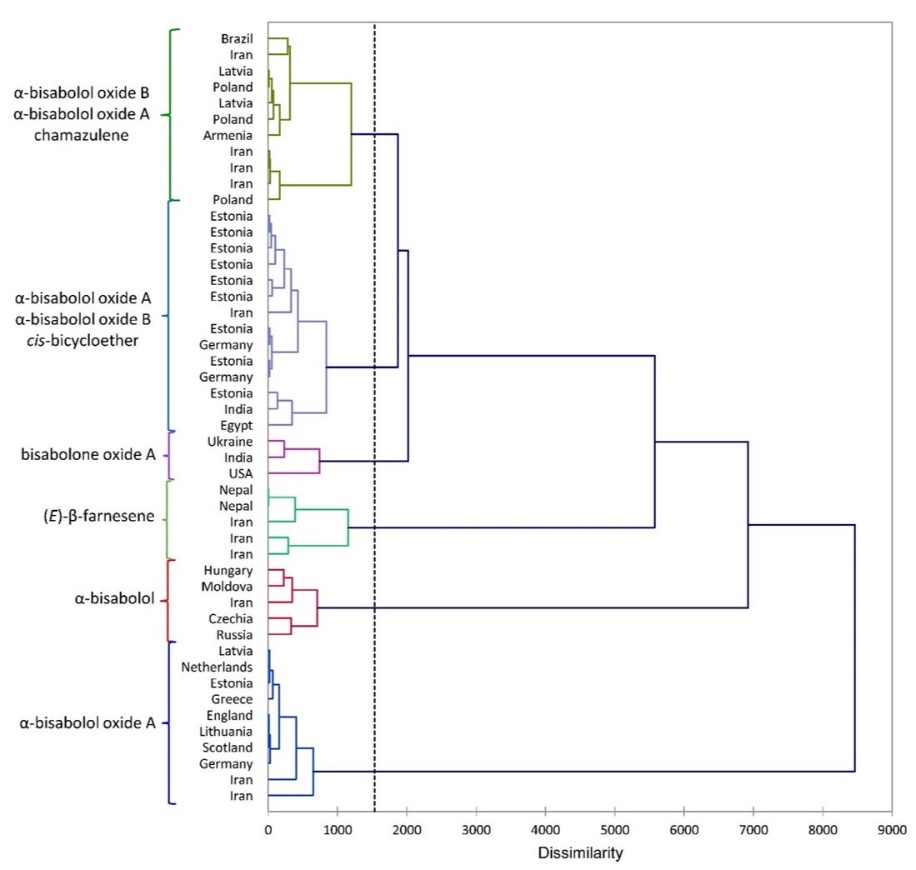
Figure 5. Dendrogram based on hierarchical cluster analysis of Matricaria chamomilla essential oil compositions.
matricaria ester (6.0%), and (E)-β-farnesene (5.6%) [591]. The major components in the essential oil of Matricaria sevanensis (Manden.) Rauschert aerial parts from Osmaniye Province, Türkiye, were bisabolene oxide A (50.3%), (Z)-β-farnesene (24.2%), and α-bisabolol oxide A (8.1%) [592].
3.1.43. Mauranthemum Vogt & Oberpr.
The floral essential oil of Mauranthemum paludosum (Poir.) Vogt & Oberpr. from Rades, Tunisia, was largely composed of pentacosane (26.9%), palmitic acid (19.1%), caryophyllene oxide (7.6%), and tricosane (5.2%) [581].
3.1.44. Mikania Willd.
Although 456 species of Mikania [33] have been recognized, only a few have been examined for their essential oil content. The pharmacology and phytochemistry of Mikania species have been previously reviewed [593–596]. Recent reports on the chemical composition of Mikania species are summarized in Table 41.
3.1.45. Montanoa Cerv.
There are 29 species of Montanoa distributed in the Neotropics [33]. The essential oils of several species have been characterized (Table 42).
3.1.46. Neomirandea R.M. King & H. Rob.
The Neomirandea genus comprises 32 Neotropical species [33]. Only Neomirandea angularis (B.L. Rob.) R.M. King & H. Rob. from Monteverde, Costa Rica, has been investigated for its essential oil composition. The leaf essential oil was dominated by the sesquiterpene hydrocarbons germacrene D (83.2%) and β-selinene (10.5 %) [611].
3.1.47. Ormenis (Cass.) Cass. (syn. Cladanthus Cass.)
The most important species in terms of essential oil is Ormenis mixta (L.) Dumort. (syn. Cladanthus mixtus (L.) Chevall.), also known as Moroccan chamomile. The essential oil compositions and biological activities of Ormenis (Cladanthus) have been reviewed [612–614]. The essential oil yields and chemical compositions vary widely and are strongly dependent on geographical location (Table 43) [612, 615].
3.1.48. Parthenium L.
Of the 12 recognized species of Parthenium [33], only two have been examined for their essential oils. Commercially, Parthenium argentatum A. Gray (guayule) is the most important species as an alternative source of rubber [624]. Parthenium hysterophorus L. is a noxious weed outside its natural range, but it has also shown medicinal potential [31]. The major essential oil components of P. argentatum and P. hysterophorus are summarized in Table 44.
Table 41. Chemical compositions of Mikania essential oils.
Mikania species | Geographical location | Plant tissue | Major components (> 5%) | Ref. |
Mikania cordifolia (L.f.) Willd. | State of Paraná, Brazil | Aerial parts | Limonene (19.2%), β-pinene (17.8%), α-pinene (16.0%), myrcene (13.3%), bicyclogermacrene (8.8%), (E)-γ-bisabolene (5.4%) | [597] |
Mikania glomerata Spreng. | Ribeirão Preto, State of São Paulo, Brazil | Leaves | Coumarin (7.3-28.3%), spathulenol (17.3-20.8%), caryophyllene oxide (8.0-10.9%) | [598] |
Mikania glomerata Spreng. | Paulinia, State of São Paulo, Brazil | Leaves | Germacrene D (46.0%), (E)-β-caryophyllene (20.4%), bicyclogermacrene (5.8%) | [599] |
Mikania involucrata Hook. & Arn. | Penha, Santa Catarina, Brazil | Leaves | Caryophyllene oxide (27.7%), limonene (12.7%), spathulenol (8.2%), (E)-β-caryophyllene (6.8%), 1-epi-cubenol (5.4%) | [600] |
Mikania laevigata Sch.Bip. ex Baker | Oratórios, Minas Gerais, Brazil | Leaves | Germacrene D (44.4%), bicyclogermacrene (15.2%), (E)-β-caryophyllene (12.8%), α-pinene (6.1%), | [601] |
Mikania laevigata Sch.Bip. ex Baker | Oratórios, Minas Gerais, Brazil | Leaves | Germacrene D (40.3-35.3%), bicyclogermacrene (15.7-19.7%), (E)-β-caryophyllene (8.0-9.0%), α-pinene (5.9-10.3%), spathulenol (4.9-8.9%) | [602] |
Mikania laevigata Sch.Bip. ex Baker | Paulinia, State of São Paulo, Brazil | Leaves | Germacrene D (40.8%), (E)-β-caryophyllene (14.3%), bicyclogermacrene (10.6%), β-pinene (8.1%), α-pinene (7.9%) | [599] |
Mikania micrantha Kunth | Vietnam | Leaves | β-Cubebene (11.3%), germacrene D (11.0%), α-zingiberene (10.8%) | [603] |
Mikania micrantha Kunth | Vietnam | Stems | Limonene (17.0%), β-pinene (7.9%), α-zingiberene (7.3%) | [603] |
Mikania micrantha Kunth | Assam, India | Flowers | Isoledene (16.0%), δ-cadinene (11.2%), debromofiliformin (9.4%), (E)-β-caryophyllene (9.1%), β-bisabolene (7.4%), germacrene-D (5.8%), zingiberene (5.3%) | [604] |
Mikania scandens (L.) Willd. | Muksudpur, Gopalganj, Bangladesh | Leaves | (E)-β-Caryophyllene (17.0%), δ-cadinene (12.2%), α-cubebene (11.3%), caryophyllene oxide (7.7%) | [605] |
Table 42. Chemical compositions of Montanoa essential oils.
Montanoa species | Geographical location | Plant tissue | Major components (> 5%) | Ref. |
Montanoa bipinnatifida (Kunth) K. Koch | Doqqi, Giza Governorate, Egypt | Leaves | Germacrene D (37.2%), (E)-β-caryophyllene (30.7%) | [606] |
Montanoa guatemalensis B.L. Rob. & Greenm. | Monteverde, Costa Rica | Leaves | Cyclocolorenone (14.5-27.5%), limonene (8.1-21.3%), α-selinene (0.0-21.2%), trans-muurola-4(14),5-diene (0.0-16.8%), β-cadinene (0.0-13.3%), β-selinene (0.0-14.8%), α-pinene (3.2-8.6%), selina-3,7(11)-diene (3.6-7.7%) | [607] |
Montanoa quadrangularis Sch.Bip. | Mérida, Venezuela | Flowers | Limonene + β-phellandrene (27.8%), trans-sabinol (23.5%), myrcene (13.5%), (E)-β-caryophyllene (5.9%) | [608] |
Montanoa quadrangularis Sch.Bip. | Mérida, Venezuela | Leaves | Myrcene (26.2%), limonene + β-phellandrene (16.1%), (E)-β-caryophyllene (14.7%), sabinene (8.9%), 1,8-cineole (5.7%), α-thujene (5.2%) | [608] |
Montanoa quadrangularis Sch.Bip. | Mérida, Venezuela | Stems | Sabionene (22.3%), myrcene (13.6%), limonene + β-phellandrene (12.2%), β-pinene (9.9%), α-thujene (9.2%), terpinen-4-ol (5.8%), germacrene D (5.7%) | [608] |
Montanoa speciosa K. Koch | Mérida, Yucatan, México | Flowers | (E)-β-Caryophyllene (17.9%), δ-cadinene (9.3%), caryophyllene oxide (8.7%), germacrene D (5.8%) | [609] |
Montanoa speciosa K. Koch | Mérida, Yucatan, México | Leaves | (E)-β-Caryophyllene (20.7%), δ-cadinene (9.9%), caryophyllene oxide (9.5%), germacrene D (6.9%) | [609] |
Montanoa tomentosa Cerv. | Guanajuato, Mexico | Leaf glandular trichomes | β-Eudesmol (26.8-56.1%), valencene (25.3-45.0%) | [610] |
Table 43. Chemical compositions of Ormenis (Cladanthus) essential oils.
Ormenis species | Geographical location | Plant tissue | Major components (> 5%) | Ref. |
Ormenis eriolepis Coss. ex Maire | Morocco | Aerial parts | Isobutyl angelate (22.0-22.4%), isobutyl isobutyrate (20.8-21.2%), α-pinene (5.8-9.2%), 2-methylbutyl angelate (7.2-7.7%), 2.-methylbutyl isobutyrate (5.7-5.8%), 2-methylallyl isobutyrate (5.3-5.5%) | [616] |
Ormenis mixta Dumort. | Morocco | Flowers | Camphor (14.4-29.0%), 2-tridecanone (21.5%), (E)-β-farnesene (8.3%) | [617] |
Ormenis mixta Dumort. | Morocco | Leaves | (E)-Nerolidol (44.1%), camphor (11-33%), myrcene (12.4%) | [617] |
Ormenis mixta Dumort. | Maâmoura region, Morocco | Aerial parts | Santolina alcohol (37.5%), (E)-β-farnesene (6.2%), τ-muurolol (6.0%) | [618] |
Ormenis mixta Dumort. | Souk Had, Morocco | Aerial parts | 1,8-Cineole (20.8%), α-pinene (16.1%) | [619] |
Ormenis mixta Dumort. | Sidi Slimane, Morocco | Aerial parts | (E)-Nerolidol (13.9%), farnesa-1,7(14),10-triene (5.8%), 6,9-epoxyfarnesa-1,7(14),10-trien-3-ol (5.4%) | [619] |
Ormenis mixta Dumort. | Bouznika, Morocco | Aerial parts | 2-Methyl-2-(E)-butenyl methacrylate a (32.0-35.2%), ar-curcumene (13.0-14.0%) | [620] |
Ormenis mixta Dumort. | Oujda, Morocco | Aerial parts | (E)-β-Farnesene (35.5-50.5%) | [620] |
Ormenis mixta Dumort. | Taounate region, Morocco | Aerial parts | Germacrene D (11.5%), 1,8-cineole (10.3%), (Z)-methyl isoeugenol (9.0%), butyric acid (8.5%), δ-elemene (5.5%) | [621] |
Ormenis mixta Dumort. subsp. multicaulis Maire | Kénitra, Morocco | Aerial parts | Santolina alcohol (24.1-47.6%), τ-muurolol (5.5%), α-cadinol (5.4%) | [622] |
Ormenis mixta Dumort. subsp. multicaulis Maire | Salé, Morocco | Aerial parts | Santolina alcohol (44.7-55.1%), τ-muurolol (5.7%), α-cadinol (5.2%) | [622] |
Ormenis multicaulis Braun-Blanq. & Maire | Commercial, Morocco | Flowers | α-Pinene (24.9%), santolina alcohol (15.2%), 1,8-cineole (7.2%), δ-elemene b (6.7%), limonene (6.0%) | [520] |
Ormenis scariosa Litard. & Maire | Tizi n’Ticha, Morocco | Aerial parts | Germacrene D (13.2%), α-pinene (11.9%), sabinene (10.2%), terpinen-4-ol (8.8%), p-cymene (8.5%), α-phellandrene (5.2%) | [614] |
Ormenis scariosa Litard. & Maire | Ait M’hamed, Morocco | Aerial parts | p-Cymene c (11.3%), caryophyllene oxide (9.9%), γ-terpinene (8.3%), sabinene (7.1%), elemol (6.5%), terpinolene (5.6%), spathulenol (5.0%) | [623] |
Ormenis scariosa Litard. & Maire | Azilal, Morocco | Aerial parts | Sabinene (15.6-23.8%), α-pinene (12.2-17.7%), terpinen-4-ol (4.6-11.0%) | [615] |
a This compound is not found in the Dictionary of Natural Products [98]; its identification may be incorrect. b Isomer was not identified, but RI is consistent with δ-elemene. | ||||
Table 44. Chemical compositions of Parthenium essential oils.
Parthenium species | Geographical location | Plant tissue | Major components (> 5%) | Ref. |
Parthenium argentatum A. Gray | Tehran, Iran | Flowers | α-Pinene (27.2%), β-phellandrene (17.0%), γ-eudesmol (11.3%), β-pinene (10.0%), β-eudesmol (9.0%) | [625] |
Parthenium argentatum A. Gray | CIRAD, Montpellier, France | Aerial parts | α-Pinene (22.5-37.0%), sabinene (12.5-14.0%), limonene (8.1-9.1%), bornyl acetate (4.3-7.0%) | [626] |
Parthenium argentatum A. Gray | Riverside, California, USA | Leaves | α-Pinene (16.7%), β-pinene (13.6%), terpinolene (9.2%), sabinene (6.5%), limonene (5.9%) | [627] |
Parthenium hysterophorus L. | Lavras, Minas Gerais state, Brazil | Leaves | Germacrene D (35.9%), (E)-β-ocimene (8.5%) | [628] |
Parthenium hysterophorus L. | Nghe An Province, Vietnam | Aerial parts | Germacrene D (23.2%), myrcene (14.4%), (E)-β-caryophyllene, (12.6%), | [629] |
3.1.49. Phania DC.
Phania is a small genus comprising six species restricted to the Caribbean (Cuba and Dominican Republic) [33]. The essential oil of Phania cajalbanica Borhidi & O. Muñiz from Cuba was dominated by δ-elemene (25.9%) and 1,7-di-epi-β-cedrene (20.8%) [630]. The major components of Phania matricarioides Griseb. essential oil from Cuba, were contained lavandulyl acetate (40.1%), thymyl isobutyrate (13.9%), 8,9-dehydrothymul isobutyrate (5.9%), and lavandulol (5.5%) [631].
3.1.50. Polymnia Kalm.
As far as we are aware, the essential oils have been reported from only two species of Polymnia. There are two reports of Polymnia canadensis L. essential oils from north Alabama, USA. The major components were germacrene D (63.6%), (E)-β-caryophyllene
(15.9%), and bicyclogermacrene (5.4%) from Monte Sano, Alabama [632]; germacrene D (44.5%), (E)-β-caryophyllene (14.8%), and kauran-16β-ol (5.4%) from Blue Spring, Alabama [632]; and α-phellandrene (28.3%), α-pinene (19.7%), and germacrene D (11.4%) from Hampton Cove, Alabama [13]. The essential oil from the tubers of Polymnia sonchifolia Poepp. was rich in α-pinene (33.5%), neo-abienol (15.7%), cis-abienol (15.4%), and trans-abienol (7.0%) [633].
3.1.51. Porophyllum Guett
The genus Porophyllum comprises of 32 species, which are native to the New World [33]. The phytochemical and pharmacological properties of Porophyllum species have been reviewed [634]. The essential oils of Porophyllum species are summarized in Table 45.
3.1.52. Pulicaria Gaertn.
The compositions and biological activities of Pulicaria essential oils was reviewed in 2021 [646]. Essential oil compositions of Pulicaria species recently reported are summarized in Table 46.
3.1.53. Rudbeckia L.
Of the 27 species of Rudbeckia recognized by the World Flora Online [33], only three species have been examined in terms of essential oils, Rudbeckia fulgida Aiton, Rudbeckia hirta L., and Rudbeckia laciniata L. (Table 47).
3.1.54. Santolina L.
There are around 21 species of Santolina, which are native to Europe, North Africa, and the Caucasus [33]. D’Auria and co-workers presented a summary of Santolina chamaecyparissus L. essential oil compositions in 2023 [665], while Sarri and co-authors reviewed the essential oil compositions of Santolina rosmarinifolia L. until 2021 [666]. A summary of the essential oil compositions of Santolina species is presented in Table 48.
3.1.55. Saussurea DC.
Currently, 436 species of Saussurea have been recognized [33]. The essential oil compositions of several species of Saussurea have been reviewed [672], including Saussurea costus (Falc.) Lipsch. [673–675], Saussurea lappa (Decne.) Sch. Bip. [676–678], Saussurea medusa Maxim. [679], Saussurea involucrata (Kar. & Kir.) Sch. Bip., Saussurea obvallata (DC.) Edgew. [680], as well as Saussurea controversa DC., Saussurea latifolia Ledeb., Saussurea parviflora (Poir.) DC., and Saussurea salicifolia DC. [681]. Recent reports on the essential oil compositions of Saussurea species are summarized in Table 49.
Table 45. Chemical compositions of Porophyllum essential oils.
Porophyllum species | Geographical location | Plant tissue | Major components (> 5%) | Ref. |
Porophyllum angustissimum Gardner | Balneário Pinhal, Rio Grande do Sul state, Brazil | Aerial parts | β-Pinene (37.7%), limonene (14.6%), myrcene (12.0%), (E)-β-ocimene (10.2%), (3Z)-undecene (5.5%) | [635] |
Porophyllum curticeps Malme | Porto Alegre, Rio Grande do Sul state, Brazil | Aerial parts | Limonene (28.2%), myrcene (22.6%), (2E)-dodecadienal (14.7%), decanal (11.5%), β-pinene (10.6%) | [635] |
Porophyllum gracile Benth. | Ottawa, Ontario, Canada | Leaves | Myrcene (40.6%), sabinene (20.5%), β-cubebene (9.1%) | [636] |
Porophyllum lanceolatum DC. | Barão do Triunfo, Rio Grande do Sul state, Brazil | Aerial parts | Decanal (60.2%), (2E,6Z)-dodecadienal (12.1%) | [635] |
Porophyllum linaria (Cav.) DC. | Santa Cruz Xoxocotlán, Oaxaca, México | Leaves | Myrcene (41.9%), limonene (20.3%), estragole (20.0%), 1-undecene (8.0%) | [637] |
Porophyllum linaria (Cav.) DC. | San Andrés Cholula, Puebla, Mexico | Aerial parts | Linoleic acid (29.5%), phytol (25.5%), palmitic acid (18.4%) | [638] |
Porophyllum ruderale (Jacq.) Cass. | Viçosa, Minas Gerais state, Brazil | Flowers | β-Phellandrene (44.9%), (Z)-β-ocimene (9.6%), α-pinene (6.3%) | [639] |
Porophyllum ruderale (Jacq.) Cass. | Viçosa, Minas Gerais state, Brazil | Leaves | β-Phellandrene (56.9%), α-pinene (8.0%), (Z)-β-ocimene (6.7%) | [639] |
Porophyllum ruderale (Jacq.) Cass. | Cochabamba valley, Bolivia | Aerial parts | Sabinene (64.1%), terpinen-4-ol (10.3%) | [640] |
Porophyllum ruderale (Jacq.) Cass. | Barão do Triunfo, Rio Grande do Sul state, Brazil | Aerial parts | (E)-β-Ocimene (51.3%), myrcene (9.8%), perillene (6.1%) | [635] |
Porophyllum ruderale (Jacq.) Cass. | Mérida, Venezuela | Aerial parts | Limonene + β-phellandrene (50.3%), sabinene (20.2%) | [641] |
Porophyllum ruderale (Jacq.) Cass. | Bingerville, Côte d'Ivoire | Aerial parts | Myrcene (35.5%), γ-terpinene (26.4%), β-pinene (21.7%), limonene (9.3%) | [642] |
Porophyllum ruderale (Jacq.) Cass. subsp. macrocephalum (DC.) R.R.Johnson | São Paulo, Brazil | Aerial parts | Limonene (83.5%), 1-undecene (5.4%) | [643] |
Porophyllum ruderale (Jacq.) Cass. subsp. macrocephalum (DC.) R.R.Johnson | São Paulo, Brazil | Aerial parts | 1-Undecene (29.0%), limonene (27.4%), α-iso-comene (5.7%) | [644] |
Porophyllum ruderale (Jacq.) Cass. subsp. macrocephalum (DC.) R.R.Johnson | Cajamarca, Perú | Aerial parts | Limonene (63.9%), 1-undecene (10.2%) and (E)-β-caryophyllene (5.1%) | [645] |
Porophyllum ruderale (Jacq.) Cass. subsp. ruderale | São Paulo, Brazil | Aerial parts | (E)-β-Ocimene (54.9%), limonene (25.2%), 1-β-pinene (10.1%) | [643] |
Porophyllum ruderale (Jacq.) Cass. subsp. ruderale | São Paulo, Brazil | Aerial parts | (E)-β-Ocimene (58.6%), limonene (17.4%), 1-undecene (13.7%) | [644] |
Table 46. Chemical compositions of Pulicaria essential oils.
Pulicaria species | Geographical location | Plant tissue | Major components (> 5%) | Ref. |
Pulicaria arabica Cass. | M’sala, Algeria | Aerial parts | τ-Cadinol (23.9%), δ-cadinene (21.1%), α-cadinol (19.8%), germacrene D-4-ol (8.4%) | [187] |
Pulicaria arabica Cass. | Bordj Bou Arreridj, Algeria | Aerial parts | α-Cadinol (35.1%), δ-cadinene (22.5%), τ-muurolol (12.6%), τ-cadinol (11.8%), α-muurolene (5.9%) | [647] |
Pulicaria arabica Cass. | Riyadh city, Saudi Arabia | Aerial parts | Carvotanacetone (36.9%), carvomenthone (27.2%) | [648] |
Pulicaria arabica Cass. | Al-shadeeda, Alkharj province, Saudi Arabia | Aerial parts | τ-Cadinol (38.6%), carvotanacetone (10.3%), caryophyllene oxide (5.3%), palmitic acid (5.3%) | [649] |
Pulicaria burchardii Hutch. subsp. burchardii | Chichaoua, Morocco | Aerial parts | 1-Oxobisabolone (65.1%), 1,8-cineole (13.9%) | [650] |
Pulicaria crispa Sch. Bip. | Riyadh, Saudi Arabia | Aerial parts | Caryophyllene oxide (34.0%), modheph-2-ene (23.3%), geranyl isovalerate (6.7%) | [651] |
Pulicaria crispa Sch. Bip. | Dead Sea region, Jordan | Flowers | Chrysanthenone (34.7%), p-cymen-8-ol (24.6%) | [652] |
Pulicaria crispa Sch. Bip. | Dead Sea region, Jordan | Leaves | Chrysanthenone (29.2%), p-cymen-8-ol (19.4%), vanillin (10.9%), 7-epi-α-eudesmol (9.8%) | [652] |
Pulicaria crispa Sch. Bip. | Kenadsa, Algeria | Aerial parts | (E)-β-Caryophyllene (40.1%), caryophyllene oxide (11.1%) | [653] |
Pulicaria crispa Sch. Bip. | Al-henniya, Alkharj province, Saudi Arabia | Aerial parts | τ-Cadinol (53.5%), (E)-β-caryophyllene (10.8%) | [649] |
Pulicaria dysenterica (L.) Bernh. | Paklenik, Karaula, Olovo Municipality, Bosnia and Herzegovina | Aerial parts | Caryophyllene oxide (14.9%), (E)-nerolidol (9.2%), nerol (5.9%) | [14] |
Pulicaria dysenterica (L.) Bernh. | Skrapež, Serbia | Aerial parts | 3-Methoxycuminyl isobutyrate (31.1%), neryl isobutyrate (22.1%), (E)-β-caryophyllene (5.6%), neryl 2-methylbutyrate (5.5%) | [654] |
Pulicaria dysenterica (L.) Bernh. | Niš, Serbia | Aerial parts | 3-Methoxycuminyl isobutyrate (25.5%), neryl isobutyrate (16.4%), (E)-β-caryophyllene (8.2%) | [654] |
Pulicaria gnaphaloides (Vent.) Boiss. | Dalfard, Kerman province, Iran | Aerial parts | 1,8-Cineole (17.7%), α-terpineol (7.9%), eudesma-4(15),7-dien-1β-ol (7.2%), terpinen-4-ol (5.7%) | [655] |
Pulicaria gnaphaloides (Vent.) Boiss. | Khabr, Kerman province, Iran | Aerial parts | Terpinen-4-ol (20.3%), 1,8-cineole (11.8%), α-terpineol (9.0%), cedr-8(15)-en-9α-ol (7.5%), eudesma-4(15),7-dien-1β-ol (7.1%) | [655] |
Pulicaria gnaphaloides (Vent.) Boiss. | Koohpayeh, Kerman province, Iran | Aerial parts | 1,8-Cineole (22.8%), terpinen-4-ol (11.2%), α-terpineol (11.2%), eudesma-4(15),7-dien-1β-ol (5.5%), geraniol (5.2%) | [655] |
Pulicaria gnaphaloides (Vent.) Boiss. | Mayduk, Kerman province, Iran | Aerial parts | 1,8-Cineole (24.0%), α-terpineol (11.5%), cedr-8(15)-en-9α-ol (11.1%), geraniol (7.5%) | [655] |
Pulicaria gnaphaloides (Vent.) Boiss. | Sarcheshmeh, Kerman province, Iran | Aerial parts | Citronellyl acetate (23.5%), cis-chrysanthenyl acetate (19.9%), α-terpineol (8.7%), terpinen-4-ol (5.6%) | [655] |
Pulicaria incisa (Lam.) DC. | Neve Zonar, Israel | Aerial parts | cis-Chrysanthenol (52.7%), xanthoxylin (15.4%), carvotanacetone (11.7%) | [656] |
Pulicaria incisa (Lam.) DC. subsp. candolleana E. Gamal-Eldin | Jabal Al-Lawz, Tabuk province, Saudi Arabia | Aerial parts | Linalool (33.0%), chrysanthenone (10.3%), eugenol (8.9%) cis-chrysanthenol (8.0%), (Z)-jasmone (5.7%) | [657] |
Pulicaria jaubertii E. Gamal-Eldin | Sana’a, Yemen | Aerial parts | Carvotanacetone (20.7%), linolenic acid (9.6%), 1-hexacosanol (5.6%), palmitic acid (5.1%) | [658] |
Pulicaria mauritanica Batt. | Kasr Igoudman Aghbalou N’Kerdous, Morocco | Aerial parts | Carvotanacetone (67.9%) | [659] |
Pulicaria odora (L.) Rchb. | Peloritani mountains, Sicily | Aerial parts | (2E)-Hexenal (14.8%), thymyl isobutyrate (11.4%), α-cadinol (5.7%) | [660] |
Pulicaria petiolaris Jaub. & Spach | Sana’a, Yemen | Aerial parts | (10E,12Z)-Linoleic acid (10.2%), palmitic acid (6.2%), piperitone (5.8%), linoleic acid (5.5%) | [658] |
Pulicaria somalensis O. Hoffm. | Al-senaiyya, Alkharj province, Saudi Arabia | Aerial parts | Intermedeol (15.9%), α-cadinol (9.7%), γ-eudesmol (9.1%), α-eudesmol (5.2%) | [649] |
Pulicaria undulata (L.) C.A. Mey. | Wadi Alsahbaa, Alkharj, Riyadh region, Saudi Arabia | Aerial parts | β-Pinene (21.1%), γ-terpinene (7.7%), iso-shyobunone (7.7%), 6-epi-shyobunol (6.5%), α-pinene (5.1%) | [661] |
Pulicaria undulata (L.) C.A. Mey. | Wadi Hagoul, Eastern Desert, Egypt | Aerial parts | Spathulenol (30.9%), hexahydrofarnesyl acetone (18.1%), α-bisabolol (6.3%) | [661] |
Pulicaria undulata (L.) C.A. Mey. | Ardestan, Isfahan province, Iran | Aerial parts | 1,8-Cineole (26.0%), α-pinene (12.5%), camphor (8.4%), camphene (5.0%) | [662] |
Table 47. Chemical compositions of Rudbeckia essential oils.
Rudbeckia species | Geographical location | Plant tissue | Major components (> 5%) | Ref. |
Rudbeckia fulgida Aiton | Huntsville, Alabama, USA | Aerial parts | Germacrene D (30.1%), δ-cadinene (17.8%), (E)-β-caryophyllene (10.0%), γ-muurolene (8.9%), (E)-β-ocimene (6.2%), (2E)-hexenal (6.0%) | [663] |
Rudbeckia hirta L. | Bucharest, Romania | Flowers | β-Phellandrene (26.0%), germacrene D (21.6%), α-pinene (16.3%), sabinene (12.0%) | [664] |
Rudbeckia hirta L. | Huntsville, Alabama, USA | Aerial parts | Germacrene D (23.6%), (2E)-hexenal (20.2%), δ-cadinene (16.2%), (E)-β-ocimene (15.2%), γ-muurolene (8.9%) | [663] |
Rudbeckia laciniata L. | Monte Sano, Alabama, USA | Aerial parts | Limonene (58.9%), α-pinene (10.2%), β-pinene (9.2%), myrcene (5.3%), | [13] |
Table 48. Chemical compositions of Santolina essential oils.
Santolina species | Geographical location | Plant tissue | Major components (> 5%) | Ref. |
Santolina africana Jord. & Fourr. | El Krib Sud region, Tunisia | Stems | Artemisia ketone (44.3%), iso-borneol (26.6%) | [667] |
Santolina africana Jord. & Fourr. | Taounate Province, Morocco | Stems | Artemisia ketone (35.4%), santolina alcohol (16.2%), iso- borneol (6.1%), β-oplopenone (5.1%) | [667] |
Santolina chamaecyparissus L. | Siedlce, Poland | Aerial parts | Artemisia ketone (25.9%), β-phellandrene (18.7%), vulgarone B (11.6%), myrcene (9.2%), β-pinene (6.1%) | [4] |
Santolina chamaecyparissus L. | Commercial, Spain | Aerial parts | Artemisia ketone (26.6%), β-phellandrene (21.7%), myrcene (9.7%), sabinene (7.2%), β-pinene (6.9%), longiverbenone (5.9%) | [520] |
Santolina chamaecyparissus L. | Osmaniye province, Türkiye | Aerial parts | Artemisia ketone (39.8%), camphor (17.7%), β-phellandrene (8.0%) and β-bisabolene (7.3%). | [668] |
Santolina etrusca (Lacaita) Marchi & D'Amato | Acquapendente, Italy | Aerial parts | Viridiflorol (24.0%), 1,8-cineole (9.2%), β-pinene (8.8%), terpinen-4-ol (8.1%), pinocarveol (6.3%) | [665] |
Santolina impressa Hoffmanns. & Link | Portugal | Aerial parts | β-Pinene (12.6%), β-phellandrene (10.4%), yomogi alcohol (8.8%), limonene (8.1%), camphor (7.1%), 1,8-cineole (6.2%), myrcene (6.0%) | [669] |
Santolina insularis (Gennari ex Fiori) Arrigoni | Nebida, Sardinia, Italy | Aerial parts | β-Phellandrene (22.6%), myrcene (11.4%), artemisia ketone (7.6%), ar-curcumene (7.1%), β-pinene (5.4%), γ-curcumene (5.0%) | [670] |
Santolina rosmarinifolia L. | Palmela, Setúbal, Portugal | Aerial parts | β-Pinene (29.6%), borneol (16.9%), myrcene (15.4%), limonene (5.7%) | [671] |
Santolina rosmarinifolia L. | Hodna area, Algeria | Aerial parts | Capillene (32.8%), 1,8-cineole (15.1%), myrcene (14.0%) | [666] |
3.1.56. Schizogyne Cass.
There are only three species of Schizogyne, all of which are endemic to the Canary Islands: Schizogyne glaberrima DC., Schizogyne obtusifolia Cass., and Schizogyne sericea (L.f.) DC. [33]. The major essential oil components of S. glaberrima and S. sericea are summarized in Table 50. To date, the essential oil composition of S. obtusifolia has not been reported.
Table 49. Chemical compositions of Saussurea essential oils.
Saussurea species | Geographical location | Plant tissue | Major components (> 5%) | Ref. |
Saussurea amara (L.) DC. | Qianshan, China | Aerial parts | Caryophyllene oxide (12.4%), δ-selinene (9.5%), trans-β-elemene (8.8%), (E)-β-caryophyllene (7.6%), β-selinene (5.6%), δ-guaiene (5.1%) | [682] |
Saussurea costus (Falc.) Lipsch. | Not reported | Roots | 1,8,11,14-Heptadecatetraene (40.9%), trans-β-elemene (9.3%), (E)-β-caryophyllene (7.2%), | [683] |
Saussurea costus (Falc.) Lipsch. | Lahaul & Spiti, Himachal Pradesh, India | Roots | Linoleic acid (24.7%), valerenol (11.8%), erementhin (10.7%), α-costol (6.6%), germacrene B (6.7%), (Z)-trans-α-bergamotyl acetate (6.7%), γ-costol (5.5%) | [684] |
Saussurea lappa (Decne.) Sch. Bip. | Cairo, Egypt (market) | Roots | Velleral (22.5%), eremanthin (23.7%), α-selinene (9.7%), dehydrosaussurea lactone (6.9%), costunolide (6.9%) | [685] |
Saussurea lappa (Decne.) Sch. Bip. | Dronagiri village, Uttarkhand, India | Roots | Dehydrocostus lactone (68.8%), dihydrodehydrocostus lactone (20.4%) | [686] |
Saussurea lappa (Decne.) Sch. Bip. | Bordj Bou Arreridj, Algeria (market) | Roots | Dehydrocostus lactone (55.4%), costunolide (8.9%), dehydrosaussurea lactone (5.6%) | [687] |
Saussurea nivea Turcz. | Beijing, China | Aerial parts | Limonene (15.5%), caryophyllene oxide (7.6%), linalool (7.2%), α-pinene (6.4%), β-pinene (5.7%), spathulenol (5.0%) | [688] |
Saussurea pulchella (Fisch.) Fisch. | Primorsky Krai, Shkotovsky District, Russia | Aerial parts | Caryophyllene oxide (30.8%), germacrene D (24.3%), (E)-β-caryophyllene (9.1%) | [689] |
3.1.57. Smallanthus Mack.
Currently, the World Flora Online recognizes 21 species of Smallanthus [33]. Of these, the essential oils of five species have been reported (Table 51).
3.1.58. Solidago L.
Solidago is a large genus comprising 156 species [33]. Of these, Solidago canadensis L. seems to be the most important with respect to essential oil characterization, which has been reviewed [13, 699]. The essential oil compositions of S. canadensis and other Solidago species are summarized in Table 52.
3.1.59. Sphaeranthus L.
The phytochemistry and biological activities of Sphaeranthus indicus L. have been reviewed [725, 726]. The major essential oil components of Sphaeranthus species are summarized in Table 53.
3.1.60. Sphagneticola O. Hoffm.
There are only four species of Sphagneticola (syn. Thelechitonia), namely Sphagneticola brachycarpa (Baker) Pruski, Sphagneticola calendulacea (L.) Pruski, Sphagneticola gracilis (Rich.) Pruski, and Sphagneticola trilobata (L.) Pruski [33]. Apparently, only S. trilobata has been investigated for its essential oil composition (Table 54). The phytochemistry and pharmacology of S. trilobata have been reviewed [732].
Table 50. Chemical compositions of Schizogyne essential oils.
Schizogyne species | Geographical location | Plant tissue | Major components (> 5%) | Ref. |
Schizogyne glaberrima DC. | Barranco de Mogán, Gran Canaria | Aerial parts | p-Cymene (64.9%), limonene (25.2%), α-phellandrene (5.2%) | [690] |
Schizogyne sericea (L.f.) DC. | La Barranquera, Tenerife | Aerial parts | p-Cymene (34.0%), isobornyl acetate (11.5%) | [691] |
Schizogyne sericea (L.f.) DC. | Palm Mar, Tenerife | Aerial parts | p-Cymene (48.0%), limonene (5.6%) | [692] |
Schizogyne sericea (L.f.) DC. | Fasnia, Tenerife | Aerial parts | p-Cymene (43.0%), β-pinene (5.3%) | [692] |
Schizogyne sericea (L.f.) DC. | La Barranquera, Tenerife | Aerial parts | p-Cymene (57.0%), isobornyl acetate (5.1%) | [692] |
Schizogyne sericea (L.f.) DC. | Montaña de Guaza, Tenerife | Aerial parts | p-Cymene (45.0%), β-pinene (6.0%), isobornyl acetate (5.3%) | [693] |
Schizogyne sericea (L.f.) DC. | Palm Mar, Tenerife | Aerial parts | p-Cymene (48.0%), isobornyl acetate (11.0%), limonene (5.6%) | [694] |
Schizogyne sericea (L.f.) DC. | Los Roques, Tenerife | Aerial parts | p-Cymene (43.0%), β-pinene (5.3%) | [694] |
Schizogyne sericea (L.f.) DC. | La Barranquera, Tenerife | Aerial parts | p-Cymene (57.0%), isobornyl acetate (5.1%) | [694] |
Table 51. Chemical compositions of Smallanthus essential oils.
Smallanthus species | Geographical location | Plant tissue | Major components (> 5%) | Ref. |
Smallanthus maculatus (Cav.) H. Rob. | San José, Costa Rica | Leaves | α-Pinene (32.9%), germacrene D (13.7%), (E)-β-caryophyllene (10.7%), β-pinene (7.1%), camphene (5.4%) | [695] |
Smallanthus parviceps (S.F. Blake) H. Rob. | Ayacucho, Peru | Leaves | α-Phellandrene (18.3%), (E)-β-caryophyllene (8.7%), p-cymene (8.1%), β-curcumene (7.3%) | [696] |
Smallanthus quichensis (J.M. Coult.) H. Rob. | Turrialba Volcano, Costa Rica | Aerial parts | α-Pinene (35.5%), p-cymene (11.5%), β-phellandrene (9.2%), α-phellandrene (9.0%), limonene (5.8%) | [697] |
Smallanthus quichensis (J.M. Coult.) H. Rob. | Turrialba Volcano, Costa Rica | Aerial parts | α-Pinene (64.5%), 1,8-cineole (9.7%) | [697] |
Smallanthus sonchifolius (Poepp.) H. Rob. | Duitama, Colombia | Leaves | Sabinene (40.8%), germacrene D (15.4%), (E)-β-caryophyllene (9.9%), terpinen-4-ol (5.5%) | [698] |
Smallanthus uvedalia (L.) Mack. | Monte Sano, Alabama, USA | Leaves | (E)-β-Caryophyllene (24.5%), caryophyllene oxide (19.8%), 14-hydroxy-9-epi-(E)-caryophyllene (8.9%), 14-hydroxy-9-epi-(Z)-caryophyllene (8.2%) | [632] |
Smallanthus uvedalia (L.) Mack. | Blue Spring, Alabama, USA | Leaves | (E)-β-Caryophyllene (16.5%), caryophyllene oxide (14.2%), spathulenol (7.5%), 14-hydroxy-9-epi-(E)-caryophyllene (6.2%) | [632] |
Smallanthus uvedalia (L.) Mack. | Monte Sano, Alabama, USA | Aerial parts | α-Pinene (65.6%), limonene (11.4%), β-pinene (6.0%) | [13] |
Smallanthus uvedalia (L.) Mack. | Caesars Head, South Carolina, USA | Aerial parts | α-Pinene (23.9%), (E)-β-caryophyllene (16.9%), perillene (14.5%), germacrene D (12.2%), limonene (6.1%) | [580] |
Table 52. Chemical compositions of Solidago essential oils.
Solidago species | Geographical location | Plant tissue | Major components (> 5%) | Ref. |
Solidago caesia L. | Göttingen, Germany | Aerial parts | β-Cubebene (22.6%), α-pinene (8.7%), α-cadinol (7.7%), δ-cadinene (6.3%), (E)-β-caryophyllene (5.1%) | [700] |
Solidago canadensis L. | Bhimtal, Kumaon, India | Aerial parts | Germacrene D (56.7-75.5%), limonene (0.2-12.5%) | [701] |
Solidago canadensis L. | L’ubotice, Slovakia | Aerial parts | Germacrene D (34.9%), limonene (12.5%), α-pinene (11.6%), trans-β-elemene (7.1%), bornyl acetate (6.3%) | [702] |
Solidago canadensis L. | El-Mansoureya, Giza, Egypt | Aerial parts | Germacrene D (9.86-29.47%), α-pinene (3.38-29.17%), γ-cadinene (0.39-20.36%), myrcene (2.98-13.74%), limonene (4.81-11.47%) | [703] |
Solidago canadensis L. | Hampton Cove, Alabama, USA | Aerial parts | Myrcene (20.3%), bornyl acetate (14.4%), sabinene (14.3%), α-pinene (13.9%), germacrene D (10.7%) | [13] |
Solidago canadensis L. | Ljubljana, Slovenia | Flowers | α-Pinene (33.1%), limonene (21.5%), germacrene D (10.4%) | [704] |
Solidago canadensis L. | Szentlőrinc, Hungary | Flowers | α-Pinene (29.5%), bornyl acetate (12.2%), limonene (5.1%) | [705] |
Solidago canadensis L. | Bucharest, Romania | Flowers | α-Pinene (27.9%), germacrene D (13.2%), limonene (12.3%), bornyl acetate (5.8%) | [706] |
Solidago canadensis L. | Vilnius, Lithuania | Flowers | α-Pinene (18.1%), trans-verbenol (13.1%), bornyl acetate (11.9%), germacrene D (8.1%) | [707] |
Solidago canadensis L. | Moscow, Russia | Flowers | α-Pinene (61.2%), limonene (13.7%), bornyl acetate (8.5%) | [708] |
Solidago canadensis L. | Vilnius, Lithuania | Flowers | α-Pinene (18.8%), germacrene D (8.4%), bornyl acetate (6.0%) | [709] |
Solidago canadensis L. | Ljubljana, Slovenia | Leaves | Germacrene D (48.7%), cyclocolorenone (7.6%), bornyl acetate (5.5%) | [704] |
Solidago canadensis L. | Szentlőrinc, Hungary | Leaves | Bornyl acetate (13.4%), germacrene D (11.0%), cyclocolorenone (8.8%), eudesma-4(15).7-dien-1β-ol (7.1%) | [705] |
Solidago canadensis L. | Bhimtal, India | Leaves | Germacrene D (64.1%) | [710] |
Solidago canadensis L. | Vilnius, Lithuania | Leaves | Carvacrol (23.3%), β-cubebene (21.3%), germacrene D (19.6%), bornyl acetate (18.7%), α-pinene (8.6%) | [707] |
Solidago canadensis L. | Moscow, Russia | Leaves | Bornyl acetate (29.8%), germacrene D (16.6%) | [708] |
Solidago canadensis L. | Vilnius, Lithuania | Leaves | Germacrene D (19.5%), bornyl acetate (7.1%) | [709] |
Solidago canadensis L. | Szentlőrinc, Hungary | Roots | Limonene (32.7%), β-pinene (31.3%) | [705] |
Solidago canadensis L. | Bhimtal, India | Roots | Thymol (20.3%), α-copaene (6.3%), carvacrol (5.5%) | [711] |
Solidago chilensis Meyen | Pérez, Rosario, Argentina | Flowers | Limonene (13.4%), pumiloxide (12.7%), γ-cadinene (8.2%) | [712] |
Solidago chilensis Meyen | Pérez, Rosario, Argentina | Leaves | Pumiloxide (15.3%), γ-cadinene (5.6%) | [712] |
Solidago decurrens Lour. | Tonglu county, Zhejiang province, China | Leaves | δ-Elemene (30.8%), (E)-β-caryophyllene (15.4%), ledene oxide II (13.1%), β-elemene (6.4%) | [713] |
Solidago gigantea Aiton | Warsaw, Poland | Aerial parts | Germacrene D (21.6%), cyclocolorenone (8.1%), α-pinene (7.0%), α-gurjunene (6.1%) | [714] |
Solidago gigantea Aiton | Łódź, Poland | Aerial parts | Cyclocolorenone (32.4%), germacrene D (23.5%) | [714] |
Solidago glomerata Michx. | Göttingen, Germany | Aerial parts | β-Cubebene (16.4%), α-pinene (14.4%), limonene (9.2%), | [700] |
Solidago gigantea Aiton | Ljubljana, Slovenia | Flowers | Germacrene D (20.8%), α-pinene (7.6%) | [704] |
Solidago gigantea Aiton | Szentlőrinc, Hungary | Flowers | Bornyl acetate (11.4%), germacrene D (9.0%), α-pinene (8.1%), cyclocolorenone (6.4%) | [705] |
Solidago gigantea Aiton | Vilnius, Lithuania | Flowers | Germacrene D (11.2%), p-cymene (10.9%), α-pinene (10.7%), bornyl acetate (10.4%), isospathulenol (6.1%), spathulenol (5.0%) | [707] |
Solidago gigantea Aiton | Vilnius, Lithuania | Flowers | Germacrene D (16.7%) | [709] |
Solidago gigantea Aiton | Ljubljana, Slovenia | Leaves | Germacrene D (33.8%), bornyl acetate (9.1%) | [704] |
Solidago gigantea Aiton | Szentlőrinc, Hungary | Leaves | Cyclocolorenone (15.6%), bornyl acetate (13.7%), germacrene D (6.3%) | [705] |
Solidago gigantea Aiton | Vilnius, Lithuania | Leaves | Bornyl acetate (22.4%), β-cubebene (14.1%), spathulenol (6.7%), isospathulenol (6.3%), epoxyazulene (6.1%), germacrene D (5.9%) | [707] |
Solidago gigantea Aiton | Vilnius, Lithuania | Leaves | Germacrene D (15.5%), bornyl acetate (12.7%), | [709] |
Solidago gigantea Aiton | Szentlőrinc, Hungary | Roots | Germacrene D (14.4%), 1-nonene (13.1%) | [705] |
Solidago graminifolia (L.) Salisb. | Opole, Lower Silesia, Poland | Aerial parts | β-Phellandrene (23.1%), sabinene (18.3%), β-pinene (10.3%) | [715] |
Solidago litoralis Savi | Lucca, Tuscany, Italy | Aerial parts | Myrcene (65.1%), α-pinene (13.3%), (E)-β-caryophyllene (7.4%) | [716] |
Solidago nemoralis Aiton | Göttingen, Germany | Aerial parts | Germacrene D (25.5%), α-pinene (9.5%), limonene (8.7%), β-phellandrene (6.1%), sabinene (5.9%), myrcene (5.5%) | [700] |
Solidago odora Aiton | Worton, Maryland, USA | Flowers | Methyl chavicol (70.8%), myrcene (12.5%), methyl eugenol (5.8%) | [717] |
Solidago puberula Nutt. | Saint-Ludger-de-Milot, Québec, Canada | Aerial parts | α-Phellandrene (53.0%), (E,E)-α-farnesene (10.7%), α-pinene (9.4%), γ-terpinenea (6.0%), α-phellandrene (5.7%) | [718] |
Solidago rugosa Mill. | Göttingen, Germany | Aerial parts | Germacrene D (41.8%), sabinene (8.3%), terpinen-4-ol 7.0%) | [700] |
Solidago tortifolia Elliott | Göttingen, Germany | Aerial parts | Sabinene (18.3%), β-pinene (12.2%), β-cubebene (8.3%), α-calacorene (7.5%) α-pinene (6.6%), limonene (5.6%) | [700] |
Solidago virga-aurea L. var. asiatica Nakai | Koheung, Jeolanamdo, Korea | Aerial parts | Palmitic acid (29.2%), 7-hexyl eicosane (9.1%), spathulenol (7.7%), 3,8-dimethyl decane (6.5%) | [719] |
Solidago virga-aurea L. var. asiatica Nakai | Seoguipo, Jejudo, Korea | Aerial parts | δ-2-Carene (41.0%), α-copaene (10.8%), α-muurolene (5.8%) | [720] |
Solidago virgaurea L. | Almora, Uttarakhand, India | Aerial parts | Limonene (25.6%), α-humulene (12.2%), trans-dehydroxylinalool oxide (8.7%), benzyl salicylate (6.4%), 1,4-cineole (6.2%), humulene epoxide II (5.9%) | [721] |
Solidago virgaurea L. | Łódź, Poland | Aerial parts | α-Pinene (32.5%), myrcene (17.9%), limonene (14.1%), germacrene D (8.2%), β-pinene (5.4%) | [722] |
Solidago virgaurea L. | Warsaw, Poland | Aerial parts | α-Pinene (34.1%), germacrene D (17.0%), myrcene (9.0%), β-pinene (7.5%) | [722] |
Solidago virgaurea L. | Kielce, Poland | Aerial parts | α-Pinene (27.4%), germacrene D (13.5%), sabinene (11.8%), myrcene (7.8%), β-pinene (7.5%) | [722] |
Solidago virgaurea L. | Čačak, Serbia | Aerial parts | Cyclocolorenol (18.0-29.5%), germacrene D (7.7-9.4%), germacra-4(15),5,10(14)-trien-1α-ol (5.8-6.8%), spathulenol (4.8-5.9%), gymnomitrol (4.3-5.0%), bornyl acetate (3.1-5.2%) | [723] |
Solidago virgaurea L. | Zasavje, Slovenia | Flowers | α-Pinene (28.5%), germacrene D (8.4%) | [704] |
Solidago virgaurea L. | Vilnius, Lithuania | Flowers | α-Pinene (28.6%), β-copaene (12.2%), spathulenol (8.5%), trans-verbenol (6.6%) | [707] |
Solidago virgaurea L. | Novo-Mikhaylovskoe, Russia | Flowers | α-Pinene (36.5%), myrcene (14.8%), (E)-β-caryophyllene (10.5%), germacrene D (8.2%), limonene (6.4%) | [724] |
Solidago virgaurea L. | Vilnius, Lithuania | Flowers | Caryophyllene oxide (9.2%), humulene epoxide II (6.8%), germacrene D (6.7%), trans-verbenol (6.4%) | [709] |
Solidago virgaurea L. | Zasavje, Slovenia | Leaves | α-Pinene (13.1%), caryophyllene oxide (10.2%), humulene epoxide II (6.7%), spathulenol (6.5%), germacrene D (6.3%) | [704] |
Solidago virgaurea L. | Vilnius, Lithuania | Leaves | trans-Verbenol (24.6%), α-pinene (16.0%), caryophyllene oxide (9.0%), verbenone (7.3%) | [707] |
Solidago virgaurea L. | Vilnius, Lithuania | Leaves | Caryophyllene oxide (9.0%), trans-verbenol (6.3%), spathulenol (5.9%), humulene epoxide II (5.7%), α-pinene (5.2%) | [709] |
Table 53. Chemical compositions of Sphaeranthus essential oils.
Sphaeranthus species | Geographical location | Plant tissue | Major components (> 5%) | Ref. |
Sphaeranthus africanus L. | Diên Lãm Commune, Pù Huèng Natural Reserve, Nghe An Province, Vietnam | Aerial parts | 1-Decen-3-ol (36.9%), α-pinene (21.0%), τ-cadinol (7.5%), 3-octyl propionate (5.6%), (E)-β-caryophyllene (5.5%) | [629] |
Sphaeranthus amaranthoides Burm.f. | Tirunelveli District, Tamil Nadu, India | Leaves | Carvone (89.7%), 2-cyclohexen-1-ol (6.7%) | [727] |
Sphaeranthus cyathuloides O. Hoffm. | Carnivore, Nairobi, Kenya | Leaves | trans-Dihydrocarvone (67.4%), cis-dihydrocarvone (26.2%) | [728] |
Sphaeranthus indicus L. | Calicut University, Kerala, India | Aerial parts | Thymohydroquinone dimethylether (27.0%), τ-cadinol (12.5%), β-eudesmol (9.1%), α-eudesmol (7.0%) | [729] |
Sphaeranthus indicus L. | Hyderabad, India | Aerial parts | Thymohydroquinone dimethylether (18.2%), selin-11-en-4α-ol (12.7%), α-agarofuran (11.8%), (E)-β-caryophyllene (5.4%) | [730] |
Sphaeranthus indicus L. | Calicut University, Kerala, India | Flowers | β-Eudesmol (21.4%), thymohydroquinone dimethylether (16.2%), (E)-β-caryophyllene (7.8%), τ-cadinol (7.2%), caryophyllene oxide (6.9%) | [729] |
Sphaeranthus indicus L. | Calicut University, Kerala, India | Roots | Thymohydroquinone dimethylether (28.3%), τ-cadinol (25.3%), (Z)-arteannuic alcohol (10.1%), | [729] |
Sphaeranthus suaveolens DC. | Tanta, Egypt | Leaves | iso-Pinocamphone (33.5%), thymohydroquinone dimethylether (16.1%), α-pinene (10.6%), 1,8-cineole (6.6%), p-cymene (6.3%) | [731] |
Table 54. Chemical compositions of Sphagneticola trilobata (L.) Pruski (syn. Thelechitonia trilobata (L.) H. Rob. & Cuatrec.) essential oils.
Geographical location | Plant tissue | Major components (> 5%) | Ref. |
Federal University of Viçosa, Minas Gerais state, Brazil | Leaves | Germacrene D (11.9-35.8%), α-phellandrene (1.4-28.5%), α-pinene (7.3-23.8%), (E)-β-caryophyllene (4.6-19.0%), bicyclogermacrene (6.0-17.0%), limonene (1.8-15.1%), α-humulene (4.0-11.6%) | [733] |
University of Zululand, Kwa-Zulu Natal Province, South Africa | Leaves | α-Pinene (21.6%), α-phellandrene (21.0%), limonene (12.8%), germacrene D (7.5%) | [734] |
Pantnagar, Uttarakhand, India | Aerial parts | α-Pinene (78.6–83.3%) | [735] |
3.1.61. Symphyotrichum Nees
There are around 100 species of Symphyotrichum [33], but the essential oils of only Symphyotrichum novae-angliae (L.) G.L. Nesom (syn. Aster novae-angliae L.) and Symphyotrichum squamatum (Spreng.) G.L. Nesom (syn. Aster squamatus Hieron.) have been reported. The leaf essential oil of S. novae-angliae from north Alabama, USA, was largely composed of (2E)-hexenal (31.0%), germacrene D (25.5%), α-pinene (16.4%), δ-cadinene (14.3%), and γ-muurolene (5.4%) [663]. The essential oils of S. squamatum aerial parts were obtained from an inland population (Mansoura, Egypt) and a Mediterranean coastal population (Gamsa City, Al-Dakahlia Governorate, Egypt) [736]. The major components of the coastal sample were humulene epoxide I (18.5%), spathulenol (15.5%), caryophyllene oxide (14.4%), germacrene D (5.9%), and α-humulene (5.5%). On the other hand, the inland sample, showed α-pinene (24.2%), germacrene D (8.6%), α-humulene (7.4%), α-muurolene (6.8%), humulene epoxide I (6.3%), and caryophyllene oxide (6.0%) as the major components.
3.1.62. Tagetes L.
Tagetes (marigolds), is a genus of approximately 50 species native to southern North America, Central America, and South America [33]. The phytochemistry and biological activities of this genus have been extensively studied, and there are several reviews on Tagetes [737–740], including Tagetes erecta L. (Mexican marigold) [741–746], Tagetes minuta L. (southern marigold) [747, 748], and Tagetes patula L. (French marigold) [749]. The representative essential oil compositions of Tagetes species are summarized in Table 55.
3.1.63. Tanacetum L.
The chemical compositions and biological activities of the members of the genus Tanacetum have been previously reviewed [775–779]. Of the 192 species of Tanacetum [33], the most important in terms of ethnopharmacological uses and biological activities are Tanacetum parthenium (L.) Sch. Bip. (feverfew), Tanacetum vulgare L. (tansy), and Tanacetum balsamita L. (costmary) [778]. The phytochemical and pharmacological
properties of T. parthenium [780, 781], T. vulgare [32, 782], and T. balsamita [783] have been reviewed. The essential oil compositions of several Tanacetum species are presented in Table 56.
Table 55. Chemical compositions of Tagetes species essential oils.
Tagetes species | Geographical location | Plant tissue | Major components (> 5%) | Ref. |
Tagetes argentina Cabrera | Sierras Grandes, Córdoba, Argentina | Aerial parts | (E)-Tagetenone (28.8%), (Z)-tagetenone (17.9%), (E)-tagetone (11.8%), (Z)-tagetone (9.4%), dihydrotagetone (6.4%) | [750] |
Tagetes argentina Cabrera | Pampa de Achala, El Condor, Córdoba Province, Argentina | Flowers | (Z)-Tagetenone (44.0%), (E)-tagetenone (38.3%) | [751] |
Tagetes coronopifolia Willd. | Santa María Tecuanulco, Texcoco, Mexico | Aerial parts | Verbenone (30.7%), dihydrotagetonea (14.5%), cis-verbenolb (13.3%), (Z)-β-ocimene (9.5%), (E)-tagetone (9.4%) | [752] |
Tagetes elliptica Sm. | Chupaca Province, Junín Region, Peru | Leaves | (Z)-Tagetenone (37.3%), (E)-tagetenone (18.8%), dihydrotagetone (14.4%), (E)-tagetone (5.2%) | [753] |
Tagetes elliptica Sm. | Chupaca Province, Junín Region, Peru | Leaves | (Z)-Tagetenone (34.2%), (E)-tagetenone (15.0%), (Z)-myroxide (14.5%), dihydrotagetone (13.9%), (E)-tagetone (5.8%) | [754] |
Tagetes erecta L. | Po Valley, Italy | Flowers | Piperitone (28.9%), terpinolene (5.8%) | [737] |
Tagetes erecta L. | Miyaneh county, East Azerbaijan Province, Iran | Fruit | 2-Isopropyl-5-methyl-3-cyclohexen-1-one (20.0%), palmitic acid (19.1%), limonene (12.8%), terpinolene (11.6%) | [755] |
Tagetes erecta L. | Mérida Municipio Libertador, Mérida State, Venezuela | Leaves | Piperitone (35.9%), terpinolene (22.2%), limonene (8.8%), (E)-β-ocimene (7.0%) | [756] |
Tagetes erecta L. | Po Valley, Italy | Leaves | Terpinolene (28.8%), piperitone (24.2%), limonene (15.6%) | [737] |
Tagetes filifolia Lag. | Tucumán, Argentina | Aerial parts | (E)-Anethole (76.9%), estragole (19.3%) | [10] |
Tagetes filifolia Lag. | Sierra de Los Gigantes, Córdoba province, Argentina | Aerial parts | (E)-Anethole (74.8%), estragole (23.7%) | [757] |
Tagetes filifolia Lag. | Occopa, Santiago District, Cuzco, Peru | Aerial parts | (E)-Anethole (85.0%), estragole (12.9%) | [758] |
Tagetes filifolia Lag. | Alta Gracia, Córdoba Province, Argentina | Flowers | (E)-Anethole (67.0%), estragole (30.3%) | [751] |
Tagetes filifolia Lag. | Mérida Municipio Libertador, Mérida State, Venezuela | Leaves | (E)-Anethole (87.5%), estragole (10.7%) | [756] |
Tagetes filifolia Lag. | Po Valley, Italy | Leaves | Estragole (90.4%), (E)-anethole (5.5%) | [737] |
Tagetes filifolia Lag. | Cerro Villonaco, Loja Province, Ecuador | Leaves | (E)-Anethole (55.6%), 1-tridecene (8.7%), estragole (5.8%) | [759] |
Tagetes lacera Brandegee | La Paz y Los Cabos, Baja California Sur, México | Aerial parts | (E)-Tagetone (26.2%), verbenone (22.1%), α-thujene (20.5%), chrysanthenone (24.8%) | [760] |
Tagetes laxa Cabrera | Salta Province, La Caldera, Yacones, Argentina | Aerial parts | (E)-Tagetenone (31.4%), (Z)-tagetenone (26.2%), (Z)-β-ocimene (24.1%) | [761] |
Tagetes laxa Cabrera | Yacones and Quebrada del Toro, Salta Province, Argentina | Flowers | (E)-Tagetenone (33.2%), (Z)-tagetenone (27.1%), (Z)-β-ocimene (15.8%), (E)-β-ocimene (8.7%), dihydrotagetone (6.2%), (Z)-tagetone (5.6%) | [751] |
Tagetes lemmonii A. Gray | Sierra de Mazatlán, Sonora, Mexico | Aerial parts | Dihydrotagetonea (35.2%), (E)-tagetone (21.8%), (Z)-β-ocimene (11.5%), (Z)-tagetone (7.5%) | [752] |
Tagetes lemmonii A. Gray | Dover, Deleware, USA | Aerial parts | Dihydrotagetone (42.5%), (E)-tagetone (16.1%), (E)-tagetenone (14.2%) | [762] |
Tagetes lucida Cav. | San Pablo Ixayoc, Texcoco, Mexico | Aerial parts | Estragole (36.0%), (E)-anethole (17.2%), (E)-β-ocimene (9.0%) | [752] |
Tagetes lucida Cav. | Havana, Cuba | Aerial parts | Estragole (97%) | [763] |
Tagetes lucida Cav. | Po Valley, Italy | Flowers | Estragole (93.8%) | [737] |
Tagetes lucida Cav. | Po Valley, Italy | Leaves | Estragole (78.2%), (E)-β-caryophyllene (9.4%) | [737] |
Tagetes mandonii Sch. Bip. ex Klatt | Sacsayhuman National Park, Cusco District, Peru | Aerial parts | (E)-β-Ocimene (15.2%), (Z)-β-ocimene (11.8%), (Z)-anethole (9.2%), (E)-tagetenone (8.6%), (E)-tagetone (8.5%), spathulenol (6.9%) | [764] |
Tagetes mendocina Phil. | Bauchaceta district, San Juan Province, Argentina | Aerial parts | (E)-β-Ocimene (28.6%), (Z)-tagetone (28.0%), (E)-tagetone (11.7%), (Z)-tagetenone (7.3%), α-pinene (5.5%) | [765] |
Tagetes minuta L. | Tucumán, Argentina | Aerial parts | (Z)-Tagetone (62.4%), (E)-β-ocimene (16.2%), dihydrotagetone (10.3%) | [10] |
Tagetes minuta L. | Po Valley, Italy | Flowers | (E)-Tagetone (58.0%), (Z)-β-ocimene (25.5%) | [737] |
Tagetes minuta L. | Highlands near São Joaquim, Santa Catarina, Brazil | Flowers | (Z)-Tagetone (62.7%), (Z)-β-ocimene (21.3%), dihydrotagetone (5.6%) | [766] |
Tagetes minuta L. | Dhamar Province, Yemen | Leaves | (E)-Tagetenone (34.8%), (Z)-tagetenone (15.9%), (Z)-β-ocimene (8.3%) | [767] |
Tagetes minuta L. | Po Valley, Italy | Leaves | Dihydrotagetone (61.1%), (E)-tagetone (9.7%), limonene (8.8%), camphor (5.7%), (Z)-β-ocimene (5.1%) | [737] |
Tagetes multiflora Kunth | Andahuaylas Province, Peru | Leaves | (Z)-Tagetone (29.1%), (E)-β-ocimene (20.3%), dihydrotagetone (7.9%), terpinolene (7.4%) | [768] |
Tagetes nelsonii Greenm. | San Cristóbal de las Casas, Mexico | Leaves | (Z)-Tagetenone (25.0%), (E)-tagetone (15.3%), dihydrotagetone (12.7%), (Z)-tagetone (10.3%), cis-muurola-4(14),5-diene (5.8%) | [769] |
Tagetes parryi A.Gray | Villa de Zaragoza, San Luis Potosí State, Mexico | Aerial parts | Verbenone (33.4%), dihydrotagetone (26.9%), (Z)-tagetone (20.8%) | [770] |
Tagetes patula L. | Siedlce district, Poland | Aerial parts | Terpinolene (15.8%), limonene (12.5%), piperitone (9.8%), piperitenone (8.4%), (Z)-β-ocimene (7.9%) | [4] |
Tagetes patula L. | La Culata, Mérida State, Venezuela | Flowers | (E)-β-Caryophyllene (23.7%), terpinolene (15.6%), (Z)-β-ocimene (15.5%), piperitenone (8.4%), (Z)-tagetenone (8.7%), limonene (6.8%), (E)-tagetenone (5.1%) | [756] |
Tagetes patula L. | Po Valley, Italy | Flowers | (E)-β-Caryophyllene (18.2%), (E)-β-ocimene (15.0%), terpinolene (14.6%), (Z)-β-ocimene (11.8%), limonene (6.1%) | [737] |
Tagetes patula L. | La Culata, Mérida State, Venezuela | Leaves | Terpinolene (20.9%), piperitenone (14.0%), (E)-tagetenone (9.5%), limonene (8.4%), (Z)-β-ocimene (8.1%), piperitone (7.8%), (Z)-tagetenone (7.3%), (E)-β-caryophyllene (5.8%) | [756] |
Tagetes patula L. | Po Valley, Italy | Leaves | Terpinolene (22.6%), (E)-β-ocimene (16.5%), limonene (13.4%), piperitone (7.2%), (Z)-β-ocimene (6.5%) | [737] |
Tagetes pusilla Kunth | Guayaquil, Ecuador | Aerial parts | (E)-Anethole (68.0%), estragole (24.5%) | [771] |
Tagetes pusilla Kunth | El Valle, Mérida, Venezuela | Leaves | (E)-Anethole (70.0%), estragole (30.0%) | [772] |
Tagetes riojana M. Ferraro | Catamarca Province, Argentina | Leaves | (E)-Tagetone (40.3%), (Z)-tagetenone (23.2%), dihydrotagetone (15.4%), (E)-β-ocimene (7.5%) | [773] |
Tagetes rupestris Cabrera | Tucumán, Argentina | Aerial parts | (E)-Tagetenone (39.3%), (E)-tagetone (24.4%), (Z)-β-ocimene (6.1%), (Z)-tagetenone (5.9%) | [10] |
Tagetes subulata Cerv. | Mérida Municipio Libertador, Mérida State, Venezuela | Leaves | Terpinolene (26.0%), piperitenone (13.1%), limonene (10.8%), (Z)-β-ocimene (9.5%), (E)-tagetenone (9.5%), (E)-β-caryophyllene (6.0%), (Z)-tagetenone (5.5%), piperitone (5.4%) | [756] |
Tagetes tenuifolia Cav. | Po Valley, Italy | Flowers | (E)-Tagetenone (24.7%), dihydrotagetone (20.2%), (Z)-β-ocimene (17.0%), (E)-tagetone (11.5%) | [737] |
Tagetes tenuifolia Cav. | Po Valley, Italy | Leaves | (E)-Tagetenone (41.6%), dihydrotagetone (12.6%), (E)-tagetone (9.8%), (Z)-β-ocimene (5.9%) | [737] |
Tagetes terniflora Kunth | Tucumán, Argentina | Aerial parts | (Z)-Tagetone (31.0%), (Z)-β-ocimene (15.4%), (E)-tagetenone (15.4%), (Z)-tagetenone (14.5%), (E)-tagetone (10.3%), dihydrotagetone (6.5%) | [10] |
Tagetes terniflora Kunth | Los Altos de Chiapas, Mexico | Aerial parts | (E)-Tagetone (28.7%), dihydrotagetonea (20.5%), (Z)-β-ocimene (19.3%), cis-verbenolb (13.8%) | [752] |
Tagetes terniflora Kunth | Salta Province, La Caldera, Yacones, Argentina | Aerial parts | (Z)-Tagetone (67.8%), (Z)-β-ocimene (18.0%), (E)-tagetenone (7.6%) | [761] |
Tagetes terniflora Kunth | Tafi, Tucumán Province, Argentina | Flowers | Dihydrotagetone (68.2%), (Z)-β-ocimene (15.0%), (E)-tagetenone (5.5%) | [751] |
Tagetes verticillata Lag. & Rod. | Mérida Municipio Libertador, Mérida State, Venezuela | Leaves | (E)-Tagetenone (64.3%), (Z)-tagetone (13.7%), dihydrotagetone (7.4%), (Z)-tagetenone (6.7%) | [756] |
Tagetes zypaquirensis Bonpl. | Pasto, Colombia | Aerial parts | Dihydrotagetone (42.2%), (E)-tagetone (22.9%), (E)-tagetenone (20.8%), (Z)-tagetenone (5.6%) | [774] |
a Labeled as 4-ethyl-4-methyl-1-hexene, but that compound is not found in the Dictionary of Natural Products [98], the retention time is more consistent with dihydrotagetone. b Labeled as cis-verbenone, but this must be a misspelling. | ||||
Table 56. Chemical compositions of Tanacetum essential oils.
Tanacetum species | Geographical location | Plant tissue | Major components (> 5%) | Ref. |
Tanacetum annuum L. | Beni Aerousse region, Tanger-Tétouan-Al Hoceima province, Morocco | Aerial parts | Chamazulene (17.7%), sabinene (14.4%), camphor (14.2%), 3,6-dihydrochamazulene (7.0%), p-cymene (8.9%), β-pinene (5.3%), α-phellandrene (5.1%) | [784] |
Tanacetum annuum L. | Ben Karrich, Tetouan province, Morocco | Aerial parts | Camphor (16.7%), α-pinene (12.4%), bornyl acetate (12.0%), borneol (6.3%) | [785] |
Tanacetum balsamita L. | Türkiye | Aerial parts | Carvone (51.0%), β-thujone (20.8%) | [786] |
Tanacetum balsamita L. | Ovčar-Kablar Gorge, Serbia | Flowers | Carvone (54.2%), trans-dihydrocarvone (7.7%), β-thujone (6.4%) | [787] |
Tanacetum balsamita L. | Ovčar-Kablar Gorge, Serbia | Leaves | Carvone (52.1%), α-thujone (11.4%), 1,8-cineole (5.9%) | [787] |
Tanacetum corymbosum (L.) Sch. Bip. | Chisinau, Moldova | Aerial parts | Germacrene D (47.5%), 1-octadecanol (9.7%), (Z)-β-farnesene (8.6%), γ-elemene (5.2%) | [788] |
Tanacetum dolichophyllum (Kitam.) Kitam. | Khaliya, Munsyari, Uttarakhand, India | Flowers | γ-Eudesmol (24.5%), (E)-β-farnesene (7.2%), linalool (5.6%) | [789] |
Tanacetum dolichophyllum (Kitam.) Kitam. | Khaliya, Munsyari, Uttarakhand, India | Leaves | γ-Eudesmol (20.3%), (E)-β-farnesene (13.4%), (E)-β-caryophyllene (10.9%) | [789] |
Tanacetum fisherae Aitch. & Hemsl. | Kerman, Iran | Flowers | cis-p-Menth-2-en-1-ol (11.2%), trans-p-menth-2-en-1-ol (10.7%), trans-piperitol (7.8%), 1,8-cineole (6.1%) | [790] |
Tanacetum fisherae Aitch. & Hemsl. | Kerman, Iran | Leaves | 1,8-Cineole (16.7%), cis-p-menth-2-en-1-ol (14.6%), trans-p-menth-2-en-1-ol (10.4%), trans-piperitol (12.8%), α-terpineol (5.4%) | [790] |
Tanacetum fruticosum C. Sm. | Karaj, Iran | Aerial parts | Camphor (16.8%), bornyl acetate (14.3%), borneol (11.8%), camphene (11.1%) | [791] |
Tanacetum lingulatum (Boiss.) Bornm. | Urmia Province, Iran | Aerial parts | 1,8-Cineole (18.8%), camphor (15.0%), linalyl propionate (8.5%), α-terpineol (8.0%), sabinene (5.8%), terpinen-4-ol (5.8%) | [792] |
Tanacetum macrophyllum Sch. Bip. | Tsigov Chark, Batak, Bulgaria | Flowers | 1,8-Cineole (23.7%), camphor (22.8%), borneol (5.9%) | [793] |
Tanacetum parthenium (L.) Sch. Bip. | Kashan, Iran | Aerial parts | Camphor (43.8%), camphene (9.4%), bornyl acetate (6.8%) | [794] |
Tanacetum parthenium (L.) Sch. Bip. | Brezovica, Serbia | Aerial parts | Camphor (44.8%), trans-chrysanthenyl acetate (29.0%), camphene (8.1%) | [795] |
Tanacetum parthenium (L.) Sch. Bip. | Southern Bulgaria | Aerial parts | Camphor (45.5%), trans-chrysanthenyl acetate (21.7%), camphene (9.5%), (Z)-iso-geraniol (5.4%) | [796] |
Tanacetum parthenium (L.) Sch. Bip. | Chormaghzak village, Yovon region, Tajikistan | Aerial parts | Camphor (69.7%), camphene (12.2%), bornyl acetate (8.7%) | [797] |
Tanacetum parthenium (L.) Sch. Bip. | Tsigov Chark, Rhodope Mountains, Bulgaria | Flowers | Camphor (50.9%), camphene (16.1%), bornyl acetate (6.1%) | [796] |
Tanacetum parthenium (L.) Sch. Bip. | Gabrovo, Balkan Mountains, Bulgaria | Flowers | Camphor (45.5%), trans-chrysanthenyl acetate (13.9%), camphene (13.0%), trans-verbenyl acetate (8.9%) | [796] |
Tanacetum parthenium (L.) Sch. Bip. | Wola Zadybska, Poland | Leaves | Camphor (40.1%), trans-chrysanthenyl acetate (22.2%), camphene (7.1%) | [798] |
Tanacetum polycephalum Sch. Bip. | Urmia Province, Iran | Aerial parts | 1,8-Cineole (15.7%), camphor (10.9%), α-pinene (5.4%), sabinene (5.1%) | [792] |
Tanacetum sinaicum (Fresen.) Delile ex K. Bremer & Humphries | Wadi Jibaal, St. Katherine Protectorate, South Sinai, Egypt | Aerial parts | Thymol (17.0%), cis-verbenol (12.2%), 3-thujan-2-one (6.3%), 1,8-cineole (5.9%), eudesm(4(14)en-4-ol (5.5%) | [15] |
Tanacetum sinaicum (Fresen.) Delile ex K. Bremer & Humphries | South Sinai, Egypt | Aerial parts | trans-Chrysanthenyl acetate (33.7%), α-thujone (28.9%), verbenola (9.1%), 1,8-cineole (5.4%) | [799] |
Tanacetum vulgare L. | Chicoutimi, Quebec, Canada | Aerial parts | Camphor (30.5%), borneol (14.8%), 1,8-cineole (10.8%), camphene (7.3%), bornyl acetate (5.5%) | [800] |
Tanacetum vulgare L. | Siedlce district, Poland | Aerial parts | α-Thujone (26.9%), 1,8-cineole (16.8%), bornyl acetate (8.9%), camphor (8.4%), β-thujone (7.6%), borneol (7.2%) | [4] |
Tanacetum vulgare L. | Košice, Slovakia | Aerial parts | Borneol (13.6%), umbellulone (11.7%), artemisia ketone (9.3%), cis-chrysanthenol (6.9%), camphor (5.9%), terpinen-4-ol (5.5%), α-pinene (5.0%) | [801] |
Tanacetum vulgare L. | Aleksinac, Serbia | Aerial parts | β-Thujone (49.8%), trans-chrysanthenyl acetate (22.3%), camphor (8.2%) | [795] |
Tanacetum vulgare L. | Rhodope Mountains, Tsigov Chark, Batak, Bulgaria | Flowers | Camphor (25.2%), trans-chrysanthenyl acetate (18.4%), cis-verbenol (10.9%), 1,8-cineole (6.0%), α-campholenal (6.0%) | [802] |
Tanacetum vulgare L. | Wohyń Commune, Radzyń Poviat, Lubelskie Voivodeship, Poland | Flowers | trans-Chrysanthenyl acetate (0.1-76.1%), camphor (1.3-31.2%), trans-dihydrocarvone (0.1-20.6%), 1,8-cineole (2.7-7.9%) | [803] |
a Correct isomer was not indicated. | ||||
3.1.64. Tarchonanthus L.
Tarchonanthus is a relatively small genus comprising six species scattered in southern Africa, eastern Africa, and the Arabian Peninsula [33]. Two species of Tarchonanthus, Tarchonanthus camphoratus L. and Tarchonanthus trilobus DC., have been examined in terms of their essential oil composition and listed in Table 57.
3.1.65. Tithonia Desf. ex Juss
World Flora Online currently recognizes 13 species of Tithonia [33]. The phytochemical compositions and biological activities of Tithonia have been reviewed [809]. The most important member of the genus in terms of phytochemical investigation is Tithonia diversifolia (Hemsl.) A. Gray (Mexican sunflower), and this species has been reviewed [810–812]. This species is native to Mexico and Central America, but it has become naturalized in many other tropical countries, where it is an invasive pest. The essential
oils of T. diversifolia have been extensively studied in its current geographical locations (Table 58), showing wide variations in composition.
3.1.66. Verbesina L.
The genus Verbesina is very large, with 340 species [33]. Nevertheless, the genus is relatively understudied in terms of essential oil chemistry [828, 829] (Table 59).
3.1.67. Vernonia Schreb,
Vernonia is another large genus with 724 species [33]. Of these, Vernonia amygdalina Delile, Vernonia cinerea (L.) Less. (syn. Cyanthillium cinereum (L.) H. Rob.), and Vernonia anthelmintica (L.) Willd. (syn. Baccharoides anthelmintica (L.) Moench) have received the most attention [17,836]. The biological properties, medicinal potential, and phytochemical constituents of V. amygalina [837–843], V. cinerea [844], and V. anthelmintica [845] have been reviewed. The nomenclature of the genus seems to be in flux and there have been several changes (Table 60). Sesquiterpenoids are often the dominant components of the essential oils of Vernonia species (Table 60).
3.1.68. Xanthium L.
Currently , the World Flora Online recognizes nine species of Xanthium [33]. The phytochemistry and pharmacology of Xanthium have been reviewed [867–870] and their major essential oil components are summarized in Table 61.
Table 57. Chemical compositions of Tarchonanthus camphoratus L. and Tarchonanthus trilobus DC. essential oils.
Tarchonanthus species | Geographical location | Plant tissue | Major components (> 5%) | Ref. |
Tarchonanthus camphoratus L. | Kenya | Aerial parts | α-Pinene (16.9%), 1,8-cineole (13.1%), exo-fenchol (10.8%) | [804] |
Tarchonanthus camphoratus L. | Alselw district, Taiz province, Yemen | Leaves | endo-Fenchol (21.2%), trans-pinene hydrate (8.8%), caryophyllene oxide (7.5%), α-terpineol (6.4%), τ-cadinol (6.4%), α-cadinol (5.2%) | [805] |
Tarchonanthus camphoratus L. | Njoro, Nakuru, Rift Valley, Kenya | Leaves | endo-Fenchol (15.9%), 1,8-cineole (14.3%), α-terpineol (13.2%), α-pinene (6.9%), trans-pinene hydrate (6.5%), β-eudesmol (5.8%) | [806] |
Tarchonanthus camphoratus L. | Sangoyana, Kwa-Zulu Natal province, South Africa | Leaves | α-Cadinol (9.4%), 1,8-cineole (9.2%), δ-cadinene (6.9%), butanal (6.1%) | [807] |
Tarchonanthus trilobus DC. var. galpinii (Hutch. & E. Phillips) Paiva | Ubombo, Kwa-Zulu Natal province, South Africa | Leaves | (E)-β-Caryophyllene (30.4%), δ-cadinene (8.0%), γ-muurolene (5.8%), γ-neo-clovene (5.8%), longifolene (5.6%) | [808] |
Table 58. Chemical compositions of Tithonia diversifolia (Hemsl.) A. Gray and Tithonia rotundifolia S.F. Blake essential oils.
Tithonia species | Geographical location | Plant tissue | Major components (> 5%) | Ref. |
Tithonia diversifolia (Hemsl.) A. Gray | Bungoma County, Western Kenya | Aerial parts | α-Pinene (63.6%), β-pinene (15.0%), (E)-β-caryophyllene (7.6%) | [813] |
Tithonia diversifolia (Hemsl.) A. Gray | Uyo, Nigeria | Flowers | Germacrene D (32.5%), α-pinene (7.5%) (E)-β-caryophyllene (6.6%), p-cymene (5.4%) | [814] |
Tithonia diversifolia (Hemsl.) A. Gray | uMhlathuze district, KwaZulu-Natal Province, South Africa | Flowers | α-Pinene (72.8%), β-pinene (9.5%) | [815] |
Tithonia diversifolia (Hemsl.) A. Gray | Yaounde region, Cameroon | Flowers | α-Pinene (61.0%), (Z)-β-ocimene (15.5%), limonene (6.4%) | [816] |
Tithonia diversifolia (Hemsl.) A. Gray | Olanbiwonu Village, Iwo, Osun State, Nigeria | Flowers | Germacrene D (20.3%), (E)-β-caryophyllene (20.1%), bicyclogermacrene (8.0%), α-pinene (6.8%), 1,8-cineole (5.7%) | [817] |
Tithonia diversifolia (Hemsl.) A. Gray | Gagnoa, Côte d’Ivoire | Flowers | α-Pinene (42.0%), limonene (40.1%), α-cubebene (11.3%) | [818] |
Tithonia diversifolia (Hemsl.) A. Gray | Dschang, Cameroon | Flowers | α-Pinene (13.7%), limonene (7.6%), cis-chrysanthenol 6.2%) | [819] |
Tithonia diversifolia (Hemsl.) A. Gray | Pires do Rio, Goiás, Brazil | Flowers | α-Pinene (44.3%), cis-chrysanthenol (10.7%), α-copaene (8.2%) | [820] |
Tithonia diversifolia (Hemsl.) A. Gray | Ribeirão Preto, São Paulo, Brazil | Flowers | β-Pinene (37.r%), α-pinene (33.8%), α-copaene (6.0%) | [820] |
Tithonia diversifolia (Hemsl.) A. Gray | Ribeirão Preto, São Paulo, Brazil | Flowers | α-Pinene (68.1%), β-pinene (21.9%) | [821] |
Tithonia diversifolia (Hemsl.) A. Gray | Nainital, Uttarakhand, India | Leaves | α-Pinene (33.6%), β-pinene (8.6%), germacrene D (8.1%), δ-cadinene (5.1%) | [822] |
Tithonia diversifolia (Hemsl.) A. Gray | Fazenda São Jorge, Itaguaçu, Espírito Santo, Brazil | Leaves | β-Pinene (32.7%), α-pinene (24.7%), limonene (22.7%), (E)-β-ocimene (5.6%), sabinene (5.0%) | [823] |
Tithonia diversifolia (Hemsl.) A. Gray | Huong Son district, Ha Tinh Province, Vietnam | Leaves | α-Pinene (30.7%), (E)-β-caryophyllene (5.1%) | [824] |
Tithonia diversifolia (Hemsl.) A. Gray | Yaoundé, Cameroon | Leaves | α-Terpineol (20.3%), 1,8-cineole (14.6%), camphor (20.3%), α-pinene (13.5%), ledol (5.7%), pinocarveol (5.1%) | [825] |
Tithonia diversifolia (Hemsl.) A. Gray | Uyo, Nigeria | Leaves | Germacrene D (46.0%), (E)-β-caryophyllene (12.2%), estragole (9.8%), α-humulene (6.5%) | [814] |
Tithonia diversifolia (Hemsl.) A. Gray | Fazendinha, Amapá, Brazil | Leaves | Piperitone (11.7%), spathulenol (10.8%), α-pinene (9.9%), limonene (5.4%) | [16] |
Tithonia diversifolia (Hemsl.) A. Gray | Ile-Ife, Nigeria | Leaves | (E)-β-Ocimene (43.7%), α-pinene (28.6%), limonene (12.0%) | [39] |
Tithonia diversifolia (Hemsl.) A. Gray | Yaoundé region, Cameroon | Leaves | (Z)-β-Ocimene (40.2%), α-pinene (25.0%), limonene (13.9%), (E)-β-ocimene (5.8%) | [826] |
Tithonia diversifolia (Hemsl.) A. Gray | uMhlathuze district, KwaZulu-Natal Province, South Africa | Leaves | α-Pinene (60.9%), β-pinene (10.7%) | [815] |
Tithonia diversifolia (Hemsl.) A. Gray | Olanbiwonu Village, Iwo, Osun State, Nigeria | Leaves | α-Pinene (32.9%), (E)-β-caryophyllene (20.8%), germacrene D (12.6%), β-pinene (10.9%), 1,8-cineole (9.1%) | [817] |
Tithonia diversifolia (Hemsl.) A. Gray | Gagnoa, Côte d’Ivoire | Leaves | Limonene (44.1%), (E)-β-ocimene (27.0%), α-pinene (16.8%) | [818] |
Tithonia diversifolia (Hemsl.) A. Gray | Pires do Rio, Goiás, Brazil | Leaves | α-Pinene (41.9%), limonene (8.6%), camphene (7.6%) | [820] |
Tithonia diversifolia (Hemsl.) A. Gray | Ribeirão Preto, São Paulo, Brazil | Leaves | β-Pinene (49.4%), α-pinene (26.2%) | [820] |
Tithonia diversifolia (Hemsl.) A. Gray | Ribeirão Preto, São Paulo, Brazil | Leaves | α-Pinene (45.0%), β-pinene (34.0%) | [821] |
Tithonia diversifolia (Hemsl.) A. Gray | Fokoue Village, Dschang, Menoua Division, Cameroon | Leaves | Limonene (20.1%), α-copaene (10.3%), p-cymene (10.0%), 1-pentadecanol (8.8%), (E)-β-caryophyllene (8.4%), α-pinene (7.7%) | [827] |
Tithonia rotundifolia S.F. Blake | Awo village, Osun State, Nigeria | Leaves | Germacrene D (33.0%), (E)-β-caryophyllene (25.8%), bicyclogermacrene (8.7%), neo-phytadiene (6.5%) | [39] |
Table 59. Chemical compositions of Verbesina essential oils.
Verbesina species | Geographical location | Plant tissue | Major components (> 5%) | Ref. |
Verbesina diversifolia DC. | Fortaleza and Ubajara, Ceara, Brazil | Leaves | γ-Muurolene (30.5%), γ-elemene (24.6%), α-pinene (7.9%), trans-β-elemene (5.8%), β-pinene (5.3%) | [410] |
Verbesina diversifolia DC. | Pico Alto, Guaramiranga Mountain, State of Ceará, Brazil | Leaves | Bicyclogermacrene (23.2%), germacrene D-4-ol (14.1%), (E)-β-caryophyllene (7.4%), β-phellandrene (5.4%) | [830] |
Verbesina macrophylla (Cass.) S.F. Blake | Ilhéus, Bahia, Brazil | Leaves | Germacrene D (37.3%), germacrene D-4-ol (17.0%), (E)-β-caryophyllene (5.9%), δ-cadinene (5.7%), bicyclogermacrene (5.3%) | [831] |
Verbesina macrophylla (Cass.) S.F. Blake | Camocim de São Félix, Pernambuco, Brazil | Leaves | Germacrene D (25.5%), germacrene D-4-ol (18.8%), bicyclogermacrene (11.3%), (E)-β-caryophyllene (9.9%) | [832] |
Verbesina negrensis Steyerm. | Pueblo Hondo, Aldea Llanetes, Táchira State, Venezuela | Aerial parts | α-Pinene (43.1%), α-humulene (13.8%), δ-cadinene (8.1%) | [833] |
Verbesina turbacensis Kunth | Pueblo Llano, Municipio Miranda, Mérida State, Venezuela | Leaves | Germacrene D (56.2%), bicyclogermacrene (8.2%), (E)-β-caryophyllene (8.1%), α-pinene (6.2%), α-eudesmol (6.1%) | [834] |
Verbesina turbacensis Kunth | Monteverde, Costa Rica | Leaves | Germacrene D (29.1-36.9%), δ-elemene (21.7-22.1%), β-pinene (12.8-15.6%), α-pinene (11.1-13.9%), limonene (8.4-9.6%) | [835] |
Table 60. Chemical compositions of Vernonia essential oils.
Vernonia species | Geographical location | Plant tissue | Major components (> 5%) | Ref. |
Vernonia albicans DC. | Shiroda, Maharashtra, India | Aerial parts | (E)-β-Caryophyllene (34.3%), γ-amorphene (19.5%), 9-epi-(E)-β-caryophyllene (6.9%), α-pinene (6.9%) | [846] |
Vernonia amygdalina Delile | Umdike, Nigeria | Leaves | 1,8-Cineole (25.1%), β-pinene (14.5%), myrtenal (6.5%), trans-pinocarveol (6.2%) | [847] |
Vernonia amygdalina Delile | Tho Xuan district, Thanh Hoa province, Vietnam | Leaves | Caryophyllene oxide (29.5%), (E)-β-caryophyllene (20.0%), α-humulene (8.5%), humulene epoxide II (5.7%) | [848] |
Vernonia amygdalina Delile | Iwo, Nigeria | Leaves | α-Muurolol (45.7%) | [849] |
Vernonia amygdalina Delile | Ibadan, Nigeria | Leaves | Thymol (27.0%), (E)-phytol (15.7%), p-cymenea (12.7%), β-selinene (8.1%) | [850] |
Vernonia brasiliana (L.) Druce | Sobral, Brazil | Leaves | (E)-β-Caryophyllene (36.7%), germacrene D (35.5%), α-humulene (11.7%), α-copaene (5.2%) | [851] |
Vernonia brasiliana (L.) Druce | Monte Alegre de Minas, Minas Gerais state, Brazil | Leaves | Germacrene D (10.2%), (E)-β-caryophyllene (8.7%), bicyclogermacrene (5.8%), spathulenol (5.2%) | [24] |
Vernonia brasiliana (L.) Druce | Santa Luzia, Maranhão State, Brazil | Leaves | (E)-β-Caryophyllene (21.5%), germacrene D (14.6%), caryophyllene oxide (10.3%), α-humulene (8.9%), α-copaene (5.2%) | [852] |
Vernonia chalybaea Mart. ex DC. | Meruoca Mountain, Ceará, Brazil | Aerial parts | β-Pinene (30.6%), (E)-β-caryophyllene (12.1%), α-pinene (9.7%), bicyclogermacrene (8.6%) | [853] |
Vernonia chalybaea Mart. ex DC. | Alcântaras, Ceará, Brazil | Aerial parts | (E)-β-Caryophyllene (39.1%), bicyclogermacrene (19.7%), caryophyllene oxide (8.7%), trans-β-elemene (8.3%), spathulenol (6.8%) | [854] |
Vernonia cinerea (L.) Less. | Belgaum, Karnataka, India | Aerial parts | (E)-β-Caryophyllene (23.2%), δ-cadinene (10.3%), γ-amorphene (7.5%), cis-β-guaiene (6.8%), premnaspirodiene (6.3%) | [855] |
Vernonia colorata Drake | Kolakani, Mali | Aerial parts | Palmitic acid (14.8%), hexahydrofarnesyl acetone (12.2%), tetradecane-2-one (8.3%) | [856] |
Vernonia condensata Baker | Caatinga biome, Pernambuco, Brazil | Leaves | (E)-β-Caryophyllene (18.4%), γ-muurolene (16.4%), α-humulene (6.0%) | [857] |
Vernonia crotonoides Sch. Bip. | Ouro Preto, Minas Gerais, Brazil | Aerial parts | α-Cadinol (14.1%), spathulenol (9.8%), eugenol (6.8%), (E)-β-caryophyllene (6.3%), caryophyllene oxide (5.9%), τ-cadinol (5.3%) | [858] |
Vernonia migeodii S. Moore | Isanlu-Isin, Kwara State, Nigeria | Leaves | Germacrene D (26.8%), (E)-β-caryophyllene (16.4%), caryophyllene oxide (6.0%), α-humulene (5.6%), 1-octen-3-one (5.1%) | [859] |
Vernonia nigritiana Oliv. & Hiern | Kolakani, Mali | Aerial parts | τ-Cadinol (9.7%), phytol (8.7%), (E,E)-α-farmesol (7.8%), hexahydrofarnesyl acetone (7.5%) | [856] |
Vernonia patula Merr. | Pu Hoat Nature Reserve, Nghe An Province, Vietnam | Leaves | (E)-β-Caryophyllene (28.5%), caryophyllene oxide (16.6%), α-copaene (9.0%), α-humulene (7.1%) | [860] |
Vernonia perrottetii Sch. Bip. ex Walp. | Isanlu-Isin, Kwara State, Nigeria | Leaves | Germacrene D (34.5%), (E)-β-caryophyllene (28.1%) | [861] |
Vernonia polyanthes Less. | Lavras, Brazil | Leaves | Germacrene D (42.2%), bicyclogermacrene (17.2%), (E)-β-caryophyllene (13.6%), α-humulene (7.8%), spathulenol (5.2%) | [862] |
Vernonia polyanthes Less. | Brazil | Leaves | Myrcene (34.3%), zerumbone (15.8%), bicyclogermacrene (8.9%) | [863] |
Vernonia remotiflora Rich. | Crato, Ceará, Brazil | Leaves | (E)-β-Caryophyllene (42.2%), bicyclogermacrene (20.0%), α-humulene (7.9%) | [851] |
Vernonia scorpioides (Lam.) Cass. | Guaramiranga mountain, Ceará, Brazil | Aerial parts | (E)-β-Caryophyllene (30.6%), germacrene D (27.3%), bicyclogermacrene (8.5%), δ-cadinene (5.2%) | [864] |
Vernonia solanifolia Benth. | Pu Hot Nature Reserve, Nghe An Province, Vietnam | Leaves | Sabinene (49.2%), δ-cadinene (10.9%), (E)-β-caryophyllene (7.8%) | [865] |
Vernonia volkameriifolia DC. | Pu Luong Nature Reserve, Thanh Hoa Province, Vietnam | Leaves | β-Bisabolene (25.2%), β-pinene (19.1%), germacrene D (13.1%), trans-β-elemeneb (11.4%) | [866] |
a Reported as o-cymene, but the retention index is more consistent with p-cymene. b Reported as cis-β-elemene, but the retention index is more consistent with trans-β-elemene. | ||||
Table 61. Chemical compositions of Xanthium essential oils.
Xanthium species | Geographical location | Plant tissue | Major components (> 5%) | Ref. |
Xanthium brasilicum Vell. | Tehran, Iran | Aerial parts | Borneol (28.9%), fenchone (21.1%), isobornyl acetate (9.1%) | [871] |
Xanthium cavanillesii Schouw ex Didr. | Las Piedras, Entre Rios province, Argentina | Aerial parts | Limonene (43.6%), β-pinene (5.4%), bornyl acetate (5.1%) | [872] |
Xanthium italicum Moretti | Corsica, France | Aerial parts | Limonene (30.4%), germacrene D (8.9%), sabinene (6.1%) | [873] |
Xanthium italicum Moretti | Urumqi city, Xinjiang Uygur autonomous region, China | Aerial parts | Limonene (51.6%), germacrene B (7.0%), δ-cadinol (5.9%), β-pinene (5.6%), α-humulene (5.1%) | [874] |
Xanthium sibiricum Patrin ex Widder | Urumqi, Xinjiang Uygur Autonomous Region, China | Aerial parts | Limonene (56.9%), myrcene (26.2%) | [875] |
Xanthium italicum Moretti | Temska village, near Pirot city, Serbia | Fruit | Germacrene B (28.7%), shyobunol (16.7%), α-humulene (8.4%) | [876] |
Xanthium spinosum L. | Corsica, France | Aerial parts | Eudesma-4(14),7-dien-1β-ol (18.7%), germacrene D (8.1%), β-elemol (5.7%), humulene epoxide II (5.6%), cadalene (5.5%) | [873] |
Xanthium strumarium L. | Hampton Cove, Alabama, USA | Aerial parts | Limonene (48.0%), myrcene (14.3%), germacrene D (13.9%), (2E)-hexenal (5.8%) | [13] |
Xanthium strumarium L. | Sari, Taberestan, Iran | Fruit | Methyl linoleate (40.6%), methyl oleate (13.1%), methyl palmitate (12.4%), neo-intermedeol (9.7%) | [877] |
Xanthium strumarium L. | El-Salhia region, Al-Sharkia Province, Egypt | Leaves | 1,5-Dimethyltetralin (14.3%), α-eudesmol (10.6%), spathulenol (7.5%), borneol (6.6%), ledene alcohol (6.5%), caryophyllene oxide (5.4%), 7,8-dehydro-8α-hydroxyisolongifolene (5.1%) | [878] |
Xanthium strumarium L. | Khoramabad, Province, Lurestan, Iran | Leaves | Limonene (24.7%), borneol (10.6%), β-cubebene (6.3%), bornyl acetate (5.9%) | [879] |
Xanthium strumarium L. | Lahore, Pakistan | Leaves | (E)-β-Caryophyllene (17.5%), α-cadinol (6.7%), spathulenol (6.1%), limonene (5.7%) | [880] |
Xanthium strumarium L. | Campinas, São Paulo, Brazil | Leaves | β-Guaiene (79.6%) | [881] |
Xanthium strumarium L. | Yozgat, Türkiye | Leaves | α-Cadinol (12.4%), caryophyllene oxide (11.9%), borneol (9.2%), iso-aromadendrene epoxide (8.7%), cubebol (8.6%), hexahydrofarnesyl acetone (8.1%), τ-cadinol (6.8%), α-bisabolene epoxide (5.0%) | [882] |
Xanthium strumarium L. | Zabol, Sistan and Baluchestan Province, Iran | Leaves | cis-β-Guaiene (34.2%), limonene (20.3%), borneol (11.6%) | [883] |
4. Conclusions |
The Asteraceae (Compositae) family is one of the largest and most diverse plant families, with many species that produce essential oils that contribute to fragrance, flavor, aroma, and biological activities. Asteraceae essential oils are dominated by mono- and sesquiterpenoids, and the particular group of major components vary by genus and species. The essential oil compositions are strongly influenced by environmental factors, including soil type, climate, altitude, and seasonality, which leads to chemotypes with the same species.
We hope that this review will provide information for researchers, aromatherapists, medicinal chemists, horticulturists, and other essential oil enthusiasts, who are interested in the compositions and biological activities of Asteraceae essential oils. However, the intraspecific variability in Asteraceae essential oils poses challenges for the standardization and reproducibility of their biological activities. Thus, essential oils intended for therapeutic, cosmetic, or food use should undergo safety assessments (e.g., toxicity, dermal irritation, sensitization) and regulatory compliance (e.g., labeling, concentrations).
Disclaimer (artificial intelligence)
Authors hereby state that no generative AI tools such as Large Language Models (ChatGPT, Copilot, etc.) and text-to-image generators were utilized in the preparation or editing of this manuscript.
Authors’ contributions
Conceptualization, W.N.S. and A.E.; data curation, W.N.S.; writing—original draft preparation, W.N.S. and A.E.; writing—review and editing, A.E. and F.S.; project administration, W.N.S.
Acknowledgments
W.N.S. participated in this work as part of the activities of the Aromatic Plant Research Center (APRC, https://aromaticplant.org/).
Funding
This research received no specific grant from any funding agency.
Availability of data and materials
All data will be made available on request according to the journal policy.
Conflicts of interest
The authors declare no conflict of interest.
References
1. | Mohlenbrock, R.H. Illustrated Flora of Illinois Flowering Plants: Asteraceae, Part 1; Southern Illinois University Press: Carbondale, Illinois, USA, 2015; ISBN 978-0-8093-3368-4. |
2. | Keller, R. Acanthaceae to Asteraceae. In A Field Guide to Tropical Plant Families; Keller, R., Ed.; Springer Nature: Cham, Switzerland, 2023; pp. 141–172 ISBN ISBN 978-3-031-05941-4. |
3. | Abad, M.J.; Bedoya, L.M.; Apaza, L.; Bermejo, P. The Artemisia L. genus: A review of bioactive essential oils. Molecules. 2012, 17, 2542–2566. https://doi.org/10.3390/molecules17032542 |
4. | Czerniewicz, P.; Chrzanowski, G.; Sprawka, I.; Sytykiewicz, H. Aphicidal activity of selected Asteraceae essential oils and their effect on enzyme activities of the green peach aphid, Myzus persicae (Sulzer). Pestic. Biochem. Physiol. 2018, 145, 84–92. https://doi.org/10.1016/j.pestbp.2018.01.010. |
5. | Sharma, J.H.; Tiwari, S.N. Bio-efficacy of Ageratum houstonianum Mill. (Asteraceae) essential oil against five major insect pests of stored cereals and pulses. Pantnagar J. Res. 2021, 19, 40–55. |
6. | Yeom, H.J.; Jung, C.S.; Kang, J.; Kim, J.; Lee, J.H.; Kim, D.S.; Kim, H.-S.; Park, P.S.; Kang, K.S.; Park, I.K. Insecticidal and acetylcholine esterase inhibition activity of Asteraceae plant essential oils and their constituents against adults of the German cockroach (Blattella germanica). J. Agric. Food Chem. 2015, 63, 2241–2248. https://doi.org/10.1021/jf505927n |
7. | Chebbac, K.; Benziane Ouaritini, Z.; Allali, A.; Tüzün, B.; Zouirech, O.; Chalkha, M.; El Moussaoui, A.; Lafraxo, S.; Nafidi, H.A.; Bin Jardan, Y.A.; et al. Promising insecticidal properties of essential oils from Artemisia aragonensis Lam. and Artemisia negrei L. (Asteraceae) by targeting gamma-aminobutyric acid and ryanodine receptor proteins: In vitro and in silico approaches. Separations. 2023, 10, 329. https://doi.org/10.3390/separations10060329 |
8. | Seugling, J.; Kuhnen, S.; de Barros, G.P.; Velerinho, M.B.; Mazzarino, L.; Bricarello, P.A. Development of Baccharis dracunculifolia (Asteraceae) essential oil nanoemulsion and its biological activity on pre-pupae of Cochliomyia hominivorax (Diptera: Calliphoridae). J. Pharm. Pharmacol. 2019, 7, 293–308. https://doi.org/10.17265/2328-2150/2019.06.003 |
9. | Umpiérrez, M.L.; Lagreca, M.E.; Cabrera, R.; Grille, G.; Rossini, C. Essential oils from Asteraceae as potential biocontrol tools for tomato pests and diseases. Phytochem. Rev. 2012, 11, 339–350. https://doi.org/10.1007/s11101-012-9253-5 |
10. | López, S.B.; López, M.L.; Aragón, L.M.; Tereschuk, M.L.; Slanis, A.C.; Feresin, G.E.; Zygadlo, J.A.; Tapia, A.A. Composition and anti-insect activity of essential oils from Tagetes L species (Asteraceae, Helenieae) on Ceratitis capitata Wiedemann and Triatoma infestans Klug. J. Agric. Food Chem. 2011, 59, 5286–5292. https://doi.org/10.1021/jf104966b |
11. | Borges, D.F.; Lopes, E.A.; Côrtes, F.R.; Visôtto, L.E.; Valente, V.M.M.; Souza, M. de F. Nematicidal potential of essential oils of Ageratum fastigiatum, Callistemon viminalis and Schinus terebinthifolius. Biosci. J. 2018, 34, 90–96. https://doi.org/10.14393/BJ-v34n6a2018-39879 |
12. | Pamo, T.E.; Tendonkeng, F.; Kana, J.R.; Tenekeu, G.; Tapondjou, L.A.; Khan Payne, V. The acaricidal effect of the essential oil of (Rhipicephalus lunulatus) in Cameroon. South Afr. J. Anim. Sci. 2004, 34, 244–247. |
13. | Lawson, S.K.; Sharp, L.G.; Powers, C.N.; McFeeters, R.L.; Satyal, P.; Setzer, W.N. Volatile compositions and antifungal activities of Native American medicinal plants: Focus on the Asteraceae. Plants. 2020, 9, 126. https://doi.org/10.3390/plants9010126. |
14. | Cilović Kozarević, E.; Dautović, E.; Halilčević, D.; Kolarević, L.; Šarić-Kundalić, B.; Karić, E.; Smajlagić, A.; Husejnagić, D.; Horozić, E.; Glamočlija, J.; et al. Antimicrobial and cytotoxic activities of essential oil from the aerial parts of Pulicaria dysenterica (L.) Bernh. (Asteraceae). Technol. Acta 2023, 16, 81–86. https://doi.org/10.51558/2232-7568.2023.16.2.81 |
15. | Elshamy, A.; Abd-ElGawad, A.; Mohamed, T.; El Gendy, A.E.-N.; Abd El Aty, A.A.; Saleh, I.; Moustafa, M.F.; Hussien, T.A.; Pare, P.W.; Hegazy, M.E.F. Extraction development for antimicrobial and phytotoxic essential oils from Asteraceae species: Achillea fragrantissima, Artemisia judaica and Tanacetum sinaicum. Flavour Fragr. J. 2021, 36, 352–364. https://doi.org/10.1002/ffj.3647 |
16. | Farias, A.L.F.; Rodrigues, A.B.L.; Martins, R.L.; Rabelo, É. de M.; Farias, C.W.F.; de Almeida, S.S.M. da S. Chemical characterization, antioxidant, cytotoxic and microbiological activities of the essential oil of leaf of Tithonia diversifolia (Hemsl) A. Gray (Asteraceae). Pharmaceuticals. 2019, 12, 34. https://doi.org/10.3390/ph12010034 |
17. | Sobrinho, A.C.N.; de Souza, E.B.; Fontenelle, R.O. dos S. A review on antimicrobial potential of species of the genus Vernonia (Asteraceae). J. Med. Plants Res. 2015, 9, 838–850. https://doi.org/10.5897/jmpr2015.5868 |
18. | Goel, R.; Singh, V.; Kumari, R.; Kumari, R.; Srivastava, S.; Mallavarapu, G.R.; Goel, D.; Kumar, S. Artemisia (Asteraceae) essential oils: Compositional variation and mechanisms of its origin, biosynthesis of constituents, correspondence between biological activities and ethnomedicinal usage and repurposement prospects. Proc. Indian Natl. Sci. Acad. 2019, 85, 723–790. https://doi.org/10.16943/ptinsa/2019/49644 |
19. | Brandenburg, M.M.; Rocha, F.G.; Pawloski, P.L.; Soley, B. da S.; Rockenbach, A.; Scharf, D.R.; Heiden, G.; Ascari, J.; Cabrini, D.A.; Otuki, M.F. Baccharis dracunculifolia (Asteraceae) essential oil displays anti-inflammatory activity in models of skin inflammation. J. Ethnopharmacol. 2020, 259, 112840. https://doi.org/10.1016/j.jep.2020.112840 |
20. | de Almeida, V.P.; Tolouei, S.E.L.; Minteguiaga, M.; Chaves, D.S. de A.; Heiden, G.; Khan, S.I.; Trott, J.; Wang, M.; Dellacassa, E.; Raman, V.; et al. Chemical profiles and cytotoxic activities of essential oils from six species of Baccharis subgenus Coridifoliae (Asteraceae). Chem. Biodivers. 2023, 20, e202300862. https://doi.org/10.1002/cbdv.202300862 |
21. | Zuccolotto, T.; Bressan, J.; Lourenço, A.V.F.; Bruginski, E.; Veiga, A.; Marinho, J.V.N.; Raeski, P.A.; Heiden, G.; Salvador, M.J.; Murakami, F.S.; et al. Chemical, antioxidant, and antimicrobial evaluation of essential oils and an anatomical study of the aerial parts from Baccharis species (Asteraceae). Chem. Biodivers. 2019, 16, e1800547. https://doi.org/10.1002/cbdv.201800547 |
22. | Lazarotto, D.C.; da Silva, E.R.; Pawlowski, Â.; Ricachenevsky, F.K.; Zini, C.A.; Soares, G.L.G. Phytotoxic effects of Baccharis psiadioides (Asteraceae) volatiles on different phases of plant development. J. Essent. Oil Res. 2017, 29, 313–319. https://doi.org/10.1080/10412905.2016.1278406 |
23. | Touré, D.; Kouamé, B.K.F.P.; Bedi, G.; Joseph, A.; Guessennd, N.; Oussou, R.; Chalchat, J.C.; Dosso, M.; Tonzibo, F. Effect of geographical location and antibacterial activities of essential oils from Ivoirian Chromolaena odorata (L) R. M. King & Robinson (Asteraceae). J. Pharmacogn. Phyther. 2014, 6, 70–78. https://doi.org/10.5897/JPP2014.0309 |
24. | Martins, M.M.; de Aquino, F.J.T.; de Oliveira, A.; do Nascimento, E.A.; Chang, R.; Borges, M.S.; de Melo, G.B.; da Silva, C. V.; Machado, F.C.; de Morais, S.A.L. Chemical composition, antimicrobial and antiprotozoal activity of essential oils from Vernonia brasiliana (Less) Druce (Asteraceae). J. Essent. Oil-Bear. Plant. 2015, 18, 561–569. https://doi.org/10.1080/0972060X.2014.895683 |
25. | Pitakpawasutthi, Y.; Thitikornpong, W.; Palanuvej, C.; Ruangrungsi, N. Chlorogenic acid content, essential oil compositions, and in vitro antioxidant activities of Chromolaena odorata leaves. J. Adv. Pharm. Technol. Res. 2016, 7, 37–42. https://doi.org/10.4103/2231-4040.177200 |
26. | Ekiert, H.; Świątkowska, J.; Knut, E.; Klin, P.; Rzepiela, A.; Tomczyk, M.; Szopa, A. Artemisia dracunculus (tarragon): A review of its traditional uses, phytochemistry and pharmacology. Front. Pharmacol. 2021, 12, 653993. https://doi.org/10.3389/fphar.2021.653993 |
27. | Salleh, W.M.N.H.W.; Salihu, A.S. Systematic review on chemical diversity and biological activities of essential oils from the genus Blumea (Asteraceae). Riv. Ital. delle Sostanze Grasse 2024, 101, 111–120. |
28. | Tadrent, W.; Kabouche, A.; Touzani, R.; Kabouche, Z. Chemotypes investigation of essential oils of chamomile herbs: A short review. J. Mater. Environ. Sci. 2016, 7, 1229–1235. |
29. | Majid, G.A.; Hijazi, M.A.L.I.; Lakany, A.E.L.; Ela, M.A. Variations in volatile oil constituents of Echinops species growing in the Middle East and the Mediterranean regions: Mini review. Int. J. Pharm. Pharm. Sci. 2024, 16, 1–11. https://doi.org/10.22159/ijpps.2024v16i11.52107 |
30. | Ghasemi, S.; Yousefbeyk, F. A review on phytochemicals and biological properties of golden chamomile (Matricaria aurea). Res. J. Pharmacogn. 2024, 11, 79–91. https://doi.org/10.22127/rjp.2024.448034.2392 |
31. | Kaur, L.; Malhi, D.S.; Cooper, R.; Kaur, M.; Sohal, H.S.; Mutreja, V.; Sharma, A. Comprehensive review on ethnobotanical uses, phytochemistry, biological potential and toxicology of Parthenium hysterophorus L.: A journey from noxious weed to a therapeutic medicinal plant. J. Ethnopharmacol. 2021, 281, 114525. https://doi.org/10.1016/j.jep.2021.114525 |
32. | Turek, A. A review of chemical variability and metal contamination of herbaceous plants in terms of health safety—A case study of Tanacetum vulgare L. Appl. Sci. 2025, 15, 911. https://doi.org/10.3390/app15020911 |
33. | World Flora Online, W.F.O. An Online Flora of All Known Plants Available online: https://www.worldfloraonline.org/ (accessed on 18 March 2026). |
34. | eFloras.org Acanthospermum hispidum DC. Available online: http://www.efloras.org/florataxon.aspx?flora_id=110&taxon_id=242420070 (accessed on 3 April 2024). |
35. | eFloras.org Acanthospermum hispidum de Candolle Available online: http://www.efloras.org/florataxon.aspx?flora_id=1&taxon_id=242420070 (accessed on 19 January 2024). |
36. | Alva, M.; Popich, S.; Borkosky, S.; Cartagena, E.; Bardón, A. Bioactivity of the essential oil of an Argentine collection of Acanthospermum hispidum (Asteraceae). Nat. Prod. Commun. 2012, 7, 245–248. https://doi.org/10.1177/1934578x1200700235 |
37. | Menut, C.; Molangui, T.; Lamaty, G.; Ouamba, J.-M.; Silou, T.; Bessière, J.-M. Aromatic plants of tropical Central Africa. XXIV. Volatile constituents of Acanthospermum hispidum DC from the Congo. J. Essent. Oil Res. 1995, 7, 589–592. https://doi.org/10.1080/10412905.1995.9700511 |
38. | Timotou, A.; Ouattara, L.H.; Kambire, D.A.; Sissouma, M.; Zon, D.; Kablan, A.L.C.; Boti, J.B. Comparative study of the chemical composition of the essential oils of the aerial part of Acanthospermum hispidium D.C. 1836 collected in three towns in Ivory Coast. J. Drug Deliv. Ther. 2024, 14, 16–22. https://doi.org/10.22270/jddt.v14i2.6290 |
39. | Gbolade, A.A.; Biondi, D.M.; Ruberto, G. Comparative analysis of the essential oils from two Asteraceous plants found in Nigeria, Acanthospermum hispidum and Tithonia diversifolia. Nat. Prod. Commun. 2008, 3, 1735–1738. https://doi.org/10.1177/1934578x0800301031 |
40. | Olubukola, D.-S.R.; Owolabi, M.S.; Ogundajo, L.A.; Satyal, P.; Poudel, A.; Setzer, W.N. Chemical composition, enantiomeric analysis, and bactericidal activities of sesquiterpene-rich essential oil of Acanthospermum hispidum DC. from northwestern Nigeria. J. Essent. Oil Plant Compos. 2024, 2, 91–98. https://doi.org/10.58985/jeopc.2024.v02i01.48 |
41. | Nemeth, E. Essential oil composition of species in the genus Achillea. J. Essent. Oil Res. 2005, 17, 501–512. https://doi.org/10.1080/10412905.2005.9698978 |
42. | Başer, K.H.C. Essential oils of Achillea species of Turkey. Nat. Volatiles Essent. Oils 2016, 3, 1–14. |
43. | Afshari, M.; Rahimmalek, M. Variation in essential oil composition, anatomical, and antioxidant characteristics of Achillea filipendulina Lam. as affected by different phenological stages. J. Essent. Oil Res. 2021, 33, 283–298. https://doi.org/10.1080/10412905.2021.1885510 |
44. | Asnaashari, S.; Marefat, S.; Vatankhah, A.M.; Moghaddam, S.B.; Delazar, A.; Hamedeyazdan, S. Bioactivity assays and phytochemical analysis upon Achillea filipendulina, focusing on xanthine oxidase inhibitory and antimalarial properties. Beni-Suef Univ. J. Basic Appl. Sci. 2023, 12, 46. https://doi.org/10.1186/s43088-023-00385-6 |
45. | Mottaghi, M.; Shanjani, P.; Jafari, A.A.; Mirza, M.; Bihamta, M.R. Essential oil composition of Achillea filipendulina, A. arabica and A. eriophora cultivated under temperate climate in Iran. J. Med. Plant. By-prod. 2016, 2, 153–158. |
46. | Aminkhani, A.; Sharifi, S.; Ekhtiyari, S. Achillea filipendulina Lam.: Chemical constituents and antimicrobial activities of essential oil of stem, leaf, and flower. Chem. Biodivers. 2020, 17, e2000133. https://doi.org/10.1002/cbdv.202000133 |
47. | Asghari, B.; Mafakheri, S.; Zengin, G.; Dinparast, L.; Bahadori, M.B. In-depth study of phytochemical composition, antioxidant activity, enzyme inhibitory and antiproliferative properties of Achillea filipendulina: A good candidate for designing biologically-active food products. J. Food Meas. Charact. 2020, 14, 2196–2208. https://doi.org/10.1007/s11694-020-00466-5 |
48. | Salehi, N. Chemical composition of the essential oil from aerial parts of Achillea filipendulina Lam. from Iran. J. Chem. Lett. 2020, 1, 160–163. |
49. | Sadyrbekov, D.T.; Suleimenov, E.M.; Tikhonova, E. V.; Atazhanova, G.A.; Tkachev, A. V.; Adekenov, S.M. Component composition of essential oils from four species of the genus Achillea growing in Kazakhstan. Chem. Nat. Compd. 2006, 42, 294–297. https://doi.org/10.1007/s10600-006-0102-x |
50. | Sharopov, F.S.; Setzer, W.N. Composition of the essential oil of Achillea filipendulina Lam. from Tajikistan. Der Pharma Chem. 2010, 2, 134–138. |
51. | Demirci, B.; Başer, K.H.C.; Aytaç, Z.; Khan, S.I.; Jacob, M.R.; Tabanca, N. Comparative study of three Achillea essential oils from eastern part of Turkey and their biological activities. Rec. Nat. Prod. 2018, 12, 195–200. https://doi.org/10.25135/rnp.09.17.03.019 |
52. | Daniel, P.S.; Lourenço, E.L.B.; da Cruz, R.M.S.; De Souza Gonçalves, C.H.; Das Almas, L.R.M.; Hoscheid, J.; da Silva, C.; Jacomassi, E.; Brum Junior, L.; Alberton, O. Composition and antimicrobial activity of essential oil of yarrow (Achillea millefolium L.). Aust. J. Crop Sci. 2020, 14, 545–550. https://doi.org/10.21475/ajcs.20.14.03.p2325 |
53. | Pino, J.A.; Rosado, A.; Fuentes, V. Chemical composition of the leaf oil of Achillea millefolium L. grown in Cuba. J. Essent. Oil Res. 1998, 10, 427–428. https://doi.org/10.1080/10412905.1998.9700934 |
54. | Nenaah, G.E. Chemical composition, toxicity and growth inhibitory activities of essential oils of three Achillea species and their nano-emulsions against Tribolium castaneum (Herbst). Ind. Crops Prod. 2014, 53, 252–260. https://doi.org/10.1016/j.indcrop.2013.12.042 |
55. | Orav, A.; Kailas, T.; Ivask, K. Composition of the essential oil from Achillea millefolium L. from Estonia. J. Essent. Oil Res. 2001, 13, 290–294. https://doi.org/10.1080/10412905.2001.9699697 |
56. | Ben Abdallah, S.; Riahi, C.; Vacas, S.; Navarro-Llopis, V.; Urbaneja, A.; Pérez-Hedo, M. The dual benefit of plant essential oils against Tuta absoluta. Plant. 2023, 12, 985. https://doi.org/10.3390/plants12050985 |
57. | El-Kalamouni, C.; Venskutonis, P.R.; Zebib, B.; Merah, O.; Raynaud, C.; Talou, T. Antioxidant and antimicrobial activities of the essential oil of Achillea millefolium L. grown in France. Medicines. 2017, 4, 30. https://doi.org/10.3390/medicines4020030 |
58. | Kokkalou, E.; Kokkini, S.; Hanlidou, E. Volatile constituents of Achillea millefolium in telation to yheir infraspecific bariation. Biochem. Syst. Ecol. 1992, 20, 665–670. https://doi.org/10.1016/0305-1978(92)90023-7 |
59. | Chatzopoulou, P.; Katsiotis, S.T.; Svendsen, A.B. An ascaridole containing essential oil of the Achillea millefolium L. complex growing wild in northern Greece. J. Essent. Oil Res. 1992, 4, 457–459. https://doi.org/10.1080/10412905.1992.9698109 |
60. | Agnihotri, V.K.; Lattoo, S.K.; Thappa, R.K.; Kaul, P.; Qazi, G.N.; Dhar, A.K.; Saraf, A.; Kapahi, B.K.; Saxena, R.K.; Agarwal, S.C. Chemical variability in the essential oil components of Achillea millefolium Agg. from different Himalayan habitats (India). Planta Med. 2005, 71, 280–283. https://doi.org/10.1055/s-2005-837828 |
61. | Nadim, M.M.; Malik, A.A.; Ahmad, J.; Bakshi, S.K. The essential oil composition of Achillea millefolium L. cultivated under tropical condition in India. World J. Agric. Sci. 2011, 7, 561–565. |
62. | Verma, R.S.; Joshi, N.; Padalia, R.C.; Goswami, P.; Singh, V.R.; Chauhan, A.; Verma, S.K.; Iqbal, H.; Verma, R.K.; Chanda, D.; et al. Chemical composition and allelopathic, antibacterial, antifungal and in vitro acetylcholinesterase inhibitory activities of yarrow (Achillea millefolium L.) native to India. Ind. Crops Prod. 2017, 104, 144–155. https://doi.org/10.1016/j.indcrop.2017.04.046 |
63. | Ebadollahi, A. Essential oil isolated from Iranian yarrow as a bio-rational agent to the management of saw-toothed grain beetle, Oryzaephilus surinamensis (L.). Korean J. Appl. Entomol. 2017, 56, 395–402. |
64. | Ahmadi-Dastgerdi, A.; Ezzatpanah, H.; Asgary, S.; Dokhani, S.; Rahimi, E. Phytochemical, antioxidant and antimicrobial activity of the essential oil from flowers and leaves of Achillea millefolium subsp. millefolium. J. Essent. Oil-Bear. Plant. 2017, 20, 395–409. https://doi.org/10.1080/0972060X.2017.1280419 |
65. | Azizi, M.; Chizzola, R.; Ghani, A.; Oroojalian, F. Composition at different development stages of the essential oil of four Achillea species grown in Iran. Nat. Prod. Commun. 2010, 5, 283–290. https://doi.org/10.1177/1934578x1000500224 |
66. | Ebrahimi, M.; Farajpour, M.; Hadavand, H.; Bahmani, K.; Khodaiyan, F. Essential oil variation among five Achillea millefolium ssp. elbursensis collected from different ecological regions of Iran. Ann. Biol. Res. 2012, 3, 3248–3253. |
67. | Farhadi, N.; Babaei, K.; Farsaraei, S.; Moghaddam, M.; Ghasemi Pirbalouti, A. Changes in essential oil compositions, total phenol, flavonoids and antioxidant capacity of Achillea millefolium at different growth stages. Ind. Crops Prod. 2020, 152, 112570. https://doi.org/10.1016/j.indcrop.2020.112570 |
68. | Howyzeh, M.S.; Aslani, S.; Pooraskari, O. Essential oil profile of an Iranian yarrow (Achillea millefolium). J. Essent. Oil-Bear. Plant. 2019, 22, 295–300. https://doi.org/10.1080/0972060X.2019.1586589 |
69. | Jaimand, K.; Rezaee, M.B.; Mozaffarian, V. Chemical constituents of the leaf and flower oils from Achillea millefolium ssp. elbursensis Hub.-Mor. from Iran rich in chamazulene. J. Essent. Oil Res. 2006, 18, 293–295. https://doi.org/10.1080/10412905.2006.9699093 |
70. | Rahimmalek, M.; Tabatabaei, B.E.S.; Etemadi, N.; Goli, S.A.H.; Arzani, A.; Zeinali, H. Essential oil variation among and within six Achillea species transferred from different ecological regions in Iran to the field conditions. Ind. Crops Prod. 2009, 29, 348–355. https://doi.org/10.1016/j.indcrop.2008.07.001 |
71. | Rowshan, V.; Bahmanzadegan, A. Effects of salicylic acid on essential oil components in yarrow (Achillea millefolium Boiss). Int. J. Basic Sci. Appl. Res. 2013, 2, 347–351. |
72. | Orth, M.; Czygan, F.C.; Dedkov, V.P. Variation in essential oil composition and chiral monoterpenes of Achillea millefolium s.l. from Kaliningrad. J. Essent. Oil Res. 1999, 11, 681–687. https://doi.org/10.1080/10412905.1999.9711995 |
73. | Bertoli, A.; Conti, B.; Mazzoni, V.; Meini, L.; Pistelli, L. Volatile chemical composition and bioactivity of six essential oils against the stored food insect Sitophilus zeamais Motsch. (Coleoptera Dryophthoridae). Nat. Prod. Res. 2012, 26, 2063–2071. https://doi.org/10.1080/14786419.2011.607453 |
74. | Shawl, A.S.; Srivastava, S.K.; Syamasundar, K.V.; Tripathi, S.; Raina, V.K. Essential oil composition of Achillea millefolium L. growing wild in Kashmir, India. Flavour Fragr. J. 2002, 17, 165–168. https://doi.org/10.1002/ffj.1074 |
75. | Suleimenov, Y.M.; Atazhanova, G.A.; Ozek, T.; Demirci, B.; Kulyyasov, A.T.; Adekenov, S.M.; Baser, K.H.C. Essential oil composition of three species of Achillea from Kazakhstan. Chem. Nat. Compd. 2001, 37, 447–450. https://doi.org/10.1023/a:1014471326724. |
76. | Haziri, A.I.; Aliaga, N.; Ismaili, M.; Govori-odai, S.; Leci, O.; Faiku, F.; Arapi, V.; Haziri, I. Secondary metabolites in essential oil of Achillea millefolium (L.) growing wild in east part of Kosova. Am. J. Biochem. Biotechnol. 2010, 6, 32–34. https://doi.org/10.3844/ajbbsp.2010.32.34 |
77. | Judzentiene, A.; Mockute, D. Essential oil composition of two yarrow taxonomic forms. Cent. Eur. J. Biol. 2010, 5, 346–352. https://doi.org/10.2478/s11535-010-0011-7 |
78. | Boskovic, Z.; Radulovic, N.; Stojanovic, G. Essential oil composition of four Achillea species from the Balkans and its chemotaxonomic significance. Chem. Nat. Compd. 2005, 41, 674–678. https://doi.org/10.1007/s10600-006-0009-6 |
79. | Konarska, A.; Weryszko-Chmielewska, E.; Sulborska-Różycka, A.; Kiełtkya-Dadasiewicz, A.; Dmitruk, M.; Gorzel, M. Herb and flowers of Achillea millefolium subsp. millefolium L.: Structure and histochemistry of decretory yissues and phytochemistry of essential oils. Molecules. 2023, 28, 7791. https://doi.org/10.3390/molecules28237791 |
80. | Falconieri, D.; Piras, A.; Porcedda, S.; Marongiu, B.; Gonçalves, M.J.; Cabral, C.; Cavaleiro, C.; Salgueiro, L. Chemical composition and biological activity of the volatile extracts of Achillea millefolium. Nat. Prod. Commun. 2011, 6, 1527–1530. https://doi.org/10.1177/1934578x1100601030 |
81. | Figueiredo, A.C.; Barroso, J.G.; Pais, M.S.S.; Scheffer, J.J.C. Composition of the essential oils from leaves and flowers of Achillea millefolium L. ssp. millefolium. Flavour Fragr. J. 1992, 7, 219–222. https://doi.org/10.1002/ffj.2730070409 |
82. | Smelcerovic, A.; Lamshoeft, M.; Radulovic, N.; Ilic, D.; Palic, R. LC-MS analysis of the essential oils of Achillea millefolium and Achillea crithmifolia. Chromatograph. 2010, 71, 113–116. https://doi.org/10.1365/s10337-009-1393-4 |
83. | Stevanovic, Z.D.; Pljevljakušic, D.; Ristic, M.; Šoštaric, I.; Kresovic, M.; Simic, I.; Vrbnièanin, S. essential oil composition of Achillea millefolium Agg. populations collected from saline habitats in Serbia. J. Essent. Oil-Bear. Plant. 2015, 18, 1343–1352. https://doi.org/10.1080/0972060X.2014.884952 |
84. | Candan, F.; Unlu, M.; Tepe, B.; Daferera, D.; Polissiou, M.; Sökmen, A.; Akpulat, H.A. Antioxidant and antimicrobial activity of the essential oil and methanol rxtracts of Achillea millefolium subsp. millefolium Afan. (Asteraceae). J. Ethnopharmacol. 2003, 87, 215–220. https://doi.org/10.1016/S0378-8741(03)00149-1 |
85. | Bariş, Ö.; Güllüce, M.; Şahın, F.; Özer, H.; Kiliç, H.; Özkan, H.; Sökmen, M.; Özbek, T. Biological activities of the essential oil and methanol extract of Achillea biebersteinii Afan. (Asteraceae). Turkish J. Biol. 2006, 30, 65–73. |
86. | Mansi, I.; Awadh Ali, N.A.; Mhaidat, N.M.; Hussain, K.; Al-Kaf, A.G.; Anwar, S.; Setzer, W.N. Chemical composition and biological activity of the essential oil isolated from the leaves of Achillea fragrantissima growing wild in Yemen. Pharmacog. J. 2019, 11, 1077-1081. https://doi.org/10.5530/pj.2019.11.168 |
87. | Ur Rehman, N.; Salkini, M.A.A.; Alanizi, H.M.K.; Alharbi, A.G.; Alqarni, M.H.; Abdel-Kader, M.S. Achillea fragrantissima essential oil: Composition and detailed pharmacodynamics study of the bronchodilator activity. Separations. 2022, 9, 334. https://doi.org/10.3390/separations9110334 |
88. | Čulum, D.; Čopra-Janićijević, A.; Muratović, E.; Siljak-Yakovlev, S.; Maksimović, M.; Vidic, D. Essential oil composition and antioxidant activity of endemic Achillea lingulata Waldst. & Kit. compared to common A. millefolium L. Rec. Nat. Prod. 2022, 16, 335–345. https://doi.org/10.25135/rnp.285.2107.2143 |
89. | Jansen, R.K. The systematics of Acmella (Asteraceae-Heliantheae). Syst. Bot. Monogr. 1985, 8, 1–115, https://doi.org/10.2307/25027614 |
90. | Tropicos, Missouri Botanical Garden. Acmella oleracea (L.) R.K. Jansen Available online: https://www.tropicos.org/name/2738307 (accessed on 3 April 2024). |
91. | Benelli, G.; Pavela, R.; Drenaggi, E.; Maggi, F. Insecticidal efficacy of the essential oil of jambú (Acmella oleracea (L.) R.K. Jansen) cultivated in central Italy against filariasis mosquito vectors, houseflies and moth pests. J. Ethnopharmacol. 2019, 229, 272–279. https://doi.org/10.1016/j.jep.2018.08.030 |
92. | Dedino, D.B.; de Lima, J.D.; Bortolucci, W. de C.; Rivadavea, W.R.; Lovato, E.C.W.; Gazim, Z.C.; Gonçalves, J.E.; Monzon, D.L.R.; da Silva, G.J. Red LED light and different cultivation methods changed the essential oil composition of Acmella oleracea. Plant Cell. Tissue Organ Cult. 2022, 151, 511–520. https://doi.org/10.1007/s11240-022-02367-5 |
93. | do Carmo, A.P.M.; Freitas, M.S.M.; Machado, L.C.; Silva, L. dos S.; Petri, D.J.C.; Vimercati, J.C.; Matos, C.R.R.; Mathias, L.; Vieira, I.J.C.; de Carvalho, A.J.C. Electrical conductivity of nutrient solutions affects the growth, nutrient levels, and content and composition of essential oils of Acmella oleracea (L.) R. K. Jansen from southeastern Brazil. J. Agric. Food Res. 2024, 15, 100968. https://doi.org/10.1016/j.jafr.2024.100968 |
94. | Jerônimo, L.B.; Lima Santos, P.V.; Pinto, L.C.; da Costa, J.S.; Andrade, E.H. de A.; Setzer, W.N.; da Silva, J.K. do R.; de Araújo, J.A.C.; Figueiredo, P.L.B. Acmella oleracea (L.) R.K. Jansen essential oils: Chemical composition, antioxidant, and cytotoxic activities. Biochem. Syst. Ecol. 2024, 112, 104775. https://doi.org/10.1016/j.bse.2023.104775 |
95. | Jerônimo, L.B.; de Araújo, J.A.C.; da Silva, J.K.R.; Mourão, R.H. V.; Setzer, W.N.; Figueiredo, P.L.B. Seasonality’s effects on the chemical composition and antiradical capacity of the floral essential oil of Acmella oleracea (L.) R.K. Jansen cultivated in the Brazilian Amazon. Horticulturae. 2024, 10, 925. https://doi.org/10.3390/horticulturae10090925 |
96. | Spinozzi, E.; Pavela, R.; Bonacucina, G.; Perinelli, D.R.; Cespi, M.; Petrelli, R.; Cappellacci, L.; Fiorini, D.; Scortichini, S.; Garzoli, S.; et al. Spilanthol-rich essential oil obtained by microwave-assisted extraction from Acmella oleracea (L.) R.K. Jansen and its nanoemulsion: Insecticidal, cytotoxic and anti-inflammatory activities. Ind. Crops Prod. 2021, 172, 114027. https://doi.org/10.1016/j.indcrop.2021.114027 |
97. | Jirovetz, L.; Buchbauer, G.; Abraham, G.T.; Shafi, M.P. Chemical composition and olfactoric characterization of Acmella radicans (Jacq.) R.K. Jansen var. radicans from southern India. Flavour Fragr. J. 2006, 21, 88–91. https://doi.org/10.1002/ffj.1524 |
98. | Dictionary of Natural Products on USB; CRC Press: Boca Raton, Florida, 2024; ISBN 978-0-412-49150-4. |
99. | Yang, K.; Yang, Y.; Wu, X.; Zheng, F.; Xu, G.; Yang, S.; Jin, G.; Clements, D.R.; Shen, S.; Zhang, F. Allelopathic potential and chemical composition of essential oil from the invasive plant Acmella radicans. Agronomy 2024, 14, 342. https://doi.org/10.3390/agronomy14020342 |
100. | Mabberley, D.J. Mabberley’s Plant-Book, 3rd edition; Cambridge University Press: Cambridge, UK, 2008; ISBN 978-0-521-82071-4. |
101. | Adjou, E.S.; Dahouenon-Ahoussi, E.; Degnon, R.; Soumanou, M.M.; Sohounhloue, D.C.K. Investigations on bioactivity of essential oil of Ageratum conyzoides L., from Benin against the growth of fungi and aflatoxin production. Int. J. Pharm. Sci. Rev. Res. 2012, 13, 143–148. |
102. | do Rosário, C.J.R.M.; da Rocha, C.Q.; de Aguiar, D.M.; Lima, C.A.A.; Silveira, D.P.B.; Leite, J.A.C.; Coutinho, D.F.; Melo, F.A. Anti-Ehrlichia properties of the essential oil of Ageratum conyzoides L. and its interaction with doxycycline. AMB Express. 2019, 9, 58. https://doi.org/10.1186/s13568-019-0780-y |
103. | do Rosário, C.J.R.M.; Lima, A.S.; Mendonça, C. de J.S.; Soares, I.S.; Júnior, E.B.A.; Gomes, M.N.; Costa-Junior, L.M.; Maia, J.G.S.; da Rocha, C.Q. Essential oil Ageratum conyzoides chemotypes and anti-tick activities. Vet. Parasitol. 2023, 319, 109942. https://doi.org/10.1016/j.vetpar.2023.109942 |
104. | Lima, M.A.S.; Barros, M.C.P.; Pinheiro, S.M.; do Nascimento, R.F.; de Abreu Matos, F.J.; Silveira, E.R. Volatile compositions of two Asteraceae from the northeast of Brazil: Ageratum conyzoides and Acritopappus confertus (Eupatorieae). Flavour Fragr. J. 2005, 20, 559–561. https://doi.org/10.1002/ffj.1483 |
105. | Nogueira, J.H.C.; Gonçalez, E.; Galleti, S.R.; Facanali, R.; Marques, M.O.M.; Felício, J.D. Ageratum conyzoides essential oil as aflatoxin suppressor of Aspergillus flavus. Int. J. Food Microbiol. 2010, 137, 55–60. https://doi.org/10.1016/j.ijfoodmicro.2009.10.017 |
106. | Menut, C.; Lamaty, G.; Amvam Zollo, P.H.; Kuiate, J.R.; Bessière, J.M. Aromatic plants of tropical Central Africa. Part X. Chemical composition of the essential oils of Ageratum houstonianum Mill. and Ageratum conyzoides L. from Cameroon. Flavour Fragr. J. 1993, 8, 1–4. https://doi.org/10.1002/ffj.2730080102 |
107. | Liu, X.C.; Liu, Z.L. Evaluation of larvicidal activity of the essential oil of Ageratum conyzoides L. aerial parts and its major constituents against Aedes albopictus. J. Entomol. Zool. Stud. 2014, 2, 345–350. |
108. | Sundufu, A.J.; Shoushan, H. Chemical composition of the essential oils of Ageratum conyzoides L. occurring in south China. Flavour Fragr. J. 2004, 19, 6–8. https://doi.org/10.1002/ffj.1198 |
109. | Kwembe, J.T.K.; Onautshu, O.; Mpiana, P.T.; Vermeir, P.; Haesaert, G. Chemical composition of essential oil of Ageratum conyzoides with antifungal activity on the Lasiodiplodia theobromae strain in the region of Kisangani and DR Congo. Arch. Curr. Res. Int. 2021, 21, 12–23. https://doi.org/10.9734/acri/2021/v21i130222. |
110. | Aalbersberg, W.G.L.; Singh, Y. Essential oil of Fijian Ageratum conyzoides L. Flavour Fragr. J. 1991, 6, 117–120. https://doi.org/10.1002/ffj.2730060204. |
111. | Mensah, M.; Sarpong, K.; Baser, K.H.C.; Özek, T. The essential oil of Ageratum conyzoides L. from Ghana. J. Essent. Oil Res. 1993, 5, 113–115. https://doi.org/10.1080/10412905.1993.9698184. |
112. | Patil, R.P.; Nimbalkar, M.S.; Jadhav, U.U.; Dawkar, V. V.; Govindwar, S.P. Antiaflatoxigenic and antioxidant activity of an essential oil from Ageratum conyzoides L. J. Sci. Food Agric. 2010, 90, 608–614. https://doi.org/10.1002/jsfa.3857 |
113. | Rana, V.S.; Amparo Blazquez, M. Chemical composition of the volatile oil of Ageratum conyzoides aerial parts. Int. J. Aromather. 2003, 13, 203–206. https://doi.org/10.1016/S0962-4562(03)00080-8 |
114. | Kouame, B.K.F.P.; Toure, D.; Kablan, A.L.C.; Bedi, S.G.; Tea, I.; Robins, R.J.; Chalchat, J.C.; Tonzibo, Z.F. Chemical constituents and antibacterial activity of essential oils from flowers and stems of Ageratum conyzoides from Ivory Coast. Rec. Nat. Prod. 2017, 12, 160–168. https://doi.org/10.25135/rnp.22.17.06.040 |
115. | Séraphin, K.N.; Antoine, K.B.; Lanciné, T.; Serge, G.K.; Akhanovna, M.-B.J.; Yves-Alain, B. Chemical composition and antioxidant activity of essential oils of Ageratum conyzoides (Asteraceae) harvested in the region of the mountain district in Côte d’Ivoire. World J. Pharm. Res. 2022, 11, 73–83. https://doi.org/10.20959/wjpr202215-26001 |
116. | Satyal, P.; Poudel, A.; Setzer, W.N. Variation in the volatile phytochemistry of Ageratum conyzoides. Am. J. Essent. Oils Nat. Prod. 2018, 6, 7–10. |
117. | Ekundayo, O.; Laakso, I.; Hiltunen, R. Essential oil of Ageratum conyzoides. Planta Med. 1988, 54, 55–57. https://doi.org/10.1055/s-2006-962336 |
118. | Kasali, A.A.; Winterhalter, P.; Adio, A.M.; Knapp, H.; Bonnlander, B. Chromenes in Ageratum conyzoides L. Flavour Fragr. J. 2002, 17, 247–250. https://doi.org/10.1002/ffj.1099 |
119. | Usman, L.A.; Zubair, M.F.; Olawore, N.O.; Muhammad, N.O.; M’Civer, F.A.; Ismaeel, R.O. Chemical constituents of flower essential oil of Ageratum conyzoides Growing in Nigeria. Elixir Org. Chem. 2013, 54, 12463–12465. |
120. | Riaz, M.; Khalid, M.R.; Chaudhary, F.M. Essential oil composition of Pakistani Ageratum conyzoides L. J. Essent. Oil Res. 1995, 7, 551–553. https://doi.org/10.1080/10412905.1995.9698584 |
121. | Vera, R. Chemical composition of the essential oil of Ageratum conyzoides L. (Asteraceae) from Réunion. Flavour Fragr. J. 1993, 8, 257–260. https://doi.org/10.1002/ffj.2730080504 |
122. | Martins, A.P.; Salgueiro, L.R.; Gonçalves, M.J.; Vila, R.; Cañigueral, S.; Tomi, F.; Casanova, J. Essential oil composition and antimicrobial activity of Ageratum conyzoides from S. Tomé and Príncipe. J. Essent. Oil Res. 2005, 17, 239–242. https://doi.org/10.1080/10412905.2005.9698888 |
123. | Pintong, A.R.; Ampawong, S.; Komalamisra, N.; Sriwichai, P.; Popruk, S.; Ruangsittichai, J. Insecticidal and histopathological Effects of Ageratum conyzoides weed extracts against dengue vector, Aedes aegypti. Insects 2020, 11, 224. https://doi.org/10.3390/insects11040224 |
124. | Dũng, N.X.; Tho, P.T.T.; Dan, N. V.; Leclercq, P.A. Chemical composition of the oil of Ageratum conyzoides L. from Vietnam. J. Essent. Oil Res. 1989, 1, 135–136. https://doi.org/10.1080/10412905.1989.9697769 |
125. | Thuy, B.T.P.; Hieu, L.T.; My, T.T.A.; Hai, N.T.T.; Loan, H.T.P.; Thuy, N.T.T.; Triet, N.T.; Anh, T.T. Van; Dieu, N.T.X.; Quy, P.T.; et al. Screening for Streptococcus pyogenes antibacterial and Candida albicans antifungal bioactivities of organic compounds in natural essential oils of Piper betle L., Cleistocalyx operculatus L. and Ageratum conyzoides L. Chem. Pap. 2021, 75, 1507–1519. https://doi.org/10.1007/s11696-020-01404-x |
126. | Avelar-Freitasa, B.A.; Almeida, V.G.; Santos, M.G.; Santos, J.A.T.; Barroso, P.R.; Grael, C.F.F.; Gregório, L.E.; Rocha-Vieira, E.; Brito-Melo, G.E.A. Essential oil from Ageratum fastigiatum reduces expression of the pro-inflammatory cytokine tumor necrosis factor-alpha in peripheral blood leukocytes subjected to in vitro stimulation with phorbol myristate acetate. Rev. Bras. Farmacog. 2015, 25, 129–133. https://doi.org/10.1016/j.bjp.2015.03.002 |
127. | Del-Vechio-Vieira, G.; Sousa, O.V.; Yamamoto, C.H.; Kaplan, M.A.C. Chemical composition and antimicrobial activity of the essential oils of Ageratum fastigiatum (Asteraceae). Rec. Nat. Prod. 2009, 3, 52–57. |
128. | Del-Vechio-Vieira, G.; de Sousa, O.V.; Miranda, M.A.; Senna-Valle, L.; Coelho Kaplan, M.A. Analgesic and anti-inflammatory properties of essential oil from Ageratum fastigiatum. Brazilian Arch. Biol. Technol. 2009, 52, 1115–1121. https://doi.org/10.1590/S1516-89132009000500008 |
129. | Gonçalves, L.D.; Almeida, H.R.; de Oliveira, P.M.; Lopes, N.P.; Turatti, I.C.C.; Archanjo, F.C.; Grael, C.F.F. Contribution for the phytochemical studies of Ageratum fastigiatum. Rev. Bras. Farmacogn. 2011, 21, 936–942. https://doi.org/10.1590/S0102-695X2011005000151 |
130. | Adebisi, O.; Dolma, S.K.; Verma, P.K.; Singh, B.; Reddy, S.G.E. Volatile, nonvolatile composition and biological activities of Ageratum houstonianum Mill. against diamondback moth, Plutella xylostella (L.) and aphid, Aphis craccivora Koch. Indian J. Exp. Biol. 2019, 57, 908–915. |
131. | Chandra, S.; Shahi, A.K.; Dutt, P.; Tava, A. Essential oil composition of Ageratum houstonianum Mill. from Jammu region of India. J. Essent. Oil Res. 1996, 8, 129–134. https://doi.org/10.1080/10412905.1996.9700579 |
132. | El Hadidy, D.; El Sayed, A.M.; El Tantawy, M.; El Alfy, T. Phytochemical analysis and biological activities of essential oils of the leaves and flowers of Ageratum houstonianum Mill. cultivated in Egypt. J. Essent. Oil-Bear. Plant. 2019, 22, 1241–1251. https://doi.org/10.1080/0972060X.2019.1673831 |
133. | Kurade, N.P.; Jaitak, V.; Kaul, V.K.; Sharma, O.P. Chemical composition and antibacterial activity of essential oils of Lantana camara, Ageratum houstonianum and Eupatorium adenophorum. Pharm. Biol. 2010, 48, 539–544. https://doi.org/10.3109/13880200903193336 |
134. | Lu, X.N.; Liu, X.C.; Liu, Q.Z.; Liu, Z.L. Isolation of insecticidal constituents from the essential oil of Ageratum houstonianum Mill. against Liposcelis bostrychophila Badonnel. J. Chem. 2014, 2014, ID645687. https://doi.org/10.1155/2014/645687 |
135. | Ramadan, K.M.; El-Gobashy, R.E.; Georghiou, P.E.; Ali, N.A.; Zaher, E.A. Application of volatile fractions from Ageratum houstonianum and Tagetes erecta as safe management of some root phytopatogenic fungi. Arab Univ. J. Agric. Sci. 2007, 15, 185–193. https://doi.org/10.21608/ajs.2007.14798 |
136. | Bisht, L.S.; Melkani, A.B.; Prasad, R.; Mohan, L.; Palni, M.; Nitwal, L. Chemical composition and antimicrobial assay of essential oil from whole aerial parts of Ainsliaea aptera DC. collected from two different regions of central Himalaya. J. Essent. Oil-Bear. Plant. 2021, 24, 510–518. https://doi.org/10.1080/0972060X.2021.1951361 |
137. | Zhao, M.P.; Liu, X.C.; Liu, Q.Z.; Liu, Z.L. Gas chromatography-mass spectrometry analysis of insecticidal essential oil derived from Chinese Ainsliaea fragrans Champ ex Benth (Compositae). Trop. J. Pharm. Res. 2015, 14, 1685–1689. https://doi.org/10.4314/tjpr.v14i9.20 |
138. | Yang, F.; Yang, B.; Zhang, L. Volatile constituents of Ainsliaea pertyoides oils. Chem. Nat. Compd. 2012, 48, 335–336. https://doi.org/10.1007/s10600-012-0242-0 |
139. | Pandey, A.K.; Singh, P. The genus Artemisia: A 2012–2017 literature review on chemical composition, antimicrobial, insecticidal and antioxidant activities of essential oils. Medicines. 2017, 4, 68. https://doi.org/10.3390/medicines4030068 |
140. | Nigam, M.; Atanassova, M.; Mishra, A.P.; Pezzani, R.; Devkota, H.P.; Plygun, S.; Salehi, B.; Setzer, W.N.; Sharifi-Rad, J. Bioactive compounds and health benefits of Artemisia species. Nat. Prod. Commun. 2019, 14, 1934578X19850354. https://doi.org/10.1177/1934578X19850354 |
141. | Batiha, G.E.-S.; Olatunde, A.; El-Mleeh, A.; Hetta, H.F.; Al-Rejaie, S.; Alghamdi, S.; Zahoor, M.; Beshbishy, A.M.; Murata, T.; Zaragoza-Bastida, A.; et al. Bioactive compounds, pharmacological actions, and pharmacokinetics of wormwood (Artemisia absinthium). Antibiotics. 2020, 9, 353. https://doi.org/10.3390/antibiotics9060353 |
142. | Joshi, R.K. Volatile composition and antimicrobial activity of the essential oil of Artemisia absinthium growing in Western Ghats Region of North West Karnataka, India. Pharm. Biol. 2013, 51, 888–892. https://doi.org/10.3109/13880209.2013.768676 |
143. | Judžentienė, A. Wormwood (Artemisia absinthium L.) Oils. In Essential Oils in Food Preservation, Flavor and Safety; Preedy, V.R., Ed.; Elsevier: London, UK, 2016, pp.849–856. ISBN 978-0-12-416641-7. |
144. | Nguyen, H.T.; Németh, Z.É. Sources of variability of wormwood (Artemisia absinthium L.) essential oil. J. Appl. Res. Med. Aromat. Plants 2016, 3, 143–150. https://doi.org/10.1016/j.jarmap.2016.07.005 |
145. | Chialva, F.; Liddle, P.A.P.; Doglia, G. Chemotaxonomy of wormwood (Artemisia absinthium L.). I. Composition of the essential oil of several chemotypes. Zeitschrift fur Leb. Und-forsch. 1983, 176, 363–366. |
146. | Royal Botanic Gardens, Kew. Artemisia abyssinica Sch.Bip. Ex Oliv. & Hiern Available online: https://powo.science.kew.org/taxon/urn:lsid:ipni.org:names:77180859-1 (accessed on 15 May 2024). |
147. | Ali, N.A.A.; Wurster, M.; Denkert, A.; Al-sokari, S.S.; Lindequist, U.; Wessjohann, L. Cytotoxic and antiphytofungal activity of the essential oils from two Artemisia species. World J. Pharm. Res. 2014, 3, 1350–1354. |
148. | Chhetri, B.K.; Al-Sokari, S.S.; Setzer, W.N.; Ali, N.A.A. Essential oil composition of Artemisia abyssinica from three habitats in Yemen. Am. J. Essent. Oils Nat. Prod. 2015, 2, 28–30. |
149. | Chauhan, M. Chemical investigations of the essential oils of some Artemisia species of Ethiopia. IOSR J. Appl. Chem. 2013, 6, 1–7. https://doi.org/10.9790/5736-0640107 |
150. | Tariku, Y.; Hymete, A.; Hailu, A.; Rohloff, J. Essential-oil composition, antileishmanial, and toxicity study of Artemisia abyssinica and Satureja punctata ssp. punctata from Ethiopia. Chem. Biodivers. 2010, 7, 1009–1018. https://doi.org/10.1002/cbdv.200900375 |
151. | Konovalov, D.A.; Khamilonov, A.A. Biologically active compounds of Artemisia annua essential oil. Pharm. Pharmacol. 2016, 4, 4–33. https://doi.org/10.19163/2307-9266-2016-4-4-4-33 |
152. | Feng, X.; Cao, S.; Qiu, F.; Zhang, B. Traditional application and modern pharmacological research of Artemisia annua L. Pharmacol. Ther. 2020, 216, 107650. https://doi.org/10.1016/j.pharmthera.2020.107650 |
153. | Ekiert, H.; Świątkowska, J.; Klin, P.; Rzepiela, A.; Szopa, A. Artemisia annua - Importance in traditional medicine and current state of knowledge on the chemistry, biological activity and possible applications. Planta Med. 2021, 87, 584–599. https://doi.org/10.1055/a-1345-9528 |
154. | Soni, R.; Shankar, G.; Mukhopadhyay, P.; Gupta, V. A concise review on Artemisia annua L.: A major source of diverse medicinal compounds. Ind. Crops Prod. 2022, 184, 115072. https://doi.org/10.1016/j.indcrop.2022.115072 |
155. | Oftadeh, M.; Sendi, J.J.; Ebadollahi, A.; Setzer, W.N.; Krutmuang, P. Mulberry protection through flowering-stage essential oil of Artemisia annua against the lesser mulberry pyralid, Glyphodes pyloalis Walker. Foods. 2021, 10, 210. https://doi.org/10.3390/foods10020210 |
156. | Sharopov, F.S.; Salimov, A.; Numonov, S.; Safomuddin, A.; Bakri, M.; Salimov, T.; Setzer, W.N.; Habasi, M. Chemical composition, antioxidant, and antimicrobial activities of the essential oils from Аrtemisia annua L. growing wild in Tajikistan. Nat. Prod. Commun. 2020, 15, 1934578X20927814. https://doi.org/10.1177/1934578X20927814 |
157. | Janaćković, P.; Rajčević, N.; Gavrilović, M.; Novaković, J.; Giweli, A.; Stešević, D.; Marin, P.D. Essential oil composition of five Artemisia (Compositae) species in regards to chemophenetics. Biochem. Syst. Ecol. 2019, 87, 103960. https://doi.org/10.1016/j.bse.2019.103960 |
158. | Plescia, F.; Venturella, F.; Lauricella, M.; Catania, V.; Polito, G.; Schillaci, D.; Piccionello, A.P.; Giuseppe, D.; D’Anneo, A.; Raffa, D. Chemical composition, cytotoxic effects, antimicrobial and antibiofilm activity of Artemisia arborescens (Vaill.) L. growing wild in the province of Agrigento, Sicily, Italy. Plant Biosyst. 2022, 156, 1336–1345. https://doi.org/10.1080/11263504.2022.2048276 |
159. | Militello, M.; Carrubba, A.; Blázquez, M.A. Artemisia arborescens L.: Essential oil composition and effects of plant growth stage in some genotypes from Sicily. J. Essent. Oil Res. 2012, 24, 229–235. https://doi.org/10.1080/10412905.2012.676764 |
160. | Russo, A.; Bruno, M.; Avola, R.; Cardile, V.; Rigano, D. Chamazulene-rich Artemisia arborescens essential oils affect the cell growth of human melanoma cells. Plants. 2020, 9, 1000. https://doi.org/10.3390/plants9081000 |
161. | Abderrahim, A.; Belhamel, K.; Chalard, P.; Figuérédo, G. Chemotypes and radical scavenging activity of the essential oils from Artemisia arborescens L. growing in three areas of Bejaia (Algeria). J. Food Meas. Charact. 2019, 13, 2491–2499. https://doi.org/10.1007/s11694-019-00169-6 |
162. | Abderrahim, A.; Belhamel, K.; Chalchat, J.C.; Figuérédo, G. Chemical composition of the essential oil from Artemisia arborescens L. growing wild in Algeria. Rec. Nat. Prod. 2010, 4, 87–90. |
163. | Bouzenna, H.; Krichen, L. Pelargonium graveolens LHer. and Artemisia arborescens L. essential cils: Chemical composition, antifungal activity against Rhizoctonia solani and insecticidal activity against Rhysopertha dominica. Nat. Prod. Res. 2013, 27, 841–846. https://doi.org/10.1080/14786419.2012.711325 |
164. | Costa, R.; Ragusa, S.; Russo, M.; Certo, G.; Franchina, F.A.; Zanotto, A.; Grasso, E.; Mondello, L.; Germanò, M.P. Phytochemical screening of Artemisia arborescens L. by means of advanced chromatographic techniques for identification of health-promoting compounds. J. Pharm. Biomed. Anal. 2016, 117, 499–509. https://doi.org/10.1016/j.jpba.2015.10.006 |
165. | El Beyrouthy, M.; Arnold-Apostolides, N.; Labaki, M.; Cazier, F.; Najm, S.; AbouKaïs, A. Chemical composition of the essential oil of the Artemisia arborescens L. growing wild in Lebanon. Leban. Sci. J. 2011, 12, 71–78. |
166. | Lai, F.; Sinico, C.; De Logu, A.; Zaru, M.; Rainer, H.; Fadda, A.M. SLN as a topical delivery system for Artemisia arborescens essential oil: In vitro antiviral activity and skin permeation study. Int. J. Nanomedicine 2007, 2, 419–425. https://doi.org/10.2147/IJN.S2.3.419 |
167. | Marongiu, B.; Piras, A.; Porcedda, S. Comparative analysis of the oil and supercritical CO2 extract of Artemisia arborescens L. and Helichrysum splendidum (Thunb.) Less. Nat. Prod. Res. 2006, 20, 421–428. https://doi.org/10.1080/14786410500102977 |
168. | Michelakis, E.C.; Evergetis, E.; Koulocheri, S.D.; Haroutounian, S.A. Exploitation of Artemisia arborescens as a renewable source of chamazulene: Seasonal variation and distillation conditions. Nat. Prod. Commun. 2016, 11, 1513–1516. https://doi.org/10.1177/1934578X1601101022 |
169. | Militello, M.; Settanni, L.; Aleo, A.; Mammina, C.; Moschetti, G.; Giammanco, G.M.; Blàzquez, M.A.; Carrubba, A. Chemical composition and antibacterial potential of Artemisia arborescens L. essential oil. Curr. Microbiol. 2011, 62, 1274–1281. https://doi.org/10.1007/s00284-010-9855-3 |
170. | Misyri, V.; Tsekouras, V.; Iliopoulos, V.; Mavrikou, S.; Evergetis, E.; Moschopoulou, G.; Kintzios, S.; Haroutounian, S.A. Farm or lab? Chamazulene content of Artemisia arborescens (Vill.) L. essential oil and callus volatile metabolites isolate. Ind. Crop. Prod. 2021, 160, 113114. https://doi.org/10.1016/j.indcrop.2020.113114 |
171. | Ornano, L.; Venditti, A.; Ballero, M.; Cinzia, S.; Quassinti, L.; Bramucci, M.; Lupidi, G.; Papa, F.; Vittori, S.; Maggi, F.; et al. Chemopreventive and antioxidant activity of the chamazulene-rich essential oil obtained from Artemisia arborescens L. growing on the Isle of La Maddalena, Sardinia, Italy. Chem. Biodivers. 2013, 10, 1464–1474. https://doi.org/10.1002/cbdv.201200435. |
172. | Polito, F.; Papaianni, M.; Woo, S.L.; Malaspina, P.; Cornara, L.; De Feo, V. Artemisia arborescens (Vaill.) L.: Midromorpholgy, essential oil composition, and its potential as an alternative biocontrol product. Plants. 2024, 13, 825. https://doi.org/10.3390/plants13060825 |
173. | Lo Presti, M.; Crupi, M.L.; Zellner, B. d’A.; Dugo, G.; Mondello, L.; Dugo, P.; Ragusa, S. Characterization of Artemisia arborescens L. (Asteraceae) leaf-derived essential oil from southern Italy. J. Essent. Oil Res. 2007, 19, 218–224. https://doi.org/10.1080/10412905.2007.9699265 |
174. | Riahi, L.; Chograni, H.; Slaheddine, A.; Cherif, A. Genetic resources of Tunisian Artemisia arborescens L. (Asteraceae), Pattern of volatile metabolites concentration and bioactivity and implication for conservation. Biochem. Syst. Ecol. 2020, 87, 103952. https://doi.org/10.1016/j.bse.2019.103952 |
175. | Riahi, L.; Chograni, H.; Rejeb, F. Ben; Rohdhane, M. Ben; Masmoudi, A.S.; Cherif, A. Efficient in vitro regeneration of the endangered species Artemisia arborescens L. through direct organogenesis and impact on secondary metabolites production. Hortic. Environ. Biotechnol. 2022, 63, 439–450. https://doi.org/10.1007/s13580-021-00400-8 |
176. | Said, M.E.A.; Militello, M.; Saia, S.; Settanni, L.; Aleo, A.; Mammina, C.; Bombarda, I.; Vanloot, P.; Roussel, C.; Dupuy, N. Artemisia arborescens essential oil composition, enantiomeric distribution, and antimicrobial activity from different wild populations from the Mediterranean area. Chem. Biodivers. 2016, 13, 1095–1102. https://doi.org/10.1002/cbdv.201500510 |
177. | Shehata, E.; Loupassaki, S.; Makris, D.P. Essential oil composition and antiradical activity of two Artemisia species endemic to the island of Crete. Am. J. Essent. Oils Nat. Prod. 2016, 4, 32–35. |
178. | Younes, K.; Merghache, S.; Djabou, N.; Merghache, D.; Muselli, A.; Tabti, B.; Costa, J. Chemical composition, antibacterial and antioxidant activities of a new essential oil chemotype of Algerian Artemisia arborescens L. African J. Pharm. Pharmacol. 2012, 6, 2912–2921. https://doi.org/10.5897/AJPP12.122 |
179. | Dib, I.; Mihamou, A.; Berrabah, M.; Mekhfi, H.; Aziz, M.; Legssyer, A.; Bnouham, M.; Ziyyat, A. Identification of Artemisia campestris L. subsp. glutinosa (Besser) Batt. from Oriental Morocco based on its morphological traits and essential oil profile. J. Mater. Environ. Sci. 2017, 8, 180–187. |
180. | Judzentiene, A.; Budiene, J.; Buktiene, R.; Kupcinskiene, E.; Laffont-Schwob, I.; Masotti, V. Caryophyllene oxide-rich essential oils of Lithuanian Artemisia campestris ssp. campestris and their toxicity. Nat. Prod. Commun. 2010, 5, 1981–1984. https://doi.org/10.1177/1934578x1000501232 |
181. | Dib, I.; Angenot, L.; Mihamou, A.; Ziyyat, A.; Tits, M. Artemisia campestris L.: Ethnomedicinal, phytochemical and pharmacological review. J. Herb. Med. 2017, 7, 1–10. https://doi.org/10.1016/j.hermed.2016.10.005 |
182. | Boukhalkhal, S.; Gourine, N.; Pinto, D.C.G.A.; Silva, A.M.S.; Yousfi, M. Variability of the chemical composition and the antioxidant activity of the essential oils of two subspecies of Artemisia campestris L. growing in Algeria. J. Food Meas. Charact. 2018, 12, 1829–1842. https://doi.org/10.1007/s11694-018-9797-1 |
183. | Akrout, A.A.; Chemli, R.; Simmonds, M.; Kite, G.; Hammami, M.; Chreif, I. Seasonal variation of the essential oil of Artemisia campestris L. J. Essent. Oil Res. 2003, 15, 333–336. https://doi.org/10.1080/10412905.2003.9698604 |
184. | Akrout, A.; Alarcon Gonzalez, L.; El Jani, H.; Campra Madrid, P. Antioxidant and antitumor activities of Artemisia campestris and Thymelaea hirsuta from southern Tunisia. Food Chem. Toxicol. 2011, 49, 342–347. https://doi.org/10.1016/j.fct.2010.11.003 |
185. | Alami, A.; Ouali, L.A. El; Annemer, S.; El-Akhal, F.; Ez zoubi, Y.; Farah, A. Chemical composition and larvicidal properties of essential oils from wild and cultivated Artemisia campestris L., an endemic plant in Morocco. Sci. World J. 2023, 2023, ID5748133. https://doi.org/10.1155/2023/5748133 |
186. | Aloui, Z.; Messaoud, C.; Haoues, M.; Neffati, N.; Jamoussi, I.B.; Essafi-Benkhadir, K.; Boussaid, M.; Guizani, I.; Karoui, H. Asteraceae Artemisia campestris and Artemisia herba-alba essential oils trigger apoptosis and cell cycle arrest in Leishmania infantum promastigotes. Evidence-Based Complement. Altern. Med. 2016, 2016, ID9147096. https://doi.org/10.1155/2016/9147096 |
187. | Ammar, S.; Noui, H.; Djamel, S.; Madani, S.; Maggi, F.; Bruno, M.; Romano, D.; Canale, A.; Pavela, R.; Benelli, G. Essential oils from three Algerian medicinal plants (Artemisia campestris, Pulicaria arabica, and Saccocalyx satureioides) as new botanical insecticides? Environ. Sci. Pollut. Res. 2020, 27, 26594–26604. https://doi.org/10.1007/s11356-020-09064-w |
188. | Bakchiche, B.; Gherib, A.; Maatallah, M.; Miguel, M.G. Chemical composition of essential oils of Artemisia campestris and Juniperus phoenicea from Algeria. Int. J. Innov. Appl. Stud. 2014, 9, 1434–1436. |
189. | Belhattab, R.; Boudjouref, M.; Barroso, J.G.; Pedro, L.P.; Figueirido, A.C. Essential oil composition from Artemisia campestris grown in Algeria. Adv. Environ. Biol. 2011, 5, 429–432. |
190. | Chalchat, J.C.; Cabassu, P.; Petrovic, S.D.; Maksivovic, Z.A.; Gorunovic, M.S. Composition of essential oil of Artemisia campestris L. from Serbia. J. Essent. Oil Res. 2003, 15, 251–253. https://doi.org/10.1080/10412905.2003.9712132 |
191. | Dhifi, W.; Jilani, I.B.H.; Jazi, S.; El Beyrouthy, M.; Mnif, W. Essential oil chemical characterization and allelopathic potential of Artemisia campestris L growing in Tunisia. J. Microbiol. Biotechnol. Food Sci. 2017, 7, 302–306. https://doi.org/10.15414/jmbfs.2017/18.7.3.302-305 |
192. | Dob, T.; Dahmane, D.; Berramdane, T.; Chelghoum, C. Chemical composition of the essential oil of Artemisia campestris L. from Algeria. Pharm. Biol. 2005, 43, 512–514. https://doi.org/10.1080/13880200500220664 |
193. | Houicher, A.; Hechachna, H.; Özogul, F. In vitro determination of the antifungal activity of Artemisia campestris essential oil from Algeria. Int. J. Food Prop. 2016, 19, 1749–1756. https://doi.org/10.1080/10942912.2015.1107734 |
194. | Mammeri, B.; Bahri, F.; Kouidri, M.; Boudani, B.; Arioui, F. Evaluation of chemical composition, anti-inflammatory, antibacterial activity and synergistic effect between antibiotics and the essential oil of Artemisia campestris L. J. Appl. Biol. Sci. 2022, 16, 230–247. https://doi.org/10.5281/zenodo.6590285 |
195. | Marghich, M.; Amrani, O.; Karim, A.; Harit, T.; Beyi, L.; Mekhfi, H.; Bnouham, M.; Aziz, M. Myorelaxant and antispasmodic effects of the essential oil of Artemisia campestris L., and the molecular docking of its major constituents with the muscarinic receptor and the L-type voltage-gated Ca2+ channel. J. Ethnopharmacol. 2023, 311, 116456. https://doi.org/10.1016/j.jep.2023.116456 |
196. | Mathlouthi, A.; Belkessam, M.; Sdiri, M.; Dioouani, M.F.; Souli, A.; El-Bok, S.; Ben-Attia, M. Chemical composition and anti-Leishmania major activity of essential oils from Artemesia spp. grown in central Tunisia. J. Essent. Oil-Bear. Plant. 2018, 21, 1186–1198. https://doi.org/10.1080/0972060X.2018.1526128 |
197. | Saoudi, M.; Ncir, M.; Ali, M. Ben; Grati, M.; Jamoussi, K.; Allouche, N.; El Feki, A. Chemical components, antioxidant potential and hepatoprotective effects of Artemisia campestris essential oil against deltamethrin-induced genotoxicity and oxidative damage in rats. Gen. Physiol. Biophys. 2017, 36, 331–342. https://doi.org/10.4149/gpb_2016057 |
198. | Titouhi, F.; Amri, M.; Messaoud, C.; Haouel, S.; Youssfi, S.; Cherif, A.; Mediouni Ben Jemâa, J. Protective effects of three Artemisia essential oils against Callosobruchus maculatus and Bruchus rufimanus (Coleoptera: Chrysomelidae) and the Extended side-effects on their natural enemies. J. Stored Prod. Res. 2017, 72, 11–20. https://doi.org/10.1016/j.jspr.2017.02.007 |
199. | Younsi, F.; Mehdi, S.; Aissi, O.; Rahali, N.; Jaouadi, R.; Boussaid, M.; Messaoud, C. Essential oil variability in natural populations of Artemisia campestris (L.) and Artemisia herba-alba (Asso) and incidence on antiacetylcholinesterase and antioxidant activities. Chem. Biodivers. 2017, 14, e1700017. https://doi.org/10.1002/cbdv.201700017 |
200. | Bendifallah, L.; Merah, O. Phytochemical and biocidal properties of Artemisia campestris subsp. campestris L. (Asteraceae) essential oil at the southern region of Algeria. J. Nat. Pestic. Res. 2023, 4, 100035. https://doi.org/10.1016/j.napere.2023.100035 |
201. | Lis, A.; Kowal, M.; Koñczak, J. Chemical composition variability of the herb essential oil in the ontogenesis of Artemisia campestris subsp. campestris. Nat. Prod. Commun. 2015, 10, 1763–1766. https://doi.org/10.1177/1934578x1501001032 |
202. | Juteau, F.; Masotti, V.; Bessière, J.M.; Viano, J. Compositional characteristics of the essential oil of Artemisia campestris var. glutinosa. Biochem. Syst. Ecol. 2002, 30, 1065–1070. https://doi.org/10.1016/S0305-1978(02)00052-2 |
203. | Karadağ, M.; Koyuncu, M.; Atalar, M.N.; Aras, A. SPME/GC-MS analysis of Artemisia campestris subsp. glutinosa, Lavandula angustifolia Mill., and Zingiber officinale volatiles. Erzincan Univ. J. Sci. Technol. 2021, 14, 41–49, https://doi.org/10.18185/erzifbed.801731 |
204. | Rafika, G.; Zahia, H.; Nesma, H. Chemical composition and antibacterial activity of Artemisia campestris ssp. glutinosa (J. Gay) Batt. and A. judaïca ssp. sahariensis (Chev.) species endemic to the Algerian Sahara. J. Essent. Oil-Bear. Plant. 2018, 21, 779–788. https://doi.org/10.1080/0972060X.2018.1484819 |
205. | Rocha, M.I.; Gonçalves, M.J.; Cavaleiro, C.; Cruz, M.T.; Pereira, C.; Moreira, P.; Salgueiro, L.; Figueirinha, A. Chemical characterization and bioactive potential of Artemisia campestris L. subsp. maritima (DC) Arcang. essential oil and hydrodistillation residual water. J. Ethnopharmacol. 2021, 276, 114146. https://doi.org/10.1016/j.jep.2021.114146 |
206. | Royal Botanic Gardens, Kew. Artemisia capillaris Thunb. Available online: https://powo.science.kew.org/taxon/179314-1 (accessed on 19 May 2024). |
207. | Joshi, R.K.; Padalia, R.C.; Mathela, C.S. Phenyl alkynes rich essential oil of Artemisia capillaris. Nat. Prod. Commun. 2010, 5, 815–816. https://doi.org/10.1177/1934578x1000500528 |
208. | Kim, K.H.; Kim, B.-C.; Shin, C.G.; Jeong, S.I.; Kim, H.J.; Ju, Y.S. Susceptibility of oral bacteria to essential oil of Artemisia capillaris Thunb. Korean J. Orient. Med. 2004, 25, 121–128. |
209. | Liu, Z.L.; Chu, S.S.; Liu, Q.R. Chemical composition and insecticidal sctivity against Sitophilus zeamais of the essential oils of Artemisia capillaris and Artemisia mongolica. Molecules. 2010, 15, 2600–2608. https://doi.org/10.3390/molecules15042600 |
210. | Semwal, R.B.; Semwal, D.K.; Mishra, S.P.; Semwal, R. Chemical vomposition and sntibacterial potential of essential oils from Artemisia capillaris, Artemisia nilagirica, Citrus limon, Cymbopogon flexuosus, Hedychium spicatum and Ocimum tenuiflorum. Nat. Prod. J. 2015, 5, 199–205. https://doi.org/10.2174/2210315505666150827213344 |
211. | Yang, C.; Hu, D.H.; Feng, Y. Antibacterial activity and mode of action of the Artemisia capillaris essential oil and its constituents against respiratory tract infection-causing pathogens. Mol. Med. Rep. 2015, 11, 2852–2860. https://doi.org/10.3892/mmr.2014.3103 |
212. | Yun, K.W. Phytotoxicity and volatile monoterpenes of leaves from Artemisia capillaris and Artemisia iwayomogi used as Korean herbal injin. J. Ecol. F. Biol. 2009, 32, 9–12. https://doi.org/10.5141/jefb.2009.32.1.009 |
213. | Sharopov, F.S.; Salimov, A.; Numonov, S.; Bakri, M.; Sangov, Z.; Habasi, M.; Aisa, H.A.; Setzer, W.N. Phytochemical study on the essential oils of tarragon (Аrtemisia dracunculus L.) growing in Tajikistan and its comparison with the essential oil of the species in the rest of the world. Nat. Prod. Commun. 2020, 15, 1934578X20977394. https://doi.org/10.1177/1934578X20977394 |
214. | International Organization for Standardization. ISO 10115: Essential Oil of Tarragon (Artemisia dracunculus L.) 2013. |
215. | Eisenman, S.W.; Juliani, H.R.; Struwe, L.; Simon, J.E. Essential oil diversity in North American wild tarragon (Artemisia dracunculus L.) with comparisons to French and Kyrgyz tarragon. Ind. Crops Prod. 2013, 49, 220–232. https://doi.org/10.1016/j.indcrop.2013.04.037 |
216. | Azizkhani, M.; Jafari Kiasari, F.; Tooryan, F.; Shahavi, M.H.; Partovi, R. Preparation and evaluation of food-grade nanoemulsion of tarragon (Artemisia dracunculus L.) essential oil: Antioxidant and antibacterial properties. J. Food Sci. Technol. 2021, 58, 1341–1348. https://doi.org/10.1007/s13197-020-04645-6 |
217. | Golubkina, N.; Logvinenko, L.; Novitsky, M.; Zamana, S.; Sokolov, S.; Molchanova, A.; Shevchuk, O.; Sekara, A.; Tallarita, A.; Caruso, G. Yield, essential oil and quality performances of Artemisia dracunculus, Hyssopus officinalis and Lavandula angustifolia as affected by arbuscular mycorrhizal fungi under organic management. Plants. 2020, 9, 375. https://doi.org/10.3390/plants9030375 |
218. | Mrabti, H.N.; Hachlafi, N. El; Al-Mijalli, S.H.; Jeddi, M.; Elbouzidi, A.; Abdallah, E.M.; Flouchi, R.; Assaggaf, H.; Qasem, A.; Zengin, G.; et al. Phytochemical profile, assessment of antimicrobial and antioxidant properties of essential oils of Artemisia herba-alba Asso., and Artemisia dracunculus L.: Experimental and computational approaches. J. Mol. Struct. 2023, 1294, 136479. https://doi.org/10.1016/j.molstruc.2023.136479 |
219. | Mumivand, H.; Ebrahimi, A.; Morshedloo, M.R.; Shayganfar, A. Water deficit stress changes in drug yield, antioxidant enzymes activity and essential oil quality and quantity of tarragon (Artemisia dracunculus L.). Ind. Crops Prod. 2021, 164, 113381. https://doi.org/10.1016/j.indcrop.2021.113381 |
220. | Obistioiu, D.; Cristina, R.T.; Schmerold, I.; Chizzola, R.; Stolze, K.; Nichita, I.; Chiurciu, V. Chemical characterization by GC-MS and in vitro activity against Candida albicans of volatile fractions prepared from Artemisia dracunculus, Artemisia abrotanum, Artemisia absinthium and Artemisia vulgaris. Chem. Cent. J. 2014, 8, 6. https://doi.org/10.1186/1752-153X-8-6 |
221. | Mohammadi Pelarti, S.; Karimi Zarehshuran, L.; Babaeekhou, L.; Ghane, M. Antibacterial, anti-biofilm and anti-quorum sensing activities of Artemisia dracunculus essential oil (EO): A study against Salmonella enterica Serovar Typhimurium and Staphylococcus aureus. Arch. Microbiol. 2021, 203, 1529–1537. https://doi.org/10.1007/s00203-020-02138-w |
222. | Rîmbu, C.M.; Serbezeanu, D.; Vlad-Bubulac, T.; Suflet, D.M.; Motrescu, I.; Lungoci, C.; Robu, T.; Vrînceanu, N.; Grecu, M.; Cozma, A.P.; et al. Antimicrobial activity of Artemisia dracunculus oil-loaded agarose/poly(vinyl alcohol) hydrogel for bio-applications. Gels 2024, 10, 26. https://doi.org/10.3390/gels10010026 |
223. | Swor, K.; Poudel, A.; Satyal, P.; Setzer, W.N. The essential oil composition of Artemisia dracunculus growing wild in southwestern Idaho. Am. J. Essent. Oils Nat. Prod. 2022, 10, 16–19. |
224. | Bougoutaia, Y.; Garnatje, T.; Vallès, J.; Kaid-Harche, M.; Ouhammou, A.; Dahia, M.; Tlili, A.; Vitales, D. Phylogeographical and cytogeographical history of Artemisia herba-alba (Asteraceae) in the Iberian Peninsula and North Africa: Mirrored intricate patterns on both sides of the Mediterranean Sea. Bot. J. Linn. Soc. 2021, 195, 588–605. https://doi.org/10.1093/botlinnean/boaa075 |
225. | Moufid, A.; Eddouks, M. Artemisia herba alba: A popular plant with potential medicinal properties. Pakistan J. Biol. Sci. 2012, 15, 1152–1159. https://doi.org/10.3923/pjbs.2012.1152.1159 |
226. | Al-Wahaibi, L.H.N.; Mahmood, A.; Khan, M.; Alkhathlan, H.Z. Comparative study on the essential oils of Artemisia judaica and A. herba-alba from Saudi Arabia. Arab. J. Chem. 2020, 13, 2053–2065. https://doi.org/10.1016/j.arabjc.2018.03.004 |
227. | Benouda, H.; Bouammali, B.; Challioui, A.; Oulmidi, A.; Dardouri, N. Essential oil variation in wild-growing populations of Artemisia herba-alba Asso collected from Morocco: Chemical composition and multivariate analysis. J. Mater. Environ. Sci. 2018, 9, 1741–1749. https://doi.org/10.26872/jmes.2018.9.6.194 |
228. | Younsi, F.; Rahali, N.; Mehdi, S.; Boussaid, M.; Messaoud, C. Relationship between chemotypic and genetic diversity of natural populations of Artemisia herba-alba Asso growing wild in Tunisia. Phytochemistry 2018, 148, 48–56. https://doi.org/10.1016/j.phytochem.2018.01.014 |
229. | Asdadi, A.; Hamdouch, A.; Gharby, S.; Idrissi Hassani, L.M. Chemical characterization of essential oil of Artemisia herba-alba Asso and his possible potential against Covid-19. J. Anal. Sci. Appl. Biotechnol. 2020, 2, 67–72. https://doi.org/10.48402/IMIST.PRSM/jasab-v2i2.21589 |
230. | Agouillal, F.; Moghrani, H.; Nasrallah, N.; Hanapi, Z.; Mat Taher, Z.; El-Enshasy, H.A. Coupling ultrasound with enzyme-assisted extraction of essential oil from Algerian Artemisia herba-alba Asso. J. Sci. Ind. Res. 2018, 77, 465–471. |
231. | Aljaiyash, A.; Kasrati, A.; Alaoui Jamali, C.; Chaouch, A. Effect of cultivation on chemical composition and bioactivities of essential oils from Artemisia herba-alba Asso grown in Morocco. Biochem. Syst. Ecol. 2018, 81, 74–79. https://doi.org/10.1016/j.bse.2018.10.001 |
232. | Aimad, A.; Bourhia, M.; Hana, H.; Sanae, R.; Salamatullah, A.M.; Soufan, W.; Rihan, H.Z.; Ouahmane, L.; Youness, E.A.; Noureddine, E.; et al. Essential oils from Artemisia herba alba Asso., Maticaria recutita L., and Dittrichia viscosa L. (Asteraceae): A promising source of eco-friendly agents to control Callosobruchus maculatus Fab. warehouse pest. J. Chem. 2022, 2022, ID2373460. https://doi.org/10.1155/2022/2373460 |
233. | Amina, B.; Soumeya, B.; Salim, B.; Mahieddine, B.; Sakina, B.; Chawki, B.; Francesca, N.; Marzia, V.; Carmine, N.; Luigi, D.B. Chemical profiling, antioxidant, enzyme inhibitory and in silico modeling of Rosmarinus officinalis L. and Artemisia herba alba Asso. essential oils from Algeria. South African J. Bot. 2022, 147, 501–510. https://doi.org/10.1016/j.sajb.2022.02.012 |
234. | Amor, G.; Caputo, L.; La Storia, A.; De Feo, V.; Mauriello, G.; Fechtali, T. Chemical composition and antimicrobial activity of Artemisia herba-alba and Origanum majorana essential oils from Morocco. Molecules. 2019, 24, 4021. https://doi.org/10.3390/molecules24224021. |
235. | Ayoub, A.; Abdoul-Latif, M.; Fatouma; Khadija, O.; Nabila, B.; Jalludin, M.; Tarik, A. Essential oil of Artemisia herba alba from Moroccan Sahara: Characterization and antimicrobial activities. Pharmacologyonline 2021, 3, 838–846. |
236. | Bekka-Hadji, F.; Bombarda, I.; Djoudi, F.; Bakour, S.; Touati, A. Chemical composition and synergistic potential of Mentha pulegium L. and Artemisia herba alba Asso. essential oils and antibiotic against multi-drug resistant bacteria. Molecules. 2022, 27, 1095. https://doi.org/10.3390/molecules27031095 |
237. | Benyoucef, F.; El Amine Dib, M.; Arrar, Z.; Costa, J.; Muselli, A. Synergistic antioxidant activity and chemical composition of essential oils from Thymus fontanesii, Artemisia herba-alba and Rosmarinus officinalis. J. Appl. Biotechnol. Rep. 2018, 5, 151–156. https://doi.org/10.29252/JABR.05.04.03 |
238. | Bertella, A.; Benlahcen, K.; Abouamama, S.; Pinto, D.C.G.A.; Maamar, K.; Kihal, M.; Silva, A.M.S. Artemisia herba-alba Asso. essential oil antibacterial activity and acute toxicity. Ind. Crops Prod. 2018, 116, 137–143. https://doi.org/10.1016/j.indcrop.2018.02.064 |
239. | Chraibi, M.; Fadil, M.; Farah, A.; Benkhaira, N.; Lebrazi, S.; Fikri-Benbrahim, K. Simplex-centroid design as innovative approach in the optimization of antimicrobial effect of Thymus satureioides, Myrtus communis and Artemisia herba alba Essential oils against Escherichia coli, Staphylococcus aureus and Candida tropicalis. Exp. Parasitol. 2023, 247, 108472. https://doi.org/10.1016/j.exppara.2023.108472 |
240. | Dhifallah, A.; Rouissi, H.; Selmi, H. Evaluation of the antioxidant and antibacterial activities of Tunisian Artemisia herba-alba essential oil. Moroccan J. Agric. Sci. 2021, 2, 114–117. |
241. | Diass, K.; Oualdi, I.; Dalli, M.; Azizi, S.-E.; Mohamed, M.; Gseyra, N.; Touzani, R.; Hammouti, B. Artemisia herba alba essential oil: GC/MS analysis, antioxidant activities with molecular docking on S protein of SARS-CoV-2. Indones. J. Sci. Technol. 2023, 8, 1–18. https://doi.org/10.17509/ijost.v8i1.50737 |
242. | Dmour, S.M.; Saghir, S.A.M.; Abushattal, S.; Qaralleh, H.; Alnaimat, S.M.; Al-Jaafreh, A.M.; Alsbou, E.M.; Abdulghani, M.A.M.; Almajali, I.S. Biological activities and chemical composition of essential oil isolated from Artemisia herba-alba. Electron. J. Gen. Med. 2024, 21, em569. https://doi.org/10.29333/ejgm/14161 |
243. | Ed-Dra, A.; Filali, F.R.; Presti, V. Lo; Zekkori, B.; Nalbone, L.; Elsharkawy, E.R.; Bentayeb, A.; Giarratana, F. Effectiveness of essential oil from the Artemisia herba-alba aerial parts against multidrug-resistant bacteria isolated from food and hospitalized patients. Biodivers. 2021, 22, 2995–3005. https://doi.org/10.13057/biodiv/d220753 |
244. | El Hajli, F.; Kachmar, M.R.; Assouguem, A.; Ullah, R.; Bari, A.; Hammani, K.; Chakir, S.; Lahlali, R.; Barka, E.A.; Echchgadda, G. Phytochemical analysis, in vitro antioxidant and antifungal activities of extracts and essential oil derived from Artemisia herba-alba Asso. Open Chem. 2024, 22, 20230200. https://doi.org/10.1515/chem-2023-0200 |
245. | Ouahdani, K. El; Es-Safi, I.; Mechchate, H.; Al-Zahrani, M.; Qurtam, A.A.; Aleissa, M.; Bari, A.; Bousta, D. Thymus algeriensis and Artemisia herba-alba essential oils: Chemical analysis, antioxidant potential and in vivo anti-inflammatory, analgesic activities, and acute toxicity. Molecules. 2021, 26, 6780. https://doi.org/10.3390/molecules26226780 |
246. | Eljazi, J.S.; Zarroug, Y.; Aouini, J.; Salem, N.; Bachrouch, O.; Boushih, E.; Jallouli, S.; Ben Jemâa, J.M.; Limam, F. Insecticidal activity of Artemisia herba-alba and effects on wheat flour quality in storage. J. Plant Dis. Prot. 2020, 127, 323–333. https://doi.org/10.1007/s41348-020-00322-0 |
247. | Elmhalli, F.; Garboui, S.S.; Borg Karlson, A.K.; Mozūraitis, R.; Baldauf, S.L.; Grandi, G. Acaricidal activity against Ixodes ricinus nymphs of essential oils from the Libyan plants Artemisia herba alba, Origanum majorana and Juniperus phoenicea. Vet. Parasitol. Reg. Stud. Rep. 2021, 24, 100575. https://doi.org/10.1016/j.vprsr.2021.100575 |
248. | Elwardani, H.; Oubihi, A.; Haida, S.; Ez-Zriouli, R.; Kabous, K. El; Ouhssine, M. Seasonal variation in essential oil composition of Artemisia herba-alba and their effects on antioxidant, antibacterial, and antifungal activities. Chem. Data Collect. 2024, 50, 101118. https://doi.org/10.1016/j.cdc.2024.101118 |
249. | Ez-Zoubi, A.; Ez Zoubi, Y.; Bentata, F.; El-Mrabet, A.; Ben Tahir, C.; Labhilili, M.; Farah, A. Preparation and characterization of a biopesticide based on Artemisia herba-alba essential oil encapsulated with succinic acid-modified beta-cyclodextrin. J. Chem. 2023, 2023, ID3830819. https://doi.org/10.1155/2023/3830819 |
250. | Hechiche, N.; Boughrara, D.; Kadri, A.; Dahmani, N.; Benbrahim, N. Artemisia herba alba essential oil as green corrosion inhibitor for aluminum in hydrochloric acid solution. Anal. Bioanal. Electrochem. 2019, 11, 1129–1147. |
251. | Houti, H.; Ghanmi, M.; Satrani, B.; El Mansouri, F.; Cacciola, F.; Sadiki, M.; Boukir, A. Moroccan endemic Artemisia herba-alba essential oil: GC-MS analysis and antibacterial and antifungal investigation. Separations 2023, 10, 59. https://doi.org/10.3390/separations10010059 |
252. | Lakehal, S.; Chaouia, C.; Benrebiha, F.Z. Chemical composition and antibacterial activity of the essential oil of Artemisia herba-alba Asso. from Djelfa. Rev. Agrobiol. 2017, 7, 491–501. |
253. | Mahi, T.; Harizia, A.; Elouissi, A.; Pérez-Izquierdo, C.; Benguerai, A.; Canelo, T.; Bonal, R. Chemical composition and toxicity of Artemisia herba-alba essential oil against Cydia pomonella L. (Lepidoptera:Tortricidae) under laboratory conditions. Biocatal. Agric. Biotechnol. 2023, 50, 102742. https://doi.org/10.1016/j.bcab.2023.102742 |
254. | Moussii, I.M.; Nayme, K.; Timinouni, M.; Jamaleddine, J.; Filali, H.; Hakkou, F. Synergistic antibacterial effects of Moroccan Artemisia herba alba, Lavandula angustifolia and Rosmarinus officinalis essential oils. Synergy. 2020, 10, 100057. https://doi.org/10.1016/j.synres.2019.100057 |
255. | Ouchelli, Y.; Dahmani-Hamzaoui, N.; Addi, Y.; Hechiche, N.; Baaliouamer, A. Chemical characterization of volatile extract of Artemisia herba-alba and study of its antioxidant, antimicrobial and antifungal activities and its inhibitionory effect on corrosion of aluminum in hydrogen chloride solution. J. Microbiol. Biotechnol. Food Sci. 2022, 11, e4889. https://doi.org/10.55251/jmbfs.4889 |
256. | Ouedrhiri, W.; Mechchate, H.; Moja, S.; Baudino, S.; Saleh, A.; Al Kamaly, O.M.; Grafov, A.; Greche, H. Optimized antibacterial effects in a designed mixture of essential oils of Myrtus communis, Artemisia herba-alba and Thymus serpyllum for wide range of applications. Foods. 2022, 11, 132. https://doi.org/10.3390/foods11010132 |
257. | Ouguirti, N.; Bahri, F.; Bouyahyaoui, A.; Wanner, J. Chemical characterization and bioactivities assessment of Artemisia herba-alba Asso essential oil from south-western Algeria. Nat. Volatiles Essent. Oils. 2021, 8, 27–36. https://doi.org/10.37929/nveo.844309 |
258. | Sanae, A.; Ferdinand, K.E.; Bruno, E.; Najia, E. hamzaoui; Amal, B.; Malika, M.; Touriya, Z. The antifungal effect of the main monoterpenes of the essential oil of Artemisia herba alba var. huguetii (Caball.) Maire of the region of Ouarzazate-Morocco when tested against strains of Candida. Res. J. Chem. Environ. 2020, 24, 111–117. |
259. | Sara, M.; Yamina, B.; Ramazan, E.; Mesut, G.; Selma, A. Dietary risk of BlaESBL producing multidrug resistant Enterobacteriaceae and their inhibition by Artemisia herba-alba and Thymus algeriensis essential oils. J. Essent. Oil-Bear. Plant. 2021, 24, 658–670. https://doi.org/10.1080/0972060X.2021.1937334 |
260. | Said-Al Ahl, H.H.A.; Hikal, W.M.; Tkachenko, K.G. Essential oil composition of Artemisia herba-alba grown in Egypt. Asian Res. J. Curr. Sci. 2021, 3, 77–86. |
261. | Sempere-Ferre, F.; Llorens-Molina, J.A.; Roselló, J.; Pilar Santamarina, M. Essential oils from Mediterranean aromatic plants Artemisia herba-alba, Artemisia absinthium and Mentha longifolia to improve blueberry shelf life. J. Essent. Oil-Bear. Plant. 2024, 27, 414–431. https://doi.org/10.1080/0972060X.2024.2323658. |
262. | Kumar, D.; Bhat, Z.A.; Kumar, V.; Zargar, M.I. A short review on Artemisia maritima Linn. Int. J. Res. Phytochem. Pharmacol. 2011, 1, 201–206. |
263. | Stappen, I.; Wanner, J.; Tabanca, N.; Wedge, D.E.; Ali, A.; Khan, I.A.; Kaul, V.K.; Lal, B.; Jaitak, V.; Gochev, V.; et al. Chemical composition and biological effects of Artemisia maritima and Artemisia nilagirica essential oils from wild plants of western Himalaya. Planta Med. 2014, 80, 1079–1087. https://doi.org/10.1055/s-0034-1382957 |
264. | Chauhan, N.; Kashyap, U.; Dolma, S.K.; Eswara Reddy, S.G. Chemical composition, insecticidal, persistence and detoxification enzyme inhibition activities of essential oil of Artemisia maritima against the pulse beetle. Molecules. 2022, 27, 1547. https://doi.org/10.3390/molecules27051547 |
265. | Jaitak, V.; Singh, B.; Kaul, V.K. Variability of volatile constituents in Artemisia maritima in western Himalaya. Nat. Prod. Res. 2008, 22, 565–568. https://doi.org/10.1080/14786410701592653 |
266. | Mohan, M.; Pandey, A.K.; Singh, P.; Nautiyal, M.K.; Gupta, S. Evaluation of Artemisia maritima L. essential oil for its chemical and biological properties against some foodborne pathogens. Anal. Chem. Lett. 2016, 6, 47–54. https://doi.org/10.1080/22297928.2016.1153433 |
267. | Sah, S.; Lohani, H.; Narayan, O.; Bartwal, S.; Chauhan, N.K. Volatile constituents of Artemisia maritima Linn. grown in Garhwal Himalaya. J. Essent. Oil-Bear. Plant. 2010, 13, 603–606. https://doi.org/10.1080/0972060X.2010.10643869 |
268. | Shah, A.J.; Gilani, A.H.; Abbas, K.; Rasheed, M.; Ahmed, A.; Ahmad, V.U. Studies on the chemical composition and possible mechanisms underlying the antispasmodic and bronchodilatory activities of the essential oil of Artemisia maritima L. Arch. Pharm. Res. 2011, 34, 1227–1238. https://doi.org/10.1007/s12272-011-0801-0 |
269. | Sharma, V.; Singh, B.; Gupta, R.C.; Dhaliwal, H.S.; Srivastava, D.K. In vitro antimicrobial activity and GCMS analysis of essential oil of Artemisia maritima (Linn.) from Lahaul & Spiti (cold desert) region of North-Indian higher altitude Himalayas. J. Med. Plant. Stud. 2014, 2, 45–52. |
270. | Walia, S.; Rana, A.; Singh, A.; Sharma, M.; Eswara Reddy, S.G.; Kumar, R. Influence of harvesting time on essential oil content, chemical composition and pesticidal activity of Artemisia maritima growing wild in the cold desert region of western Himalayas. J. Essent. Oil-Bear. Plan. 2019, 22, 396–407. https://doi.org/10.1080/0972060X.2019.1610077 |
271. | Abd-ElGawad, A.M.; Assaeed, A.M.; Al-Rowaily, S.L.; Alshahri, M.S.; Bonanomi, G.; Elshamy, A.I. Influence of season and habitat on the essential oils composition, allelopathy, and antioxidant activities of Artemisia monosperma Delile. Separations. 2023, 10, 263. https://doi.org/10.3390/separations10040263 |
272. | Abdelgaleil, S.A.M.; El-Sabrout, A.M. Anti-nutritional, antifeedant, growth-disrupting and insecticidal effects of four plant essential oils on Spodoptera littoralis (Lepidoptera: Noctuidae). J. Crop Prot. 2018, 7, 135–150. |
273. | Amin, S.M.; Hassan, H.M.; El Gendy, A.E.N.G.; El-Beih, A.A.; Mohamed, T.A.; Elshamy, A.I.; Bader, A.; Shams, K.A.; Mohammed, R.; Hegazy, M.E.F. Comparative chemical study and antimicrobial activity of essential oils of three Artemisia species from Egypt and Saudi Arabia. Flavour Fragr. J. 2019, 34, 450–459. https://doi.org/10.1002/ffj.3525 |
274. | El Zalabani, S.M.; Tadros, S.H.; El Sayed, A.M.; Daboub, A.A.; Sleem, A.A. Chemical profile and biological activities of essential oil of aerial parts of Artemisia monosperma Del. growing in Libya. Pharmacogn. J. 2017, 9, 578–586. https://doi.org/10.5530/pj.2017.4.92. |
275. | El-Gohary, A.E.; Elsayed, A.A.A.; El-Garf, I.A.; Sabry, R.M.; Khalid, K.A.; Ahmed, S.S. Evaluation of essential oils in two Artemisia species that are grown wildly in eastern desert of Egypt. J. Essent. Oil-Bear. Plant. 2021, 24, 186–192. https://doi.org/10.1080/0972060X.2021.1923574 |
276. | El-Sherbeny, G.A.; Dakhil, M.A.; Eid, E.M.; Abdelaal, M. Structural and chemical adaptations of Artemisia monosperma Delile and Limbarda crithmoides (L.) Dumort. in response to arid coastal environments along the Mediterranean coast of Egypt. Plant. 2021, 10, 481. https://doi.org/10.3390/plants10030481 |
277. | Romeilah, R.M.; El-Beltagi, H.S.; Shalaby, E.A.; Younes, K.M.; El Moll, H.; Rajendrasozhan, S.; Mohamed, H.I. Antioxidant and cytotoxic activities of Artemisia monosperma L. and Tamarix aphylla L. essential oils. Not. Bot. Horti Agrobot. Cluj-Napoca. 2021, 49, 12233. https://doi.org/10.15835/nbha49112233 |
278. | Soliman, M.M.; Elsaba, Y.M.; Soliman, M.S.A.; Ahmed, E.Z. Composition and antimicrobial activity of Rosmarinus officinalis L. and Artemisia monosperma L. leaf essential oils and methanolic extracts from plants grown in normal and saline habitats in Egypt. Sci. Rep. 2024, 14, 7342. https://doi.org/10.1038/s41598-024-57301-w |
279. | Goswami, P.; Chauhan, A.; Verma, R.S.; Padalia, R.C.; Verma, S.K.; Darokar, M.P.; Chanotiya, C.S. Composition and antibacterial activity of the essential oil of Artemisia nilagirica var. septentrionalis from India. J. Essent. Oil Res. 2016, 28, 71–76. https://doi.org/10.1080/10412905.2015.1083489 |
280. | Joshi, R.K. Chemical constituents of Artemisia nilagirica (Clarke) from western Himalaya of Uttrakhand, India. Asian J. Pharm. Anal. 2020, 10, 182–184. https://doi.org/10.5958/2231-5675.2020.00033.2 |
281. | Kalaiselvi, D.; Mohankumar, A.; Shanmugam, G.; Thiruppathi, G.; Nivitha, S.; Sundararaj, P. Altitude-related changes in the phytochemical profile of essential oils extracted from Artemisia nilagirica and their nematicidal activity against Meloidogyne incognita. Ind. Crops Prod. 2019, 139, 111472. https://doi.org/10.1016/j.indcrop.2019.111472 |
282. | Kumar, M.; Dwivedy, A.K.; Sarma, P.; Dkhar, M.S.; Kayang, H.; Raghuwanshi, R.; Dubey, N.K. Chemically characterised Artemisia nilagirica (Clarke) Pamp. essential oil as a safe plant-based preservative and shelf-life enhancer of millets against fungal and aflatoxin contamination and lipid peroxidation. Plant Biosyst. 2020, 154, 269–276. https://doi.org/10.1080/11263504.2019.1587539 |
283. | Mishra, T.; Srivastava, M.; Kumar, A.; Pal, M.; Tewari, S.K. Chemical composition and termiticidal activity of Artemisia nilagirica essential oil growing in southern hilly regions of India. J. Essent. Oil-Bear. Plant. 2017, 20, 247–252. https://doi.org/10.1080/0972060X.2016.1256235 |
284. | Sati, S.C.; Sati, N.; Ahluwalia, V.; Walia, S.; Sati, O.P. Chemical composition and antifungal activity of Artemisia nilagirica essential oil growing in northern hilly areas of India. Nat. Prod. Res. 2013, 27, 45–48. https://doi.org/10.1080/14786419.2011.650636 |
285. | Sonker, N.; Pandey, A.K.; Singh, P. Efficiency of Artemisia nilagirica (Clarke) Pamp. essential oil as a mycotoxicant against postharvest mycobiota of table grapes. J. Sci. Food Agric. 2015, 95, 1932–1939. https://doi.org/10.1002/jsfa.6901 |
286. | Ayurzana, A.; Jambal, I.; Boldkhuu, N.; Batbayar, B.; Romanenk, E.P.; Shatar, A. Antibacterial, antioxidant and cytotoxic studies of the essential oil and ethanol extract of aerial parts of Artemisia rutifolia Steph. ex. Spreng. J. Pharm. Res. Int. 2022, 34, 1–8. https://doi.org/10.9734/jpri/2022/v34i9a35489 |
287. | Dylenova, E.P.; Zhigzhitzhapova, S. V.; Emelyanova, E.A.; Tykheev, Z.A.; Chimitov, D.G.; Goncharova, D.B.; Taraskin, V.V. Chemical civersity of Artemisia rutifolia essential oil, antimicrobial and antiradical activity. Plants. 2023, 12, 1289. https://doi.org/10.3390/plants12061289 |
288. | Sharopov, F.S.; Setzer, W.N. Thujone-rich essential oils of Artemisia rutifolia Stephan ex Spreng. growing wild in Tajikistan. J. Essent. Oil-Bear. Plants. 2011, 14, 136–139. https://doi.org/10.1080/0972060X.2011.10643913 |
289. | Trendafilova, A.; Shatar, S.; Todorova, M.; Altantsetseg, S. Essential oil composition of four Mongolian Artemisia species. Comptes Rendus L’Academie Bulg. des Sci. 2010, 63, 503–510. |
290. | eFloras.org. Artemisia scoparia Waldstein & Kitaibel Available online: |
http://www.efloras.org/florataxon.aspx?flora_id=2&taxon_id=200023326 (accessed on 10 July 2024). | |
291. | Sharopov, F.S.; Setzer, W.N. The essential oil of Artemisia scoparia from Tajikistan is dominated by phenyldiacetylenes. Nat. Prod. Commun. 2011, 6, 119–122. https://doi.org/10.1177/1934578x1100600128 |
292. | Aati, H.Y.; Perveen, S.; Orfali, R.; Al-Taweel, A.M.; Aati, S.; Wanner, J.; Khan, A.; Mehmood, R. Chemical composition and antimicrobial activity of the essential oils of Artemisia absinthium, Artemisia scoparia, and Artemisia sieberi grown in Saudi Arabia. Arab. J. Chem. 2020, 13, 8209–8217. https://doi.org/10.1016/j.arabjc.2020.09.055 |
293. | Ameri, R.; Azizi, M. Density-dependence influences the agronomical indices and chemical profile of Artemisia scoparia Waldst. et Kit. J. Essent. Oil-Bear. Plants. 2021, 24, 374–385. https://doi.org/10.1080/0972060X.2021.1914738 |
294. | Ayurzana, A.; Boldkhuu, N.; Shatar, A.; Bayarhuu, B.; Romanenko, E.P.; Jambal, I. Study on essential oil composition and biological activities of essential oil and ethanol extracts from Artemisia scoparia Waldst. et Kit grown in Mongolia. IJRDO-J. Appl. Sci. 2023, 9, 1–10. https://doi.org/10.53555/as.v9i2.5558 |
295. | Devrani, A.; Kumar, R.; Bargali, P.; Karakoti, H.; Mahawer, S.K.; Prakash, O.; Kumar, S.; Rawat, D.S.; Srivastava, R.M. Nematicidal and insecticidal activity of essential oils from Artemisia scoparia and Centratherum punctatum and their mixtures. Biochem. Syst. Ecol. 2024, 116, 104859. https://doi.org/10.1016/j.bse.2024.104859 |
296. | Ickovski, J.D.; Stepić, K.D.; Stojanović, G.S. Composition of essential oils and headspace constituents of Artemisia annua L. and A. scoparia Waldst. et Kit. J. Serbian Chem. Soc. 2020, 85, 1565–1575. https://doi.org/10.2298/JSC200727061I |
297. | Ickovski, J.D.; Jovanović, O.P.; Zlatković, B.K.; Dordević, M.M.; Stepić, K.D.; Ljupković, R.B.; Stojanović, G.S. Variations in the composition of essential oils of selected Artemisia species as a function of soil type. J. Serbian Chem. Soc. 2021, 86, 1259–1269. https://doi.org/10.2298/JSC210803094I |
298. | Parveen, A.; Abbas, M.G.; Keefover-Ring, K.; Binyameen, M.; Mozūraitis, R.; Azeem, M. Chemical composition of essential oils from natural populations of Artemisia scoparia collected at different altitudes: Antibacterial, mosquito repellent, and larvicidal effects. Molecules. 2024, 29, 1359. https://doi.org/10.3390/molecules29061359 |
299. | Radulović, M.; Rajčević, N.; Gavrilović, M.; Novaković, J.; Stešević, D.; Marin, P.D.; Janaćković, P. Five wild-growing Artemisia (Asteraceae) species from Serbia and Montenegro: Essential oil composition and its chemophenetic significance. J. Serbian Chem. Soc. 2021, 86, 1281–1290. https://doi.org/10.2298/JSC210803088R |
300. | Ranjbar, M.; Naghavi, M.R.; Alizadeh, H. Chemical composition of the essential oils of Artemisia species from Iran: A comparative study using multivariate statistical analysis. J. Essent. Oil Res. 2020, 32, 361–371. https://doi.org/10.1080/10412905.2020.1750495 |
301. | Nouri-Ganbalani, G.; Borzoui, E. Acute toxicity and sublethal effects of Artemisia sieberi Besser on digestive physiology, cold tolerance and reproduction of Trogoderma granarium Everts (Col.: Dermestidae). J. Asia. Pac. Entomol. 2017, 20, 285–292. https://doi.org/10.1016/j.aspen.2017.01.002 |
302. | Mahboubi, M. Artemisia sieberi Besser essential oil and treatment of fungal infections. Biomed. Pharmacother. 2017, 89, 1422–1430. https://doi.org/10.1016/j.biopha.2017.03.036 |
303. | Zare, S.; Shojaeifard, Z.; Asadollahi, M.; Jassbi, A.R. Chemical diversity of the essential oils of Artemisia sieberi in Iran. Biochem. Syst. Ecol. 2024, 115, 104845. https://doi.org/10.1016/j.bse.2024.104845 |
304. | Bin Break, M.K.; Hussein, W.; Huwaimel, B.; Alafnan, A.; Almansour, K.; Alafnan, D.; Alshammari, A.S.; Alanazi, I.A.; Alshammari, D.S.; Alanzi, F.S.; et al. Artemisia sieberi Besser essential oil inhibits the growth and migration of breast cancer cells via induction of S-phase arrest, caspase-independent cell death and downregulation of ERK. J. Ethnopharmacol. 2023, 312, 116492. https://doi.org/10.1016/j.jep.2023.116492 |
305. | Darabian, A.; Mosavi, Z.; Asgarpanah, J.; Bakhtiarian, A. In vivo analgesic and anti-inflammatory effects of the essential oil from Artemisia sieberi fruit. Res. J. Pharmacogn. 2017, 4, 7–15. |
306. | Ghasemi, G.; Alirezalu, A.; Ishkeh, S.R.; Ghosta, Y. Phytochemical properties of essential oil from Artemisia sieberi Besser (Iranian accession) and its antioxidant and antifungal activities. Nat. Prod. Res. 2021, 35, 4154–4158. https://doi.org/10.1080/14786419.2020.1741576 |
307. | Hemmati, C.; Nikooei, M. Phytoplasma infection could affect chemical composition of Artemisia sieberi. Plant Pathol. J. 2019, 35, 274–279. https://doi.org/10.5423/PPJ.NT.01.2019.0004 |
308. | Shahinfar, E.; Heidari, A.; Imani, S.; Ahadiyat, A.; Negahban, M. Fumigant toxicity of new formulations prepared from Artemisia sieberi (Asteraceae) essential oil against Sitophilus oryzae (Col.: Curculionidae). J. Agric. Sci. Technol. 2021, 23, 349–360. |
309. | Youssefi, M.R.; Abouhosseini Tabari, M.; Moghadamnia, A.A. In vitro and in vivo activity of Artemisia sieberi against Trichomonas gallinae. Iran. J. Vet. Res. 2017, 18, 25–29. |
310. | Zade, M.M.; Dakhili, M. The evaluation of chemical composition, antimicrobial activity and drug interaction in the essential oil of Artemisia sieberi. J. Res. Ecol. 2017, 5, 771–779. |
311. | Abiri, R.; Silva, A.L.M.; de Mesquita, L.S.S.; de Mesquita, J.W.C.; Atabaki, N.; de Almeida, E.B.; Shaharuddin, N.A.; Malik, S. Towards a better understanding of Artemisia vulgaris: Botany, phytochemistry, pharmacological and biotechnological potential. Food Res. Int. 2018, 109, 403–415. https://doi.org/10.1016/j.foodres.2018.03.072 |
312. | Ekiert, H.; Pajor, J.; Klin, P.; Rzepiela, A.; Sleasak, H.; Szopa, A. Significance of Artemisia vulgaris L. (common mugwort ) in the history of medicine and its possible contemporary applications substantiated by phytochemical and pharmacological studies. Molecules. 2020, 25, 4415. https://doi.org/10.3390/molecules25194415 |
313. | Siwan, D.; Nandave, D.; Nandave, M. Artemisia vulgaris Linn: An updated review on its multiple biological activities. Futur. J. Pharm. Sci. 2022, 8, 47. https://doi.org/10.1186/s43094-022-00436-2 |
314. | Judzentiene, A.; Budiene, J. Chemical polymorphism of essential oils of Artemisia vulgaris growing wild in Lithuania. Chem. Biodivers. 2018, 15, e1700257. https://doi.org/10.1002/cbdv.201700257 |
315. | Haider, S.Z.; Lohani, H.; Naik, G.; Chauhan, D.; Chauhan, N. Chromatographic fingerprinting of Artemisia vulgaris L. grown in various locations of Uttarakhand Himalaya, India. J. Essent. Oil-Bear. Plants. 2019, 22, 1509–1518. https://doi.org/10.1080/0972060X.2019.1696235 |
316. | Demirbolat, I.; Inal, E.; Ulusoy, S.; Kartal, M. Variations in chemical compositions and biological activities of Artemisia vulgaris L. (common mugwort) essential oils at different growth stages. J. Essent. Oil-Bear. Plants. 2022, 25, 393–402. https://doi.org/10.1080/0972060X.2022.2084348 |
317. | Han, C.; Zhang, G.; Mei, Y.; Shan, Z.; Shi, K.; Zhou, S.; Shao, H. Chemical profile of Artemisia vulgaris L. essential oil and its phytotoxic, insecticidal, and antimicrobial activities. South African J. Bot. 2023, 162, 20–28. https://doi.org/10.1016/j.sajb.2023.08.058 |
318. | Judžentienė, A.; Būdienė, J. Mugwort (Artemisia vulgaris L.) essential oils rich in germacrene D, and their toxic activity. J. Essent. Oil Res. 2021, 33, 256–264. https://doi.org/10.1080/10412905.2020.1857854 |
319. | Kunal, M.; Zafar, H.; Ujjwal, B.; Gaurav, N. Antioxidant analysis of essential oils and methanolic extracts of Artemisia vulgaris. Int. J. Agric. Sci. 2018, 10, 5710–5713. |
320. | Malik, S.; de Mesquita, L.S.S.; Silva, C.R.; de Mesquita, J.W.C.; de Sá Rocha, E.; Bose, J.; Abiri, R.; Figueiredo, P.D.M.S.; Costa-Júnior, L.M. Chemical profile and biological activities of essential oil from Artemisia vulgaris L. cultivated in Brazil. Pharmaceuticals. 2019, 12, 49. https://doi.org/10.3390/ph12020049 |
321. | Munda, S.; Pandey, S.K.; Dutta, S.; Baruah, J.; Lal, M. Antioxidant activity, antibacterial activity and chemical composition of essential oil of Artemisia vulgaris L. leaves from northeast India. J. Essent. Oil-Bear. Plants. 2019, 22, 368–379. https://doi.org/10.1080/0972060X.2019.1602083 |
322. | Satyal, P.; Paudel, P.; Kafle, A.; Pokharel, S.K.; Lamichhane, B.; Dosoky, N.S.; Moriarity, D.M.; Setzer, W.N. Bioactivities of volatile components from Nepalese Artemisia species. Nat. Prod. Commun. 2012, 7, 1651–1658. https://doi.org/10.1080/13531040802284544 |
323. | Singh, N.B.; Devi, M.L.; Biona, T.; Sharma, N.; Das, S.; Chakravorty, J.; Mukherjee, P.K.; Rajashekar, Y. Phytochemical composition and antimicrobial activity of essential oil from the leaves of Artemisia vulgaris L. Molecules. 2023, 28, 2279. https://doi.org/10.3390/molecules28052279. |
324. | Wang, J.; Zhu, F.; Zhou, X.M.; Niu, C.Y.; Lei, C.L. Repellent and fumigant activity of essential oil from Artemisia vulgaris to Tribolium castaneum (Herbst) (Coleoptera: Tenebrionidae). J. Stored Prod. Res. 2006, 42, 339–347. https://doi.org/10.1016/j.jspr.2005.06.001 |
325. | Liang, J.Y.; Wang, W.T.; Zheng, Y.F.; Zhang, D.; Wang, J.L.; Guo, S.-S.; Zhang, W.J.; Du, S.S.; Zhang, J. Bioactivities and chemical constituents of essential oil extracted from Artemisia anethoides against two stored product insects. J. Oleo Sci. 2017, 66, 71–76. https://doi.org/10.5650/jos.ess16080 |
326. | Hu, J.; Wang, W.; Dai, J.; Zhu, L. Chemical composition and biological activity against Tribolium castaneum (Coleoptera: Tenebrionidae) of Artemisia brachyloba essential oil. Ind. Crops Prod. 2019, 128, 29–37. https://doi.org/10.1016/j.indcrop.2018.10.076. |
327. | Setzer, W.N.; Vogler, B.; Schmidt, J.M.; Leahy, J.G.; Rives, R. Antimicrobial activity of Artemisia douglasiana leaf essential oil. Fitoterapia. 2004, 75, 192–200. https://doi.org/10.1016/j.fitote.2003.12.019 |
328. | Jiang, G.H.; Liu, Q.R.; Chu, S.S.; Liu, L. Chemical composition and insecticidal activity of the essential oil of Artemisia eriopoda against maize weevil, Sitophilus zeamais. Nat. Prod. Commun. 2012, 7, 267–268. https://doi.org/10.1177/1934578x1200700241 |
329. | Liu, X.C.; Li, Y.; Wang, T.; Wang, Q.; Liu, Z.L. Chemical composition and insecticidal activities of essential oil of Artemisia frigida Willd (Compositae) against two grain storage insects. Trop. J. Pharm. Res. 2014, 13, 587–592. https://doi.org/10.4314/tjpr.v13i4.15 |
330. | Abd-Elhady, H. Insecticidal activity and chemical composition of essential oil from Artemisia judaica L. against Callosobruchus maculatus (F.) (Coleoptera: Bruchidae). J. Plant Prot. Res. 2012, 52, 347–352. https://doi.org/10.2478/v10045-012-0057-9 |
331. | Ramezani, M.; Behravan, J.; Yazdinezhad, A. Chemical composition and antimicrobial activity of the volatile oil of Artemisia khorassanica from Iran. Pharm. Biol. 2005, 42, 599–602. https://doi.org/10.1080/13880200490902482 |
332. | Huang, X.; Huang, Y.; Yang, C.; Liu, T.; Liu, X.; Yuan, H. Isolation and insecticidal activity of essential oil from Artemisia lavandulaefolia DC. against Plutella xylostella. Toxins. 2021, 13, 842. https://doi.org/10.3390/toxins13120842 |
333. | Sharopov, F.S.; Numonov, S.R.; Safomuddin, A.; Gulmurodov, I.S.; Bakri, M.; Habasi, M.; Setzer, W.N.; Aisa, H.A. Chemical composition and biological activity of essential oil from Artemisia leucotricha growing in Tajikistan. Chem. Nat. Compd. 2020, 56, 940–941. https://doi.org/10.1007/s10600-020-03193-x |
334. | You, C.; Guo, S.; Zhang, W.; Yang, K.; Geng, Z.; Du, S.; Wang, C.; Deng, Z. Identification of repellent and insecticidal constituents from Artemisia mongolica essential oil against Lasioderma serricorne. J. Chem. 2015, 2015, ID549057. https://doi.org/10.1155/2015/549057 |
335. | Chebbac, K.; Moussaoui, A.E.L.; Bourhia, M.; Salamatullah, A.M.; Alzahrani, A.; Guemmouh, R. Chemical analysis and antioxidant and antimicrobial activity of essential oils from Artemisia negrei L. against drug-resistant microbes. Evidence-based Complement. Altern. Med. 2021, 2021, ID5902851. https://doi.org/10.1155/2021/5902851 |
336. | Zhang, Z.; Guo, S.; Zhang, W.; Geng, Z.; Liang, J.; Du, S.; Wang, C.; Deng, Z. Essential oil and polyacetylenes from Artemisia ordosica and their bioactivities against Tribolium castaneum Herbst (Coleoptera: Tenebrionidae). Ind. Crops Prod. 2017, 100, 132–137. https://doi.org/10.1016/j.indcrop.2017.02.020 |
337. | Zhang, J.; Pan, Q.; Zhang, X.; Tana. Chemical composition and antioxidant and antibacterial potencies of the Artemisia ordosica aerial parts essential oil during the vegetative period. Molecules. 2022, 27, 8898. https://doi.org/10.3390/molecules27248898 |
338. | Chung, M.J.; Kang, A.-Y.; Park, S.-O.; Park, K.-W.; Jun, H.-J.; Lee, S.-J. The effect of essential oils of dietary wormwood (Artemisia princeps), with and without added vitamin E, on oxidative stress and some genes involved in cholesterol metabolism. Food Chem. Toxicol. 2007, 45, 1400–1409. https://doi.org/10.1016/j.fct.2007.01.021 |
339. | Liu, X.C.; Li, Y.P.; Li, H.Q.; Deng, Z.W.; Zhou, L.; Liu, Z.L.; Du, S.S. Identification of repellent and insecticidal constituents of the essential oil of Artemisia rupestris L. aerial parts against Liposcelis bostrychophila Badonnel. Molecules. 2013, 18, 10733–10746. https://doi.org/10.3390/molecules180910733 |
340. | Shaimerdenova, Z.R.; Makubayeva, A.I.; Özek, T.; Özek, G.; Yur, S.; Atazhanova, G.A.; Adekenov, S.M. Chemical composition of essential oils from Artemisia glabella Kar. et Kir. and Artemisia rupestris L. obtained by different extraction methods. Nat. Volatiles Essent. Oils 2018, 5, 1–9. |
341. | Maiwulanjiang, M.; Maitusong, J.; Nurbolat, A.; Mahinur, B.; Zhao, F.; Aisa, H.A. Analysis of volatile chemical constituents in different parts of Artemisia rupestris L. by GC-MS/Q-TOF. J. Essent. Oil-Bear. Plants. 2018, 21, 1327–1335. https://doi.org/10.1080/0972060X.2018.1535912 |
342. | Kordali, S.; Aslan, I.; Çalmaşur, O.; Cakir, A. Toxicity of essential oils isolated from three Artemisia species and some of their major components to granary weevil, Sitophilus granarius (L.) (Coleoptera: Curculionidae). Ind. Crops Prod. 2006, 23, 162–170. https://doi.org/10.1016/j.indcrop.2005.05.005 |
343. | Ferrante, C.; Zengin, G.; Menghini, L.; Diuzheva, A.; Jeko, J.; Cziaki, Z.; Recinella, L.; Chiavaroli, A.; Leone, S.; Brunetti, L.; et al. Qualitative fingerprint analysis and multidirectional assessment of different crude extracts and essential oil from wild Artemisia santonicum L. Processes. 2019, 7, 522. https://doi.org/10.3390/pr7080522 |
344. | Chehregani, A.; Atri, M.; Yousefi, S.; Albooyeh, Z.; Mohsenzadeh, F. Essential oil variation in the populations of Artemisia spicigera from northwest of Iran: Chemical composition and antibacterial activity. Pharm. Biol. 2013, 51, 246–252. https://doi.org/10.3109/13880209.2012.717631 |
345. | Chu, S.S.; Liu, Z.L.; Du, S.S.; Deng, Z.W. Chemical composition and insecticidal activity against Sitophilus zeamais of the essential oils derived from Artemisia giraldii and Artemisia subdigitata. Molecules. 2012, 17, 7255–7265. https://doi.org/10.3390/molecules17067255 |
346. | Swor, K.; Satyal, P.; Timsina, S.; Setzer, W.N. Chemical composition and terpenoid enantiomeric distribution of the essential oil of Artemisia tridentata subsp. tridentata from southwestern Idaho. Nat. Prod. Commun. 2022, 17, 1934578X2211174. https://doi.org/10.1177/1934578x221117417 |
347. | Swor, K.; Satyal, P.; Poudel, A.; Setzer, W.N. Chemical characterization of three Artemisia tridentata essential oils and multivariate analyses: A preliminary investigation. Nat. Prod. Commun. 2023, 18, 1934578X231154965. https://doi.org/10.1177/1934578X231154965 |
348. | Sharopov, F.S.; Numonov, S.R.; Safomuddin, A.; Gulmurodov, I.S.; Valiev, A.K.; Bakri, M.; Sukhrobov, P.; Habasi, M.; Setzer, W.N.; Aisa, H.A. Chemical composition of essential oil from Artemisia vachanica growing in Tajikistan. Chem. Nat. Compd. 2019, 55, 965–967. https://doi.org/10.1007/s10600-019-02863-9 |
349. | Chu, S.S.; Liu, S.L.; Liu, Q.Z.; Jiang, G.H.; Liu, Z.L. Chemical composition and insecticidal activities of the essential oil of the flowering aerial parts of Aster ageratoides. J. Serbian Chem. Soc. 2013, 78, 209–216. https://doi.org/10.2298/JSC120130043C. |
350. | Choi, H.S. Comparison of the essential oil composition between Aster tataricus and A. koraiensis. Anal. Chem. Lett. 2012. 2, 138–151. https://doi.org/10.1080/22297928.2000.10648262 |
351. | Miyazawa, M.; Kawata, J.; Kohno, K.; Imai, M.; Ono, T. Essential oil and headspace vonstituents from the serial parts of Aster ageratoides Turcz. var. ovatus Nakai. J. Essent. Oil Res. 2008, 20, 9–11. https://doi.org/10.1080/10412905.2008.9699408 |
352. | Chung, T.Y.; Eiserich, J.P.; Shibamoto, T. Volatile compounds isolated from edible Korean chamchwi (Aster scaber Thunb). J. Agric. Food Chem. 1993, 41, 1693–1697. https://doi.org/10.1021/jf00034a033 |
353. | Kim, C.; Bu, H.J.; Lee, S.J.; Hyun, C.G.; Lee, N.H. Chemical compositions and anti-inflammatory activities of essential oils from Aster spathulifolius and Vitex rotundifolia Maxim. J. Appl. Pharm. Sci. 2014, 4, 12–15. https://doi.org/10.7324/JAPS.2014.40103 |
354. | Ayaz, F.; Küçükboyacı, N.; Demirci, B. Essential oil composition and antimicrobial activity of Aster subulatus Michx. from Turkey. Rec. Nat. Prod. 2017, 11, 389–394. |
355. | Fernandes, G.W.; Oki, Y.; Barbosa, M. Baccharis: From Evolutionary and Ecological Aspects to Social Uses and Medicinal Applications; Fernandes, G.W., Oki, Y., Barbosa, M., Eds.; Springer Nature: Cham, Switzerland, 2021; ISBN 9783030835101. |
356. | Abad Martinez, M.J.; Latourrette Bessa, A.; Bermejo Benito, P. Biologically active substances from the genus Baccharis L. (Compositae). Stud. Nat. Prod. Chem. 2005, 30, 703–759. https://doi.org/10.1016/S1572-5995(05)80045-6 |
357. | Abad, M.J.; Bermejo, P. Baccharis (Compositae): A review update. Arkivoc 2007, 2007, 76–96. https://doi.org/10.3998/ark.5550190.0008.709 |
358. | Ambrósio, S.R.; Santos, M.F.C.; Oliveira, L.C.; Bassi, A.L.; Bastos, J.K.; Veneziani, R.C.S. Baccharis terpenoid compounds. In Baccharis: From Evolutionary and Ecological Aspects to Social Uses and Medicinal Applications; Fernandes, G.W., Oki, Y., Barbosa, M., Eds.; Springer Nature: Cham, Switzerland, pp.329–352, 2021. ISBN 9783030835118. |
359. | Manfron, J.; Raman, V.; Khan, I.A.; Farago, P.V. Essential oils of Baccharis: Chemical composition and biological activities. In Baccharis: From Evolutionary and Ecological Aspects to Social Uses and Medicinal Applications; Fernandes, G.W., Oki, Y., Barbosa, M., Eds.; Springer Nature: Cham, Switzerland, pp. 239–258, 2021. ISBN 978-3-030-83510-1. |
360. | Corrêa, E.J.A.; Alves, S.N.; Coimbra, M.C.; de Lima, L.H.F. The potential of the genus Baccharis spp. as an insecticide for mosquitoes and non-biting flies of veterinary importance. In New and Future Developments in Microbial Biotechnology and Bioengineering; Singh, H.B., Vaishnav, A., Eds.; Elsevier: Amsterdam, Netherlands, pp. 111–129, 2022. ISBN 9780323855792. |
361. | Boix, Y.F.; Victório, C.P.; Lage, C.L.S.; Kuster, R.M. Volatile compounds from Rosmarinus officinalis L. and Baccharis dracunculifolia DC. growing in southeast coast of Brazil. Quim. Nova. 2010, 33, 255–257. https://doi.org/10.1590/s0100-40422010000200004 |
362. | Cazella, L.N.; Glamoclija, J.; Soković, M.; Gonçalves, J.E.; Linde, G.A.; Colauto, N.B.; Gazim, Z.C. Antimicrobial activity of essential oil of Baccharis dracunculifolia DC (Asteraceae) aerial parts at flowering period. Front. Plant Sci. 2019, 10, 27. https://doi.org/10.3389/fpls.2019.00027 |
363. | Chaaban, A.; Martins, C.E.N.; Bretanha, L.C.; Micke, G.A.; Carrer, A.R.; Rosa, N.F.; Ferreira, L.; Molento, M.B. Insecticide activity of Baccharis dracunculifolia essential oil against Cochliomyia macellaria (Diptera: Calliphoridae). Nat. Prod. Res. 2018, 32, 2954–2958. https://doi.org/10.1080/14786419.2017.1392947 |
364. | Monteiro, E. da S.; Monteiro, K. de S.; Montes, P. da S.; da Camara, C.A.G.; Moraes, M.M.; Fagg, C.W.; Freire, D.O.; Gris, E.F.; da Silva, I.C.R.; Sá-Barreto, L.C.; et al. Chemical and antibacterial properties of Baccharis dracunculifolia DC essential oils from different regions of Brazil. J. Essent. Oil Res. 2022, 34, 524–532. https://doi.org/10.1080/10412905.2022.2103043 |
365. | Luchesi, L.A.; Paulus, D.; Busso, C.; Frata, M.T.; Oliveira, J.B. Chemical composition, antifungal and antioxidant activity of essential oils from Baccharis dracunculifolia and Pogostemon cablin against Fusarium graminearum. Nat. Prod. Res. 2022, 36, 849–852. https://doi.org/10.1080/14786419.2020.1802267 |
366. | Massignani, J.J.; Lemos, M.; Maistro, E.L.; Schaphauser, H.P.; Jorge, R.F.; Sousa, J.P.B.; Bastos, J.K.; de Andrade, S.F. Antiulcerogenic activity of the essential oil of Baccharis dracunculifolia on different experimental models in Rats. Phyther. Res. 2009, 23, 1355–1360. https://doi.org/10.1002/ptr.2624 |
367. | Minteguiaga, M.; González, A.; Cassel, E.; Umpierrez, N.; Fariña, L.; Dellacassa, E. Volatile constituents from Baccharis spp. L. (Asteraceae): Chemical support for the conservation of threatened species in Uruguay. Chem. Biodivers. 2018, 15, e1800017. https://doi.org/10.1002/cbdv.201800017 |
368. | Minteguiaga, M.; González, A.; Catalán, C.A.N.; Dellacassa, E. Relationship between Baccharis dracunculifolia DC. and B. microdonta DC. (Asteraceae) by their different seasonal volatile expression. Chem. Biodivers. 2021, 18, e2100064. https://doi.org/10.1002/cbdv.202100064 |
369. | Monteiro, E. da S.; da Silva, F.S.; Gomes, K.O.; do Prado, B.A.; dos Santos, R.D.; da Camara, C.A.G.; de Moraes, M.M.; da Silva, I.C.R.; de Macêdo, V.T.; Gelfuso, G.M.; et al. Characterization and determination of the antibacterial activity of Baccharis dracunculifolia essential-oil nanoemulsions. Antibiotics 2023, 12, 1677. https://doi.org/10.3390/antibiotics12121677 |
370. | Parreira, N.A.; Magalhães, L.G.; Morais, D.R.; Caixeta, S.C.; de Sousa, J.P.B.; Bastos, J.K.; Cunha, W.R.; Silva, M.L.A.; Nanayakkara, N.P.D.; Rodrigues, V.; et al. Antiprotozoal, schistosomicidal, and antimicrobial activities of the essential oil from the leaves of Baccharis dracunculifolia. Chem. Biodivers. 2010, 7, 993–1001. https://doi.org/10.1002/cbdv.200900292 |
371. | Pedrotti, C.; Ribeiro, R.T. da S.; Schwambach, J. Control of postharvest fungal rots in grapes through the use of Baccharis trimera and Baccharis dracunculifolia essential oils. Crop Prot. 2019, 125, 104912. https://doi.org/10.1016/j.cropro.2019.104912 |
372. | Rigotti, M.; Facanali, R.; Haber, L.L.; Vieira, M.A.R.; Isobe, M.T.C.; Cavallari, M.M.; Bajay, M.M.; Zucchi, M.I.; Pinheiro, J.B.; Marques, M.O.M. Chemical and genetic eiversity of Baccharis dracunculifolia DC. (Asteraceae) from the cerrado biome. Biochem. Syst. Ecol. 2023, 111, 104735. https://doi.org/10.1016/j.bse.2023.104735 |
373. | Tomazzoli, M.M.; Do Amaral, W.; Cipriano, R.R.; Belniaki, A.C.; Tomasi, J. de C.; Maia, B.H.L.N.S.; Deschamps, C. Chemical analyses and antioxidant activity of the essential oils from Baccharis dracunculifolia DC. in southern Brazil. J. Essent. Oil Res. 2024, 36, 342–352. https://doi.org/10.1080/10412905.2024.2342867 |
374. | Ascari, J.; de Oliveira, M.S.; Nunes, D.S.; Granato, D.; Scharf, D.R.; Simionatto, E.; Otuki, M.; Soley, B.; Heiden, G. Chemical composition, antioxidant and anti-inflammatory activities of the essential oils from male and female specimens of Baccharis punctulata (Asteraceae). J. Ethnopharmacol. 2019, 234, 1–7. https://doi.org/10.1016/j.jep.2019.01.005 |
375. | Budel, J.M.; Wang, M.; Raman, V.; Zhao, J.; Khan, S.I.; Rehman, J.U.; Techen, N.; Tekwani, B.; Monteiro, L.M.; Heiden, G.; et al. Essential oils of five Baccharis species: Investigations on the chemical composition and biological activities. Molecules. 2018, 23, 2620. https://doi.org/10.3390/molecules23102620 |
376. | Ferretti, M.D.; Rodriguez, M.V.; Ferretti, A.; Nocito, I.; Bettucci, G.R.; Srebot, M.S.; Larghi, E.L.; Martínez, M.L. Antiprotozoal effect of Baccharis spicata and B. punctulata volatile oils and their active components against Trypanosoma cruzi. Rev. Bras. Farmacogn. 2022, 32, 133–138. https://doi.org/10.1007/s43450-021-00226-6 |
377. | González, M.D. Chemical composition of the leaf oil from Baccharis punctulata DC. at two phenological stages. J. Essent. Oil Res. 2019, 31, 573–581. https://doi.org/10.1080/10412905.2019.1612472 |
378. | González, M.D. Changes in the composition of the leaf oil from Baccharis punctulata D.C. specimens from Argentina depend on the different stages of the plant through the year. J. Essent. Oil Res. 2023, 35, 197–206. https://doi.org/10.1080/10412905.2022.2160844 |
379. | Besten, M.A.; Nunes, D.S.; Wisniewski Jr., A.; Sens, S.L.; Granato, D.; Simiionatto, E.L.; Scharf, D.R.; Dalmarco, J.B.; Matzenbacher, N.I. Chemical composition of volatiles from male and female specimens of Baccharis trimera collected in two distant regions of southern Brazil: A comparative study using chemometrics. Quim. Nova. 2013, 36, 1096–1100. https://doi.org/10.1590/s0100-40422013000800003 |
380. | Caneschi, C.A.; Martins, F.J.; Larrudé, D.G.; Romani, E.C.; Brandão, M.A.F.; Raposo, N.R.B. In vitro antifungal activity of Baccharis trimera Less (DC) essential oil against dermatophytes. Trop. J. Pharm. Res. 2015, 14, 2083–2089. https://doi.org/10.4314/tjpr.v14i11.19 |
381. | da Silva, T.G.; da Silva, J.C.P.; Carneiro, J.N.P.; do Amaral, W.; Deschamps, C.; de Araújo, J.P.; da Costa, J.G.M.; de Oliveira Almeida, W.; da Silva, L.E.; Coutinho, H.D.M.; et al. Phytochemical characterization and inhibition of Candida sp. by the essential oil of Baccharis trimera (Less.) DC. Arch. Microbiol. 2021, 203, 3077–3087. https://doi.org/10.1007/s00203-021-02304-8 |
382. | de Oliveira, R.N.; Rehder, V.L.G.; Oliveira, A.S.S.; Júnior, Í.M.; de Carvalho, J.E.; de Ruiz, A.L.T.G.; Jeraldo, V. de L.S.; Linhares, A.X.; Allegretti, S.M. Schistosoma mansoni: In vitro schistosomicidal activity of essential oil of Baccharis trimera (Less) DC. Exp. Parasitol. 2012, 132, 135–143. https://doi.org/10.1016/j.exppara.2012.06.005 |
383. | de Souza, M.T.; de Souza, M.T.; Bernardi, D.; de Melo, D.J.; Zarbin, P.H.G.; Zawadneak, M.A.C. Insecticidal and oviposition deterrent effects of essential oils of Baccharis spp. and histological assessment against Drosophila suzukii (Diptera: Drosophilidae). Sci. Rep. 2021, 11, 3944. https://doi.org/10.1038/s41598-021-83557-7 |
384. | Moro, I.J.; Carvalho, F.A.; Moreira, T.F.; Souza, F. de O.; da Silva, A.A.; Politi, F.; Soares, C.P.; dos Santos, A.G. Cytotoxic activity of Baccharis trimera (Less.) DC. essential oil in tumor cell lines and its role in associated death mechanisms. Orbital. 2023, 15, 21–26. https://doi.org/10.17807/orbital.v15i1.17021 |
385. | Mossi, A.J.; Lauxen, F.R.; Cansian, R.L.; Paroul, N.; Zanella, C.Â.; Frandoloso, F.S.; Mazutti, M.A.; Treichel, H. Essential oil of Baccharis as a sustainable alternative for small farmers in South America. Int. J. Environ. Agric. Res. 2016, 2, 82–87. |
386. | Simões-Pires, C.A.; Debenedetti, S.; Spegazzini, E.; Mentz, L.A.; Matzenbacher, N.I.; Limberger, R.P.; Henriques, A.T. Investigation of the essential oil from eight species of Baccharis belonging to sect. Caulopterae (Asteraceae, Astereae): A taxonomic approach. Plant Syst. Evol. 2005, 253, 23–32. https://doi.org/10.1007/s00606-005-0296-6 |
387. | Trombin-Souza, M.; Trombin-Souza, M.; Amaral, W.; Pascoalino, J.A.L.; Oliveira, R.A.; Bizzo, H.R.; Deschamps, C. Chemical composition of the essential oils of Baccharis species from southern Brazil: A comparative study using multivariate statistical analysis. J. Essent. Oil Res. 2017, 29, 400–406. https://doi.org/10.1080/10412905.2017.1322007 |
388. | Eccel, C.; Zimmermann, R.C.; Giraldi, G.T.; Foerster, L.A.; Frasson, V. de B.; Chaaban, A.; do Amaral, W.; Sales Maia, B.H.L.N.; Dos Santos, E.F.; Poitevin, C.G.; et al. Baccharis essential oils from the Atlantic Forest as sources of natural pesticides. Ind. Crops Prod. 2024, 215, 118589. https://doi.org/10.1016/j.indcrop.2024.118589 |
389. | Ramos Paredes, S.E.; Tarqui, S.; Gutierrez, E.; Oña, E.; Flores, Y.; Almanza, G.R. Comparative characterizing analysis of essential oils of five species of the genus Baccharis, collected in three counties at La Paz, Bolivia. Rev. Boliv. Química. 2020, 37, 1–11. https://doi.org/10.34098/2078-3949.37.1.1 |
390. | Freitas, P.R.; de Araújo, A.C.J.; Barbosa, C.R. dos S.; Muniz, D.F.; Rocha, J.E.; Neto, J.B. de A.; da Silva, M.M.C.; Pereira, R.L.S.; da Silva, L.E.; do Amaral, W.; et al. Characterization and antibacterial activity of the essential oil obtained from the leaves of Baccharis coridifolia DC against multiresistant strains. Microb. Pathol. 2020, 145, 104223. https://doi.org/10.1016/j.micpath.2020.104223 |
391. | Bobek, V.B.; Cruz, L.S.; de Oliveira, C.F.; Betim, F.C.M.; Swiech, J.N.D.; Folquitto, D.G.; Ito, C.A.S.; Budel, J.M.; Zanin, S.M.W.; de Paula, J. de F.P.; et al. Chemical composition and biological activity of Baccharis erioclada DC. essential oil. Brazilian J. Pharm. Sci. 2022, 58, e19118. https://doi.org/10.1590/s2175-97902022e19118 |
392. | Retta, D.; Gattuso, M.; Gattuso, S.; Di Leo Lira, P.; van Baren, C.; Bandoni, A. Volatile constituents of five Baccharis species from northeastern Argentina. J. Braz. Chem. Soc. 2009, 20, 1379–1384. https://doi.org/10.1590/s0103-50532009000700025 |
393. | Desrini, S.; Ducloux, J.; Hamion, G.; Bodet, C.; Labanowski, J.; Mustofa, M.; Nuryastuti, T.; Imbert, C.; Girardot, M. Antibiofilm activity of invasive plants against Candida albicans: Focus on Baccharis halimifolia essential oil and its compounds. Chem. Biodivers. 2023, 20, e202300130. https://doi.org/10.1002/cbdv.202300130 |
394. | Castillejos-Ramírez, E.; Pérez-Vásquez, A.; Torres-Colín, R.; Navarrete, A.; Andrade-Cetto, A.; Mata, R. Antinociceptive effect of an aqueous extract and essential oil from Baccharis heterophylla. Plants. 2021, 10, 116, https://doi.org/10.3390/plants10010116 |
395. | Teixeira, I.E.A.Z.; Rocha, C.B.; Heiden, G.; Moreira, R.F.A. Evaluation of the essential oil and tea produced from Baccharis myriocephala leaves. J. Essent. Oil Res. 2024, 36, 380–386. https://doi.org/10.1080/10412905.2024.2371827 |
396. | Solís-Quispe, L.; Pino, J.A.; Tomaylla-Cruz, C.; Solís-Quispe, J.A.; Aragón-Alencastre, L.J. Chemical composition and antioxidant activity of essential oil from Baccharis odorata Kunth grown in Cuzco, Peru. J. Essent. Oil-Bear. Plants. 2023, 26, 1046–1054. https://doi.org/10.1080/0972060X.2023.2245409 |
397. | de Oliveira, C.T.; Maia, B.H.L. de N.S.; Ferriani, A.P.; Santos, V.A.Q.; da Cunha, M.A.A.; Teixeira, S.D. Chemical characterization, antioxidant capacity and antimicrobial potential of essential oil from the leaves of Baccharis oreophila Malme. Chem. Biodivers. 2019, 16, e1800372. https://doi.org/10.1002/cbdv.201800372 |
398. | Minteguiaga, M.; Umpierrez, N.; González, A.; Dellacassa, E.; Catalán, C.A.N. New C9-polyacetylenes from the essential oil of the highly endangered species Baccharis palustris Heering (Asteraceae). Phytochem. Lett. 2022, 48, 106–113. https://doi.org/10.1016/j.phytol.2022.01.012 |
399. | Perera, W.H.; Bizzo, H.R.; Gama, P.E.; Alviano, C.S.; Regina, F.; Salimena, G. Essential oil constituents from high altitude Brazilian species with antimicrobial activity: Baccharis parvidentata Malag., Hyptis monticola Mart. ex Benth. and Lippia origanoides Kunth. J. Essent. Oil Res. 2017, 29, 109–116. https://doi.org/10.1080/10412905.2016.1210039 |
400. | Perera, W.H.; Scherbakov, A.M.; Buravchenko, G.I.; Mikhaevich, E.I.; Leitão, S.G.; Cos, P.; Shchekotikhin, A.E.; Monzote, L.; Setzer, W.N. In vitro pharmacological screening of essential oils from Baccharis parvidentata and Lippia origanoides growing in Brazil. Molecules. 2022, 27. https://doi.org/10.3390/molecules27061926 |
401. | Lima, L.A.; Ferreira-Sá, P.S.; Garcia, M.D.N.; Pereira, V.L.P.; Carvalho, J.C.T.; Rocha, L.; Fernandes, C.P.; Souto, R.N.P.; Araújo, R.S.; Botas, G.; et al. Nano-emulsions of the essential oil of Baccharis reticularia and its constituents as eco-friendly repellents against Tribolium castaneum. Ind. Crops Prod. 2021, 162, 113282. https://doi.org/10.1016/j.indcrop.2021.113282 |
402. | Freitas, P.R.; de Araújo, A.C.J.; Barbosa, C.R. dos S.; Muniz, D.F.; da Silva, A.C.A.; Rocha, J.E.; Oliveira-Tintino, C.D. de M.; Ribeiro-Filho, J.; da Silva, L.E.; Confortin, C.; et al. GC-MS-FID and potentiation of the antibiotic activity of the essential oil of Baccharis reticulata (Ruiz & Pav.) Pers. and α-pinene. Ind. Crops Prod. 2020, 145. https://doi.org/10.1016/j.indcrop.2020.112106 |
403. | Mendes, S.; Nunes, D.S.; Marques, M.B.; Tardivo, R.C.; Filho, V.C.; Simionatto, E.L.; Wisniewski Jr., A. Essential oil of Baccharis semiserrata, a source of spathulenol. Publ. UEPG Ci. Exatas Terra, Ci. Agr. Eng., Ponta Grossa 2008, 14, 241–245. |
404. | Minteguiaga, M.; Fariña, L.; Cassel, E.; Fiedler, S.; Catalán, C.A.N.; Dellacassa, E. Chemical compositions of essential oil from the aerial parts of male and female plants of Baccharis tridentata Vahl. (Asteraceae). J. Essent. Oil Res. 2021, 33, 299–307. https://doi.org/10.1080/10412905.2020.1829720 |
405. | Adams, R.P. Identification of Essential Oil Components by Gas Chromatography/Mass Spectrometry; 4th ed.; Allured Publishing: Carol Stream, Illinois, USA, 2007; ISBN 978-1-932633-21-4. |
406. | National Institute of Standards and Technology, NIST Chemistry WebBook, SRD 69 Available online: https://webbook.nist.gov/chemistry/ (accessed on 17 January 2026). |
407. | Swor, K.; Satyal, P.; Poudel, A.; Setzer, W.N. The essential oil of Balsamorhiza sagittata from southwestern Idaho: Chemical composition and enantiomeric distribution. Nat. Prod. Commun. 2024, 19, 1934578X231225842. https://doi.org/10.1177/1934578X231225842 |
408. | Xuan, T.D.; Khanh, T.D. Chemistry and pharmacology of Bidens pilosa: An Overview. J. Pharm. Investig. 2016, 46, 91–132. https://doi.org/10.1007/s40005-016-0231-6 |
409. | Priestap, H.A.; Bennett, B.C.; Quirke, J.M.E. Investigation of the essential oils of Bidens pilosa var. minor, Bidens alba and Flaveria linearis. J. Essent. Oil Res. 2008, 20, 396–402. |
410. | Craveiro, A.A.; Andrade, C.H.S.; Matos, F.J.A.; Alencar, J.W.; Machado, M.I.L. Essential oils from Brazilian Compositae. J. Nat. Prod. 1986, 49, 361–363. https://doi.org/10.1021/np50044a039 |
411. | Chalchat, J.C.; Petrovic, S.; Maksimovic, Z.; Gorunovic, M. Composition of essential oil of Bidens cernua L., Asteraceae from Serbia. J. Essent. Oil Res. 2009, 21, 41–42. https://doi.org/10.1080/10412905.2009.9700103 |
412. | Tomczykowa, M.; Tomczyk, M.; Leszczyńska, K.; Kalemba, D. Flavonoids and essential oil of Bidens cernua of Polish origin and in vitro antimicrobial activity of the oil. Rec. Nat. Prod. 2017, 11, 468–473. https://doi.org/10.25135/rnp.59.16.09.067 |
413. | Li, H.Y.; Chen, X.B.; Liu, Q.Z.; Liu, Z.L. Chemical composition and insecticidal properties of the essential oil of Bidens frondosa L (Asteraceae) against booklice (Liposcelis bostrychophila). Trop. J. Pharm. Res. 2017, 16, 171–177. https://doi.org/10.4314/tjpr.v16i1.23 |
414. | Silva, A.C.R.; Bizzo, H.R.; Vieira, R.F.; Bringel, J.B.A.; Azevedo, D.A.; Uekane, T.M.; Rezende, C.M. Characterization of volatile and odor-active compounds of the essential oil from Bidens graveolens Mart. (Asteraceae). Flavour Fragr. J. 2020, 35, 79–87. https://doi.org/10.1002/ffj.3538 |
415. | Verma, R.S.; Padalia, R.C.; Goswami, P.; Verma, S.K.; Chauhan, A.; Darokar, M.P. Chemical composition and antibacterial activity of Bidens pilosa. Chem. Nat. Compd. 2016, 52, 340–341. https://doi.org/10.1007/s10600-016-1638-z |
416. | Ogunbinu, A.O.; Flamini, G.; Cioni, P.L.; Abedayo, M.A.; Ogunwande, I.A. Constituents of Cajanus cajan (L.) Millsp., Moringa oleifera Lam., Heliotropium indicum L. and Bidens pilosa L. from Nigeria. Nat. Prod. Commun. 2009, 4, 573–578. https://doi.org/10.1177/1934578x0900400427 |
417. | Linhares Neto, M. V.; da Silva, R.O.; de Oliveira, F.F.; Costa, L.C.B.; Conceição, A.O.; de Oliveira, R.A. Avaliation anti-Candida of essential oils from three medicinal plants species (Astereaceae). South Afr. J. Bot. 2018, 115, 132–137. https://doi.org/10.1016/j.sajb.2018.01.017 |
418. | Tomczykowa, M.; Leszczyńska, K.; Tomczyk, M.; Tryniszewska, E.; Kalemba, D. Composition of the essential oil of Bidens tripartita L. roots and its antibacterial and antifungal activities. J. Med. Food. 2011, 14, 428–433. https://doi.org/10.1089/jmf.2010.0066 |
419. | Tomczykowa, M.; Gudej, J.; Majda, T.; Góra, J. Essential oils of Bidens tripartita L. J. Essent. Oil Res. 2005, 17, 632–635. https://doi.org/10.1080/10412905.2005.9699018 |
420. | Kaškonienė, V.; Kaškonas, P.; Maruška, A.; Ragažinskienė, O. Essential oils of Bidens tripartita L. collected during period of 3 years composition variation analysis. Acta Physiol. Plant. 2013, 35, 1171–1178. https://doi.org/10.1007/s11738-012-1156-y |
421. | Lawson, S.K.; Sharp, L.G.; Satyal, P.; Setzer, W.N. Chemical composition of the essential oil from the aerial parts of Boltonia asteroides from north Alabama. Am. J. Essent. Oils Nat. Prod. 2019, 7, 15–17. |
422. | Poudel, A.; Satyal, P.; Swor, K.; Setzer, W.N. Essential oils of two Great Basin composites: Chaenactis douglasii and Dieteria canescens from southwestern Idaho. J. Essent. Oil Plant Comp. 2023, 1, 275–283. https://doi.org/10.58985/jeopc.2023.v01i03.35 |
423. | Fernández-Cervantes, M.; Pérez-Alonso, M.J.; Blanco-Salas, J.; Soria, A.C.; Ruiz-Téllez, T. Analysis of the essential oils of Chamaemelum fuscatum (Brot.) Vasc. from Spain as a contribution to reinforce its ethnobotanical use. Forests. 2019, 10, 539. https://doi.org/10.3390/f10070539 |
424. | Darriet, F.; Bendahou, M.; Costa, J.; Muselli, A. Chemical compositions of the essential oils of the aerial parts of Chamaemelum mixtum (L.) Alloni. J. Agric. Food Chem. 2012, 60, 1494–1502. https://doi.org/10.1021/jf203872z |
425. | Aremu, O.O.; Tata, C.M.; Sewani-Rusike, C.R.; Oyedeji, A.O.; Oyedeji, O.O.; Nkeh-Chungag, B.N. Phytochemical composition, and analgesic and anti-inflammatory properties of essential oil of Chamaemelum nobile (Asteraceae L All) in rodents. Trop. J. Pharm. Res. 2018, 17, 1939–1945. https://doi.org/10.4314/tjpr.v17i10.7 |
426. | Filipović, V.; Marković, T.; Dimitrijević, S.; Song, A.; Prijić, Ž.; Mikić, S.; Čutović, N.; Ugrenović, V. The first study on cultivating Roman chamomile (Chamaemelum nobile (L.) All.) for its flower and essential oil in southeast Serbia. Horticulturae 2024, 10, 396. https://doi.org/10.3390/horticulturae10040396 |
427. | Mohamed Abdoul-Latif, F.; Ainane, A.; Oumaskour, K.; Boujaber, N.; Mohamed, J.; Ainane, T. Chemical composition and antimicrobial activity of the essential oil of Chamaemelum nobile (L.) All. Pharmacol. 2021, 2, 449–457. |
428. | Farhoudi, R. Chemical constituents and antioxidant properties of Matricaria recutita and Chamaemelum nobile essential oil growing wild in the south west of Iran. J. Essent. Oil-Bear. Plants 2013, 16, 531–537. https://doi.org/10.1080/0972060X.2013.813219. |
429. | Bail, S.; Buchbauer, G.; Jirovetz, L.; Denkova, Z.; Slavchev, A.; Stoyanova, A.; Schmidt, E.; Geissler, M. Antimicrobial activities of Roman chamomile oil from France and its main compounds. J. Essent. Oil Res. 2009, 21, 283–286. https://doi.org/10.1080/10412905.2009.9700171 |
430. | Farkas, P.; Hollá, M.; Vaverková, S.; Stahlová, B.; Tekel, J.; Havránek, E. Composition of the essential oil from the flowerheads of Chamaemelum nobile (L.) All. (Asteraceae) cultivated in Slovak Republic. J. Essent. Oil Res. 2003, 15, 83–85. https://doi.org/10.1080/10412905.2003.9712073 |
431. | Murakami, C.; Lago, J.H.G.; Perazzo, F.F.; Ferreira, K.S.; Lima, M.E.L.; Moreno, P.R.H.; Young, M.C.M. Chemical composition and antimicrobial activity of essential oils from Chromolaena laevigata during flowering and fruiting stages. Chem. Biodivers. 2013, 10, 621–627. https://doi.org/10.1002/cbdv.201200025 |
432. | Valarezo, E.; Arias, A.; Cartuche, L.; Meneses, M.; Ojeda-Riascos, S.; Morocho, V. Biological activity and chemical composition of the essential oil from Chromolaena laevigata (Lam.) R.M. King & H. Rob. (Asteraceae) from Loja, Ecuador. J. Essent. Oil-Bearing Plants 2016, 19, 384–390. https://doi.org/10.1080/0972060X.2014.935042 |
433. | Félicien, A.; Guy Alain, A.; Sébastien, D.T.; Fidele, T.; Boniface, Y.; Chantal, M.; Dominique, S. Chemical composition and biological activities of the essential oil extracted from the fresh leaves of Chromolaena odorata (L. Robinson) growing in Benin. ISCA J. Biol. Sci. 2012, 1, 7–13. |
434. | Gogoi, R.; Sarma, N.; Begum, T.; Pandey, S.K.; Lal, M. North-east Indian Chromolaena odorata (L. King Robinson) aerial part essential oil chemical composition, pharmacological activities - Neurodegenerative inhibitory and toxicity study. J. Essent. Oil-Bear. Plants. 2020, 23, 1173–1191. https://doi.org/10.1080/0972060X.2020.1867009 |
435. | Joshi, R.K. Chemical composition of the essential oil of Chromolaena odorata (L.) R. M. King & H. Rob. roots from India. J. Chem. 2013, 2013, ID195057. https://doi.org/10.1155/2013/195057 |
436. | Joshi, R.K. Chemical composition of the essential oils of aerial parts and flowers of Chromolaena odorata (L.) R. M. King & H. Rob. from Western Ghats region of north west Karnataka, India. J. Essent. Oil-Bear. Plants. 2013, 16, 71–75. https://doi.org/10.1080/0972060X.2013.793971 |
437. | Koba, K.; Nénonéné, A.Y.; Catherine, G.; Raynaud, C.; Chaumont, J.P.; Sanda, K.; Laurence, N. Chemical composition and cytotoxic activity of essential oil of Chromolaena odorata L. growing in Togo. J. Essent. Oil-Bear. Plants. 2011, 14, 423–429. https://doi.org/10.1080/0972060X.2011.10643597 |
438. | Kossouoh, C.; Moudachirou, M.; Adjakidje, V.; Chalchat, J.-C.; Figuérédo, G.; Chalard, P. Volatile constituents of Chromolaena odorata (L.) R.M. King & H. Rob. leaves from Benin. J. Essent. Oil-Bear. Plants. 2011, 14, 224–228. https://doi.org/10.1080/0972060X.2011.10643925 |
439. | Owolabi, M.S.; Ogundajo, A.; Yusuf, K.O.; Lajide, L.; Villanueva, H.E.; Tuten, J.A.; Setzer, W.N. Chemical composition and bioactivity of the essential oil of Chromolaena odorata from Nigeria. Rec. Nat. Prod. 2010, 4, 72–78. |
440. | Pisutthanan, N.; Liawruangrath, B.; Liawruangrath, S.; Baramee, A.; Apisariyakul, A.; Korth, J.; Bremner, J.B. Constituents of the essential oil from aerial parts of Chromolaena odorata from Thailand. Nat. Prod. Res. 2006, 20, 636–640. |
441. | Tonzibo, Z.F.; Wognin, E.; Chalchat, J.C.; N’Guessan, Y.T. Chemical investigation of Chromolaena odorata L. King Robinson from Ivory Coast. J. Essent. Oil-Bear. Plants. 2007, 10, 94–100. https://doi.org/10.1080/0972060X.2007.10643525 |
442. | Chae, S.C. An up-to-date review of phytochemicals and biological activities in Chrysanthemum spp. Biosci. Biotechnol. Res. Asia. 2016, 13, 615–623. https://doi.org/10.13005/bbra/2077 |
443. | Zhang, J.; Su, W.; Filipczak, N.; Luo, Y.; Wan, A.; He, Y.; Yan, S.; Li, X.; Yang, M. Pharmacological effects of volatile oil from Chrysanthemum and its associated mechanisms: A review. Acupunct. Herb. Med. 2024, 4, 79–91. https://doi.org/10.1097/HM9.0000000000000090 |
444. | Jiang, Y.; Zhang, W.; Chen, X.; Wang, W.; Köllner, T.G.; Chen, S.; Chen, F.; Chen, F. Diversity and biosynthesis of volatile terpenoid secondary metabolites in the Chrysanthemum genus. CRC. Crit. Rev. Plant Sci. 2021, 40, 422–445. https://doi.org/10.1080/07352689.2021.1969504 |
445. | eFloras.org. Chrysanthemum indicum Linnaeus Available online: http://www.efloras.org/florataxon.aspx?flora_id=2&taxon_id=220002857 (accessed on 2 August 2024). |
446. | Youssef, F.S.; Eid, S.Y.; Alshammari, E.; Ashour, M.L.; Wink, M.; El-Readi, M.Z. Chrysanthemum indicum and Chrysanthemum morifolium: Chemical composition of their essential oils and their potential use as natural preservatives with antimicrobial and antioxidant activities. Foods. 2020, 9, 1460. https://doi.org/10.3390/foods9101460 |
447. | Gao, W.; Zhang, X.; Qiang, W.; Kou, X.; Chen, F.; Ke, Q.; He, M.; Meng, Q. Differences in volatile composition and expression of genes involved in terpenoids biosynthesis in Chrysanthemum indicum var. aromaticum. Sci. Hortic. (Amsterdam). 2024, 337, 113461. https://doi.org/10.1016/j.scienta.2024.113461 |
448. | Zhan, J.; He, F.; Cai, H.; Wu, M.; Xiao, Y.; Xiang, F.; Yang, Y.; Ye, C.; Wang, S.; Li, S. Composition and antifungal mechanism of essential oil from Chrysanthemum morifolium cv. Fubaiju. J. Funct. Foods. 2021, 87, 104746. https://doi.org/10.1016/j.jff.2021.104746 |
449. | Kotb, E.A.; El-Shiekh, R.A.; Hassan, M.; Abd-Elsalam, W.H.; El Tanbouly, N.; El Senousy, A.S. Potential anti-acne loaded nanogel formulations of Origanum majorana L. and Chrysanthemum morifolium Ramat. essential oils. Appl. Biol. Chem. 2024, 67, 9. https://doi.org/10.1186/s13765-024-00859-w |
450. | Liu, X.J.; Li, Y.; Su, S.L.; Wei, D.D.; Yan, H.; Guo, S.; Shang, E.-X.; Sun, X.D.; Duan, J.A. Comparative analysis of chemical composition and antibacterial and anti-inflammatory activities of the essential oils from Chrysanthemum morifolium of different flowering stages and different parts. Evid-based Complement. Altern. Med. 2022, 2022. ID5954963. https://doi.org/10.1155/2022/5954963 |
451. | Luong, T.H.; Nguyen, D.M.C.; Trinh, T.N.; Han, V.C.; Jung, W.J. Chemical properties and antioxidant activity of essential oils of Chrysanthemum morifolium Ramat. and Chrysanthemum indicum L. in Vietnam. J. Appl. Biol. Chem. 2022, 65, 367–374. https://doi.org/10.3839/jabc.2022.047 |
452. | Tessema, F.B.; Belachew, A.M.; Gonfa, Y.H.; Asfaw, Z.G.; Admassie, Z.G.; Bachheti, A.; Buchheti, R.K.; Tadesse, M.G. Efficacy of fumigant compounds from essential oil of feverfew (Chrysanthemum parthenium L.) against maize weevil (Sitophilus zeamais Mots.): Fumigant toxicity test and in-silico study. Bull. Chem. Soc. Ethiop. 2024, 38, 457–472. https://doi.org/10.4314/bcse.v38i2.13 |
453. | Satyal, P.; Dosoky, N.S.; Poudel, A.; Swor, K.; Setzer, W.N. Chemical composition of the aerial parts essential oil of Chrysothamnus viscidiflorus from southwestern Idaho. J. Essent. Oil Plant Comp. 2023, 1, 115–121. https://doi.org/10.58985/jeopc.2023.v01i02.16 |
454. | Washington, V.D.; Agius, B.R.; Palazzo, M.C.; Haber, W.A.; Setzer, W.N. Chemical composition of the leaf essential oil of Clibadium leiocarpum from Monteverde, Costa Rica. Am. J. Essent. Oils Nat. Prod. 2013, 1, 43–45. |
455. | Ulia, R.V.; Suryati; Santoni, A. Cytotoxic potential of Essential oil isolated from demambu (Clibadium surinamese L) leaves against T47D breast and HeLa cervical cancer cells. Molekul. 2023, 18, 289–299. https://doi.org/10.20884/1.jm.2023.18.2.7816 |
456. | Haouas, D.; Cioni, P.L.; Ben Halima-Kamel, M.; Flamini, G.; Ben Hamouda, M.H. Chemical constituents and toxicity of essential oils from three Asteraceae plants against Tribolium confusum. Tunis. J. Plant Prot. 2014, 9, 67–82. |
457. | Flamini, G.; Cioni, P.L.; Maccioni, S.; Baldini, R. Essential oil composition and in vivo volatiles emission by different parts of Coleostephus myconis capitula. Nat. Prod. Commun. 2010, 5, 1321–1324. https://doi.org/10.1177/1934578x1000500837 |
458. | Haouas, D.; Ben Halima-Kamel, M.; Cioni, P.L.; Flamini, G.; Ben Hamouda, M. Comparison of chemical composition and Bio-insecticidal activity of three Chrysanthemum species essential oils on Tribolium confusum Du Val (Coleoptera: Tenebrionidae). Rev. des Régions Arid. 2014, 35, 1799–1810. |
459. | Lawson, S.K.; Sharp, L.G.; Satyal, P.; Setzer, W.N. Volatile components of the aerial parts of Conoclinium coelestinum from north Alabama. Am. J. Essent. Oils Nat. Prod. 2020, 8, 17–19. |
460. | Hoi, T.M.; Huong, L.T.; van Chinh, H.; Hau, D.V.; Satyal, P.; Tai, T.A.; Dai, D.N.; Hung, N.H.; Hien, V.T.; Setzer, W.N. Essential oil compositions of three invasive Conyza species collected in Vietnam and their larvicidal activities against Aedes aegypti, Aedes albopictus, and Culex quinquefasciatus. Molecules. 2020, 25, 4576. https://doi.org/10.3390/molecules25194576 |
461. | Barhoumi, L.M.; Shakya, A.K.; Al-Fawares, O.; Al-Jaber, H.I. Conyza canadensis from Jordan: Phytochemical profiling, antioxidant, and antimicrobial activity evaluation. Molecules. 2024, 29, 2403. https://doi.org/10.3390/molecules29102403 |
462. | Mansour, S.A.; Mohamed, R.I. Insecticidal properties and chemical composition of Conyza aegyptiaca (L.) oil: Studies on two dipterous insect pests. Open Toxinol. J. 2013, 5, 1–7. https://doi.org/10.2174/1875414701305010001 |
463. | Tzakou, O.; Gani, A.; Economou, G.; Yannitsaros, A. Chemical composition and allelopathic activity of oil and volatile fractions of Conyza albida Willd. ex Sprengel from Greece. J. Essent. Oil Res. 2004, 16, 425–428. https://doi.org/10.1080/10412905.2004.9698762 |
464. | Tzakou, O.; Vagias, C.; Gani, A.; Yannitsaros, A. Volatile constituents of essential oils isolated at different growth stages from three Conyza species growing in Greece. Flavour Fragr. J. 2005, 20, 425–428. https://doi.org/10.1002/ffj.1451 |
465. | Adande, K.; Eloh, K.; Simalou, O.; Bakaï, M.F.; Caboni, P. Chemical composition of different extracts of Conyza bonariensis: Insecticidal and nematicidal activities. Am. J. Anal. Chem. 2023, 14, 95–120. https://doi.org/10.4236/ajac.2023.142006 |
466. | Ferreira, R.C.; do Nascimento, Y.M.; Loureiro, P.B. de A.; Martins, R.X.; Maia, M.E. de S.; Farias, D.F.; Tavares, J.F.; Gonçalves, J.C.R.; da Silva, M.S.; Sobral, M.V. Chemical composition, in vitro antitumor effect, and toxicity in zebrafish of the essential oil from Conyza bonariensis (L.) Cronquist (Asteraceae). Biomolecules. 2023, 13, 1439. https://doi.org/10.3390/biom13101439 |
467. | Mayeku, W.P.; Omollo, N.I.; Odalo, O.J.; Hassanali, A. Chemical composition and mosquito repellency of essential oil of Conyza newii propagated in different geographical locations of Kenya. Med. Vet. Entomol. 2014, 28, 253–256. https://doi.org/10.1111/mve.12039 |
468. | Omolo, M.O.; Okinyo, D.; Ndiege, I.O.; Lwande, W.; Hassanali, A. Fumigant toxicity of the essential oils of some African plants against Anopheles gambiae sensu stricto. Phytomedicine. 2005, 12, 241–246. https://doi.org/10.1016/j.phymed.2003.10.004 |
469. | Chaverri, C.; Morales, C.O.; Cicció, J.F. Aceites esenciales, fenología e interacciones bióticas de la planta invasora Crassocephalum crepidioides (Asteraceae) en Costa Rica. UNED Res. J. 2022, 14, e4079. https://doi.org/10.22458/urj.v14i2.4079 |
470. | Zollo, P.H.A.; Kuliate, J.R.; Menut, C.; Bessiere, J.M. Aromatic plants of tropical Central Africa. XXXVI. Chemical composition of essential oils from seven Cameroonian Crassocephalum species. J. Essent. Oil Res. 2000, 12, 533–536. https://doi.org/10.1080/10412905.2000.9712152 |
471. | Hung, N.H.; Satyal, P.; Do, N.D.; Tai, T.A.; Huong, L.T.; Chuong, N.T.H.; Hieu, H.V.; Tuan, P.A.; Vuong, P. Van; Setzer, W.N. Chemical compositions of Crassocephalum crepidioides essential oils and larvicidal activities against Aedes aegypti, Aedes albopictus, and Culex quinquefasciatus. Nat. Prod. Commun. 2019, 14, 1934578X19850033. https://doi.org/10.1177/1934578X19850033 |
472. | Joshi, R.K. Terpene composition of Crassocephalum crepidioides from Western Ghats region of India. Int. J. Nat. Prod. Res. 2011, 1, 19–22. |
473. | Joshi, R.K. Study on essential oil composition of the roots of Crassocephalum crepidioides (Benth.) S. Moore. J. Chil. Chem. Soc. 2014, 59, 2363–2365. https://doi.org/10.4067/s0717-97072014000100025 |
474. | Karakoti, M.; Arya, P.; Joshi, P.K. Chemical composition of essential oils of flower and aerial part (leaves and stems) of Crassocephalum crepidiodes (Benth.) S. Moore collected from foothills of Kumaon region of Uttarakhand, India. J. Essent. Oil-Bear. Plants. 2022, 25, 651–656. https://doi.org/10.1080/0972060X.2022.2100230 |
475. | Thakur, S.; Koundal, R.; Kumar, D.; Maurya, A.K.; Padwad, Y.S.; Lal, B.; Agnihotri, V.K. Volatile composition and cytotoxic activity of aerial parts of Crassocephalum crepidioides growing in western Himalaya, India. Indian J. Pharm. Sci. 2019, 81, 167–172. https://doi.org/10.4172/pharmaceutical-sciences.1000494 |
476. | Olaoluwa, O.; Oladosu, I.; Aiyelaagbe, O.; Flamini, G. Essential oils of aerial parts of Crassocephalum rubens (Juss. Ex Jacq.) S. Moore and Cardiospermum grandiflorum (Sweet) stem. J. Complement. Altern. Med. Res. 2018, 6, 1–8. https://doi.org/10.9734/jocamr/2018/42485 |
477. | Yehouenou, B.; Wotto, V.; Bankole, H.; Sessou, P.; Noudogbessi, J.-P.; Sohounhloue, D. Chemical study and antimicrobial activities of volatile extracts from fresh leaves of Crassocephalum rubens (Juss & Jack) S. Moore against food-borne pathogens. Sci. Study Res. 2010, 11, 343–351. |
478. | Prévost, K.B.K.F.; Zana, O.; Chardin, S.S.; Gervais, G.S.; Landry, K.; Gustave, B.; Illa, T.; Felix, T. Chemical constituents of essential oils from flowers and stems of an Ivorian species of the genus Crassocephalum. J. Pharmacogn. Phytochem. 2022, 11, 42–45. https://doi.org/10.22271/phyto.2022.v11.i6a.14523 |
479. | Grauso, L.; Cesarano, G.; Zotti, M.; Ranesi, M.; Sun, W.; Bonanomi, G.; Lanzotti, V. Exploring Dittrichia viscosa (L.) Greuter Phytochemical Diversity to Explain Its Antimicrobial, Nematicidal and Insecticidal Activity; Springer Netherlands, 2020, Vol. 19. ISBN 0123456789. |
480. | Jerada, R.; Er-Rakibi, A.; Cherkani Hassani, A.; Benzeid, H.; El Ouardi, A.; Harhar, H.; Goh, B.H.; Yow, Y.Y.; Ser, H.L.; Bouyahya, A.; et al. A comprehensive review on ethnomedicinal uses, phytochemistry, toxicology, and pharmacological activities of Dittrichia viscosa (L.) Greuter. J. Tradit. Complement. Med. 2024, 14, 355–380. https://doi.org/10.1016/j.jtcme.2024.03.012 |
481. | Zouaghi, N.; Bensiradj, N.E.H.; Cavaleiro, C.; Nadjemi, B.; Telfah, A. Antimicrobial activities of natural volatiles organic compounds extracted from Dittrichia viscosa (L.) by hydrodistillation. Jordan J. Biol. Sci. 2021, 14, 41–49. https://doi.org/10.54319/jjbs/140107 |
482. | Mitic, V.; Jovanovic, V.S.; Ilic, M.; Jovanovic, O.; Djordjevic, A.; Stojanovic, G. Dittrichia graveolens (L.) Greuter essential oil: Chemical composition, multivariate analysis, and antimicrobial activity. Chem. Biodivers. 2016, 13, 85–90. https://doi.org/10.1002/cbdv.201500028 |
483. | Aghel, N.; Mahmoudabadi, A.Z.; Darvishi, L. Volatile constituents and anti Candida activity of the aerial parts essential oil of Dittrichia graveolens (L.) Greuter grown in Iran. African J. Pharm. Pharmacol. 2011, 5, 772–775. https://doi.org/10.5897/AJPP10.145 |
484. | Ghosn, M.W.; Chemali, C.B.; Zaknoun, F.I.; Saliba, N.A. Chemical profile of the Dittrichia graveolens (Desf.) Greuter essential oil of Lebanese origin. J. Essent. Oil Res. 2006, 18, 443–444. https://doi.org/10.1080/10412905.2006.9699136 |
485. | Mahboubi, M. Chemical composition, antimicrobial and antioxidant activities of Dittrichia graveolens (L.) Greuter essential oil. Herba Pol. 2011, 57, 20–31. |
486. | Miladinović, D.L.; Ilić, B.S.; Kocić, B.D.; Marković, M.S.; Miladinović, L.C. In vitro trials of Dittrichia graveolens essential oil combined with antibiotics. Nat. Prod. Commun. 2016, 11, 865–868. https://doi.org/10.1177/1934578x1601100642 |
487. | Al-Qudah, M.A.; Al-Jaber, H.I.; Mayyas, A.S.; Abu-Orabi, S.T.; Abu Zarga, M.H. Chemical compositions of the essential oil from the Jordanian medicinal plant Dittrichia viscosa. Jordan J. Chem. 2010, 5, 343–348. |
488. | Camacho, A.; Fernández, C.; Altarejos, J.; Laurent, R. Composition of the essential oil of Dittrichia viscosa (L.) W. Greuter. Riv. Ital. EPPOS 2000, 29, 3–8. |
489. | Pistelli, L.; Bandeira Reidel, R.V.; Parri, F.; Morelli, E.; Pistelli, L. Chemical composition of essential oil from plants of abandoned mining site of Elba Island. Nat. Prod. Res. 2019, 33, 143–147. https://doi.org/10.1080/14786419.2018.1437430 |
490. | Vuko, E.; Dunkić, V.; Maravić, A.; Ruščić, M.; Nazlić, M.; Radan, M.; Ljubenkov, I.; Soldo, B.; Fredotović, Ž. Not only a weed plant — Biological activities of essential oil and hydrosol of Dittrichia viscosa (L.) Greuter. Plants 2021, 10, 1837. https://doi.org/10.3390/plants10091837 |
491. | Miguel, G.; Faleiro, L.; Cavaleiro, C.; Salgueiro, L.; Casanova, J. Susceptibility of Helicobacter pylori to essential oil of Dittrichia viscosa subsp. revoluta. Phyther. Res. 2008, 22, 259–263. https://doi.org/10.1002/ptr.2284 |
492. | Blanc, M.C.; Bradesi, P.; Gonçalves, M.J.; Salgueiro, L.; Casanova, J. Essential oil of Dittrichia viscosa ssp. viscosa: Analysis by 13C-NMR and antimicrobial activity. Flavour Fragr. J. 2006, 21, 324–332. https://doi.org/10.1002/ffj.1605 |
493. | Bitew, H.; Hymete, A. The genus Echinops: Phytochemistry and biological activities: A review. Front. Pharmacol. 2019, 10, 1234. https://doi.org/10.3389/fphar.2019.01234 |
494. | Elseragy, M.A.; El-Fishawy, A.; Fayed, M.A.A.; Younis, I.Y. An updated review of the ethnopharmacological uses, phytochemistry, and selected biological activities of genus Echinops L. Egypt. J. Chem. 2024, 67, 205–233. https://doi.org/10.21608/EJCHEM.2023.236540.8624 |
495. | Sun, N.; Wang, Y.; Ma, S.; Kang, H.; Zhou, C.; Jin, L.; Zhang, X.; Zhang, Y.; Yuan, Y.; Shu, P. A Review of the phytochemistry and biological activities of Echinopsis radix. Molecules. 2024, 29, 2267. https://doi.org/10.3390/molecules29102267 |
496. | Radulovic̈, N.S.; Denic̈, M.S. Essential oils from the roots of Echinops bannaticus Rochel ex Schrad. and Echinops sphaerocephalus L. (Asteraceae): Chemotaxonomic and biosynthetic aspects. Chem. Biodivers. 2013, 10, 658–676. https://doi.org/10.1002/cbdv.201200330 |
497. | Menut, C.; Lamaty, G.; Weyerstahl, P.; Marschall, H.; Seelmann, I.; Amvam Zollo, P.H. Aromatic plants of tropical Central Africa. Part XXXI. Tricyclic sesquiterpenes from the root essential oil of Echinops giganteus var. lelyi C. D. Adams. Flavour Fragr. J. 1997, 12, 415–421. https://doi.org/10.1002/(SICI)1099-1026(199711/12)12:6<415::AID-FFJ666>3.0.CO;2-T |
498. | Papadopoulou, P.; Couladis, M.; Tzakou, O. Essential oil composition of two Greek Echinops species: E. graecus Miller and E. ritro L. J. Essent. Oil Res. 2006, 18, 242–243. https://doi.org/10.1080/10412905.2006.9699076 |
499. | Zhao, M.P.; Liu, Q.Z.; Liu, Q.; Liu, Z.L. Identification of larvicidal constituents of the essential oil of Echinops grijsii roots against the three species of mosquitoes. Molecules. 2017, 22, 205. https://doi.org/10.3390/molecules22020205 |
500. | Mohebat, R.; Bidoki, M.Z. Comparative chemical analysis of volatile compounds of Echinops ilicifolius using hydrodistillation and headspace solid-phase microextraction and the antibacterial activities of its essential oil. R. Soc. Open Sci. 2018, 5, 171424. https://doi.org/10.1098/rsos.171424 |
501. | Hymete, A.; Rohloff, J.; Iversen, T.-H.; Kjøsen, H. Volatile constituents of the roots of Echinops kebericho Mesfin. Flavour Fragr. J. 2007, 22, 35–38. https://doi.org/10.1002/ffj.1746 |
502. | Tariku, Y.; Hymete, A.; Hailu, A.; Rohloff, J. In vitro evaluation of antileishmanial activity and toxicity of essential oils of Artemisia absinthium and Echinops kebericho. Chem. Biodivers. 2011, 8, 614–623. https://doi.org/10.1002/cbdv.201000331 |
503. | Liu, X.C.; Hao, X.; Zhou, L.; Liu, Z.L. GC-MS Analysis of insecticidal essential oil of aerial parts of Echinops latifolius Tausch. J. Chem. 2013, 2013, ID249182. https://doi.org/10.1155/2013/249182 |
504. | Hasan, H.S.; Shakya, A.K.; Al-Jaber, H.I.; Abu-Sal, H.E.; Barhoumi, L.M. Exploring Echinops polyceras Boiss. from Jordan: Essential oil composition, COX, protein denaturation inhibitory power and antimicrobial activity of the alcoholic extract. Molecules. 2023, 28, 4238. https://doi.org/10.3390/molecules28104238 |
505. | Yahyaoui, A.; Khedher, O.; Rigane, G.; Ben Salem, R.; Moussaoui, Y. Chemical analysis of essential oil from Echinops spinosus L. roots: Antimicrobial and antioxidant activities. Rev. Roum. Chim. 2018, 63, 199–204. |
506. | Oladimeji, A.O.; Karigidi, K.O.; Yeye, E.O.; Omoboyowa, D.A. Phytochemical composition, antioxidant and antimicrobial activities of essential oils extracted from Emilia coccinea (Sims) G. Don using in-vitro and in-silico approaches. Vegetos 2024, 38, 2181–2191. https://doi.org/10.1007/s42535-024-01018-8 |
507. | da Camara, C.A.G.; Dias, I.J.M.; de Moraes, M.M.; Melo, M.R.C.S. Chemical composition of Emilia fosbergii and Melanthera latifolia essential oil from a montane forest fragment in northeast Brazil. Chem. Nat. Compd. 2020, 56, 930–932. https://doi.org/10.1007/s10600-020-03190-0 |
508. | Ogundajo, A.L.; Ewekeye, T.; Sharaibi, O.J.; Owolabi, M.S.; Dosoky, N.S.; Setzer, W.N. Antimicrobial activities of sesquiterpene-rich essential oils of two medicinal plants, Lannea egregia and Emilia sonchifolia, from Nigeria. Plants. 2021, 10, 488. https://doi.org/10.3390/plants10030488 |
509. | Wright, C.; Chhetri, B.K.; Setzer, W.N.; Chhetri, B.K.; Setzer, W.N. Chemical composition and phytotoxicity of the rssential Oil of Encelia farinosa growing in the Sonoran Desert. Am. J. Essent. Oils Nat. Prod. 2013, 1, 18–22. |
510. | Hung, N.H.; Satyal, P.; Hieu, H.V.; Chuong, N.T.H.; Dai, D.N.; Huong, L.T.; Tai, T.A.; Setzer, W.N. Mosquito larvicidal activity of the rssential oils of Erechtites species growing wild in Vietnam. Insects 2019, 10, 47. https://doi.org/10.3390/insects10020047 |
511. | Swor, K.; Poudel, A.; Satyal, P.; Setzer, W.N. Characterization of the volatiles of Ericameria linearifolia from southwestern Utah. J. Essent. Oil Plant Comp. 2024, 2, 77–85. https://doi.org/10.58985/jeopc.2024.v02i01.46 |
512. | Stirling, J.; Platt, B.G.; Satyal, P.; Swor, K.; Setzer, W.N. The essential oils of rubber rabbitbrush (Ericameria nauseosa) from north-central Utah and southwestern Idaho. Nat. Prod. Commun. 2023, 18, 1934578X231161186. https://doi.org/10.1177/1934578X231161186 |
513. | Schepetkin, I.A.; Özek, G.; Özek, T.; Kirpotina, L.N.; Khlebnikov, A.I.; Ayçiçek, K.; Lavin, M.; Quinn, M.T. Phytochemical composition and biological activity of the essential oil from Ericameria nauseosa collected in southwestern Montana, United States. Plants. 2024, 13, 2063. https://doi.org/10.3390/plants13152063 |
514. | Behiry, S.I.; EL-Hefny, M.; Salem, M.Z.M. Toxicity effects of Eriocephalus africanus L. leaf essential oil against some molecularly identified phytopathogenic bacterial strains. Nat. Prod. Res. 2020, 34, 3394–3398. https://doi.org/10.1080/14786419.2019.1566824 |
515. | Haikal, A.; Galala, A.A.; Elshal, M.; Amen, Y.; Gohar, A.A. Bioactivity of Eriocephalus africanus essential oil against concanavalin A-induced hepatitis via suppressing immune cell infiltration, inhibiting TNF-α/NF-ΚB and IFN-γ/STAT1 signaling pathways. J. Ethnopharmacol. 2024, 318, 117000. https://doi.org/10.1016/j.jep.2023.117000 |
516. | Khalil, N.; Elhady, S.S.; Diri, R.M.; Fekry, M.I.; Bishr, M.; Salama, O.; El-Zalabani, S.M. Salicylic acid spraying affects secondary metabolites and radical scavenging capacity of drought-stressed Eriocephalus africanus L. Agronomy. 2022, 12, 2278. https://doi.org/10.3390/agronomy12102278 |
517. | Merle, H.; Verdeguer, M.; Blázquez, M.A.; Boira, H. Chemical composition of the essential oils from Eriocephalus africanus L. var. africanus populations growing in Spain. Flavour Fragr. J. 2007, 22, 152–163. https://doi.org/10.1002/ffj.1821 |
518. | Mohamed, T.A.D.; Habib, A.M.A.; EL-Zefzafy, M.M.; Soliman, A.I.E. In vitro culture and studing the chemical composition of the essential oils extracted from three samples of Eriocephalus africanus L. plant in Egypt. Sci. J. Flowers Ornam. Plants. 2018, 5, 219–231. https://doi.org/10.21608/sjfop.2018.24212 |
519. | Viljoen, A.M.; Njenga, E.W.; van Vuuren, S.F.; Bicchi, C.; Rubiolo, P.; Sgorbini, B. Essential oil composition and in vitro biological activities of seven Namibian species of Eriocephalus L. (Asteraceae). J. Essent. Oil Res. 2006, 18, 124–128. https://doi.org/10.1080/10412905.2006.12067133 |
520. | Seo, S.-M.; Kim, J.; Kang, J.; Koh, S.-H.; Ahn, Y.-J.; Kang, K.-S.; Park, I.-K. Fumigant toxicity and acetylcholinesterase inhibitory activity of 4 Asteraceae plant essential oils and their constituents against Japanese termite (Reticulitermes speratus Kolbe). Pestic. Biochem. Physiol. 2014, 113, 55–61. https://doi.org/10.1016/j.pestbp.2014.06.001 |
521. | Mierendorff, H.G.; Stahl-Biskup, E.; Posthumus, M.A.; van Beek, T.A. Composition of commercial Cape chamomile oil (Eriocephalus punctulatus). Flavour Fragr. J. 2003, 18, 510–514. https://doi.org/10.1002/ffj.1259 |
522. | Liu, P.-Y.; Liu, D.; Li, W.H.; Zhao, T.; Sauriol, F.; Gu, Y.-C.; Shi, Q.-W.; Zhang, M.-L. Chemical constituents of plants from the genus Eupatorium (1904-2014). Chem. Biodivers. 2015, 12, 1481–1515. https://doi.org/10.1002/cbdv.201400227 |
523. | Sobrinho, A.C.N.; de Morais, S.M.; de Souza, E.B.; Fontenelle, R.O. dos S. The genus Eupatorium L. (Asteraceae): A review of their antimicrobial activity. J. Med. Plants Res. 2017, 11, 43–57. https://doi.org/10.5897/jmpr2016.6313 |
524. | Adebisi, O.; Dolma, S.K.; Verma, P.K.; Singh, B.; Reddy, S.G.E. Volatile, non-volatile composition and insecticidal activity of Eupatorium adenophorum Spreng against diamondback moth, Plutella xylostella (L.), and aphid, Aphis craccivora Koch. Toxin Rev. 2019, 38, 143–150. https://doi.org/10.1080/15569543.2018.1434795 |
525. | Bisht, S.; Negi, A.S.; Lohani, H.; Bhandari, U. A comparative study on distillation methods for oil content, chemical composition, yield and economics in Eupatorium adenophorum. Int. J. Chem. Stud. 2020, 8, 528–531. https://doi.org/10.22271/chemi.2020.v8.i3f.9266 |
526. | Chen, H.; Zhou, B.; Yang, J.; Ma, X.; Deng, S.; Huang, Y.; Wen, Y.; Yuan, J.; Yang, X. Essential oil derived from Eupatorium adenophorum Spreng. mediates anticancer effect by inhibiting STAT3 and AKT activation to induce apoptosis in hepatocellular carcinoma. Front. Pharmacol. 2018, 9, 483. https://doi.org/10.3389/fphar.2018.00483 |
527. | Babady-Bila, P.; Dinangayi, D.T.; Tshibangu, D.S.-T.; Lengbiye, E.; Ngbolua, J.-P.; Tshimankinda, P.M. Chemical composition and in vitro antibacterial activity of essential oil from Eupatorium africanum Oliv. & Hiern. Am. J. Essent. Oils Nat. Prod. 2017, 5, 1–6. |
528. | Albuquerque, M.R.J.R.; Silveira, E.R.; Uchôa, D.E.D.A.; Lemos, T.L.G.; Souza, E.B.; Santiago, G.M.P.; Pessoa, O.D.L. Chemical composition and larvicidal activity of the essential oils from Eupatorium betonicaeforme (U.C.) Baker (Asteraceae). J. Agric. Food Chem. 2004, 52, 6708–6711. https://doi.org/10.1021/jf0352881 |
529. | Guerreiro, A.C.; Cecati, F.M.; Ardanáz, C.E.; Donadel, O.J.; Tonn, C.E.; Sosa, M.E. Assessment of the insecticidal potential of the Eupatorium buniifolium essential oil against Triatoma infestans (Hemiptera: Reduviidae). A chiral recognition approach. Neotrop. Entomol. 2018, 47, 418–428. https://doi.org/10.1007/s13744-018-0601-z |
530. | Rossini, C.; Rodrigo, F.; Davyt, B.; Umpiérrez, M.L.; González, A.; Garrido, P.M.; Cuniolo, A.; Porrini, L.P.; Eguaras, M.J.; Porrini, M.P. Sub-lethal effects of the consumption of Eupatorium buniifolium essential oil in honeybees. PLoS One 2020, 15, e0241666. https://doi.org/10.1371/journal.pone.0241666 |
531. | Zhang, W.-J.; Liu, Q.-Y.; Li, D.-W.; Zhang, Z.-M.; You, C.-X. Antagonistic storage potential of Tagetes minuta, Eupatorium fortunei and Ocimum basilicum oils with volatile secondary metabolites against Tribolium castaneum and Lasioderma serricorne. Ind. Crops Prod. 2022, 187, 115502. https://doi.org/10.1016/j.indcrop.2022.115502 |
532. | El-Seedi, H. Antimicrobial activity and chemical composition of essential oil of Eupatorium glutinosum (Lam.). Nat. Prod. Commun. 2006, 1, 655–659. https://doi.org/10.1177/1934578X0600100811 |
533. | de Oliveira, C.; Confortin, C.; do Amaral, W.; Moritz, A.H.L.; Alberton, M.D.; da Silva, L.E. Eupatorium intermedium: Chemical characterization and biological activity. J. Essent. Oil Plant Compos. 2023, 1, 65–72. https://doi.org/10.58985/jeopc.2023.v01i02.10 |
534. | Piazza, L.A.; López, D.; Silva, M.P.; López Rivilli, M.J.; Tourn, M.G.; Cantero, J.J.; Scopel, A.L. Volatiles and nonvolatiles in Flourensia campestris Griseb. (Asteraceae). How much do capitate glandular trichomes matter? Chem. Biodivers. 2018, 15, e1700511. https://doi.org/10.1002/cbdv.201700511 |
535. | Aranda-Ledesma, N.E.; González-Hernández, M.D.; Rojas, R.; Paz-González, A.D.; Rivera, G.; Luna-Sosa, B.; Martínez-Ávila, G.C.G. Essential oil and polyphenolic vompounds of Flourensia cernua leaves: Chemical profiling and functional properties. Agronomy 2022, 12, 2274. https://doi.org/10.3390/agronomy12102274 |
536. | Tellez, M.R.; Estell, R.E.; Fredrickson, E.L.; Havstad, K.M. Essential oil of Flourensia cernua DC. J. Essent. Oil Res. 1997, 9, 619–624. https://doi.org/10.1080/10412905.1997.9700799 |
537. | García, M.; Gonzalez-Coloma, A.; Donadel, O.J.; Ardanaz, C.E.; Tonn, C.E.; Sosa, M.E. Insecticidal effects of Flourensia oolepis Blake (Asteraceae) essential oil. Biochem. Syst. Ecol. 2007, 35, 181–187. https://doi.org/10.1016/j.bse.2006.10.009 |
538. | Priotti, Z.E.; Zygadlo, J.A.; Ariza-Espinar, L. Essential oils of Flourensia oolepis S. L. Blake. J. Essent. Oil Res. 1997, 9, 345–347. https://doi.org/10.1080/10412905.1997.10554257 |
539. | Poudel, A.; Dosoky, N.S.; Satyal, P.; Swor, K.; Setzer, W.N. Essential oil composition of Grindelia squarrosa from southern Idaho. Molecules. 2023, 28, 3854. https://doi.org/10.3390/molecules28093854 |
540. | Newton, M.N.; Espinar, L.A.; Grosso, N.R.; Zunino, M.P.; Maestri, D.M.; Zygadlo, J.A. Analysis of the essential oil of Grindelia discoidea. Planta Med. 1998, 64, 470–473. https://doi.org/10.1055/s-2006-957488 |
541. | Veres, K.; Roza, O.; Laczkó-Zöldb, E.; Hohmann, J. Chemical composition of essential oils of Grindelia squarrosa and G. hirsutula. Nat. Prod. Commun. 2014, 9, 573–574. https://doi.org/10.1177/1934578x1400900438 |
542. | El-Shamy, A.M.; El-Hawary, S.S.; El-Shabrawy, A.O.; El-Hefnawy, H.M.; Glasl, H. Essential oil composition of three Grindelia species. J. Essent. Oil Res. 2000, 12, 631–634. https://doi.org/10.1080/10412905.2000.9712175 |
543. | Nowak, S.; Lisiecki, P.; Tomaszczak-Nowak, A.; Grudzińska, E.; Olszewska, M.A.; Kicel, A. Chemical composition and antimicrobial activity of the essential oils from flowers and leaves of Grindelia integrifolia DC. Nat. Prod. Res. 2019, 33, 1535–1540. https://doi.org/10.1080/14786419.2017.1423302 |
544. | Bertaccini, A.; Contaldo, N.; Benni, A.; Curini, M.; Genovese, S.; Epifano, F.; Bellardi, M.G. Effects of “Candidatus Phytoplasma asteris” on the volatile chemical content and composition of Grindelia robusta Nutt. J. Phytopathol. 2011, 159, 124–126. https://doi.org/10.1111/j.1439-0434.2010.01727.x |
545. | Fraternale, D.; Giamperi, L.; Bucchini, A.; Ricci, D. Essential oil composition and antioxidant activity of aerial parts of Grindelia robusta from central Italy. Fitoterapia. 2007, 78, 443–445. https://doi.org/10.1016/j.fitote.2007.04.011 |
546. | Schäfer, M.; Schimmer, O. Composition of the Essential oils from flowers, leaves and stems of Grindelia robusta and G. squarrosa. J. Essent. Oil Res. 2000, 12, 547–552. https://doi.org/10.1080/10412905.2000.9712156 |
547. | Schepetkin, I.A.; Özek, G.; Özek, T.; Kirpotina, L.N.; Khlebnikov, A.I.; Quinn, M.T. Neutrophil immunomodulatory activity of (−)-Borneol, a major component of essential oils extracted from Grindelia squarrosa. Molecules. 2022, 27, 4897. https://doi.org/10.3390/molecules27154897 |
548. | Clemente, S. V.; Mareggiana, G.; Juárez, B.E.; Mendiondo, M.; van Baren, C.M.; Lira, P.D.L.; Broussalis, A.M.; Bandoni, A.L.; Ferraro, G.E. Insecticidal activity of the essential oil and extracts of Gutierrezia mondonii and G. repens (Asteraceae) growing in Argentina. J. Essent. Oil Res. 2008, 20, 276–278. https://doi.org/10.1080/10412905.2008.9700011 |
549. | Clemente, S.V.; Mareggiani, G.; Juárez, B.E.; Mendiondo, M.E.; van Baren, C.M.; Di Leo Lira, P.; Broussalis, A.M.; Bandoni, A.L.; Ferraro, G.E. Insecticidal activity of the essential oil and extracts of Gutierrezia mandonii and G. repens (Asteraceae) growing in Argentina. J. Essent. Oil Res. 2008, 20, 383–385. https://doi.org/10.1080/10412905.2008.9700036 |
550. | Epstein, W.W.; Seidel, J.L. Monoterpenes of Gutierrezia sarothrae. J. Agric. Food Chem. 1989, 37, 651–654. https://doi.org/10.1021/jf00087a016 |
551. | Lucero, M.E.; Fredrickson, E.L.; Estell, R.E.; Morrison, A.A.; Richman, D.B. Volatile composition of Gutierrezia sarothrae (broom snakeweed) as determined by steam distillation and solid phase microextraction. J. Essent. Oil Res. 2006, 18, 121–125. https://doi.org/10.1080/10412905.2006.9699039 |
552. | Molyneux, R.J.; Stevens, K.L.; James, L.F. Chemistry of toxic range plants. Volatile constituents of broomweed (Gutierrezia sarothrae). J. Agric. Food Chem. 1980, 28, 1332–1333. https://doi.org/10.1021/jf60232a044 |
553. | Swor, K.; Poudel, A.; Satyal, P.; Setzer, W.N. The essential oil compositions of Ambrosia acanthicarpa Hook., Artemisia ludoviciana Nutt., and Gutierrezia sarothrae (Pursh) Britton & Rusby (Asteraceae) from the Owyhee Mountains of Idaho. Molecules. 2024, 29, 1383. https://doi.org/10.3390/molecules29061383 |
554. | Adams, R.P.; TeBeest, A.K.; Holmes, W.; Bartel, J.A.; Corbet, M.; Parker, C. Geographic variation in volatile leaf oils (Terpenes) in natural populations of Helianthus annuus (Asteraceae, sunflowers). Phytologia. 2017, 99, 130–138. |
555. | Ogunwande, I.A.; Flamini, G.; Cioni, P.L.; Omikorede, O.; Azeez, R.A.; Ayodele, A.A.; Kamil, Y.O. Aromatic plants growing in Nigeria: Essential oil constituents of Cassia alata (Linn.) Roxb. and Helianthus annuus L. Rec. Nat. Prod. 2010, 4, 211–217. |
556. | Liu, X.-S.; Gao, B.; Li, X.-L.; Li, W.-N.; Qiao, Z.-A.; Han, L. Chemical composition and antimicrobial and antioxidant activities of essential oil of sunflower (Helianthus annuus L.) receptacle. Molecules. 2020, 25, 5244. https://doi.org/10.3390/MOLECULES25225244 |
557. | Cioni, P.L.; Flamini, G.; Caponi, C.; Ceccarini, L.; Morelli, I. Analysis of volatile fraction, fixed oil and tegumental waxes of the seeds of two different cultivars of Helianthus annuus. Food Chem. 2005, 90, 713–717. https://doi.org/10.1016/j.foodchem.2004.04.031 |
558. | Ceccarini, L.; Macchia, M.; Flamini, G.; Cioni, P.L.; Caponi, C.; Morelli, I. Essential oil composition of Helianthus annuus L. leaves and heads of two cultivated hybrids “Carlos” and “Florom 350.” Ind. Crops Prod. 2004, 19, 13–17. https://doi.org/10.1016/S0926-6690(03)00076-1 |
559. | Lawson, S.K.; Sharp, L.G.; Powers, C.N.; McFeeters, R.L.; Satyal, P.; Setzer, W.N. Essential oil compositions and antifungal activity of sunflower (Helianthus) species growing in north Alabama. Appl. Sci. 2019, 9. https://doi.org/10.3390/app9153179 |
560. | Liu, X.S.; Gao, B.; Dong, Z.D.; Qiao, Z.A.; Yan, M.; Han, W.W.; Li, W.N.; Han, L. Chemical compounds, antioxidant activities, and inhibitory activities against xanthine oxidase of the essential oils from the three varieties of sunflower (Helianthus annuus L.) receptacles. Front. Nutr. 2021, 8, 737157. https://doi.org/10.3389/fnut.2021.737157 |
561. | Saran, A.; Fernandez, L.; Latini, C.Y.; Reinhard, M.B.; Minig, M.; Thijs, S.; Vangronsveld, J.; Merini, L.J. Phytomanagement of a lead-polluted shooting range using an aromatic plant species and its effects on the rhizosphere bacterial diversity and essential oil production. Plants. 2022, 11, 3024. https://doi.org/10.3390/plants11223024 |
562. | Helmi, Z.; Al Azzam, K.M.; Tsymbalista, Y.; Ghazleh, R.A.; Shaibah, H.; Aboul-Enein, H. Analysis of essential oil in Jerusalem artichoke (Helianthus tuberosus L.) leaves and tubers by gas chromatography-mass spectrometry. Adv. Pharm. Bull. 2014, 4, 521–526. https://doi.org/10.5681/apb.2014.077 |
563. | Radulović, N.S.; Đordević, M.R. Chemical composition of the tuber essential oil from Helianthus tuberosus L. (Asteraceae). Chem. Biodivers. 2014, 11, 427–437. https://doi.org/10.1002/cbdv.201300323 |
564. | Rhind, J.P. Essential Oils: A Comprehensive Handbook for Aromatic Therapy; Singing Dragon: London, UK, 2020; ISBN 978-1787752290. |
565. | Aćimović, M.; Ljujić, J.; Vulić, J.; Zheljazkov, V.D.; Pezo, L.; Varga, A.; Šaponjac, V.T. Helichrysum italicum (Roth) G. Don essential oil from Serbia: Chemical composition, classification and biological activity—May it be a suitable new crop for Serbia? Agronomy. 2021, 11, 1282. https://doi.org/10.3390/agronomy11071282 |
566. | Lourens, A.C.U.; Viljoen, A.M.; van Heerden, F.R. South African Helichrysum species: A review of the traditional uses, biological activity and phytochemistry. J. Ethnopharmacol. 2008, 119, 630–652. https://doi.org/10.1016/j.jep.2008.06.011 |
567. | Akaberi, M.; Sahebkar, A.; Azizi, N.; Emami, S.A. Everlasting flowers: Phytochemistry and pharmacology of the genus Helichrysum. Ind. Crops Prod. 2019, 138, 111471. https://doi.org/10.1016/j.indcrop.2019.111471 |
568. | Akinyede, K.A.; Cupido, C.N.; Hughes, G.D.; Oguntibeju, O.O.; Ekpo, O.E. Medicinal properties and in vitro biological activities of selected Helichrysum species from South Africa: A review. Plants. 2021, 10, 1566. https://doi.org/10.3390/plants10081566 |
569. | Zheljazkov, V.D.; Semerdjieva, I.; Yankova-Tsvetkova, E.; Astatkie, T.; Stanev, S.; Dincheva, I.; Kacániová, M. Chemical profile and antimicrobial activity of the essential oils of Helichrysum arenarium (L.) Moench. and Helichrysum italicum (Roth.) G. Don. Plants. 2022, 11, 951. https://doi.org/10.3390/plants11070951 |
570. | Adewinogo, S.O.; Sharma, R.; Africa, C.W.J.; Marnewick, J.L.; Hussein, A.A. Chemical study and comparison of the biological activities of the essential oils of Helichrysum petiolare, H. cymosum, and H. odoratissimum. Plants. 2022, 11, 2606. https://doi.org/10.3390/plants11192606 |
571. | Judzentiene, A.; Budiene, J.; Nedveckyte, I.; Garjonyte, R. Antioxidant and toxic activity of Helichrysum arenarium (L.) Moench and Helichrysum italicum (Roth) G. Don essential oils and extracts. Molecules. 2022, 27, 1311. https://doi.org/10.3390/molecules27041311 |
572. | Liu, X.; Jing, X.; Li, G. A process to acquire essential oil by distillation concatenated liquid-liquid extraction and flavonoids by solid-liquid extraction simultaneously from Helichrysum arenarium (L.) Moench inflorescences under ionic liquid-microwave mediated. Sep. Purif. Technol. 2019, 209, 164–174. https://doi.org/10.1016/j.seppur.2018.07.028 |
573. | Stankov, S.; Fidan, H.; Petkova, N.; Stoyanova, A.; Dincheva, I.; Dogan, H.; Senkal, B.C.; Uskutoglu, T.; Bas, H.; Yilmaz, G. Phytochemical vomposition of Helichrysum arenarium (L.) Moench essential oil (aerial parts) from Turkey. Ukr. Food J. 2020, 9, 503–512. https://doi.org/10.24263/2304-974X-2020-9-3-3 |
574. | Rabehaja, D.J.R.; Bezert, G.; Rakotonandrasana, S.R.; Ramanoelina, P.A.R.; Andrianjara, C.; Bighelli, A.; Tomi, F.; Paoli, M. Chemical composition of aerial parts essential oils from six endemic Malagasy Helichrysum species. Plants. 2020, 9, 265. https://doi.org/10.3390/plants9020265 |
575. | Kürkçüoğlu, M.; Ağalar, H.G.; Aksoy, A.; Başer, K.H.C. Composition of the essential oils of two endemic Helichrysum species in Turkey. Rec. Nat. Prod. 2019, 13, 236–242. |
576. | Najar, B.; Nardi, V.; Cervelli, C.; Mecacci, G.; Mancianti, F.; Ebani, V.V.; Nardoni, S.; Pistelli, L. Volatilome analyses and in vitro antimicrobial activity of the essential oils from five South African Helichrysum species. Molecules. 2020, 25, 3196. https://doi.org/10.3390/molecules25143196 |
577. | Razafiarimanga, Z.N.; Judicael, L.; Randriamampianina; Randrianarivo, H.R.; Sadam, S.M.; Rakoto, D.A.D.; Jeannoda, V.L. Chemical composition and antimicrobial properties of the essential oil from the leaves of Helichrysum ibityense R.Vig. & Humbert (Asteraceae). GSC Biol. Pharm. Sci. 2021, 15, 143–153. https://doi.org/10.30574/gscbps.2021.15.3.0158 |
578. | Yurteri, E.; Seyis, F.; Kuplemez, H. The essential oil components of Helichrysum pallasii flowers. Turkish J. Agric. Food Sci. Technol. 2021, 9, 2591–2593. https://doi.org/10.24925/turjaf.v9isp.2591-2593.4941 |
579. | Sharopov, F.S.; Sulaymonova, V.A.; Sun, Y.; Numonov, S.; Gulmurodov, I.S.; Valiev, A.K.; Aisa, H.A.; Setzer, W.N. Composition of Helichrysum thianschanicum Regel essential oil from Pamir (Tajikistan). Nat. Prod. Commun. 2018, 13, 99–100. https://doi.org/10.1177/1934578X1801300129 |
580. | Lawson, S.K.; Satyal, P.; Setzer, W.N. The volatile phytochemistry of seven Native American aromatic medicinal plants. Plants. 2021. 10. 1061. https://doi.org/10.3390/plants10061061 |
581. | Haouas, D.; Cioni, P.L.; Ben-Halima-Kamel, M.; Flamini, G.; Habib, B.H.M. Chemical constituents and toxicity of essential oils from three Asteraceae plants against Tribolium confusum. Tunis. J. Plant Prot. 2014, 9, 67–82. |
582. | Fadjkhi, N.; Hameurlaine, S.; Fellah, O.; Djermane, M.; Zellagui, A.; Abidi, A.; Gherraf, N. Chemical composition and antibacterial activity of Algerian Launaea nudicaulis essential oils. Int. J. Chem. Biochem. Sci. 2020, 17, 52–56. |
583. | Owolabi, M.S.; Ogundajo, A.L.; Alafia, A.O.; Ajelara, K.O.; Setzer, W.N. Composition of the essential oil and insecticidal activity of Launaea taraxacifolia (Willd.) Amin ex C. Jeffrey growing in Nigeria. Foods. 2020, 9, 914. https://doi.org/10.3390/foods9070914 |
584. | Singh, O.; Khanam, Z.; Misra, N.; Srivastava, M.K. Chamomile (Matricaria chamomilla L.): An overview. Pharmacogn. Rev. 2011, 5, 82–95. https://doi.org/10.4103/0973-7847.79103 |
585. | Sharifi-Rad, M.; Nazaruk, J.; Polito, L.; Morais-Braga, M.F.B.; Rocha, J.E.; Coutinho, H.D.M.; Salehi, B.; Tabanelli, G.; Montanari, C.; del Mar Contreras, M.; et al. Matricaria genus as a source of antimicrobial agents: From farm to pharmacy and food applications. Microbiol. Res. 2018, 215, 76–88. https://doi.org/10.1016/j.micres.2018.06.010 |
586. | Mihyaoui, A. El; Esteves da Silva, J.C.G.; Charfi, S.; Castillo, M.E.C.; Lamarti, A.; Arnao, M.B. Chamomile (Matricaria chamomilla L.): A review of ethnomedicinal use, phytochemistry and pharmacological uses. Life. 2022, 12, 479. https://doi.org/10.3390/life12040479 |
587. | Dai, Y.L.; Li, Y.; Wang, Q.; Niu, F.J.; Li, K.-W.; Wang, Y.-Y.; Wang, J.; Zhou, C.Z.; Gao, L.N. Chamomile: A review of its traditional uses, chemical constituents, pharmacological activities and quality control studies. Molecules. 2023, 28, 133. https://doi.org/10.3390/molecules28010133 |
588. | Al-Snafi, A.E.; Hasham, L.F. Bioactive constituents and pharmacological importance of Matricaria chamomilla: A recent review. GSC Biol. Pharm. Sci. 2023, 22, 79–98. https://doi.org/10.30574/gscbps.2023.22.2.0477 |
589. | Akram, W.; Ahmed, S.; Rihan, M.; Arora, S.; Khalid, M.; Ahmad, S.; Ahmad, F.; Haque, S.; Vashishth, R. An updated comprehensive review of the therapeutic properties of chamomile (Matricaria chamomilla L.). Int. J. Food Prop. 2024, 27. 133–164. https://doi.org/10.1080/10942912.2023.2293661 |
590. | Satyal, P.; Shrestha, S.; Setzer, W.N. Composition and bioactivities of an (E)-β-farnesene chemotype of chamomile (Matricaria chamomilla) essential oil from Nepal. Nat. Prod. Commun. 2015, 10, 1453–1457. https://doi.org/10.1177/1934578x1501000835 |
591. | Javidnia, K.; Shafiee, A. Constituents of the essential oil of Matricaria decipiens C. Koch. Flavour Fragr. J. 1999, 14, 153–155, https://doi.org/10.1002/(SICI)1099-1026(199905/06)14:3<153::AID-FFJ792>3.0.CO;2-V |
592. | Süfer, Ö.; Bozok, F. Characterization of essential oil from Matricaria sevanensis by microwave-assisted distillation. J. Therm. Anal. Calorim. 2020, 140, 253–261. https://doi.org/10.1007/s10973-019-08829-x |
593. | Rufatto, L.C.; Gower, A.; Schwambach, J.; Moura, S. Genus Mikania: Chemical composition and phytotherapeutical activity. Rev. Bras. Farmacogn. 2012, 22, 1384–1403. https://doi.org/10.1590/S0102-695X2012005000099 |
594. | Banarase, N.B.; Singh, M.K.; Singh, G.; Patel, R.; Tiwari, P. A comprehensive review on some species of Mikania. YMER Digit. 2022, 21, 299–309. https://doi.org/10.37896/ymer21.04/27 |
595. | Sarkar, A.; Banerjee, T.; Maji, A.; Paul, A.; Guria, T. Mikania species: Revealing phytochemicals from the Pandora’s Box. In New Avenues in Drug Discovery and Bioactive Natural Products; Chakraborty, R., Sen, S., Eds.; Bentham Science Publishers: Singapore, pp. 149–167. 2023, ISBN 9789815136326. |
596. | Khan, M.A.; El-Kersh, D.M.; Islam, M.S.; Khan, S.A.; Kamli, H.; Sarkar, C.; Bhuia, M.S.; Islam, T.; Shill, M.C.; Gobe, G.C.; et al. Mikania micrantha Kunth: An ethnopharmacological treasure trove of therapeutic potential. Chem. Biodivers. 2023, 20, e202300392. https://doi.org/10.1002/cbdv.202300392 |
597. | de Araújo, A.C.J.; Freitas, P.R.; Barbosa, C.R. dos S.; Muniz, D.F.; Rocha, J.E.; da Silva, A.C.A.; Oliveira-Tintino, C.D. de M.; Ribeiro-Filho, J.; da Silva, L.E.; Confortin, C.; et al. GC-MS-FID characterization and antibacterial activity of the Mikania cordifolia essential oil and limonene against MDR strains. Food Chem. Toxicol. 2020, 136, 111023. https://doi.org/10.1016/j.fct.2019.111023 |
598. | Cappelaro, E.A.; Yariwake, J.H. HS-SPME-GC-MS analysis of volatile and semi-volatile compounds from dried leaves of Mikania glomerata Sprengel. Quim. Nova. 2015, 38, 427–430. https://doi.org/10.5935/0100-4042.20150004 |
599. | Ueno, V.A.; Sawaya, A.C.H.F. Influence of environmental factors on the volatile composition of two Brazilian medicinal plants: Mikania laevigata and Mikania glomerata. Metabolomics. 2019, 15, 91. https://doi.org/10.1007/s11306-019-1546-x |
600. | da Silva, T.D.; de Souza, M.T.; de Souza, M.T.; Cipriano, R.R.; Bizzo, H.R.; Deschamps, C. Essential oil content and chemical composition in 14 selected species from a stretch of Restinga in southern Brazil. J. Agric. Sci. 2021, 13, 23–32. https://doi.org/10.5539/jas.v13n11p23 |
601. | Fonseca, M.C.M.; Pinto, C.L. de O.; Sartoratto, A.; Machado, T.I.; Bitencourt, E.P.; Neves, Y.P.; Souza, M.R. de M.; Donzeles, S.M.L.; Silva, A.F.; Sediyama, M.A. Effect of drying temperature on yield and phytochemical quality of essential oil extracted from Mikania laevigata (Guaco) leaves. Brazilian J. Dev. 2020, 6, 48960–48972. https://doi.org/10.34117/bjdv6n7-516 |
602. | Fonseca, M.C.M.; de Ávila, M.B.R.; Coutinho, Í.A.C.; das Dôres, R.G.R.; Meira, R.M.S.A.; Silva, A.F. Biomass production, essential oil’s yield and composition of three genotypes of Mikania laevigata Sch. Bip. ex Baker. Acta Physiol. Plant. 2021, 43, 71. https://doi.org/10.1007/s11738-021-03241-1 |
603. | Nguyen, Q.T.; Huynh Thi, K.L.; Nguyen, M.P.; Trinh, T.; Pham, N.T.; Ho, M.N.; Thi, Y.N.T.; Tran, N.Q.; Le Thi, P. A Comparative study on essential oils from the leaves and stems of Vietnamese Mikania micrantha Kunth. Nat. Prod. Res. 2023, 39, 66–72. https://doi.org/10.1080/14786419.2023.2251168 |
604. | Saikia, S.; Tamuli, K.J.; Narzary, B.; Banik, D.; Bordoloi, M. Chemical characterization, antimicrobial activity, and cytotoxic activity of Mikania micrantha Kunth flower essential oil from north east India. Chem. Pap. 2020, 74, 2515–2528. https://doi.org/10.1007/s11696-020-01077-6 |
605. | Siddiqui, S.A.; Islam, R.; Islam, R.; Jamal, A.H.M.; Parvin, T.; Rahman, A. Chemical composition and antifungal properties of the essential oil and various extracts of Mikania scandens (L.) Willd. Arab. J. Chem. 2017, 10, S2170–S2174. https://doi.org/10.1016/j.arabjc.2013.07.050 |
606. | El-Nashar, H.A.S.; Abbas, A.M.; Al-Qaaneh, A.M.; Abdel-Maksoud, M.A.; El-Tayeb, M.A.; Almutairi, S.; Kiani, B.H.; Elhawary, E.A. Chemical composition and antimicrobial investigation of the essential oil isolated from Montanoa bipinnatifida (Kunth) K. Koch leaves. J. Essent. Oil-Bear. Plants. 2024, 27, 1428–1438. https://doi.org/10.1080/0972060X.2024.2411398 |
607. | Flatt, V.D.; Campos, C.R.; Kraemer, M.P.; Bailey, B.A.; Satyal, P.; Setzer, W.N. Compositional variation and bioactivity of the leaf essential oil of Montanoa guatemalensis from Monteverde, Costa Rica: A preliminary investigation. Medicines. 2015, 2, 331–339. https://doi.org/10.3390/medicines2040331 |
608. | Rojas, J.; Ndong Ntoutoume, G.M.A.; Martin, P.; Morillo, M. Antibacterial activity and reversal of multidrug resistance of tumor cells by essential oils from fresh leaves, flowers, and stems of Montanoa quadrangularis Schultz Bipontinus (Asteraceae) collected in Mérida—Venezuela. Biomolecules. 2021, 11, 605. https://doi.org/10.3390/biom11040605 |
609. | Ruiz-Ciau, D.; Cuevas-Glory, L.; Quijano, L.; Sauri-Duch, E. Chemical composition and antioxidant DPPH activity of the floral and leaves essential oils of Montanoa speciosa DC. Am. J. Plant Sci. 2017, 8, 745–753. https://doi.org/10.4236/ajps.2017.84052 |
610. | Robles-Zepeda, R.E.; Lozoya-Gloria, E.; López, M.G.; Villarreal, M.L.; Ramírez-Chávez, E.; Molina-Torres, J. Montanoa tomentosa glandular trichomes containing kaurenoic acids chemical profile and distribution. Fitoterapia. 2009, 80, 12–17. https://doi.org/10.1016/j.fitote.2008.09.002 |
611. | Washington, V.D.; Palazzo, M.C.; Haber, W.A.; Setzer, W.N. The chemical composition and antibacterial activity of the leaf essential oil of Neomirandea angularis (Asteraceae) from Monteverde, Costa Rica. J. Essent. Oil-Bear. Plants. 2010, 13, 108–111. https://doi.org/10.1080/0972060X.2010.10643797 |
612. | Elouaddari, A.; El Amrani, A.; Eddine, J.J.; Correia, A.I.D.; Barroso, J.G.; Pedro, L.G.; Figueiredo, A.C. Yield and chemical composition of the essential oil of Moroccan chamomile [Cladanthus mixtus (L.) Chevall.] growing wild at different sites in Morocco. Flavour Fragr. J. 2013, 28, 360–366. https://doi.org/10.1002/ffj.3146 |
613. | Elouaddari, A.; El Amrani, A.; Cayuela Sánchez, J.A.; Bellahcen, T.O.; Zouiten, A.; Eddine, J.J. Chemical composition and biological activities of the Cladanthus mixtus essential oil: A review. Anal. Chem. Lett. 2019, 9, 649–663. https://doi.org/10.1080/22297928.2019.1682665 |
614. | Badalamenti, N.; Ilardi, V.; Bruno, M.; Maggi, F.; Quassinti, L.; Bramucci, M. Cladanthus scariosus essential oil and its principal constituents with cytotoxic effects on human tumor cell lines. Plants 2024, 13, 1555. https://doi.org/10.3390/plants13111555 |
615. | El Hafidi, S.; Bakhy, K.; Ouhssine, M.; Benzakour, A.; Khamar, H.; Casanova, J.; Paoli, M.; Tomi, F. Composition and chemical variability of the essential oil from aerial parts of Cladanthus scariosus, an endemic species to the Moroccan High Atlas. Chem. Biodivers. 2023, 20, e202201022. https://doi.org/10.1002/cbdv.202201022 |
616. | El Hafidi, S.; Bakhy, K.; Ouhssine, M.; Casanova, J.; Tomi, F.; Paoli, M. Essential oil composition of Cladanthus eriolepis (Coss. ex Maire) Oberpr. & Vogt, an endemic species to Morocco. J. Essent. Oil Res. 2021, 33, 369–375. https://doi.org/10.1080/10412905.2021.1918276 |
617. | Anass, E.; El Amrani, A.; Eddine, J.J. Effect of the parts of plant material (flowers and leaves) on essential oil chemical composition of Ormenis mixta from Morocco. J. Essent. Oil-Bear. Plants. 2015, 18, 398–408. https://doi.org/10.1080/0972060X.2014.935022 |
618. | Chraibi, M.; Fadil, M.; Farah, A.; Lebrazi, S.; Fikri-Benbrahim, K. Antimicrobial combined action of Mentha pulegium, Ormenis mixta and Mentha piperita essential oils against S. aureus, E. coli and C. tropicalis: Application of mixture design methodology. LWT - Food Sci. Technol. 2021, 145, 111352. https://doi.org/10.1016/j.lwt.2021.111352 |
619. | El Hafidi, S.; Bakhy, K.; Ouhssine, M.; Benzakour, A.; Casanova, J.; Paoli, M.; Tomi, F. Integrated analysis by GC/MS and 13C NMR of Moroccan Cladanthus mixtus essential oil; identification of uncommon epoxyfarnesanes. Compounds. 2023, 3, 365–375. https://doi.org/10.3390/compounds3020028 |
620. | Elouaddari, A.; El Amrani, A.; JamalEddine, J.; Barroso, J.G.; Pedro, L.G.; Figueiredo, A.C. Intraspecific variability of the essential oil of Cladanthus mixtus from Morocco. Nat. Prod. Commun. 2014, 9, 133–136. https://doi.org/10.1177/1934578x1400900137 |
621. | Ouedrhiri, W.; Balouiri, M.; Bouhdid, S.; Harki, E.H.; Moja, S.; Greche, H. Antioxidant and antibacterial activities of Pelargonium asperum and Ormenis mixta essential oils and their synergistic antibacterial effect. Environ. Sci. Pollut. Res. 2018, 25, 29860–29867. https://doi.org/10.1007/s11356-017-9739-1 |
622. | Zrira, S.; Menut, C.; Bessiere, J.M.; Benjilalii, B. Chemical composition of the essential oils of Moroccan Ormenis mixta (L.) Dumort. ssp. multicaulis. J. Essent. Oil-Bear. Plants. 2007, 10, 378–385. https://doi.org/10.1080/0972060X.2007.10643570 |
623. | Bellioua, S.; Amari, S.; Warda, K.; Aghraz, A.; Dilagui, I.; Ouhaddou, S.; Sissi, S.; Bekkouche, K.; Larhsini, M.; Markouk, M. Chemical profile, antioxidant and antimicrobial effects of essential oil from the Moroccan endemic plant Cladanthus scariosus (L.). J. Essent. Oil Res. 2022, 34, 394–404. https://doi.org/10.1080/10412905.2022.2074556 |
624. | Dehghanizadeh, M.; Mendoza Moreno, P.; Sproul, E.; Bayat, H.; Quinn, J.C.; Brewer, C.E. Guayule (Parthenium argentatum) resin: A review of chemistry, extraction techniques, and applications. Ind. Crops Prod. 2021, 165, 113410. https://doi.org/10.1016/j.indcrop.2021.113410 |
625. | Baher Nik, Z.; Mirza, M.; Ghaffari, M. Chemical composition of the essential oil of Parthenium argentatum Gray. flowers. Iran. J. Med. Aromat. Plants. 2007, 23, 141–145. |
626. | González-Navarro, E.J.; García-Martínez, M.M.; Esteban, L.S.; Mediavilla, I.; Carrión, M.E.; Carmona, M.; Zalacain, A. Profile and accumulation of essential oils from guayule (Parthenium argentatum A. Gray) accessions and hybrids. Ind. Crops Prod. 2024, 213, 118469. https://doi.org/10.1016/j.indcrop.2024.118469 |
627. | Scora, R.W.; Kumamoto, J. Essential leaf oils of Parthenium argentatum A. Gray. J. Agric. Food Chem. 1979, 27, 642–643. https://doi.org/10.1021/jf60223a016 |
628. | de Miranda, C.A.S.F.; Cardoso, M.G.; de Carvalho, M.L.M.; Figueiredo, A.C.S.; Nelson, D.L.; de Oliveira, C.M.; Gomes, M.S.; de Andrade, J.; de Souza, J.A.; de Albuquerque, L.R. Chemical composition and allelopathic activity of Parthenium hysterophorus and Ambrosia polystachya weeds essential oils. Am. J. Plant Sci. 2014, 5, 1248–1257. |
629. | Hoi, T.M.; Satyal, P.; Huong, L.T.; Hau, D.V.; Binh, T.D.; Duyen, D.T.H.; Dai, D.N.; Huy, N.G.; Chinh, H. Van; Hoa, V.V.; et al. Essential oils from Vietnamese Asteraceae for environmentally friendly control of Aedes mosquitoes. Molecules. 2022, 27, 7961. https://doi.org/10.3390/molecules27227961 |
630. | Pino, J.A.; Rosado, A.; Bello, A.; Urguiola, A.; Garcia, S.; Aguero, J. Essential oil of Phania cajalbanica Borhidi et Muñiz from Cuba. J. Essent. Oil Res. 2000, 12, 499–500. https://doi.org/10.1080/10412905.2000.9699574 |
631. | Gutiérrez, Y.I.; Scull, R.; Villa, A.; Satyal, P.; Cos, P.; Monzote, L.; Setzer, W.N. Chemical composition, antimicrobial and antiparasitic screening of the essential oil from Phania matricarioides (Spreng.) Griseb. Molecules. 2019, 24, 1615. https://doi.org/10.3390/molecules24081615 |
632. | Craft, J.D.; Lawson, S.K.; Setzer, W.N. Leaf essential oil compositions of bear’s foot, Smallanthus uvedalia and Polymnia canadensis. Am. J. Essent. Oils Nat. Prod. 2019, 7, 31–35. |
633. | Miyazawa, M.; Tamura, N. Characteristic odor components in the essential oil from yacón tubers (Polymnia sonchifolia Poepp. et Endl.). J. Essent. Oil Res. 2008, 20, 12–14. https://doi.org/10.1080/10412905.2008.9699409 |
634. | Vázquez-Atanacio, M.J.; Bautista-Ávila, M.; Velázquez-González, C.; Castañeda-Ovando, A.; González-Cortazar, M.; Sosa-Gutiérrez, C.G.; Ojeda-Ramírez, D. Porophyllum genus compounds and pharmacological activities: A review. Sci. Pharm. 2021, 89, 7. https://doi.org/10.3390/scipharm89010007 |
635. | Maia, I. de C.; Vestena, A.S.; Bordignon, S.; Cassel, E.; Vargas, R.M.F.; Apel, M.A.; von Poser, G.L. Porophyllum sp. pl. (Asteraceae): Chemical compounds obtained by hydrodistillation and supercritical CO2 extraction procedures. Plant Biosyst. 2024, 158, 523–528. https://doi.org/10.1080/11263504.2024.2330072 |
636. | Guillet, G.; Bélanger, A.; Arnason, J.T. Volatile monoterpenes in Porophyllum gracile and P. ruderale (Asteraceae): Identification, localization and insecticidal synergism with α-terthienyl. Phytochem. 1998, 49, 423–429. https://doi.org/10.1016/S0031-9422(98)00189-7 |
637. | Hernández-Cruz, J.; Luna-Cruz, A.; Loera-Alvarado, E.; Villanueva-Sánchez, E.; Landero-Valenzuela, N.; Zárate-Nicolás, B.H.; Diego-Nava, F.; Granados-Echegoyen, C.A. Effiency of the essential oil of Porophyllum linaria (Asteraceae) a Mexican endemic plant against Sitophilus zeamais (Coleoptera: Curculionidae). J. Insect Sci. 2023, 23, 1–9. https://doi.org/10.1093/jisesa/iez079 |
638. | Juárez, Z.N.; Hernández, L.R.; Bach, H.; Sánchez-Arreola, E.; Bach, H. Antifungal activity of essential oils extracted from Agastache mexicana ssp. xolocotziana and Porophyllum linaria against post-harvest pathogens. Ind. Crops Prod. 2015, 74, 178–182. https://doi.org/10.1016/j.indcrop.2015.04.058 |
639. | Fonsceca, M.C.M.; Barbosa, L.C.A.; Nascimento, E.A.; Casali, V.W.D. Essential oil from leaves and flowers of Porophyllum ruderale (Jacq.) Cassini (Asteraceae). J. Essent. Oil Res. 2006, 18, 345–347. https://doi.org/10.1080/10412905.2006.9699108 |
640. | Loayza, I.; de Groot, W.; Lorenzo, D.; Dellacassa, E.; Mondello, L.; Dugo, G. Composition of the essential oil of Porophyllum ruderale (Jacq.) Cass. from Bolivia. Flavour Fragr. J. 1999, 14, 393–398. https://doi.org/10.1002/(SICI)1099-1026(199911/12)14:6<393::AID-FFJ849>3.0.CO;2-5 |
641. | Rondon, M.E.; Delgado, J.; Velasco, J.; Rojas, J.; Rojas, L.B.; Morales, A.; Carmona, J. Chemical composition and antibacterial activity of the essential oil from aerial parts of Porophllyum ruderale (Jacq.) Cass. collected in Venezuela. Cienc. 2008, 16, 5–9. |
642. | Séraphin, K.K.; Antoine, K.B.; Janat Akhanovna, M.-B.; Yves-Alain, B. Composition chimique et activité antimicrobienne de l’huile essentielle de Porophyllum ruderale (Jacq.) Cass. (Asterales; Asteraceae) récoltée en Côte d’Ivoire. Eur. Sci. J. ESJ 2020, 16, 268–276. https://doi.org/10.19044/esj.2020.v16n27p268 |
643. | Raggi, L.; Young, M.C.M.; Cordeiro, I.; Moreno, P.R.H. Differentiation of two Porophyllum ruderale (Jacq.) Cass. subspecies by the essential oil composition. J. Essent. Oil Res. 2015, 27, 30–33. https://doi.org/10.1080/10412905.2014.962188 |
644. | Rodrigues, D.S.; Leporini, N.; Raggi, L.; Zara, K.R.; Young, M.C.M. Influence of mineral nutrition on plant development and chemical composition of volatile oils of Porophyllum ruderale (Jacq.) Cass subspecies. Afr. J. Agric. Res. 2019, 14, 1870–1877. https://doi.org/10.5897/ajar2017.12359 |
645. | Segura Vilchez, T.; Castro Luna, A.; Ramos Cevallos, N.; Alcarraz Curi, M.; Inostroza Ruiz, L.; Castillo Morales, F. Composición química, actividad antioxidante, antimicrobiana y antifúngica del aceite esencial de hojas y flores de Porophyllum ruderale (Jacq.) Cass. subsp. macrocephalum (DC.) R.R. Johnson “Hierba de Gallinazo.” Rev. la Soc. Química del Perú. 2023, 89, 266–280. https://doi.org/10.37761/rsqp.v89i04.443 |
646. | Salleh, W.M.N.H.W.; Kassim, H.; Tawang, A. Volatile components and biological activities of Pulicaria essential oils. A review. Riv. Ital. delle Sostanze Grasse. 2021, 98, 49–58. |
647. | Djermane, N.; Khellaf, R.; Brahmi, M.; Erenler, R.; Arhab, R.; Gherraf, N. Essential oil and crude extracts of Pulicaria arabica (L.) Cass. aerial parts: Chemical composition, antioxidant affect, α-glucosidase, acetylcholinesterase, and butyrylcholinesterase inhibitory activities. Phytother. 2023, 21, 199–208. https://doi.org/10.3166/phyto-2022-0374 |
648. | Nasr, F.A.; Noman, O.M.; Al-zharani, M.; Ahmed, M.Z.; Qamar, W.; Rizwan Ahamad, S.; Al Mishari, A.A.; Aleissa, M.S.; Rudayni, H.A.; Alqahtani, A.S. Chemical profile, antiproliferative and pro-apoptotic activities of essential oils of Pulicaria arabica against A549 lung cancer cell line. Saudi Pharm. J. 2023, 31, 101879. https://doi.org/10.1016/j.jsps.2023.101879 |
649. | Yusufoglu, H.S.; Alqarni, M.H.; Salkini, M.A.; Tabanca, N.; Demirci, B.; Kendra, P.E. Chemical composition of essential oils of Pulicaria species growing in Saudi Arabia and activity for Mediterranean fruit fly, Ceratitis capitata. Phytochem. Lett. 2021, 46, 51–55. https://doi.org/10.1016/j.phytol.2021.08.021 |
650. | Castagliuolo, G.; Dell’Annunziata, F.; Pio, S.; Di Napoli, M.; Troiano, A.; Antonini, D.; Badalamenti, N.; Bruno, M.; Ilardi, V.; Folliero, V.; et al. Spectroscopic characterization and biological effects of 1-oxo-bisabolone-rich Pulicaria burchardii Hutch. subsp. burchardii essential oil against viruses, bacteria, and spore germination. Plants. 2025, 14, 68. https://doi.org/10.3390/plants14010068 |
651. | AlMotwaa, S.M.; Al-Otaibi, W.A. Determination of the chemical composition and antioxidant, anticancer, and antibacterial properties of essential pil of Pulicaria crispa from Saudi Arabia. J. Indian Chem. Soc. 2022, 99, 100341. https://doi.org/10.1016/j.jics.2022.100341 |
652. | Al-Qudah, M.A.; Migdadi, R.S.; Mayyas, A.S.; Al-Zereini, W.A.; Al-Dalahmeh, Y.; Abu Orabi, F.M.; Bataineh, T.T.; Abu-Orabi, S.T. Chemical composition, cytotoxicity and antioxidant activity of the essential oil from flower buds and leaves of the Pulicaria incisa (Lam.) DC and Pulicaria crispa (Forskel) Oliver. J. Essent. Oil-Bear. Plants. 2022, 25, 758–772. https://doi.org/10.1080/0972060X.2022.2121618 |
653. | Mansour, M.; Mohammed, Z.; Mohammed, G.; Zones, S.; Adel, B.; Feriha, B.; Hadda, K. The anti-oxidant activity of essential oils from two plants of the Asteraceae family: Rhetinolepis lonadioides (Coss.) and Pulicaria crispa (Forssk.). Brazilian J. Anim. Environ. Res. 2024, 7, 1–14. https://doi.org/10.34188/bjaerv7n4-035 |
654. | Radulović, N.S.; Mladenović, M.Z.; Vukićević, D.R.; Stojanović, N.M.; Randjelović, P.J.; Stojanović-Radić, Z.Z.; Boylan, F. Pulicaria dysenterica (L.) Bernh.—Rightfully earned name? Identification and biological activity of new 3-methoxycuminyl esters from P. dysenterica essential oil. Plants. 2022, 11, 3340. https://doi.org/10.3390/plants11233340 |
655. | Hassanabadi, Z.; Mohayeji, M.; Sharififar, F.; Mehrafarin, A.; Mirtadzadini, S.M. Variability in phenolic compounds, DPPH scavenging activity, and essential oil profile of Pulicaria gnaphaloides (Vent.) Boiss. populations: An opportunity for industrial products. J. Essent. Oil-Bear. Plants. 2022, 25, 1096–1108. https://doi.org/10.1080/0972060X.2022.2133974 |
656. | Porrello, A.; Postiglione, A.; Badalamenti, N.; Bruno, M.; Basile, A.; Capasso, L.; Bontempo, P.; Maresca, V. Investigating the antiproliferative and antioxidant aotential of xanthoxylin and of essential oil isolated from Pulicaria incisa (Lam.) DC. herbal medicine. Fitoterapia. 2025, 180, 106344. https://doi.org/10.1016/j.fitote.2024.106344 |
657. | El-Said, H.; Ashgar, S.S.; Bader, A.; AlQathama, A.; Halwani, M.; Ascrizzi, R.; Flamini, G. Essential oil analysis and antimicrobial evaluation of three aromatic plant species growing in Saudi Arabia. Molecules. 2021, 26, 959. https://doi.org/10.3390/molecules26040959 |
658. | Al-Maqtari, Q.A.; Al-Ansi, W.; Mahdi, A.A.; Al-Gheethi, A.A.S.; Mushtaq, B.S.; Al-Adeeb, A.; Wei, M.; Yao, W. Supercritical fluid extraction of four aromatic herbs and assessment of the volatile compositions, bioactive compounds, antibacterial, and anti-biofilm activity. Environ. Sci. Pollut. Res. 2021, 28, 25479–25492. https://doi.org/10.1007/s11356-021-12346-6 |
659. | Sabiri, M.; Chtibi, H.; Aanouz, I.; Barbouchi, M.; Benali, T.; Alaqarbeh, M.; Hammani, K.; Amechrouq, A.; Bouachrine, M. Phytochemical profiling and bioactive potential of Moroccan Pulicaria mauritanica essential oils: In-silico and in vitro antibacterial and antioxidant assessment. Chem. Biodivers. 2025, 22, e202401267. https://doi.org/10.1002/cbdv.202401267 |
660. | Sgadari, F.; Vaglica, A.; Porrello, A.; Crisafulli, A.; Schicchi, R.; Bruno, M. The chemical composition of the aerial parts essential oil of Pulicaria odora (L.) Rchb. growing in Sicily (Italy). Nat. Prod. Res. 2025, 39, 2029–2035. https://doi.org/10.1080/14786419.2023.2278170 |
661. | Abd-ElGawad, A.M.; Al-Rowaily, S.L.; Assaeed, A.M.; Ei-Amier, Y.A.; El Gendy, A.E.N.G.; Omer, E.; Al-Dosari, D.H.; Bonanomi, G.; Kassem, H.S.; Elshamy, A.I. Comparative chemical profiles and phytotoxic activity of essential oils of two ecospecies of Pulicaria undulata (L.) C.A.Mey. Plants. 2021, 10, 2366. https://doi.org/10.3390/plants10112366 |
662. | Amjad, L.; Noori, A.; Ranjbar, M.; Rezaeizadeh, G. The chemical analysis and insecticidal activity of Francoeuria undulata essential oil on the German cockroach, Blattella germanica. J. Entomol. Soc. Iran. 2022, 42, 195–203. https://doi.org/10.52547/jesi.42.3.3 |
663. | Stewart, C.D.; Jones, C.D.; Setzer, W.N. Leaf essential oil compositions of Rudbeckia fulgida Aiton, Rudbeckia hirta L., and Symphyotrichum novae-angliae (L.) G.L. Nesom (Asteraceae). Am. J. Essent. Oils Nat. Prod. 2014, 2, 36–38. |
664. | Moldovan, Z.; Buleandrǎ, M.; Oprea, E.; Mînea, Z. Studies on chemical composition and antioxidant activity of Rudbeckia triloba. J. Anal. Methods Chem. 2017, 2017, ID3407312. https://doi.org/10.1155/2017/3407312 |
665. | D’Auria, M.; Bellocchi, D.; Battellocchi, G.; Monachino, C.; Guidobaldi, E.; Marucci, F.; Billi, L. Composition and seasonal variation of volatile organic compounds in Santolina etrusca (Lacaita) Marchi & D’Amato found at Acquapendente (Viterbo, central Italy). Nat. Prod. Res. 2023, 37, 3310–3313. https://doi.org/10.1080/14786419.2022.2064466 |
666. | Sarri, D.; Hendel, N.; Fodil, H.; Ruberto, G.; Sarri, M. Chemical composition of essential oil from the aerial parts of Santolina rosmarinifolia L. a wild Algerian medicinal plant. Nat. Volatiles Essent. Oils. 2021, 8, 22–28. https://doi.org/10.37929/nveo.827601 |
667. | Khammassi, M.; Khedhri, S.; Slama, A.; Boudkhili, M.; Amri, I.; Hamrouni, L.; Jammoussi, B. Secondary metabolites of Santolina africana: Chemical profiles and assessment of biological activities. Int. J. Second. Metab. 2024, 11, 472–485. https://doi.org/10.21448/ijsm.1353012 |
668. | Süfer, Ö.; Ceylan, A.; Onbaşli, D.; Çelık Yuvali, G.; Bozok, F. Chemical compounds and biological activity of Turkish Santolina chamaecyparissus L. essential oil by microwave assisted distillation. Kastamonu Üniversitesi Orman Fakültesi Derg. 2021, 21, 165–175. https://doi.org/10.17475/kastorman.1000463 |
669. | Rodrigues, A.M.; Mendes, A.R.; Caeiro, M.F.; Figueiredo, A.C.; Ascensão, L. New reports on the Portuguese endemic species, Santolina impressa: Secretory structures, essential oil composition and antiviral activity. Plants. 2023, 12, 2391. https://doi.org/10.3390/plants12132391 |
670. | Alves-Silva, J.M.; Piras, A.; Porcedda, S.; Falconieri, D.; Maxia, A.; Gonçalves, M.J.; Cruz, M.T.; Salgueiro, L. Chemical characterization and bioactivity of the essential oil from Santolina insularis, a Sardinian endemism. Nat. Prod. Res. 2021, 36, 445–449. https://doi.org/10.1080/14786419.2020.1774764 |
671. | Alves-Silva, J.M.; Gonçalves, M.J.; Silva, A.; Cavaleiro, C.; Cruz, M.T.; Salgueiro, L. Chemical profile, anti-microbial and anti-inflammaging activities of Santolina rosmarinifolia L. essential oil from Portugal. Antibiotics. 2023, 12, 179. https://doi.org/10.3390/antibiotics12010179 |
672. | Sharma, C.; Mukherjee, P. Biotechnological approaches for conservation and secondary metabolites production in medicinally important species of genus Saussurea. South Afr. J. Bot. 2023, 161, 696–710. https://doi.org/10.1016/j.sajb.2023.08.040 |
673. | Ali, S.I.; Venkatesalu, V. Botany, traditional uses, phytochemistry and pharmacological properties of Saussurea costus – An endangered plant from Himalaya- A review. Phytochem. Lett. 2022, 47, 140–155. https://doi.org/10.1016/j.phytol.2021.12.008 |
674. | Kumari, R.; Negi, M.; Thakur, P.; Mahajan, H.; Raina, K.; Sharma, R.; Singh, R.; Anand, V.; Ming, L.C.; Goh, K.W.; et al. Saussurea costus (Falc.) Lipsch.: A comprehensive review of its pharmacology, phytochemicals, ethnobotanical uses, and therapeutic potential. Naunyn. Schmiedebergs. Arch. Pharmacol. 2024, 397, 1505–1524. https://doi.org/10.1007/s00210-023-02694-0 |
675. | Elnour, A.A.M.; Abdurahman, N.H. Current and potential future biological uses of Saussurea costus (Falc.) Lipsch: A comprehensive review. Heliyon. 2024, 10, e37790. https://doi.org/10.1016/j.heliyon.2024.e37790 |
676. | Madhuri, K.; Elango, K.; Ponnusankar, S. Saussurea lappa (Kuth root): Review of its traditional uses, phytochemistry and pharmacology. Orient. Pharm. Exp. Med. 2012, 12, 1–9. https://doi.org/10.1007/s13596-011-0043-1 |
677. | Madhavi, M.; Mallika, G.; Lokanath, N.; Vishnu, M.N.; Madhusudhana Chetty, C.; Mohamed Saleem, T.S. A review on phytochemical and pharmacological aspects of Saussurea lappa. Int. J. Rev. Life Sci. 2012, 2, 24–31. |
678. | Wahab, A.; Khera, R.A.; Rehman, R.; Mushtaq, A.; Azeem, M.W.; Rezgui, M. Kuth (Saussurea lappa L.): A review of its traditional uses, phytochemistry and pharmacological potentials. Int. J. Chem. Biochem. Sci. 2015, 8, 97–102. |
679. | Fan, J.Y.; Chen, H.B.; Zhu, L.; Chen, H.L.; Zhao, Z.Z.; Yi, T. Saussurea medusa, source of the medicinal herb snow lotus: A review of its botany, phytochemistry, pharmacology and toxicology. Phytochem. Rev. 2015, 14, 353–366. https://doi.org/10.1007/s11101-015-9408-2 |
680. | Kumar, J.; Pundir, M. Phytochemistry and pharmacology of Saussurea genus (Saussurea lappa, Saussurea costus, Saussurea obvallata, Saussurea involucrata). Mater. Today Proc. 2022, 56, 1173–1181. https://doi.org/10.1016/j.matpr.2021.11.145 |
681. | Avdeeva, E.; Reshetov, Y.; Domrachev, D.; Gulina, E.; Krivoshchekov, S.; Shurupova, M.; Brazovskii, K.; Belousov, M. Constituent composition of the essential oils from some species of the genus Saussurea DC. Nat. Prod. Res. 2022, 36, 660–663. https://doi.org/10.1080/14786419.2020.1795655 |
682. | Li, Z.H.; Wang, Y.; Sun, J.-S.; Li, J.G.; Zou, K.X.; Liu, H.; Li, G.X.; Hu, Z.Z.; Nong, L.Z.; Ning, Z.X.; et al. Repellent activities of essential oils rich in sesquiterpenoids from Saussurea amara (L.) DC. and Sigesbeckia pubescens Makino against Two stored-product insects. Environ. Sci. Pollut. Res. 2019, 26, 36048–36054. https://doi.org/10.1007/s11356-019-06876-3 |
683. | Ahmed, G.S.; Coskun, U.S.Ş. Investigation of antibacterial and antifungal activity of Saussurea costus root extracts. An. Acad. Bras. Cienc. 2023, 95, e20230059. https://doi.org/10.1590/0001-3765202320230059 |
684. | Vishvamitera, S.; Dhiman, D.; Baghla, S.; Singh, S.; Kumar, M.; Kumar, A.; Kumar, D.; Singh, S.; Chauhan, R. Sustainable production of Saussurea costus under different levels of nitrogen, phosphorus and potassium fertilizers in cold desert region of western Himalaya. Front. Plant Sci. 2023, 14, 1179183. https://doi.org/10.3389/fpls.2023.1179183 |
685. | Abd El-Razek, M.H.; Saleh, I.A.; Abdel-Halim, S.; Bata, S.M.; Essa, A.F.; Hussien, T.A.; El-Beih, A.A.; Mohamed, T.A.; Hegazy, M.E.F. Secondary metabolites generated from Saussurea lappa and Ligusticum sinensis essential oils by microwave-assisted hydrodistillation: In silico molecular docking and in vitro antibacterial efficacy. Chem. Biodivers. 2023, 20, e202201249. https://doi.org/10.1002/cbdv.202201249 |
686. | Bisht, B.S.; Singh, D.; Mathela, C.S.; Panwar, A. Sesquiterpene lactones of Saussurea lappa (Decne.) Sch.Bip. and comparative antimicrobial activity of its root oil and extracts. J. Essent. Oil Plant Comp. 2023, 1, 89–96. https://doi.org/10.58985/jeopc.2023.v01i02.13 |
687. | Lammari, N.; Demautis, T.; Louaer, O.; Meniai, A.H.; Casabianca, H.; Bensouici, C.; Devouassoux, G.; Fessi, H.; Bentaher, A.; Elaissari, A. Nanocapsules containing Saussurea lappa essential oil: Formulation, characterization, antidiabetic, anti-cholinesterase and anti-inflammatory potentials. Int. J. Pharm. 2021, 593, 120138. https://doi.org/10.1016/j.ijpharm.2020.120138 |
688. | Chu, S.S.; Jiang, G.H.; Liu, Z.L. GC-MS Analysis of insecticidal essential oil of flowering aerial parts of Saussurea nivea Turcz. DARU, J. Pharm. Sci. 2012, 20, 14. https://doi.org/10.1186/2008-2231-20-14 |
689. | Suleimen, E.M.; Ibataev, Z.A.; Gorovoi, P.G.; Dudkin, R. V.; Aubakirov, K.A.; Tlepov, A.A.; Ross, S.A. Constituent composition of essential oil from Saussurea pulchella. Chem. Nat. Compd. 2016, 52, 1127–1128. https://doi.org/10.1007/s10600-016-1884-0 |
690. | Palá-Paúl, J.; Pérez-Alonso, M.J.; Velasco-Negueruela, A.; Sanz, J. Essential oil composition of Schizogyne glaberrima DC, a species endemic to the Canary Islands. Flavour Fragr. J. 2002, 17, 13–14. https://doi.org/10.1002/ffj.1043 |
691. | Benelli, G.; Pavela, R.; Zorzetto, C.; Sánchez-Mateo, C.C.; Santini, G.; Canale, A.; Maggi, F. Insecticidal activity of the essential oil from Schizogyne sericea (Asteraceae) on four insect pests and two non-target species. Entomol. Gen. 2019, 39, 9–18. https://doi.org/10.1127/entomologia/2019/0662 |
692. | Blomme, E. Chemical analysis and biological activity of Schizogyne sericea and Lonicera caerulea, M.S. Thesis, Ghent University, 2015. |
693. | Venditti, A.; Bianco, A.; Muscolo, C.; Zorzetto, C.; Sánchez-Mateo, C.C.; Rabanal, R.M.; Quassinti, L.; Bramucci, M.; Damiano, S.; Iannarelli, R.; et al. Bioactive secondary metabolites from Schizogyne sericea (Asteraceae) endemic to Canary Islands. Chem. Biodivers. 2016, 13, 826–836. https://doi.org/10.1002/cbdv.201500222 |
694. | Zorzetto, C.; Sánchez-Mateo, C.C.; Rabanal, R.M.; Iannarelli, R.; Maggi, F. Chemical analysis of the essential oils from Schizogyne sericea growing in eifferent areas of Tenerife (Spain). Biochem. Syst. Ecol. 2016, 65, 192–197. https://doi.org/10.1016/j.bse.2016.02.013 |
695. | Cicció, J.F. Composition of the essential oil from leaves of Smallanthus maculatus (Cav.) H. Rob. (Asteraceae). J. Essent. Oil Res. 2004, 16, 353–355. https://doi.org/10.1080/10412905.2004.9698740 |
696. | Neves Ordóñez, G.; Fernández Ruiz, M.; Solís Miranda, S.; Castro Mandujano, N.; Serrano Flores, C. Study of the essential oil of the “yareta” Smallanthus parviceps (Blake) Rob. Rev. la Soc. Química del Perú. 2020, 86, 143–151. |
697. | Chaverri, C.; Cicció, J.F. Composition of the essential oil from leaves of Smallanthus quichensis (Asteraceae) from Costa Rica. Bol. Latinoam. y del Caribe Plantas Med. y Aromat. 2015, 14, 355–363. |
698. | Mendoza Meza, D.L.; Parra Flórez, L.; Loza Rosas, S. Capacidad captadora de radicales libres del aceite esencial y extractos etanólicos de yacón (Smallanthus sonchifolius Poepp. & Endl) H. Robinson, cultivado en Colombia. Rev. Biosalud. 2014, 13, 9–23. |
699. | Zhu, X.; Li, W.; Shao, H.; Tang, S. Selected aspects of invasive Solidago canadensis with an emphasis on its allelopathic abilities: A review. Chem. Biodivers. 2022, 19, e202200728. https://doi.org/10.1002/cbdv.202200728 |
700. | Zhang, Y.; Jia, C.; Zhang, Y.; Yang, S.; Dong, Y.; Wei, D.; Sun, J.; Wang, S.; He, S.; Li, J.; et al. Chemical variability in volatile composition among five species of genus Solidago (Asteraceae). Biochem. Syst. Ecol. 2019, 84, 42–46. https://doi.org/10.1016/j.bse.2019.03.006 |
701. | Chanotiya, C.S.; Yadav, A. Natural variability in enantiomeric composition of bioactive chiral terpenoids in the essential oil of Solidago canadensis L. from Uttarakhand, India. Nat. Prod. Commun. 2008, 3, 263–266. https://doi.org/10.1177/1934578x0800300232 |
702. | Elshafie, H.S.; Grul’ová, D.; Baranová, B.; Caputo, L.; De Martino, L.; Sedlák, V.; Camele, I.; De Feo, V. Antimicrobial activity and chemical composition of essential oil extracted from Solidago canadensis L. growing wild in Slovakia. Molecules. 2019, 24, 1206. https://doi.org/10.3390/molecules24071206 |
703. | El-Sherei, M.; Khaleel, A.; Motaal, A.A.; Abd-Elbaki, P. Effect of seasonal variation on the composition of the essential oil of Solidago canadensis cultivated in Egypt. J. Essent. Oil-Bear. Plants. 2014, 17, 891–898. https://doi.org/10.1080/0972060X.2014.901612 |
704. | Anžlovar, S.; Janeš, D.; Koce, J.D. The effect of extracts and essential oil from invasive Solidago spp. and Fallopia japonica on crop-borne fungi and wheat germination. Food Technol. Biotechnol. 2020, 58, 273–283. https://doi.org/10.17113/ftb.58.03.20.6635 |
705. | Benelli, G.; Pavela, R.; Cianfaglione, K.; Nagy, D.U.; Canale, A.; Maggi, F. Evaluation of two invasive plant invaders in Europe (Solidago canadensis and Solidago gigantea) as possible sources of botanical insecticides. J. Pest Sci. 2019, 92, 805–821. https://doi.org/10.1007/s10340-018-1034-5 |
706. | Marinas, I.-C.; Oprea, E.; Buleandra, M.; Bleotu, C.; Badea, I.A.; Anastasiu, P.; Lazar, V.; Gardus, I.-D.; Chifiriuc, M.C. Chemical, antimicrobial, antioxidant and anti-proliferative features of the essential oil extracted from the invasive plant Solidago canadensis L. Rev. Chim. 2020, 71, 255–264. https://doi.org/10.37358/RC.20.7.8243 |
707. | Radušienė, J.; Karpavičienė, B.; Marksa, M.; Ivanauskas, L.; Raudonė, L. Distribution patterns of essential oil terpenes in native and invasive Solidago species and their comparative assessment. Plants. 2022, 11, 1159. https://doi.org/10.3390/plants11091159 |
708. | Shelepova, O.; Vinogradova, Y.; Zaitchik, B.; Ruzhitsky, A.; Grygorieva, O.; Brindza, J. Constituents of the essential oil in Solidago canadensis L. from Eurasia. Slovak J. Food Sci. 2018, 12, 20–25. https://doi.org/10.5219/847 |
709. | Nkuimi Wandjou, J.G.; Quassinti, L.; Gudžinskas, Z.; Nagy, D.U.; Cianfaglione, K.; Bramucci, M.; Maggi, F. Chemical composition and antiproliferative effect of essential oils of four Solidago species (S. canadensis, S. gigantea, S. virgaurea and S. × niederederi). Chem. Biodivers. 2020, 17, e2000685. https://doi.org/10.1002/cbdv.202000685 |
710. | Mishra, D.; Joshi, S.; Sah, S.P.; Bisht, G. Chemical composition, analgesic and antimicrobial activity of Solidago canadensis essential oil from India. J. Pharm. Res. 2011, 4, 63–66. |
711. | Mishra, D.; Joshi, S.; Bisht, G.; Pilkhwal, S. Chemical composition and antimicrobial activity of Solidago canadensis Linn. root essential oil. J. Basic Clin. Pharm. 2010, 1, 187–190. |
712. | Vila, R.; Mundina, M.; Tomi, F.; Furlán, R.; Zacchino, S.; Casanova, J.; Cañigueral, S. Composition and antifungal activity of the essential oil of Solidago chilensis. Planta Med. 2002, 68, 164–167. https://doi.org/10.1055/s-2002-20253 |
713. | Zhu, X.; Zhang, X.; Chen, J.; Zhu, X.; Tan, J.; Chen, H.; Wan, F. Chemical composition of leaf essential oil from Solidago decurrens Lour. J. Essent. Oil Res. 2009, 21, 354–356. https://doi.org/10.1080/10412905.2009.9700190 |
714. | Kalemba, D.; Marschall, H.; Bradesi, P. Constituents of the essential oil of Solidago gigantea Ait. (giant goldenrod). Flavour Fragr. J. 2001, 16, 19–26. https://doi.org/10.1002/1099-1026(200101/02)16:1<19::AID-FFJ940>3.0.CO;2-U |
715. | Kalemba, D.; Weyerstahl, P.; Marschall, H. Constituents of the essential oil of Solidago graminifolia (L.) Salisb. Flavour Fragr. J. 1994, 9, 269–274. https://doi.org/10.1002/ffj.2730090514 |
716. | Bertoli, A.; Cioni, P.L.; Flamini, G.; Morelli, I.; Spinelli, G.; Tomei, P.E. Constituents of the essential oil of Solidago litoralis, an endemic plant from northern Tuscany (Italy). J. Essent. Oil Res. 1999, 11, 215–216. https://doi.org/10.1080/10412905.1999.9701114 |
717. | Tucker, A.O.; Maciarello, M.J.; Clancy, K. Sweet goldenrod (Solidago odora, Asteraceae): A medicine, tea, and state herb. Econ. Bot. 1999, 53, 281–284. https://doi.org/10.1007/BF02866639 |
718. | Piochon, M.; Legault, J.; Pichette, A. Chemical composition of the essential oil from Solidago puberula Nutt. growing wild in the north of Quebec. J. Essent. Oil Res. 2010, 22, 228–229. https://doi.org/10.1080/10412905.2010.9700309 |
719. | Choi, H.S. Analysis of essential oil composition of Solidago virga-aurea var. asiatica Nakai with different extraction methods. Korean J. Food Nutr. 2016, 29, 153–161. https://doi.org/10.9799/ksfan.2016.29.2.153 |
720. | Choi, H.S. Chemical composition of the essential oils from Solidago virga-aurea var. asiatica Nakai with different harvesting area. Korean J. Food Nutr. 2020, 33, 257–265. |
721. | Bisht, M.; Pant, B.; Samant, M.; Shah, G.C.; Dhami, D.S. Solidago virgaurea L.: Chemical composition, antibacterial, and antileishmanial activity of essential oil from aerial part. J. Essent. Oil-Bear. Plants. 2024, 27, 770–778. https://doi.org/10.1080/0972060X.2024.2356693 |
722. | Kalemba, D. Constituents of the essential oil of Solidago virgaurea L. Flavour Fragr. J. 1998, 13, 373–376. https://doi.org/10.1002/(SICI)1099-1026(199811/12)13:6<373::AID-FFJ749>3.0.CO;2-G |
723. | Malićanin, M.; Karabegović, I.; Đorđevic, N.; Mančić, S.; Stamenković Stojanović, S.; Brković, D.; Danilović, B. Influence of the extraction method on the biological potential of Solidago virgaurea L. essential oil and hydrolates. Plants. 2024, 13, 2187. https://doi.org/10.3390/plants13162187 |
724. | Tkachev, A. V.; Korolyuk, E.A.; Letchamo, W. Volatile oil-bearing flora of Siberia VIII: Essential oil composition and antimicrobial activity of wild Solidago virgaurea L. from the Russian Altai. J. Essent. Oil Res. 2006, 18, 46–50. https://doi.org/10.1080/10412905.2006.9699382 |
725. | Ramachandran, S. Review on Sphaeranthus indicus Linn. (kottaikkarantai). Pharmacogn. Rev. 2013, 7, 157–169. https://doi.org/10.4103/0973-7847.120517 |
726. | Mahajan, N.G.; Chopda, M.Z.; Mahajan, R.T. A review on Sphaeranthus indicus Linn: Multipotential medicinal plant. Int. J. Pharm. Res. Allied Sci. 2015, 4, 48–74. |
727. | Thanigaivel, A.; Chanthini, K.M.P.; Karthi, S.; Vasantha-Srinivasan, P.; Ponsankar, A.; Sivanesh, H.; Stanley-Raja, V.; Shyam-Sundar, N.; Narayanan, K.R.; Senthil-Nathan, S. Toxic effect of essential oil and its compounds isolated from Sphaeranthus amaranthoides Burm. f. against dengue mosquito vector Aedes aegypti Linn. Pestic. Biochem. Physiol. 2019, 160, 163–170. https://doi.org/10.1016/j.pestbp.2019.08.006 |
728. | Mwangi, J.W.; Achola, K.J.; Laurent, R.; Lwande, W.; Hassanali, A. Essential oil constituents of Sphaeranthus cyathuloides O. Hoffm. J. Essent. Oil Res. 1995, 7, 177–178. https://doi.org/10.1080/10412905.1995.9698494 |
729. | Jirovetz, L.; Buchbauer, G.; Shahabi, M.; Shafi, P.M.; Rajeeve, K.R. Medicinal used plants from India: Analysis of the essential oils of Sphaeranthus indicus flowers, roots and stems with leaves. Scientia Pharm. 2003, 71, 251–259. https://doi.org/10.3797/scipharm.aut-03-23 |
730. | Kaul, P.N.; Sajeswara Rao, B.R.; Bhattacharya, A.K.; Singh, K.; Mallavarapu, G.R.; Ramesh, S. Essential oil composition of Sphaeranthus indicus L. J. Essent. Oil Res. 2005, 17, 453–454. https://doi.org/10.1080/10412905.2005.9698961 |
731. | De Pooter, H.L.; De Buyck, L.F.; Schamp, N.M.; Harraz, F.M.; El-Shami, I.M. The essential oil of Sphaeranthus suaveolens DC. Flavour Fragr. J. 1991, 6, 157–159. https://doi.org/10.1002/ffj.2730060213 |
732. | Ali, M.T.; Al-Mahdy, D.A.; El Fishawy, A.M.; Otify, A.M. Sphagneticola trilobata (L.) Pruski: An updated exploration of its traditional applications, taxonomy, phytochemical profile and pharmacological properties. South Afr. J. Bot. 2024, 174, 183–207. https://doi.org/10.1016/j.sajb.2024.08.060 |
733. | da Silva, C.J.; Barbosa, L.C.A.; Demuner, A.J.; Montanari, R.M.; Francino, D.; Meira, R.M.S.A.; de Souza, A.O. Chemical composition and histochemistry of Sphagneticola trilobata essential oil. Rev. Bras. Farmacogn. 2012, 22, 482–489. https://doi.org/10.1590/S0102-695X2012005000012 |
734. | Peebles, J.; Gwebu, E.; Oyedeji, O.; Nanyonga, S.; Kunene, N.; Jackson, D.; Setzer, W.; Oyedeji, A. Composition and biological potential of essential oil from Thelechitonia trilobata growing in South Africa. Nat. Prod. Commun. 2011, 6, 1945–1948. https://doi.org/10.1177/1934578x1100601238 |
735. | Verma, R.S.; Padalia, R.C.; Chauhan, A.; Sundaresan, V. Essential oil composition of Sphagneticola trilobata (L.) Pruski from India. J. Essent. Oil Res. 2014, 26, 29–33. https://doi.org/10.1080/10412905.2013.822431 |
736. | Abd-ElGawad, A.M.; Elshamy, A.I.; El-Amier, Y.A.; El Gendy, A.E.N.G.; Al-Barati, S.A.; Dar, B.A.; Al-Rowaily, S.L.; Assaeed, A.M. Chemical composition variations, allelopathic, and antioxidant activities of Symphyotrichum squamatum (Spreng.) Nesom essential oils growing in heterogeneous habitats. Arab. J. Chem. 2020, 13, 4237–4245. https://doi.org/10.1016/j.arabjc.2019.07.005 |
737. | Marotti, M.; Piccaglia, R.; Biavati, B.; Marotti, I. Characterization and yield evaluation of essential oils from different Tagetes species. J. Essent. Oil Res. 2004, 16, 440–444. https://doi.org/10.1080/10412905.2004.9698767 |
738. | Salehi, B.; Valussi, M.; Morais-Braga, M.F.B.; Carneiro, J.N.P.; Leal, A.L.A.B.; Coutinho, H.D.M.; Vitalini, S.; Kręgiel, D.; Antolak, H.; Sharifi-Rad, M.; et al. Tagetes spp. essential oils and other extracts: Chemical characterization and biological activity. Molecules. 2018, 23, 2847. https://doi.org/10.3390/molecules23112847 |
739. | Sharma, G.; Rajhansa, K.C.; Sharma, P.; Singh, A.; Sharma, A.; Sahu, M.K.; Sharma, R.; Pandey, A.K. Marigold (Tagetes spp.): A diverse crop with multipurpose value for health and environment: A review. Agric. Rev. 2022, R-2475. https://doi.org/10.18805/ag.r-2475 |
740. | Mishra, D.K.; Singh, S.; Singh, P. Therapeutic benefits and processing of marigold (Tagetes species): A review. Indian J. Heal. Care, Med. Pharm. Pract. 2024, 5, 148–166. |
741. | Gopi, G.; Elumalai, A.; Jayasri, P. A concise review on Tagetes erecta. Int. J. Phytopharm. Res. 2012, 3, 16–19. |
742. | Shetty, L.J.; Sakr, F.M.; Al-Obaidy, K.; Patel, M.J.; Shareef, H. A brief review on medicinal plant Tagetes erecta Linn. J. Appl. Pharm. Sci. 2015, 5, 91–95. https://doi.org/10.7324/JAPS.2015.510.S16 |
743. | Khulbe, A. A review on Tagetes erecta. World J. Pharm. Sci. 2015, 3, 645–649. |
744. | Karwani, G.; Sisodia, S.S. Tagetes erecta plant: Review with significant pharmacological activities. World J. Pharm. Sci. 2015, 3, 1180–1183. |
745. | Singh, Y.; Gupta, A.; Kannojia, P. Tagetes erecta (marigold) - A review on its phytochemical and medicinal properties. Curr. Med. Drug Res. 2020, 4, ID 201. https://doi.org/10.53517/cmdr.2581-5008.412020201 |
746. | Talukdar, N.; Kashyap, B.; Barman, I.; Gogoi, J.; Kalita, P.P. A review on Tagetes erecta (marigold) with reference to its pharmacological importance. Indian J. Nat. Sci. 2023, 14, 56465–56472. |
747. | Schiavon, D.B.A.; Schuch, L.F.D.; Faccin, Â.; Gonçalves, C.L. Revisão sistemática de Tagetes minuta L. (Asteraceae): Uso popular, composição química e atividade biológica. Sci. Anim. Heal. 2015, 3, 192–208. https://doi.org/10.15210/sah.v3i2.4766 |
748. | Verma, N.; Aggarwal, N.; Sood, P. Exploring the phytochemistry and biological potential of Tagetes minuta (L.): A comprehensive review. South Afr. J. Bot. 2024, 168, 175–195. https://doi.org/10.1016/j.sajb.2024.03.004 |
749. | Riaz, M.; Ahmad, R.; Rahman, N.U.; Khan, Z.; Dou, D.; Sechel, G.; Manea, R. Traditional uses, phyto-chemistry and pharmacological activities of Tagetes patula L. J. Ethnopharmacol. 2020, 255, 112718. https://doi.org/10.1016/j.jep.2020.112718 |
750. | Vázquez, A.M.; Aimar, M.L.; Demmel, G.I.; Criado, S.G.; Ruuiz, G.M.; Cantero, J.J.; Rossi, L.I.; Velasco, M.I. Determination of volatile organic compounds of Tagetes argentina Cabrera (Asteraceae) using HS-SPME analysis. Bol. Latinoam. y del Caribe Plantas Med. y Aromat. 2011, 10, 463–469. |
751. | Zygadlo, J.A.; Lamarque, A.L.; Maestri, D.M.; Guzman, C.A.; Grosso, N.R. Composition of the inflorescence oils of some Tagetes species from Argentina. J. Essent. Oil Res. 1993, 5, 679–681. https://doi.org/10.1080/10412905.1993.9698306 |
752. | Mendoza-García, E.E.; Ortega-Arenas, L.D.; Serrato-Cruz, M.Á.; Villanueva-Jiménez, J.A.; López-Arroyo, J.I.; Pérez-Pacheco, R. Chemical composition, toxicity, and repellence of plant essential oils against Diaphorina citri (Hemiptera: Liviidae). Chil. J. Agric. Res. 2019, 79, 636–647. https://doi.org/10.4067/S0718-58392019000400636 |
753. | Cerrón-Mercado, F.; Perez-Alvarez, J.A.; Nolazco-Cama, D.; Salva-Ruíz, B.; Tellez-Monzon, L.; Fernández-López, J.; Viuda-Martos, M. Chemical composition, antioxidant and antibacterial activities of essential oil obtained from chincho (Tagetes elliptica Sm) leaves grown in the Peruvian Andes. Foods. 2023, 12, 894. https://doi.org/10.3390/foods12040894 |
754. | Torre Alvarez, R.; Nolazco Cama, D.; Tellez Monzon, L. Effect of the conditioning and ultrasound-microwave sequential technique on the yield, chemical and functional properties of the essential oils and hydrolats extracted from the leaves of Tagetes elliptica Smith. Sci. Agropecu. 2022, 13, 315–325. https://doi.org/10.17268/sci.agropecu.2022.028 |
755. | Ahmadpour, V.; Modarresi, M.; Eftekhari, M.; Saeedi, M.; Karimi, N.; Rasekhian, M. Chemical composition of essential and fixed oils of Tagetes erecta fruits (Iran) and their implications in inhibition of cancer signaling. Sci. Rep. 2024, 14, 19667. https://doi.org/10.1038/s41598-024-70582-5 |
756. | Armas, K.; Rojas, J.; Rojas, L.; Morales, A. Comparative study of the chemical composition of essential oils of five Tagetes species collected in Venezuela. Nat. Prod. Commun. 2012, 7, 1225–1226. https://doi.org/10.1177/1934578x1200700932 |
757. | Olmedo, R.; Herrera, J.M.; Lucini, E.I.; Zunino, M.P.; Pizzolitto, R.P.; Dambolena, J.S.; Zygadlo, J.A. Essential oil of Tagetes filifolia against the flour beetle Tribolium castaneum and its relation to acetylcholinesterase activity and lipid peroxidation. Agriscientia. 2015, 32, 113–121. https://doi.org/10.31047/1668.298x.v32.n2.16562. |
758. | Solís-Quispea, L.; Pino, J.A.; Tomaylla-Cruz, C.; Solís-Quispea, J.A.; Aragón-Alencastre, L.J.; Hernández-Balmasedad, I.; Rodeiro, I.; Fernández, M.D. Chemical composition and antioxidant activity of Tagetes filifolia Lag. essential oil from Peruvian Andes. Afinidad. 2024, 81, 178–184. https://doi.org/10.55815/428835 |
759. | Morocho, V.; Chamba, A.; Pozo, P.; Montalván, M.; Suárez, A.I. Chemical characterization and enantioselective analysis of Tagetes filifolia Lag. essential oil and crude extract. Plants. 2024, 13, 1921. https://doi.org/10.3390/plants13131921 |
760. | Díaz-Cedillo, F.; Serrato-Cruz, M.A.; Arce-Montoya, M.; León-De La Luz, J.L. Composition of essential oil of Tagetes lacera, endemic plant from Baja California Sur, Mexico. Rev. Mex. Biodivers. 2012, 83, 543–547. https://doi.org/10.22201/ib.20078706e.2012.2.936 |
761. | Zygadlo, J.A.; Abburra, R.E.; Maestri, D.M.; Guzman, C.A.; Grosso, N.R.; Ariza Espinar, L. Essential oil composition of Tagetes terniflora H.B.K. and Tagetes laxa Cabrera. Flavour Fragr. J. 1993, 8, 273–275. https://doi.org/10.1002/ffj.2730080507 |
762. | Tucker, A.O.; Maciarello, M.J. Volatile leaf oil of Tagetes lemmonii Gray. J. Essent. Oil Res. 1996, 8, 417–418. https://doi.org/10.1080/10412905.1996.9700652 |
763. | Monzote, L.; Gutiérrez, Y.; Machin, L.; Staniek, K.; Scull, R.; Satyal, P.; Gille, L.; Setzer, W.N. Antileishmanial activity and influence on mitochondria of the rssential oil from Tagetes lucida Cav. snd its main component. Sci. Pharm. 2020, 88, 31. https://doi.org/10.3390/scipharm88030031 |
764. | Senatore, F.; De Feo, V. Chemical composition of the essential oil from Tagetes mandonii Sch. Bip. (Asteraceae). Flavour Fragr. J. 1999, 14, 32–34. https://doi.org/10.1002/(SICI)1099-1026(199901/02)14:1<32::AID-FFJ772>3.0.CO;2-7 |
765. | Lima, B.; Belén Agüero, M.; Zygadlo, J.; Tapia, A.; Solis, C.; Rojas de Arias, A.; Yaluff, G.; Zacchino, S.; Egly Feresin, G.; Schmeda-Hirschmann, G. Antimicrobial activity of extracts, essential oil and metabolites obtained from Tagetes mendocina. J. Chil. Chem. Soc. 2009, 54, 68–72. https://doi.org/10.4067/s0717-97072009000100016 |
766. | Sartor, E. de B.; Schorr, R.R.; Betim, F.C.M.; dos Anjos, C.A.; de Oliveira, C.F.; Dalarmi, L.; Montrucchio, D.P.; Dias, J. de F.G.; Miguel, O.G.; Miguel, M.D. Chemical composition and larvicidal activity of the essential oil of Tagetes minuta Linnaeus from the southern Brazilian highlands. Brazilian J. Pharm. Sci. 2025, 61, e24072. https://doi.org/10.1590/s2175-97902025e24072 |
767. | Ali, N.A.A.; Sharopov, F.S.; Al-kaf, A.G.; Hill, G.M.; Arnold, N.; Al-Sokari, S.S.; Setzer, W.N.; Wessjohann, L. Composition of essential oil from Tagetes minuta and its cytotoxic, antioxidant and antimicrobial activities. Nat. Prod. Commun. 2014, 9, 265–268. https://doi.org/10.1177/1934578x1400900233 |
768. | Tapia Tadeo, F.; Palomino Rincón, H.; Delgado Laime, M.D.C.; Mescco Caceres, E.; Alarcon Camacho, J. Chemical composition and antibacterial activity of essential oils and hydrolate of chikchimpay (Tagetes multiflora Kunth). ALFA. Rev. Investig. en Ciencias Agronómicas y Vet. 2024, 8, 1108–1123. |
769. | Cruz Flores, O.; Espinoza Ruiz, M.; Santiesteban Hernández, A.; Cruz-López, L. Caracterización química de los volátiles de Tagetes nelsonii. Polibotánica. 2021, 51, 203–211. https://doi.org/10.18387/polibotanica.51.13 |
770. | González-Velasco, H.E.; Pérez-Gutiérrez, M.S.; Alonso-Castro, Á.J.; Zapata-Morales, J.R.; Niño-Moreno, P.D.C.; Campos-Xolalpa, N.; González-Chávez, M.M. Anti-inflammatory and antinociceptive activities of the essential oil of Tagetes parryi A. Gray (Asteraceae) and verbenone. Molecules. 2022, 27, 2612. https://doi.org/10.3390/molecules27092612 |
771. | Quezada-Moreno, W.F.; Quezada-Torres, W.D.; Gallardo-Aguilar, I.; Cevallos-Carvajal, E.; Arias-Palma, G.; Trávez-Castellano, A.; Zambrano-Ochoa, Z.; Rojas-Molina, O. Extraction and chemical characterization of the essential oil of Tagetes pusilla, in fresh and stored samples. Afinidad. 2019, 76, 307–313. |
772. | Buitrago, D.; Rojas, L.B.; Rojas, J.; Morales, A. Volatile compounds from Tagetes pusilla (Asteraceae) collected from the Venezuela Andes. Nat. Prod. Commun. 2010, 5, 1283–1284. https://doi.org/10.1177/1934578x1000500828 |
773. | Zygadlo, J.A. Volatile oil of Tagetes riojana Ferraro. J. Essent. Oil Res. 1995, 7, 319–320. https://doi.org/10.1080/10412905.1995.9698527 |
774. | Álvarez S., D.E.; Botina J., J.A.; Ortiz C., A.J.; Botina J., L.L. Evaluación nematicida del aceite esencial de Tagetes zypaquirensis en el manejo del nematodo Meloidogyne spp. Rev. Ciencias Agrícolas 2016, 33, 22–33. https://doi.org/10.22267/rcia.163301.3 |
775. | Abad, M.J.; Bermejo, P.; Villar, A. An approach to the genus Tanacetum L. (Compositae): Phytochemical and pharmacological review. Phyther. Res. 1995, 9, 79–92. https://doi.org/10.1002/ptr.2650090202 |
776. | Kumar, V.; Tyagi, D. Chemical composition and biological activities of essential oils of genus Tanacetum – A review. J. Pharmacogn. Phytochem. 2013, 2, 155–159. |
777. | Gevrenova, R.; Balabanova, V.; Zheleva-Dimitrova, D.; Momekov, G. The most promising southeastern European Tanacetum species: A review of chemical composition and biological studies. Pharmacia. 2023, 70, 1067–1081. https://doi.org/10.3897/pharmacia.70.e110748 |
778. | Khatib, S.; Sobeh, M.; Faraloni, C.; Bouissane, L. Tanacetum species: Bridging empirical knowledge, phytochemistry, nutritional value, health benefits and clinical evidence. Front. Pharmacol. 2023, 14, 1169629. https://doi.org/10.3389/fphar.2023.1169629 |
779. | Giuliani, C.; Bottoni, M.; Milani, F.; Spada, A.; Falsini, S.; Papini, A.; Santagostini, L.; Fico, G. An integrative approach to selected species of Tanacetum L. (Asteraceae): Insights into morphology and phytochemistry. Plants. 2024, 13, 155. https://doi.org/10.3390/plants13020155 |
780. | Kashkooe, A.; Jalali, A.; Zarshenas, M.M.; Hamedi, A. Exploring the phytochemistry, signaling pathways, and mechanisms of action of Tanacetum parthenium (L.) Sch.Bip.: A comprehensive literature review. Biomedicines. 2024, 12, 2297. https://doi.org/10.3390/biomedicines12102297 |
781. | Nithin, B.; Revathi, S.; Penebaka, V.; Chandra, Y.P. Review on Tanacetum parthenium. Int. J. Indig. Herbs Drugs. 2025, 10, 7–13. |
782. | Aćimović, M.; Puvača, N. Tanacetum vulgare L. - A systematic review. J. Agron. Technol. Eng. Manag. 2020, 3, 416–422. |
783. | Khatib, S.; Faraloni, C.; Bouissane, L. Tanacetum balsamita L.: Botany, traditional uses, phytochemical profiling, and biological activities. Drugs Drug Candidates. 2025, 4, 10. https://doi.org/10.3390/ddc4010010 |
784. | Belcadi, H.; Aknouch, A.; El Amrani, S.; Chraka, A.; Lachkar, M.; Mouhib, M.; Zantar, S.; Ibnmansour, A. Gamma-irradiation effect on the chemical composition and antibacterial activity of the Moroccan Tanacetum annuum L. essential oil. Heliyon. 2023, 9, e16625. https://doi.org/10.1016/j.heliyon.2023.e16625 |
785. | Ettakifi, H.; Abbassi, K.; Maouni, S.; Erbiai, E.H.; Rahmouni, A.; Legssyer, M.; Saidi, R.; Lamrani, Z.; Esteves da Silva, J.C.G.; Pinto, E.; et al. Chemical characterization and antifungal activity of blue tansy (Tanacetum annuum) essential oil and crude extracts against Fusarium oxysporum f. sp. albedinis, an agent causing Bayoud disease of date palm. Antibiotics. 2023, 12, 1451. https://doi.org/10.3390/antibiotics12091451 |
786. | Gokturk, T.; Kordali, S.; Bozhuyuk, A.U. Insecticidal effect of essential oils against fall webworm (Hypantria cunea Drury (Lepidoptera: Arctiidae)). Nat. Prod. Commun. 2017, 12, 1659–1662. https://doi.org/10.1177/1934578x1701201034 |
787. | Vukic, M.D.; Vukovic, N.L.; Obradovic, A.D.; Galovičová, L.; Čmiková, N.; Kačániová, M.; Matic, M.M. Chemical composition and biological activity of Tanacetum balsamita essential oils obtained from different plant organs. Plants. 2022, 11, 3474. https://doi.org/10.3390/plants11243474 |
788. | Ciocarlan, A.; Lupascu, L.; Aricu, A.; Dragalin, I.; Ciocarlan, N.; Zinicovscaia, I.; Slanina, V.; Yushin, N. Chemical composition of the essential oil and antimicrobial properties of crude extract from Tanacetum corymbosum (L.) Shi. Bip. Chem. J. Mold. 2021, 16, 83–90. https://doi.org/10.19261/CJM.2021.877 |
789. | Nitwal, L.; Palni, M.; Melkani, A.B.; Joshi, D. Tanacetum dolichophyllum (Kitam.) Kitam: Chemical composition, variation, and antibacterial activity of essential oil from flowers, leaves and roots. J. Essent. Oil-Bear. Plants. 2023, 26, 493–501. https://doi.org/10.1080/0972060X.2023.2218426 |
790. | Mohammadhosseini, M.; Venditti, A.; Mahdavi, B.; Kianasab, M.R.; Shirazi, R. Profiling of the essential oil compositions from the flowers and leaves of Tanacetum fisherae Aitch. & Hemsl., an endemic plant in Kerman Province, Iran. Nat. Prod. Res. 2022, 36, 5347–5352. https://doi.org/10.1080/14786419.2021.1924711 |
791. | Mozafari, Z.; Shams-Ghahfarokhi, M.; Yahyazadeh, M.; Razzaghi-Abyaneh, M. Effects of Tripleurospermum caucasicum, Salvia rosmarinus and Tanacetum fruticulosum essential oils on aflatoxin B1 production and AflR gene expression in Aspergillus flavus. Int. J. Food Microbiol. 2024, 415, 110639. https://doi.org/10.1016/j.ijfoodmicro.2024.110639 |
792. | Alamholo, M. Antioxidant and antibacterial activity of Tanacetum spp. essential oil and chemical components. J. Med. Microbiol. Infect. Dis. 2022, 10, 24–29. https://doi.org/10.52547/jommid.10.1.24 |
793. | Georgieva, Y.; Benbassat, N.; Karcheva-Bahchevanska, D.; Lukova, P.; Nalbantova, V.; Ivanov, K.; Todorova, V.; Ivanova, S. Inflorescence essential oil composition of Tanacetum macrophyllum (Waldst. & Kit.) Schultz Bip. growing wild in Bulgaria. J. Essent. Oil-Bear. Plants. 2023, 26, 356–361. https://doi.org/10.1080/0972060X.2023.2185544 |
794. | Ghavam, M. Tripleurospermum disciforme (C.A.Mey.) Sch.Bip., Tanacetum parthenium (L.) Sch.Bip, and Achillea biebersteinii Afan.: Efficiency, chemical profile, and biological properties of essential oil. Chem. Biol. Technol. Agric. 2021, 8, 45. https://doi.org/10.1186/s40538-021-00245-4 |
795. | Lazarević, J.; Kostić, I.; Milanović, S.; Jovanović, D.Š.; Krnjajić, S.; Ćalić, D.; Stanković, S.; Kostić, M. Repellent activity of Tanacetum parthenium (L.) and Tanacetum vulgare (L.) essential oils against Leptinotarsa decemlineata (Say). Bull. Entomol. Res. 2021, 111, 190–199. https://doi.org/10.1017/50007485320000504 |
796. | Lechkova, B.; Benbassat, N.; Karcheva-Bahchevanska, D.; Ivanov, K.; Peychev, L.; Peychev, Z.; Dyankov, S.; Georgieva-Dimova, Y.; Kraev, K.; Ivanova, S. A comparison between Bulgarian Tanacetum parthenium essential oil from two different locations. Molecules. 2024, 29, 1969. https://doi.org/10.3390/molecules29091969 |
797. | Sharopov, F.S.; Setzer, W.N.; Isupov, S.J. Composition and bioactivity of the essential oil of Tanacetum parthenium from a wild population growing in Tajikistan. Am. J. Essent. Oils Nat. Prod. 2015, 2, 32–34. |
798. | Michalak, M.; Stryjecka, M.; Żarnowiec, P.; Zagórska-Dziok, M.; Kiełtyka-Dadasiewicz, A. Chemical composition of extracts from various parts of feverfew (Tanacetum parthenium L.) and their antioxidant, protective, and antimicrobial activities. Int. J. Mol. Sci. 2024, 25, 12179. https://doi.org/10.3390/ijms252212179 |
799. | Sheashea, A.A.; Ahmed, F.A.; Zayat, E. El; Ebeed, B.W.; Elberry, M.H.; Hassan, Z.K.M.; Hafez, M.M. In vitro antiviral and anticancer effects of Tanacetum sinaicum essential oil on human cervical and breast cancer. Asian Pacific J. Cancer Prev. 2024, 25, 1457–1471. https://doi.org/10.31557/APJCP.2024.25.4.1457 |
800. | Coté, H.; Boucher, M.A.; Pichette, A.; Legault, J. Anti-inflammatory, antioxidant, antibiotic, and cytotoxic activities of Tanacetum vulgare L. essential oil and its constituents. Medicines. 2017, 4, 34. https://doi.org/10.3390/medicines4020034 |
801. | Kavallieratos, N.G.; Skourti, A.; Nika, E.P.; Mártonfi, P.; Spinozzi, E.; Maggi, F. Tanacetum vulgare essential oil as grain protectant against adults and larvae of four major stored-product insect pests. J. Stored Prod. Res. 2021, 94, 101882. https://doi.org/10.1016/j.jspr.2021.101882 |
802. | Karcheva-Bahchevanska, D.; Benbassat, N.; Georgieva, Y.; Lechkova, B.; Ivanova, S.; Ivanov, K.; Todorova, V.; Peychev, L.; Peychev, Z.; Denev, P. A study of the chemical composition, antioxidant potential, and acute toxicity of Bulgarian Tanacetum vulgare L. essential oil. Molecules. 2023, 28, 6155. https://doi.org/10.3390/molecules28166155 |
803. | Nurzyńska-Wierdak, R.; Sałata, A.; Kniaziewicz, M. Tansy (Tanacetum vulgare L.)—A wild-growing aromatic medicinal plant with a variable essential oil composition. Agronomy. 2022, 12, 277. https://doi.org/10.3390/agronomy12020277 |
804. | Costa, R.; d’Acampora Zellner, B.; Crupi, M.L.; De Fina, M.R.; Valentino, M.R.; Dugo, P.; Dugo, G.; Mondello, L. GC-MS, GC-O and enantio-GC investigation of the essential oil of Tarchonanthus camphoratus L. Flavour Fragr. J. 2008, 23, 40–48. https://doi.org/10.1002/ffj.1854 |
805. | Awadh Ali, N.A.; Al-Fatimi, M.A.; Crouch, R.A.; Denkert, A.; Setzer, W.N.; Wessjohann, L. Antimicrobial, antioxidant, and cytotoxic activities of the essential oil of Tarchonanthus camphoratus. Nat. Prod. Commun. 2013, 8, 683–686. https://doi.org/10.1177/1934578x1300800534 |
806. | Matasyoh, J.C.; Kiplimo, J.J.; Karubiu, N.M.; Hailstorks, T.P. Chemical composition and antimicrobial activity of essential oil of Tarchonanthus camphoratus. Food Chem. 2007, 101, 1183–1187. https://doi.org/10.1016/j.foodchem.2006.03.021 |
807. | Nanyonga, S.K.; Opoku, A.; Lewu, F.B.; Oyedeji, A.O.; Singh, M. Chemical composition, antioxidant activity and cytotoxicity of the essential oils of the leaves and stem of Tarchonanthus camphoratus. Afr. J. Pharm. Pharmacol. 2013, 7, 360–367. https://doi.org/10.5897/ajpp12.600 |
808. | Nanyonga, S.K.; Opoku, A.R.; Lewu, F.B.; Oyedeji, A.O. The chemical composition, larvicidal and antibacterial activities of the essential oil of Tarchonanthus trilobus var galpinii. J. Essent. Oil-Bear. Plants. 2013, 16, 524–530. https://doi.org/10.1080/0972060X.2013.831572 |
809. | Chagas-Paula, D.A.; Oliveira, R.B.; Rocha, B.A.; Da Costa, F.B. Ethnobotany, chemistry, and biological activities of the genus Tithonia (Asteraceae). Chem. Biodivers. 2012, 9, 210–235. https://doi.org/10.1002/cbdv.201100019 |
810. | Ajao, A.A.; Moteetee, A.N. Tithonia diversifolia (Hemsl) A. Gray. (Asteraceae: Heliantheae), an invasive plant of significant ethnopharmacological importance: A review. South Afr. J. Bot. 2017, 113, 396–403. https://doi.org/10.1016/j.sajb.2017.09.017 |
811. | Mabou Tagne, A.; Marino, F.; Cosentino, M. Tithonia diversifolia (Hemsl.) A. Gray as a medicinal plant: A comprehensive review of its ethnopharmacology, phytochemistry, pharmacotoxicology and clinical relevance. J. Ethnopharmacol. 2018, 220, 94–116. https://doi.org/10.1016/j.jep.2018.03.025 |
812. | Kerebba, N.; Oyedeji, A.O.; Byamukama, R.; Kuria, S.K. Pesticidal activity of Tithonia diversifolia (Hemsl.) A. Gray and Tephrosia vogelii (Hook f.); phytochemical isolation and characterization: A review. South Afr. J. Bot. 2019, 121, 366–376. https://doi.org/10.1016/j.sajb.2018.11.024 |
813. | Wanzala, W.; Osundwa, E.M.; Alwala, J.; Gakuubi, M.M. Chemical composition of essential oil of Tithonia diversifolia (Hemsl.) A. Gray from the southern slopes of Mount Elgon in western Kenya. Indian J. Ethnophytopharm. 2016, 2, 72–83. |
814. | Essien, E.; Ascrizzi, R.; Flamini, G. Characterization of volatile metabolites of Tithonia diversifolia (Hemsley) A. Gray leaves and flowers. Am. J. Essent. Oils Nat. Prod. 2018, 6, 19–21. |
815. | Lawal, O.A.; Kasali, A.A.; Opoku, A.R.; Oyedeji, A.O. Volatile constituents of the flowers, leaves, stems and roots of Tithonia diversifolia (Hemsely) A. Gray. J. Essent. Oil-Bear. Plants 2012, 15, 816–821. https://doi.org/10.1080/0972060X.2012.10644125 |
816. | Menut, C.; Lamaty, G.; Zollo, P.H.A.; Kuiate, J.R.; Bessière, J.M. Aromatic plants of Tropical Central Africa. IX. Chemical composition of flower essential oils of Tithonia diversifolia (Hemsl.) A. Gray from Cameroon. J. Essent. Oil Res. 1992, 4, 651–653. https://doi.org/10.1080/10412905.1992.9698153 |
817. | Moronkola, D.O.; Ogunwande, I.A.; Walker, T.M.; Setzer, W.N.; Oyewole, I.O. Identification of the main volatile compounds in the leaf and flower of Tithonia diversifolia (Hemsl) Gray. J. Nat. Med. 2007, 61, 63–66. https://doi.org/10.1007/s11418-006-0019-5 |
818. | N’Goran, K.; Bitchi, M.B.; Leon, W.E.; Evelyne, T.A.; Fauconnier, M.-L.; Tonzibo, F.Z. Chemical investigation on essential oil composition of Tithonia diversifolia growing wild in Côte d’Ivoire. Am. J. Biomed. Life Sci. 2024, 12, 98–106. https://doi.org/10.11648/j/ajbls.20241206.12 |
819. | Orsomando, G.; Agostinelli, S.; Bramucci, M.; Cappellacci, L.; Damiano, S.; Lupidi, G.; Maggi, F.; Ngahang Kamte, S.L.; Biapa Nya, P.C.; Papa, F.; et al. Mexican sunflower (Tithonia diversifolia, Asteraceae) volatile oil as a selective inhibitor of Staphylococcus aureus nicotinate mononucleotide adenylyltransferase (NadD). Ind. Crops Prod. 2016, 85, 181–189. https://doi.org/10.1016/j.indcrop.2016.03.003 |
820. | Sampaio, B.L.; Da Costa, F.B. Influence of abiotic environmental factors on the main constituents of the volatile oils of Tithonia diversifolia. Rev. Bras. Farmacogn. 2018, 28, 135–144. https://doi.org/10.1016/j.bjp.2018.02.005 |
821. | Sousa, I.P.; Chagas-Paula, D.A.; Tiossi, R.F.J.; Silva, E. de O.; Miranda, M.A.; de Oliveira, R.B.; Spadaro, A.C.C.; Bastos, J.K.; Furtado, N.A.J.C.; Da Costa, F.B. Essential oils from Tithonia diversifolia display potent anti-oedematogenic effects and inhibit acid production by cariogenic bacteria. J. Essent. Oil Res. 2019, 31, 43–52. https://doi.org/10.1080/10412905.2018.1500315 |
822. | Bisht, B.S.; Joshi, R.K. Comparative terpenoid composition of the leaf and root essential oil of Tithonia diversifolia (Hemsl.) A. Gray. Am. J. Essent. Oils Nat. Prod. 2017, 5, 21–24. |
823. | da Silva Júnior, R.A.; Fragoso, M. de C.; Paraguassu, B.A.; Marcos, R.A.; Scherer, R.; Osório, V.M.; Zago, H.B.; de Andrade, T.U. Chemical composition and acaricidal and insecticidal activity of the essential oil of Tithonia diversifolia (Hemsl.) A. Gray (Asteraceae). Neotrop. Entomol. 2025, 54, 50. https://doi.org/10.1007/s13744-025-01263-9 |
824. | Dai, D.N.; Thang, T.D.; Ogunmoye, A.; Eresanya, O.I.; Ogunwande, I.A. Chemical constituents of essential oils from the leaves of Tithonia diversifolia, Houttuynia cordata and Asarum glabrum grown in Vietnam. Am. J. Essent. Oils Nat. Prod. 2015, 2, 17–21. |
825. | Dongmo, A.N.; Nguefack, J.; Dongmo, J.B.L.; Fouelefack, F.R.; Azah, R.U.; Nkengfack, E.A.; Stefani, E. Chemical characterization of an aqueous extract and the essential oil of Tithonia diversifolia and their biocontrol activity against seed-borne pathogens of rice. J. Plant Dis. Prot. 2021, 128, 703–713. https://doi.org/10.1007/s41348-021-00439-w |
826. | Lamaty, G.; Menut, C.; Zollo, P.-H.A.; Kuiate, J.R.; Bessière, J.-M.; Koudou, J. Aromatic plants of Tropical Central Africa. III. Constituents of the essential oil of the leaves of Tithonia diversifolia (Hemsl.) A. Gray from Cameroon. J. Essent. Oil Res. 1991, 3, 399–402. https://doi.org/10.1080/10412905.1991.9697973 |
827. | Akeumbiwo Tchumkam, C.; Kojom Foko, L.P.; Ndo, C.; Essangui Same, E.; Cheteug Nguetsa, G.; Eya’Ane Meva, F.; Ayong, L.; Eboumbou Moukoko, C.E. Chemical composition and repellent activity of essential oils of Tithonia diversifolia (Asteraceae) leaves against the bites of Anopheles coluzzii. Sci. Rep. 2023, 13, 6001. https://doi.org/10.1038/s41598-023-31791-6 |
828. | Mora, F.D.; Alpan, L.; McCracken, V.J.; Nieto, M. Chemical and biological aspects of the genus Verbesina. Nat. Prod. J. 2013, 3, 140–150. https://doi.org/10.2174/2210315511303020009 |
829. | Ahmed, N.; ur Rehman, H.; Ahmed, S. Phytochemical diversity and therapeutic potential of the genus Verbesina: A concise review. Phytonutr. 2024, 3, 104–119. https://doi.org/10.62368/pn.v3i.34 |
830. | Albuquerque, M.R.J.R.; Canuto, K.M.; Pessoa, O.D.L.; Nunes, E.P.; Nascimento, R.F.; Silveira, E.R. Essential oil composition of Verbesina diversifolia DC. Flavour Fragr. J. 2006, 21, 634–636. https://doi.org/10.1002/ffj.1632 |
831. | Bezerra, L.D.A.; Mangabeira, P.A.O.; de Oliveira, R.A.; Costa, L.C.D.B.; Da Cunha, M. Leaf blade structure of Verbesina macrophylla (Cass.) F. S. Blake (Asteraceae): Ontogeny, duct secretion mechanism and essential oil composition. Plant Biol. 2018, 20, 433–443. https://doi.org/10.1111/plb.12700 |
832. | de Veras, B.O.; de Oliveira, J.R.S.; Lima, V.L. de M.; Navarro, D.M. do A.F.; de Aguiar, J.C.R. de O.F.; Moura, G.M. de M.; da Silva, J.W.; de Assis, C.R.D.; Gorlach-Lira, K.; de Assis, P.A.C.; et al. The essential oil of the leaves of Verbesina macrophylla (Cass.) S.F.Blake has antimicrobial, anti-inflammatory and antipyretic activities and is toxicologically safe. J. Ethnopharmacol. 2021, 265, 113248. https://doi.org/10.1016/j.jep.2020.113248 |
833. | Mora, F.D.; Rojas, Y.L.; Gonzále, V.; Velasco, J.; Díaz, T.; Ríos, N.; Rojas-Fermin, L.B.; Carmona, J.; Silva, B.; Nieto, M. Chemical composition and in vitro antibacterial activity of the essential oil of Verbesina negrensis from the Venezuelan Andes. Nat. Prod. Commun. 2015, 10, 1309–1310. https://doi.org/10.1177/1934578x1501000743 |
834. | Gualteri, M.; Araque, M.; Morales, A.; Rondon, M.; Rojas, J.; Araujo, L.; Villalta, C. Chemical composition and antibacterial activity of the essential oil of Verbesina turbacensis Kunth, HBK. Rev. Latinoam. Quim. 2005, 33, 128–131. |
835. | Ogungbe, I. V.; Crouch, R.A.; Haber, W.A.; Setzer, W.N. Phytochemical investigation of Verbesina turbacensis Kunth: trypanosome cysteine protease inhibition by (–)-bornyl esters. Nat. Prod. Commun. 2010, 5, 1161–1166. https://doi.org/10.1177/1934578x1000500801 |
836. | Toyang, N.J.; Verpoorte, R. A review of the medicinal potentials of plants of the genus Vernonia (Asteraceae). J. Ethnopharmacol. 2013, 146, 681–723. https://doi.org/10.1016/j.jep.2013.01.040 |
837. | Yeap, S.K.; Ho, W.Y.; Beh, B.K.; Liang, W.S.; Ky, H.; Hadi, A.; Yousr, N.; Alitheen, N.B. Vernonia amygdalina, an ethnoveterinary and ethnomedical used green vegetable with multiple bio-activities. J. Med. Plants Res. 2010, 4, 2787–2812. |
838. | Ijeh, I.I.; Ejike, C.E.C.C. Current perspectives on the medicinal potentials of Vernonia amygdalina Del. J. Med. Plants Res. 2011, 5, 1051–1061. |
839. | Egharevba, C.; Osayemwenre, E.; Imieje, V.; Ahomafor, J.; Akunyuli, C.; Udu-Cosi, A.A.; Theophilus, O.; James, O.; Ali, I.; Falodun, A. Significance of bitter leaf (Vernonia amagdalina) in tropical diseases and beyond: A review. Malar. Chemother. Control Elimin. 2014, 3, 1000120. https://doi.org/10.4172/2090-2778.1000120 |
840. | Kaur, D.; Kaur, N.; Chopra, A. A Comprehensive review on phytochemistry and pharmacological activities of Vernonia amygdalina. J. Pharmacogn. Phytochem. 2019, 8, 2629–2636. |
841. | Atolani, O.; Banerjee, P.; Ayeni, A.E.; Usman, A.; Adejumo, O.J.; Erukainure, O.L.; Preissner, R.; Sokoudjou, J.B.; Ologe, M.O.; Islam, M.T.; et al. Phytochemical, pharmacological, phyto-cosmeceutical, toxicity, and in silico toxicological evaluations of Vernonia amygdalina Delile – A review. J. Turkish Chem. Soc. Sect. A 2024, 11, 775–802. https://doi.org/10.18596/jotcsa.1247620 |
842. | Degu, S.; Meresa, A.; Animaw, Z.; Jegnie, M.; Asfaw, A.; Tegegn, G. Vernonia amygdalina: A comprehensive review of the nutritional makeup, traditional medicinal use, and pharmacology of isolated phytochemicals and compounds. Front. Nat. Prod. 2024, 3, 1347855. https://doi.org/10.3389/fntpr.2024.1347855 |
843. | Ndayambaje, M.; Habyarimana, T.; Niyonsaba, T.; Mwiseneza, A.; Nshizirungu, J.P.; Yadufashije, C.; Naya, A.; Oudghiri, M. Vernonia amygdalina Delile and cancer: A comprehensive review of its chemopreventive mechanisms and efficacy. Discov. Plants 2025, 2, 30. https://doi.org/10.1007/s44372-025-00104-8 |
844. | Trang, N.M.; Vinh, L.B.; Phong, N.V.; Yang, S.Y. Traditional uses, phytochemistry, and pharmacological activities of Vernonia cinerea (L.) Less.: An updated review. Nutrients. 2024, 16, 1396. https://doi.org/10.3390/nu16091396 |
845. | Dogra, N.K.; Kumar, S.; Kumar, D. Vernonia anthelmintica (L.) Willd.: An ethnomedicinal, phytochemical, pharmacological and toxicological review. J. Ethnopharmacol. 2020, 256, 112777. https://doi.org/10.1016/j.jep.2020.112777 |
846. | Joshi, R.K. Chemical composition of Vernonia albicans essential oil from India. Nat. Prod. Commun. 2014, 9, 997–998. https://doi.org/10.1177/1934578x1400900728 |
847. | Asawalam, E.F.; Hassanali, A. Constituents of the essential oil of Vernonia amygdalina as maize weevil protectants. Trop. Subtrop. Agroecosystems. 2006, 6, 95–102. |
848. | Ngoc, T.D.; Ha, M.V.T. Chemical composition of essential oils from the leaves and stems of Vernonia amygdalina Del. Collected in Vietnam. Am. J. Essent. Oils Nat. Prod. 2021, 9, 39–42. |
849. | Ogunbinu, A.O.; Flamini, G.; Cioni, P.L.; Ogunwande, I.A.; Okeniyi, S.O. Essential oil constituents of Eclipta prostrata (L.) L. and Vernonia amygdalina Delile. Nat. Prod. Commun. 2009, 4, 421–424. https://doi.org/10.1177/1934578x0900400321 |
850. | Sonibare, O.O.; Sonibare, M.A.; Adesanya, E.O. Essential oil composition of Vernonia amygdalina Del. from southwestern Nigeria. J. Essent. Oil-Bear. Plants. 2009, 12, 55–58. https://doi.org/10.1080/0972060X.2009.10643691 |
851. | Maia, A.I. V.; Conceição, M.M.T.; Pessoa, O.D.L.; de Menezes, J.E.S.A.; Costa, S.M.O.; Nogueira, V.L.R.; Melo, V.M.M.; de Souza, E.B.; Cavalcante, M.G.B.; Albuquerque, M.R.J.R. Óleos essenciais das folhas de Vernonia remotiflora e Vernonia brasiliana: Composição química e atividade biológica. Quim. Nova. 2010, 33, 584–586. https://doi.org/10.1590/s0100-40422010000300018 |
852. | Mondêgo-Oliveira, R.; de Sá Sousa, J.C.; Moragas-Tellis, C.J.; de Souza, P.V.R.; Chagas, M. do S. dos S.; Behrens, M.D.; Hardoim, D. de J.; Taniwaki, N.N.; Chometon, T.Q.; Bertho, A.L.; et al. Vernonia brasiliana (L.) Druce induces ultrastructural changes and apoptosis-like death of Leishmania infantum promastigotes. Biomed. Pharmacother. 2021, 133, 111025. https://doi.org/10.1016/j.biopha.2020.111025 |
853. | Albuquerque, M.R.J.R.; Souza, E.B.D.; Mesquita, E.F.; Nunes, E.P.; Cunha, A.N.; Silveira, E.R. Volatile constituents from leaves of Vernonia chalybaea Mart. and Eupatorium ballotaefolium H.B.K. J. Essent. Oil Res. 2001, 13, 376–377. https://doi.org/10.1080/10412905.2001.9712238 |
854. | Sobrinho, A.C.N.; de Morais, S.M.; de Souza, E.B.; Albuquerque, M.R.J.R.; dos Santos, H.S.; Cavalcante, C.S. de P.; de Sousa, H.A.; Fontenelle, R.O. dos S. Antifungal and antioxidant activities of Vernonia chalybaea Mart. ex DC. essential oil and their major constituent β-caryophyllene. Brazilian Arch. Biol. Technol. 2020, 63, e20190177. https://doi.org/10.1590/1678-4324-2020190177 |
855. | Joshi, R.K. Sesquiterpene rich essential oil of Vernonia cinerea Less. from India. South Afr. J. Bot. 2014, 95, 129–130. https://doi.org/10.1016/j.sajb.2014.09.005 |
856. | Senatore, F.; Formisano, C.; Sanogo, R. Essential oil from serial parts of Vernonia colorata Drake and Vernonia nigritiana Oliver et Hiern. (Asteraceae) growing wild in Mali. J. Essent. Oil-Bear. Plants. 2004, 7, 267–274. https://doi.org/10.1080/0972-060X.2004.10643406 |
857. | Lopes, C.B.; da Camara, C.A.G.; de Moraes, M.M. Composition of essential oils from the leaves, stems, and flowers of Vernonia condensata of Pernambuco, Brazil. Chem. Nat. Compd. 2019, 55, 756–758. https://doi.org/10.1007/s10600-019-02802-8 |
858. | de Carvalho, C.C.; Turatti, I.C.C.; Lopes, N.P.; M., do N.A. Chemical composition of the essential oil of Vernonia crotonoides. Chem. Nat. Compd. 2013, 49, 761–762. https://doi.org/10.1007/s10600-013-0734-6 |
859. | Ogunbinu, A.O.; Okeniyi, S.O.; Ogunwande, I.A.; Flamini, G.; Cioni, P.L. Terpenoid composition of the leaf and stem bark essential oils of Vernonia migeodii S. Moore (Asteraceae). J. Essent. Oil Res. 2009, 21, 246–248. https://doi.org/10.1080/10412905.2009.9700160 |
860. | Hoi, T.M.; Chung, N.T.; Huong, L.T.; Ogunwande, I.A. Studies on Asteraceae: Chemical compositions of essential oils and antimicrobial activity of the leaves of Vernonia patula (Dryand.) Merr. and Grangea maderaspatana (L.) Poir. from Vietnam. J. Essent. Oil-Bear. Plants. 2021, 24, 500–509. https://doi.org/10.1080/0972060X.2021.1947390 |
861. | Ogunbinu, A.O.; Okeniyi, S.O.; Flamini, G.; Cioni, P.L.; Ogunwande, I.A.; Olayinka, E.T. Essential oil-bearing plants from Nigeria: Studies on Vernonia perrottettii (leaf and stem bark), young leaves from Eucalyptus decaisneana and immature leaves of Hyptis suaveolens. J. Essent. Oil Res. 2009, 21, 154–158. https://doi.org/10.1080/10412905.2009.9700137 |
862. | da Silva, J.L.; de Souza, P.E.; Alves, E.; Pinto, J.E.B.P.; Bertolucci, S.K.V.; Freitas, M.L.O.; de Andrade, C.C.L.; Resende, M.L.V. Essential oil of Cymbopogon flexuosus, Vernonia polyanthes and potassium phosphite in control of bean anthracnose. J. Med. Plants Res. 2015, 9, 243–253. https://doi.org/10.5897/jmpr2014.5718 |
863. | Moreira, R.R.D.; Martins, G.Z.; Varandas, R.; Cogo, J.; Perego, C.H.; Roncoli, G.; Sousa, M. do C.; Nakamura, C.V.; Salgueiro, L.; Cavaleiro, C. Composition and leishmanicidal activity of the essential oil of Vernonia polyanthes Less (Asteraceae). Nat. Prod. Res. 2017, 31, 2905–2908. https://doi.org/10.1080/14786419.2017.1299723 |
864. | Albuquerque, M.R.J.R.; Lemos, T.L.G.; Pessoa, O.D.L.; Nunes, E.P.; Nascimento, R.F.; Silveira, E.R. Chemical composition of the essential oil from Vernonia scorpioides (Asteraceae). Flavour Fragr. J. 2007, 22, 249–250. https://doi.org/10.1002/ffj.1782 |
865. | Huong, L.T.; Hoi, T.M.; Chung, N.T.; Binh, T.D.; Son, D.H.; Ogunwande, I.A. Chemical composition and antimicrobial activity of the leaf essential oil of Vernonia solanifolia. Chem. Nat. Compd. 2022, 58, 943–946. https://doi.org/10.1007/s10600-022-03836-1 |
866. | Thinh, B.B.; Thin, D.B.; Ogunwande, I.A. Chemical composition, antimicrobial and antioxidant properties of essential oil from the leaves of Vernonia volkameriifolia DC. Nat. Prod. Commun. 2024, 19, 1934578X241239477. https://doi.org/10.1177/1934578X241239477 |
867. | Kamboj, A.; Saluja, A.K. Phytopharmacological review of Xanthium strumarium L. (Cocklebur). Int. J. Green Pharm. 2010, 4, 129–139. https://doi.org/10.4103/0973-8258.69154 |
868. | Fan, W.; Fan, L.; Peng, C.; Zhang, Q.; Wang, L.; Li, L.; Wang, J.; Zhang, D.; Peng, W.; Wu, C. Traditional uses, botany, phytochemistry, pharmacology, pharmacokinetics and toxicology of Xanthium strumarium L.: A review. Molecules. 2019, 24, 359. https://doi.org/10.3390/molecules24020359 |
869. | Linh, N.T.T.; Son, N.T.; Ha, N.T.T.; Tra, N.T.; Anh, L.T.T.; Tuyen, N.V. Biologically active constituents from plants of the genus Xanthium. In Progress in the Chemistry of Organic Natural Products; Kinghorn, A.D., Falk, H., Gibbons, S., Asakawa, Y., Liu, J., Dirsch, V.M., Eds.; Springer: Cham, Switzerland, Vol. 116, pp. 135–209, 2021. ISBN 978-3-030-80559-3. |
870. | Wang, J.; Wang, D.; Wu, B.; Han, J.; Tan, N. Phytochemical and pharmacological properties of Xanthium species: A review. Phytochem. Rev. 2025, 24, 773–844. https://doi.org/10.1007/s11101-024-09966-4 |
871. | Habibi, Z.; Laleh, A.; Masoudi, S.; Rustaiyan, A. Composition of the essential oil of Xanthium brasilicum Vellozo from Iran. J. Essent. Oil Res. 2004, 16, 31–32. https://doi.org/10.1080/10412905.2004.9698644 |
872. | Taher, H.A.; Ubiergo, G.O.; Talenti, E.C.J. Constituents of the essential oil of Xanthium cavanillesii. J. Nat. Prod. 1985, 48, 857. https://doi.org/10.1021/np50041a038 |
873. | Andreani, S.; Paolini, J.; Costa, J.; Muselli, A. Chemical composition of essential oils of Xanthium spinosum L., an invasive species of Corsica. Chem. Biodivers. 2017, 14, e1600148. https://doi.org/10.1002/cbdv.201600148 |
874. | Shao, H.; Zhang, Y.M.; Nan, P.; Huang, X.L.; Zhang, C. Chemical composition and phytotoxic activity of the volatile oil of invasive Xanthium italicum Moretti from Xinjiang, China. J. Arid Land 2013, 5, 324–330. https://doi.org/10.1007/s40333-013-0170-2 |
875. | Tang, J.S.; Jiang, C.Y.; Liu, Y.; Zhang, X.Y.; Shao, H.; Zhang, C. Allelopathic potential of volatile organic compounds released by Xanthium sibiricum Patrin ex Widder. Allelopath. J. 2019, 47, 233–241. https://doi.org/10.26651/allelo.j/2019-47-2-1234 |
876. | Mitić, V.D.; Ilić, M.D.; Jovanović, O.; Stankov-Jovanović, V.P.; Marković, M.S.; Stojanović, G.S. Essential oil composition of Xanthium italicum from Serbia. Nat. Prod. Commun. 2019, 14, 1934578X19849968. https://doi.org/10.1177/1934578X19849968 |
877. | Ghahari, S.; Alinezhad, H.; Nematzadeh, G.A.; Tajbakhsh, M.; Baharfar, R. Biochemical composition, antioxidant and biological activities of the essential oil and fruit extract of Xanthium strumarium Linn. from northern Iran. J. Agric. Sci. Technol. 2017, 19, 1603–1616 |
878. | Abd El-Gawad, A.; Elshamy, A.; El Gendy, A.E.-N.; Gaara, A.; Assaeed, A. Volatiles profiling, allelopathic activity, and antioxidant potentiality of Xanthium strumarium leaves essential oil from Egypt: Evidence from chemometrics analysis. Molecules. 2019, 24, 584. https://doi.org/10.3390/molecules24030584 |
879. | Esmaeili, A.; Rustaiyan, A.; Akbari, M.T.; Moazami, N.; Masoudi, S.; Amiri, H. Composition of the essential oils of Xanthium strumarium L. and Cetaurea solstitialis L. from Iran. J. Essent. Oil Res. 2006, 18, 427–429. https://doi.org/10.1080/10412905.2006.9699131 |
880. | Parveen, Z.; Mazhar, S.; Siddique, S.; Manzoor, A.; Ali, Z. Chemical composition and antifungal activity of essential oil from Xanthium strumarium L. leaves. Indian J. Pharm. Sci. 2017, 79, 316–321. https://doi.org/10.4172/pharmaceutical-sciences.1000232 |
881. | Scherer, R.; Wagner, R.; Meireles, M.A.A.; Godoy, H.T.; Duarte, M.C.T.; Filho, J.T. Biological activity and chemical composition of hydrodistilled and supercritical extracts of Xanthium strumarium L. leaves. J. Essent. Oil Res. 2010, 22, 424–429. https://doi.org/10.1080/10412905.2010.9700363 |
882. | Senkal, B.C.; Uskutoglu, T. The evaluation of essential oils compositions, mineral and heavy metal content of Xanthium strumarium L. grown in cultural conditions. Rev. Chim. 2022, 73, 55–66. https://doi.org/10.37358/rc.22.3.8535 |
883. | Sharifi-Rad, J.; Hoseini-Alfatemi, S.M.; Sharifi-Rad, M.; Sharifi-Rad, M.; Iriti, M.; Sharifi-Rad, M.; Sharifi-Rad, R.; Raeisi, S. Phytochemical compositions and biological activities of essential oil from Xanthium strumarium L. Molecules. 2015, 20, 7034–7047. https://doi.org/10.3390/molecules20047034 |

This work is licensed under the
Creative Commons Attribution
4.0
License (CC BY-NC 4.0).
Abstract
Essential oils extracted from the Asteraceae family, one of the largest families of angiosperms, have shown numerous biological properties and are widely used in the pharmaceutical, perfumery, agricultural, and food industries. The biological properties of these natural agents are directly related to their chemical composition. Therefore, the present review aims to investigate the chemical components of essential oils from the Asteraceae family and introduce their major compounds. The Asteraceae family, essential oils, chemical components, and major compounds were used as keywords in the searches. Terpene and phenylpropanoid compounds were identified as the dominant compounds in most of the essential oils. For instance, the major components of Artemisia annua L. essential oil are artemisia ketone, 1,8-cineole, and camphor. (Z)-β-ocimene was identified in all specimens of Tagetes minuta L. essential oils. Agglomerative hierarchical cluster analysis (HCA) was used for the essential oils that had been studied extensively. For example, in the Artemisia absinthium L. essential oil, three different chemotypes, sabinyl acetate, β-thujone-rich cluster, and 6,7-epoxyocimene, were identified. In some cases, diverse chemotypes from different locations have been introduced. For example, the chemotypes of Achillea millefolium L. are not restricted to geographical locations and the largest cluster (the β-pinene cluster) has representatives from India, Iran, Brazil, Sardinia, Lithuania, Cuba, and Portugal. Likewise, essential oils from Iran represent all five different chemotypes. The results of this review can be used to make decisions about the use of Asteraceae essential oils.
Abstract Keywords
Compositae, chemical profile, essential oils, terpenes.
This work is licensed under the
Creative Commons Attribution
4.0
License (CC BY-NC 4.0).
Editor-in-Chief


This work is licensed under the
Creative Commons Attribution 4.0
License.(CC BY-NC 4.0).